
How Memory Works
How Memory Works (A Practical Guide)
Your breakfast this morning involved five different memory systems. The research behind how memory works, explained for non-scientists, from the model every textbook starts with to the experiment that showed memories are rebuilt each time we recall them, and what to do with all of it.
When I was about four, we drove down from Aberdeen to visit my aunt. She asked if I wanted some porridge, and I said yes, because porridge was what grown-ups had and I felt very grown up. I watched her sprinkle something on it, assumed it was sugar, took a big spoonful and nearly fell off my chair. It was salt. In parts of Scotland that is how porridge is eaten. Nobody had told me.
I did not touch porridge again for about thirty years. Not because I decided not to. Every time someone offered it, the taste came back before the bowl did. I like it now, but for three decades a single spoonful ran a rule in my head that I never chose and could not argue with.
That is memory. Not a filing cabinet of facts, but something that shapes what you notice, what you know, what you decide and what you do. Think of memory holistically: it affects your focus, your expertise, your decisions and your behaviour. When memory goes, as anyone who has watched a parent or grandparent decline will know, the person seems to go with it.
This guide explains how memory works using the research that matters most, broken down for people who are not scientists. I am a practitioner, not a neuroscientist. My job for thirty years has been to take what the science shows and turn it into something you can use on a Tuesday morning. So I break down the one paper every textbook starts from in full: what it did, who was involved, what it found and what it concluded, and then what I do with it. For everything else you get the headline and the article that covers it properly. Where my view goes beyond the evidence, I will say so.
The map every textbook starts from
The research: Atkinson and Shiffrin, 1968
- In short: The classic model of memory, and the usual starting point in psychology textbooks. Information flows from your senses, into a small short-term store, and from there into a long-term store, and what you attend to and rehearse decides what makes it through.
- What they did: Built a formal model of how memory is organised and tested it against the results of many earlier laboratory experiments on recall and forgetting.
- Who was involved: Richard Atkinson and Richard Shiffrin at Stanford University. It is a theory paper, so there is no single group of volunteers; the model was fitted to data from a body of experiments.
- What they found: Separating the fixed parts of memory (a sensory register, a short-term store, a long-term store) from the things you control (attention, rehearsal, how you code information) explained why new information fades within moments unless you do something with it, why the short-term stage holds so little, and why two people exposed to the same information remember it so differently.
- What they concluded: You are not a passive recorder. Memory runs in stages, and your own control processes decide what gets stored. Later research refined the middle stage into what we now call working memory, and showed that repeating something by rote is a weak way into long-term memory.
What I take from it
The single most useful idea in that paper is the gate. Nothing reaches long-term memory without passing through attention first. You cannot remember a name you never heard, or a point in a meeting you were not present for even though you were in the room.
I learned this the hard way. Back in the nineties I had a reputation for a bad memory. My memory was fine. What I could not do was sustain attention, because my head was full of ideas, and every time one popped up it broke the pattern. I could focus; I could not stay focused. Once I worked on attention, my memory looked like it had improved overnight. It had not. More was simply getting through the gate.
The workspace: why you can only juggle a few things at once
The short-term store in that 1968 model is now understood as working memory: the small mental workspace where you hold information, pull in what you already know, and think.
Two findings are worth knowing. Without rehearsal, new items start dropping out of short-term memory within seconds; Lloyd and Margaret Peterson showed this in 1959, and Peterson and Peterson (1959): How Fast Short-Term Memory Fades tells that story. And the famous "seven, plus or minus two" from George Miller in 1956 turned out to be a rough estimate: when Nelson Cowan reviewed the evidence in 2001, the core limit was nearer four chunks, where a chunk is any bundle of information you hold as a single unit. The Magical Number Seven, and Why It Is Really Four explains the difference.
Three or four chunks is not much to think with. Fill those slots with your to-do list, an unanswered message and whatever you are worrying about, and there is nothing left for the thing in front of you. That is why it pays to empty your head before you learn anything, and why good memory techniques turn many pieces into one picture. A memory palace, where you picture what you are learning at spots along a route you know well, is, among other things, a way of putting information somewhere other than those four slots so your mind is free to think about it. What is Working Memory? goes deeper into the workspace itself.
Five questions about your breakfast
Long-term memory is not one system either. The standard map, set out by neuroscientist Larry Squire, splits it into conscious memory for facts and events, and several kinds of non-conscious memory for skills, habits and reactions, each relying on different parts of the brain.
Here it is with one meal and five questions.
What did you have for breakfast this morning? As the answer comes back, you are seeing it: the kitchen, the plate, perhaps who was there. That is episodic memory, your memory of experiences, tied to a time and a place.
Was it a healthy breakfast? You can answer yes or no, and you know why: sugar, protein, whatever you have picked up over the years. That is semantic memory, your store of knowledge, separated from the moment you learned it.
How do you know how to make it? Try to explain exactly how you make your coffee or your toast and you will find it harder than doing it. That is procedural memory. You have rehearsed it so often it lives in your body, like riding a bike.
Why did you choose that breakfast? Part of the answer may be earlier exposure you have half forgotten: an advert, a friend's recommendation, a packet you see every day. In the research sense, priming is when earlier exposure makes something easier to recognise or bring to mind later, often without you noticing. It is a non-conscious form of memory, and it influences choices more than people like to think.
Is there a breakfast you will not eat? For me, porridge, for three decades. That is a conditioned response: a reaction welded to a trigger by experience, which runs without asking you.
That split comes from decades of research on patients with brain injuries and on animals, which Larry Squire summarised in 2004: conscious memory for facts and events depends on the hippocampus and nearby areas, while skills, priming, conditioning and emotional reactions draw on other systems. Types of Memory: Working, Short-Term, Long-Term and More goes through the full map.
If you think you have a terrible memory, ask yourself those five questions. Nobody gets them wrong. What a terrible memory usually means is that one system, usually semantic memory for bare facts and names, lets you down, while the others are working perfectly. That matters, because each system is trained differently. Facts need a hook: a picture, a place, a story. Skills need doing, over and over. Conditioned reactions can be built deliberately, which is how you can anchor a focused state.
Memory is rebuilt every time you use it
This is the most exciting part of the science, because it changes how you should practise.
For a long time the working assumption was that once a memory was laid down it was fixed, like a recording. The first crack came in 1932, when the Cambridge psychologist Frederic Bartlett had people retell an unfamiliar story again and again and watched it change each time, drifting towards what made sense to the teller. Remembering, he concluded, is reconstruction, not replay. Bartlett's War of the Ghosts: Why Memory Is Reconstruction tells that story.
The experiment that turned Bartlett's idea into biology came from a laboratory in New York nearly seventy years later. In 2000 Karim Nader, Glenn Schafe and Joseph LeDoux taught rats to fear a tone, then played the tone once to bring the memory back and immediately blocked the brain's ability to store it again. The fear disappeared, but only if the memory had been recalled first. A recalled memory, it seemed, has to be saved again, and while that happens it can be changed. They called it reconsolidation, and the work was done in rats with fear memories, which matters when you apply it to people. Memory Reconsolidation: Why Recalling a Memory Changes It breaks the study down.
If you want to hear this story told brilliantly, Radiolab's episode on memory and forgetting is, for my money, one of the best explanations of how memory works ever made. Karim Nader describes walking into Joe LeDoux's office with what he thought was a naive question, and coming back months later to say it had worked. It also covers the work of the psychologist Elizabeth Loftus on false memories, and the conductor Clive Wearing, who lost the ability to hold on to new experiences yet could still conduct his choir and still greeted his wife with joy every time.
▶ Watch: Radiolab, Memory and Forgetting (57 minutes)
One note on accuracy if you watch it: in the episode the rats wait sixty days before the reminder. The paper itself tested at one day and fourteen days.
Elizabeth Loftus showed the same thing from the outside. In 1974 Loftus and Palmer found that asking people how fast cars were going when they "smashed" into each other, rather than "hit", led more of them to remember broken glass that was never there. The Misinformation Effect: Loftus and Palmer's Car Crash Study covers it. In 1995 Loftus and Pickrell went further: by telling people a story about getting lost in a shopping mall as a child, alongside true stories from their relatives, they led some to remember an event that never happened. A larger replication in 2023 found the same. Lost in the Mall: How False Memories Are Planted explains what that study does and does not show.
What I take from it
Put those two lines of research together and you get one sentence worth keeping: memory is an act of creation, and recall is an act of recreation. Every time you bring something back, you are building it again from the connections you made, and you do not always build it exactly the same way.
That has three practical consequences.
Recall, do not reread. Because each recall rebuilds the memory, pulling it out of your head does far more than looking at it again. This is retrieval practice, and it is the heart of how actors learn lines.
Check straight after you recall. If you rebuild a memory wrongly and leave it, the wrong version is the one that gets stored again. So when you test yourself, attempt it from memory, then check the source and fix the image while the memory is still open. And if you do get something wrong, don't get hung up on it. Memory is fluid, which means you can always update it. Aim for progress, not perfection: check your work, but don't let the fear of learning something wrongly stop you learning it at all.
Feeling sure is not proof. A memory can be vivid and wrong. For anything that matters, a fact you will quote, a figure you will present, a detail in a dispute, check it against the source, however certain you feel.
How memory techniques use all of this
Once you see memory this way, memory techniques stop looking like party tricks. They are a way of working with each stage.
At the gate, a technique gives your attention something to do. You cannot turn a name into a picture without listening to it.
In the workspace, a technique turns many pieces into one chunk. A string of numbers becomes a single scene; a list becomes a walk through a room.
On the way into long-term memory, a technique gives a bare fact the properties of an experience: a place, a picture, movement, a feeling. Semantic memory is weak at holding facts with nothing attached. Episodic memory is strong. A good image moves the fact into the system that holds on.
At recall, a technique gives you a route back. You do not search your whole mind for the fourth point of your talk; you walk to the fourth location in your palace and it is waiting.
This is also why memory techniques are thinking tools, not only memory tools. Take a word you have probably never met, lumbricals, the small muscles in the sole of the foot. Picture a lumberjack making a call, standing on the sole of a giant foot, and say "lumbricals, muscles in the sole of the foot" as you see it. Within a few repetitions you can pronounce the word, you know what it means, and you have something to think with. The technique did not just store the word. It made you engage with it, and engaging is how you learn.
A practical model of memory
If you want one picture to carry around, use the breakfast table.
- What reaches you depends on attention. Clear your head before you learn, and decide what you are listening for.
- What you can think about at once is three or four chunks. Group, simplify, turn many things into one image.
- What you keep depends on what you do with it. Give facts a place, a picture and a feeling, and say them aloud.
- What you recall is rebuilt each time. Recall often, check straight away, and space it out so each recall comes just as the memory starts to fade.
- What you do without thinking comes from repetition and experience. Skills come from practice; reactions can be conditioned, for better, as I learned from that bowl of porridge, or for worse.
The research gives you the map. Practice is how you walk it. If you want to start with the single most powerful technique, read What is a Memory Palace? A Beginner's Guide to the World's Oldest Memory Technique; for why things fade and how to stop it, The Forgetting Curve (and How to Beat It); for why testing yourself beats rereading, The Testing Effect (Roediger and Karpicke 2006) Explained; and for why sleep finishes the job your daytime practice starts, Sleep and Memory: Why the Night Does Half Your Learning. MindForge gives you a daily drill for turning information into images, which is the skill all of this depends on.
To put the model to work in daily life, How to Remember Names: A Five-Step Framework That Actually Works takes the gate and the workspace into every introduction you make, and How to Remember Things: Keys, Errands and What You Came In For does the same for the keys, the errands and the reason you walked into the room.
Memory map
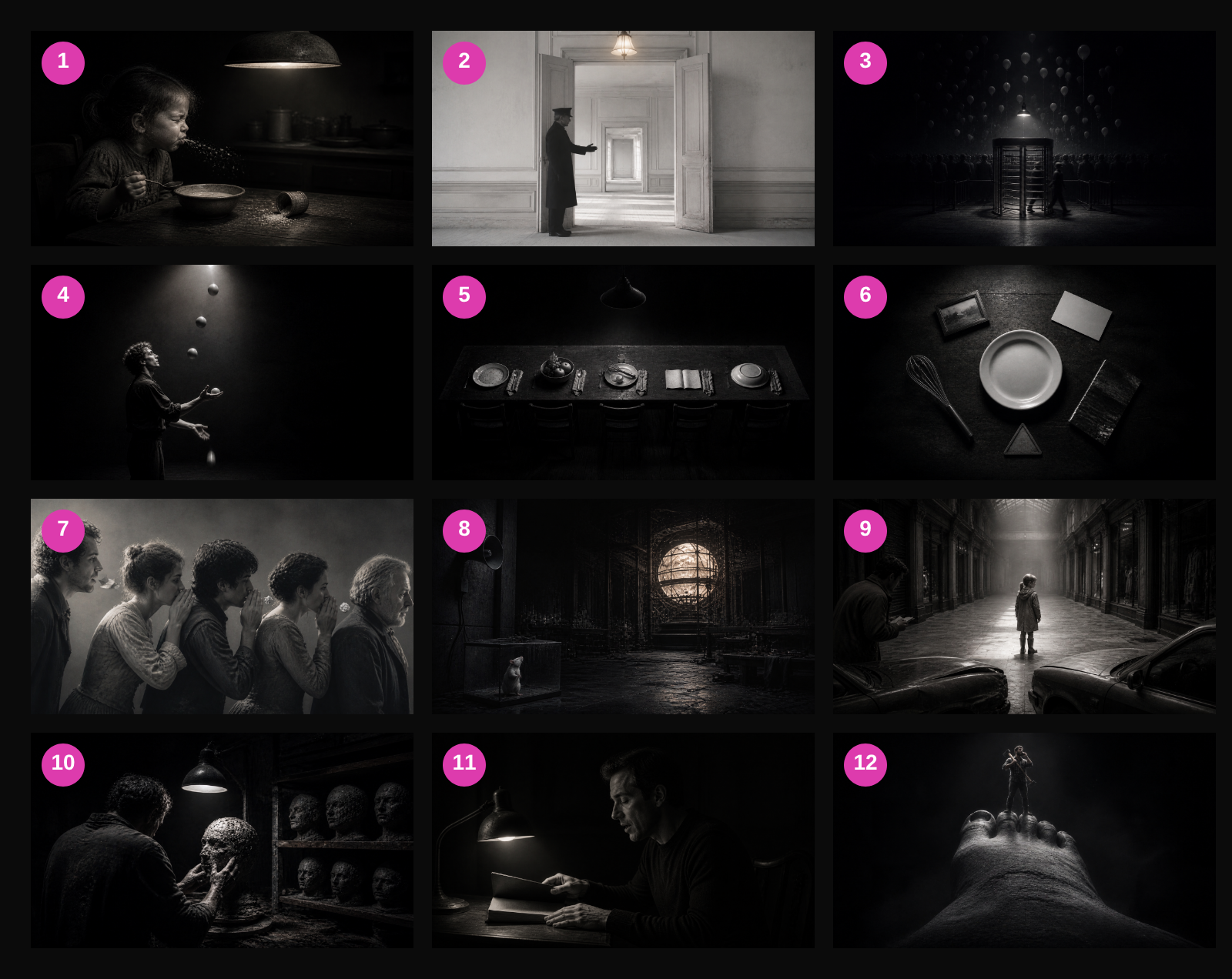
- Memory shapes focus, knowledge, decisions and behaviour, not just facts. Image: a small child spitting out a spoonful of salted porridge at a kitchen table.
- Atkinson and Shiffrin, 1968: senses, then a small short-term store, then long-term memory, with attention and rehearsal deciding what gets through. Image: three rooms in a row with a doorman at the first door.
- Attention is the gate; my "bad memory" in the nineties was really an attention problem. Image: a turnstile with only a trickle of people getting through while ideas balloon overhead.
- Working memory holds about four chunks and fades in seconds without rehearsal. Image: a juggler with four balls in the air and a fifth falling.
- Five breakfast questions, five systems: what you ate, whether it was healthy, how you make it, why you chose it, what you will not eat. Image: a breakfast table with five labelled place settings.
- Squire, 2004: conscious memory for facts and events, non-conscious memory for skills, priming, conditioning and emotion, on different brain systems. Image: one plate with a picture, a fact card, a whisk, an advert and a warning sign around it.
- Bartlett, 1932: remembering is reconstruction, not replay. Image: a story passed along a line of people, the words changing as it goes.
- Nader, Schafe and LeDoux, 2000: a recalled memory is fragile again for a few hours and can be changed. Image: a rat in a box hearing a tone, a builder's scaffold around a glowing memory.
- Loftus: one word in a question, or a trusted story, can rewrite a memory. Image: two crumpled cars with a questioner leaning in, and a small child alone in a shopping mall.
- Memory is an act of creation; recall is an act of recreation. Image: a sculptor rebuilding the same statue from clay, slightly different each time.
- Recall rather than reread, check straight after, and do not trust certainty. Image: a person reciting with eyes closed, then opening a script to check one line.
- Techniques work at every stage: the gate, the workspace, the way in and the way back. Image: a lumberjack making a call while standing on the sole of a giant foot.
Sources
- Mark Channon, How to Remember Anything (Hodder Education)
- Mark Channon, The Memory Workbook (Hodder Education)
- Atkinson, R. C., and Shiffrin, R. M. (1968). Human memory: a proposed system and its control processes. In K. W. Spence and J. T. Spence (eds), The Psychology of Learning and Motivation, Vol. 2, 89 to 195. https://doi.org/10.1016/S0079-7421(08)60422-3
- Peterson, L. R., and Peterson, M. J. (1959). Short-term retention of individual verbal items. Journal of Experimental Psychology, 58(3), 193 to 198. https://doi.org/10.1037/h0049234
- Miller, G. A. (1956). The magical number seven, plus or minus two. Psychological Review, 63, 81 to 97. https://doi.org/10.1037/h0043158
- Cowan, N. (2001). The magical number 4 in short-term memory: a reconsideration of mental storage capacity. Behavioral and Brain Sciences, 24(1), 87 to 114. https://doi.org/10.1017/S0140525X01003922
- Squire, L. R. (2004). Memory systems of the brain: a brief history and current perspective. Neurobiology of Learning and Memory, 82(3), 171 to 177. https://doi.org/10.1016/j.nlm.2004.06.005
- Bartlett, F. C. (1932). Remembering: A Study in Experimental and Social Psychology (Cambridge University Press)
- Nader, K., Schafe, G. E., and LeDoux, J. E. (2000). Fear memories require protein synthesis in the amygdala for reconsolidation after retrieval. Nature, 406(6797), 722 to 726. https://doi.org/10.1038/35021052
- Loftus, E. F., and Palmer, J. C. (1974). Reconstruction of automobile destruction: an example of the interaction between language and memory. Journal of Verbal Learning and Verbal Behavior, 13(5), 585 to 589. https://doi.org/10.1016/S0022-5371(74)80011-3
- Loftus, E. F., and Pickrell, J. E. (1995). The formation of false memories. Psychiatric Annals, 25(12), 720 to 725. https://doi.org/10.3928/0048-5713-19951201-07
- Murphy, G., Dawson, C. A., Huston, C. et al., and Greene, C. M. (2023). Lost in the mall again: a preregistered replication and extension of Loftus and Pickrell (1995). Memory, 31(6), 818 to 830. https://doi.org/10.1080/09658211.2023.2198327
- Wilson, B. A., Baddeley, A. D., and Kapur, N. (1995). Dense amnesia in a professional musician following herpes simplex virus encephalitis. Journal of Clinical and Experimental Neuropsychology, 17(5), 668 to 681. https://doi.org/10.1080/01688639508405157
- Roediger, H. L., III, and Karpicke, J. D. (2006). Test-enhanced learning: taking memory tests improves long-term retention. Psychological Science, 17(3), 249 to 255. https://doi.org/10.1111/j.1467-9280.2006.01693.x
- Radiolab (2007, re-released 2024). Memory and Forgetting. WNYC Studios. https://www.youtube.com/watch?v=Oywd34Hmfq4
Loci
Build the memory palace in this article inside Loci — store your locations, link images, and rehearse with spaced repetition.
Try it in LociMemory School community
Learn directly with Mark inside the Memory School community on Skool — monthly lessons, practice, and Q&A.
Join Memory SchoolAbout the author
Mark Channon
Grand Master of Memory (1995). Author of three books on memory published by Hodder and Nick Hern. Creator of BBC1's Monkhouse's Memory Masters. Memory coach on Channel 4's Can I Improve My Memory?
Read full bio →