
Memory Palace
What is a Memory Palace? A Beginner's Guide (2026)
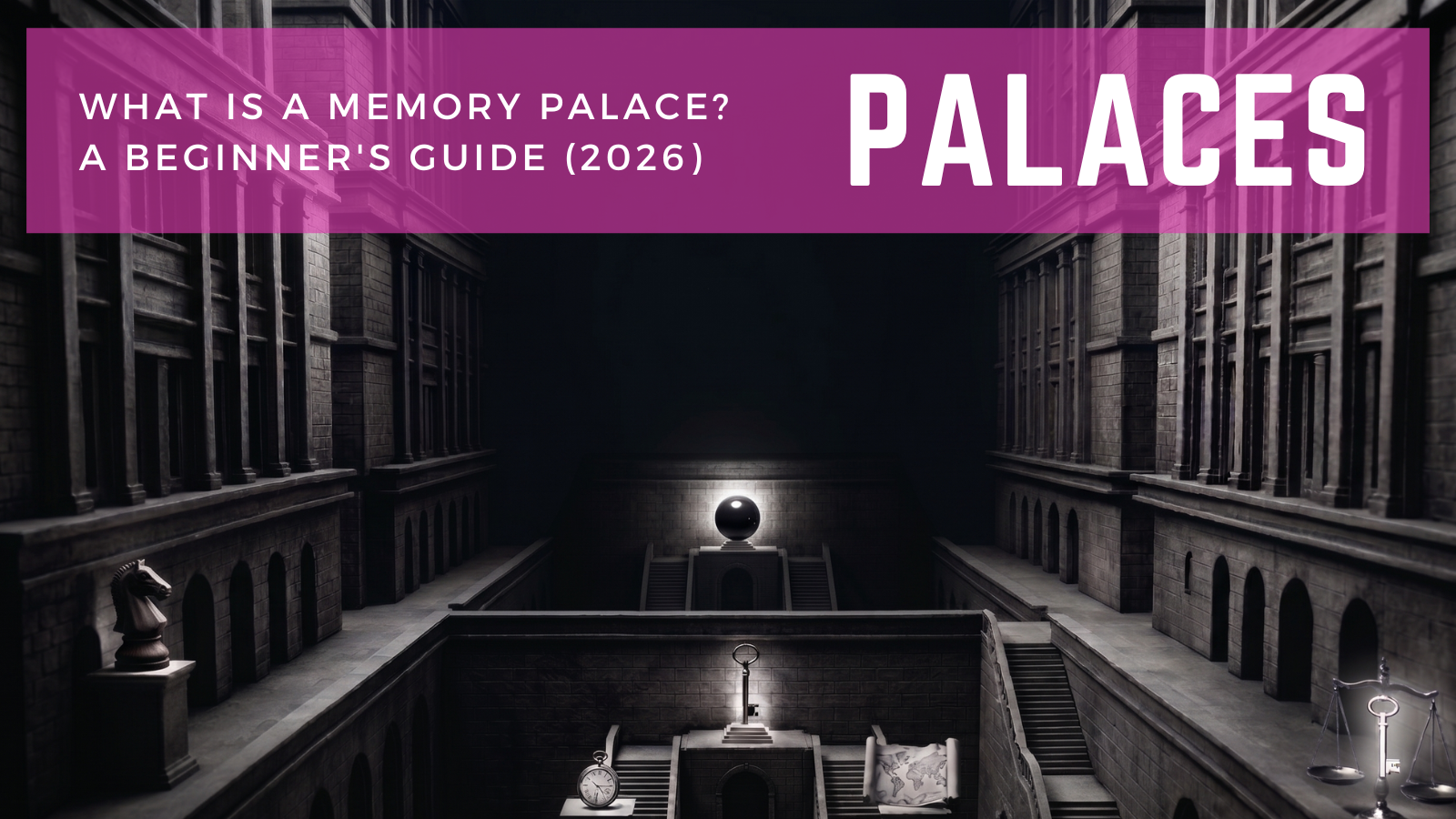
A memory palace is a journey in your mind where you store images you want to remember. It doesn't have to be a place you already know. Let's explore how, and why, it works.
What is a Memory Palace? A Beginner's Guide to the World's Oldest Memory Technique
If you've ever watched Benedict Cumberbatch close his eyes mid-scene as Sherlock Holmes, walking through a mental version of 221B Baker Street to retrieve a fact buried deep in his mind, you've already seen a memory palace at work. It looks like a Hollywood special effect. It isn't. It's a 2,500-year-old technique that anyone, including you, can learn in an afternoon.
I'm Mark Channon, a Grand Master of Memory and the author of three books on memory. I've used memory palaces to learn scripts as a West End actor and to teach executives, presenters, students and celebrities how to remember vast amounts of information without breaking a sweat. In this guide I'll explain exactly what a memory palace is, where it came from, why it works, and what you can actually do with one.
What is a Memory Palace?
A memory palace is a journey in your mind where you "place" images of the things you want to remember on specific locations along the way. To recall the information, you mentally retrace the journey, and the images trigger your memory.
The journey could be around your home, from the train station to work, or even back in time to the route you walked from a friend's house to school as a kid. It could also be somewhere you have never physically been. As long as you can remember the specific locations along the journey, the memory palace will work. (More on that in a moment, because it overturns the single biggest myth about this technique.)
The technical name for it is the method of loci (Latin for "places"). Some people call it a mind palace, popularised by Sherlock. The principles are identical.
Here's the core idea in one sentence: your brain is brilliant at remembering places, so you connect the things you want to remember onto places you already know.
Why a Memory Palace Works
Your spatial memory is one of the most powerful systems in your brain. Think about it. You can probably picture every room in the home you grew up in. You can navigate around your kitchen in the dark. You can describe the route from your front door to the corner shop without thinking. None of that took conscious effort to learn, your brain just absorbed it.
This is because of a part of your brain called the hippocampus, which plays a key role in forming explicit long-term memories and is heavily involved in spatial navigation. When you use a memory palace, you're tapping into a system your brain has spent your entire life building for free.
A memory palace gives semantic information (facts, lists, scripts, research, new domain knowledge) the one thing it usually lacks: a physical, navigable location. Once a fact has a "where," it suddenly becomes much easier to find.
A 2,500-Year-Old Idea
The memory palace isn't a productivity hack invented by some 21st-century guru. The technique dates back to ancient Greece.
The story goes that an Ancient Greek poet, Simonides of Ceos, was performing at a banquet hosted by a nobleman called Scopas. Partway through the recital he was called outside to meet two visitors, but no one was there. While he stood outside puzzled, the roof of the banquet hall collapsed and killed everyone inside. The bodies were so badly crushed that grieving families couldn't identify their relatives. Simonides, however, could. In his mind's eye he could see exactly where every guest had been sitting at the table. Not the most uplifting of stories but very hard to forget.
That moment gave him a reputation as the inventor of the art of memory, and the technique he'd stumbled on, placing information at specific locations in a mental space, became the bedrock of memory training in the ancient world. Roman orators used it to deliver speeches that lasted hours, without notes. Medieval scholars used it to memorise entire books. World Memory Championship competitors still use it today to memorise the order of a shuffled deck of cards in under thirty seconds.
A Quick Example You Can Try Right Now
Don't take my word for any of this. Try it.
Pick four items in the room you're sitting in. Look at each one for a couple of seconds. Let's say you choose the chair, the window, the door and the bookshelf (whatever's actually in your space). Now imagine the following:
- On the chair, a giant dartboard is sitting upright, slowly spinning
- Smashing through the window is a wild-eyed explorer, machete in hand
- Hanging from the door, dangling like fruit, are dozens of lit-up light bulbs
- Sticking out of the bookshelf is an enormous chess board, half-toppling out
Don't try to memorise this. Just see each scene in your mind for two or three seconds. Make the dartboard huge. Hear the window shatter. Smell the wood of the chess board.
Look away from this page. Walk around the room in your mind. Tell me what's on the chair. The window. The door. The bookshelf.
Chances are all four stuck in your mind.
You've just used a tiny memory palace. The "locations" were chair, window, door, bookshelf. The "images" were the things I asked you to place there. Scale that up, more locations, more images, and you can store hundreds of pieces of information.
(By the way: those four images were the first four chapters of one of my other books. Dartboard = Get Results. Explorer = Explore Your Memory. Light bulbs = Creative Memorisation. Chess board = Memory Strategies. You just memorised the start of a book table of contents without trying.)
But that’s only 4 things, anyone can do that right? The real power is that this system scales, 10, 20, 50, 100, 1000s. A client of mine a few years back, Jo, passed the California Bar Exam using this technique.
Memory Palace vs. Mind Palace vs. Method of Loci
People get confused by the different names. They shouldn't. They all describe the same underlying technique.
- Method of Loci, the original Latin name. "Loci" means "places." This is the term you'll see in academic papers and history books.
- Memory Palace, the modern, more accessible name. Most teachers (myself included) use this in everyday conversation.
- Mind Palace, popularised by the BBC's Sherlock. Same thing.
- Roman Room, a sub-variant where your palace is a single room.
- Journey Method, a sub-variant where your palace is a route between two places, rather than a single building.
All of them are the same core principle: pick locations you can recall in order, place images on them, walk the journey in your mind to recall.
What You Can Actually Use a Memory Palace For
This is where it gets interesting. A memory palace isn't a parlour trick. It's a way of thinking. Let that settle for a moment. It’s a distinction very few make but when you do it changes your approach. Memory Palaces are not just ‘memory tools’, they are ‘thinking tools’, allowing you to connect more deeply with the content you’re engaging with. Deepening your understanding of the material. This is crucial as meaning not only makes things more memorable it makes it more valuable.
Here are the things I've used mine for, or trained other people to use theirs for:
Speeches and presentations. Place each section of your talk on a different location along a journey in your mind. Walk the journey as you speak. No notes. No fear of going blank.
Studying for professional exams. Medical students use memory palaces for anatomy. Law students use them for case law. Beth who came to my first ever seminar passed her anatomy exam a few weeks later with 100% (previously she had failed twice).
Learning scripts. As a working actor I used memory palaces (combined with the chain method and visual cues) to get off-book on tight schedules. I still teach this to actors today, see my book Learning Your Lines.
Conversations. This is a superpower, being able to listen deeply and remember key details in meetings, 1-1’s or the things you listen to, YouTube, podcasts etc.
Stats and Research. At the BBC and other product roles I would use Memory Palaces to memorise key data and stats for my own and also other people’s products. When you hold the data in your mind you hold influence in your hand.
Pitches and Talks for meetings, interviews, founder pitches, presentations you name it. Anywhere that you have to talk to one or more people.
Common Myths About the Memory Palace
There are a few myths I want to clear up before they slow you down.
"You have to be able to visualise perfectly." No. Some people see images sharp as a film. Others get a vague sense of the scene. Others describe it to themselves in words and the visual happens quietly in the background. All of those work. If you can't picture a sharp image, just describe what's happening, your brain does the rest.
"It only works for short-term memorising." Wrong. With a small amount of review, an hour later, a day later, a week later, information placed in a memory palace can be retained for years. I still remember palaces I built over thirty years ago.
"It has to be a place you already know well." This is the single biggest myth about memory palaces, and it is wrong. Yes, a place you know well is quick to set up, which is why I get beginners to start with their own home. But the technique does not require pre-familiarity at all. You can build a palace from a town you have never visited by walking it on Google Street View, observing each location for a few seconds, and locking the sequence in. I build most of my palaces this way now. The only real requirement is that you can recall the specific locations in order. Familiarity is something you create, not something you need in advance.
"You need a huge mansion as your palace." No. Your studio flat works fine. So does your office, a bar, or a restaurant. So does the route from your front door to the bus stop. So does a virtual location pulled up on Google Street View, which gives you an almost limitless supply of palaces anywhere in the world.
"Memory champions are born, not made." Not true. The neuroscientists Boris Conrad (himself a world-class memory athlete) and Martin Dresler have shown that with around six weeks of consistent daily memory practice, the brain's activity changes, it literally becomes more efficient at learning. Memory is a skill. Like any skill, it responds to practice.
Is a Memory Palace Hard to Learn?
Here's the honest answer: the technique is simple. You can understand it in five minutes. What takes time is trusting it, committing to it long enough for it to feel natural.
In my experience teaching this for over two decades, most people get useful results within a week of practice. The skill genuinely embeds at around the six-week mark with 10,20 minutes a day. That's when it stops feeling like a "technique" and starts feeling like how you naturally think.
Frequently asked questions
Are you old school? Get Mark's book Improve Your Memory and dive in depth.
Loci
Build the memory palace in this article inside Loci — store your locations, link images, and rehearse with spaced repetition.
Try it in LociMemory School community
Learn directly with Mark inside the Memory School community on Skool — monthly lessons, practice, and Q&A.
Join Memory SchoolAbout the author
Mark Channon
Grand Master of Memory (1995). Author of three books on memory published by Hodder and Nick Hern. Creator of BBC1's Monkhouse's Memory Masters. Memory coach on Channel 4's Can I Improve My Memory?
Read full bio →