
Memory Techniques
Memory Techniques: The Complete Guide
Every memory technique that actually works, explained by a Grand Master of Memory: how they fit together, which to learn first, and how long it takes to make them yours.

Memory techniques are not tricks. That is the first thing to get straight, because the famous demonstrations make them look like party pieces: memorise a deck of cards, rattle off a hundred digits of pi, impress someone at dinner. Those feats are real, but they are not why the techniques matter. They matter because they let you learn faster, keep what you learn, and use it when it counts. In a meeting. In an exam. On a stage with two thousand people looking at you.
Here is the whole picture in one place: what the techniques are, how they relate to each other, which one to learn first, and what the honest timeline looks like from first attempt to second nature. Every technique mentioned has its own detailed article, so treat this as the map and those as the territory.
What a memory technique actually is
Every one of these memory techniques does the same underlying job. It takes information your brain finds hard to hold, which is almost always abstract, and converts it into something your brain finds easy to hold, which is almost always a vivid picture in a specific place.
Your brain is spectacular at remembering some things and poor at others. You can navigate your own home in the dark. You can recognise a face you have not seen for twenty years. You remember exactly where you were when you heard a piece of shocking news. Those are spatial memory, recognition memory and emotional memory doing what they evolved to do. What your brain is not built for is a list of unconnected facts, a string of digits, or a page of names. Those have no shape, no place and no feeling, so they slide off.
A memory technique is a bridge between the two. It borrows the strength of the systems you already have and lends it to the information you are struggling with. The technique is the conversion, and once you can see that, every technique stops looking like a separate trick and starts looking like a variation on one idea.
The foundation: creative memorisation
I call the underlying method creative memorisation. It is not a single technique but the recipe every technique is cooked from. It has four ingredients.
Flow. The state you are in when you memorise matters more than you might think. Anxiety shuts down the prefrontal cortex, where your higher thinking happens, and hands control to the amygdala, which is more interested in fight or flight than in remembering a list. Flow is the opposite: relaxed, energised, present, confident. The first part of any memory technique is getting into a state where your brain is open for business.
Imagination. Information becomes memorable when you bring it to life. Make it bigger, louder, stranger. Give it movement, colour, a smell. Put yourself in the scene. Your imagination is the engine that turns a dry fact into something your brain decides to keep.
Association. Nothing is remembered in isolation. Memory is connection. Every technique works by linking the new thing to something you already hold, whether that is a location, a number image, a body part or the item before it in a chain. The stronger and stranger the link, the stronger the memory.
Meaning. This is the ingredient people skip. A memorable image is not enough; you also have to understand what it refers to and why it matters. Meaning is what turns a memory trick into actual learning. Say the real information out loud as you see the image. Think about what it means. Connect it to what you already know.
Try a quick example. There are roughly 86 billion neurons in your brain. On its own, that number will be gone by tomorrow. Now turn it into a picture. In the major system (more on it below), 8 is an f sound and 6 is a sh sound, so 86 becomes fish. Picture a billionaire's brain with fish swimming around in brain soup. Say aloud: "86 billion neurons." The scene is absurd, which is why it sticks, and it carries meaning: the billionaire gives you the billions, the fish give you the 86, and the soup is how the neuroscientist Suzana Herculano-Houzel actually counted them, by dissolving brain tissue into a soup of cell nuclei, counting small samples and scaling up.
Creative memorisation runs as a cycle: memorise through creation, remember through re-creation, experiment through action, grow through results. Every technique plugs into that cycle.
The skills under every technique
Every technique is built from the same four ingredients: flow, imagination, association and meaning. Creative Memorisation: The Four Ingredients That Make Anything Memorable covers each one. In practice, two habits put them to work every time.
Turning words into images. Some words are already pictures. "Apple" needs no work. Most are not, and for those you have two options. A natural image is sparked by the meaning of the word: "fearless" might give you a lion. A sound image comes from how the word sounds: "Madagascar" becomes a mad gas car. Fluency in switching between the two is the single most useful skill in memory work, and it improves with every day you practise it. The full method is in How to Remember Definitions and Facts (The Reference Story Method).
Saying it out loud. When you see the image in your mind, say the real information aloud. This one habit roughly doubles the strength of what you store, because it connects the picture to the sound of the word in your own voice and to its meaning. It feels odd for about a week. Then it feels like the obvious thing to do.
The techniques, grouped by what they do
Here is the full toolkit, grouped by the job each technique does rather than by name, because that is how you choose between them in practice.
For sequences: the chain method
The simplest technique and the one to learn first. Take the items you want to remember, turn each into an image, and link each image to the next in a flowing story. Big Ben wears a fur coat and bounces on a springboard into a pot of honey. Read it twice and you have the list, forwards and backwards.
The chain method handles shopping lists, the points of a talk, the steps of a process, short vocabulary sets. Its limit is that you have to walk the chain from the start; you cannot jump to item seven. For that you need a peg list or a memory palace.
For storage and recall in any order: memory palaces and peg lists
Each of the systems here is a fixed set of mental locations you know by heart, onto which you attach information. There are three families.
Peg lists. The body system (feet, knees, thighs, behind, waist, chest, neck, face, hair, ceiling) gives you ten pegs you can never lose. The rhyme list (one is a bun, two is a shoe) and the number shape system (two is a swan, seven is a nose) give you ten numbered pegs each. Small, permanent, always available.
The memory palace and the journey method. The big one. You take a route in your mind: through your home, from the station to work, through a town you have never visited but have explored on Google Street View in LOCI, and place images on locations along it. Because your spatial memory is enormous, a palace scales to hundreds of locations. This is the method of loci, Sherlock's mind palace, and the backbone of competition memory. The only requirement is a route whose locations come back to you in order.
The major system. A code that converts digits into consonant sounds and consonant sounds into words, giving you one image for every number from 00 to 99. It is how long numbers, dates, phone numbers and cards become memorable, and it is the foundation of the PAO system, where every number or card stands for a person doing an action with an object, which compresses a deck of cards into eighteen scenes.
For pairs and facts: reference stories
A great deal of what you need to remember comes in two halves. A word and its meaning. A country and its capital. A term and its definition. A reference story holds both halves in one picture, so that recalling one hands you the other. The Russian for cow is karova: picture a cow with a car over its head. That is the technique behind vocabulary, exam terminology and general knowledge.
For people: the names method
Remembering names is a process, not a gift, and the process has five steps: mindset, attention, listen, connection, conditioning. The connection step is a reference story applied to a face. Meet a Kiefer with a distinctive nose and picture a key covered in fur sitting on it. The rest of the steps are the easy ones to skip, and skipping them is why a name goes seconds after you hear it.
For lines and performance: visual cues
Actors need words in order, under pressure, with the freedom to stay present. The method combines the chain and the palace: a mini story for each line, placed on a location, used as a cue until the words are in the body and the cues can fall away. The same system works just as well for a speech, a pitch or a presentation as it does for a script.
For skills and movement: visual cues again
Procedural memory, the kind that gets a golf swing or a dance routine into your body, is built by repetition. But creative memorisation can scaffold the early stage by placing visual cues along the physical sequence, markers that tell you where you should be at each point. I used this in a tap routine in 1997 to lock down a rhythm that would not stick, and the cues fell away as soon as my body had it.
How the techniques fit together
Think of it as layers.
At the bottom is state: flow. Above that are imagination, association and meaning, put to work by two habits: images and saying it aloud. Above those are the storage structures: chains for sequences, pegs and palaces for anything you want in any order. Above those are the applications: names, numbers, lines, facts, books, which combine the structures in specific ways. At the top is practice, which turns all of it from something you do deliberately into something you do without thinking.
In practice, almost every real task uses more than one technique. Memorising a book uses a reference story per key idea, a palace to hold them in order, and the major system for any figures. Memorising a speech uses a chain or a palace for the beats and visual cues to stay present. The techniques are a kit, not a menu.
What to learn first
If you are starting from nothing, this is the order to follow.
- The chain method, today. Fifteen items, one story, ten minutes. It teaches image-making and association, and it gives you a result on day one.
- The body system, this week. Ten pegs on your own body. It teaches you what a fixed set of mental files feels like and gives you a tool you can use in a meeting tomorrow.
- A first memory palace, this fortnight. Twenty locations in your home. This is where the technique starts to feel real.
- Reference stories alongside all of the above. Every time you meet a word, a name or a fact you want to keep, build one. This is the skill that compounds.
- The major system, when you have a reason. Numbers are worth the setup if you work with them. If you do not, the number shape system covers everyday needs.
- The names method, as soon as you meet people. Because nothing demonstrates a trained memory faster.
Resist the urge to learn everything at once. Each technique only becomes useful when it is automatic, and automatic takes practice.
How long it takes
Here is the honest answer.
You will get results in the first week. A chain of fifteen items on day one, a working palace within days. That early win is real and it is motivating.
Real fluency, where you reach for a technique without thinking and build images at speed, takes around six weeks of consistent daily practice, ten to twenty minutes a day. It is also what I see in my coaching, and a study backs it up: Boris Konrad, Martin Dresler and colleagues trained complete beginners in the memory palace, about 40 half-hour sessions spread over six weeks, and their brain networks moved closer to those of memory athletes.
So the plan is: a result this week, a habit over six weeks, then a trained memory you keep using. Fifteen minutes a day, three to five days a week for the first three weeks, then up to thirty. Treat it like going to the gym, because that is exactly what it is.
The mistakes that stop people
Trying to memorise everything. Use the MIN rule: Minimum Images Necessary. If you already know something, do not encode it. If one image can trigger a whole idea, one image is enough. Encode everything and you end up frustrated, with stories for things you already knew.
Skipping meaning. A vivid image with no understanding behind it is a trick, and tricks fade. Always say the real information aloud and think about what it means.
Building images silently. Say it out loud. Every time.
Giving up at week two. This is when the novelty wears off and the fluency has not arrived. Push through to week six. That is where the technique stops being effort.
Practising without purpose. Memorise things you actually want to know. Your phone contacts, your exam syllabus, the names of your colleagues. Purpose is what keeps you practising, and it is what makes a trained memory worth having.
Where to go from here
Every technique above has its own detailed article. Pick the one that matches the thing you most want to remember and start there:
- Sequences: The Chain Method: How to Remember Lists Without Building a Memory Palace
- Pegs: The Peg System Explained, The Number Shape System
- Places: What is a Memory Palace? A Beginner's Guide to the World's Oldest Memory Technique, How to Build a Memory Palace: A 7-Step Beginner's Guide (With Worked Examples), The Journey Method Explained, The Roman Room Method
- Numbers and cards: The Major System Explained, The PAO System Explained
- Pairs and facts: How to Remember Definitions and Facts (The Reference Story Method)
- People: How to Remember Names: A Five-Step Framework That Actually Works
- Lines and performance: How Actors Learn Lines Fast: The Seven-Step Recipe (From Learning Your Lines)
If you want somewhere to practise, MindForge is a memory gym made for exactly this: short daily drills on the techniques above, with the six-week structure built in. And if you want to build palaces for real material, LOCI turns a book, a YouTube video or your own notes into key ideas and images, placed in memory palaces you can walk through.
I used to think a good memory was something you were born with. Then, as a struggling actor, a flatmate showed me one technique, and I learned that it was a skill like any other. These techniques are that skill. They have not changed in two and a half thousand years, because they are built on how the brain actually works. The only thing that has changed is that you now know where to start.
Memory map
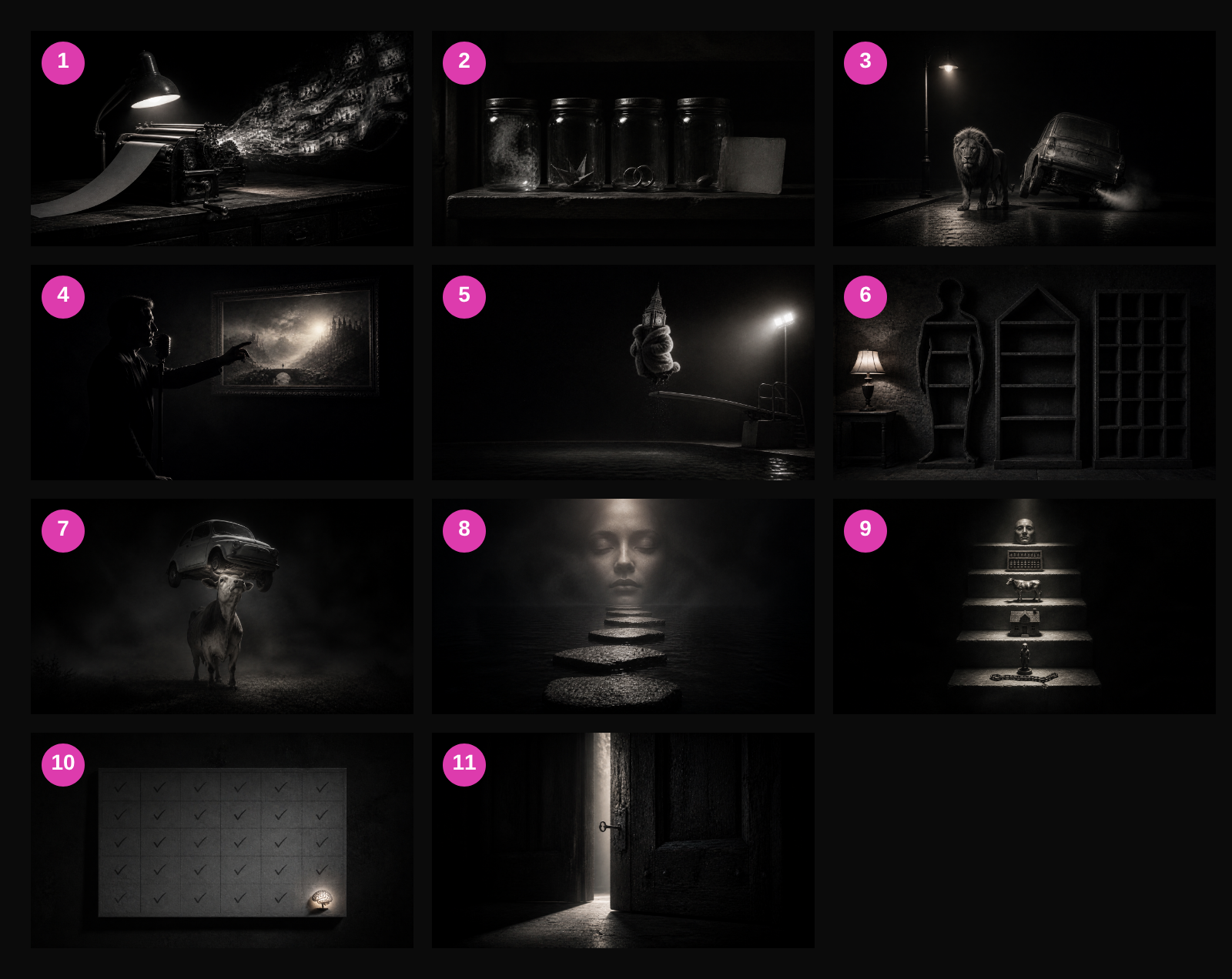
- Memory techniques convert abstract information into vivid pictures in places. Image: a grey list of words being fed into a machine and coming out as bright, moving scenes.
- Creative memorisation has four ingredients: flow, imagination, association, meaning. Image: four jars on a kitchen shelf, labelled, with a recipe card propped against them.
- Natural images and sound images are the two ways to turn any word into a picture. Image: a lion (natural) standing next to a mad gas car (sound).
- Say the real information aloud as you see the image. Image: a person pointing at a picture in their head and speaking into a microphone.
- The chain method links items in a flowing story. Image: a line of objects holding hands like paper dolls.
- Peg lists, memory palaces and the major system are fixed sets of locations. Image: three shelving units side by side, one shaped like a body, one like a house, one like a number grid.
- Reference stories hold pairs of facts together. Image: a cow with a car balanced over its head.
- The names method has five steps: mindset, attention, listen, connection, conditioning. Image: five stepping stones leading to a face.
- Learn in order: chain, body system, palace, reference stories, major system, names. Image: a staircase of six steps, each labelled.
- Six weeks of daily practice rewires the brain. Image: a calendar with 42 days ticked and a brain glowing on the last square.
- MIN rule: Minimum Images Necessary. Image: a single key opening a whole door.
Sources
- Mark Channon, How to Remember Anything (Hodder Education)
- Mark Channon, The Memory Workbook (Hodder Education)
- Dresler, M., Shirer, W. R., Konrad, B. N. et al. (2017). Mnemonic training reshapes brain networks to support superior memory. Neuron, 93(5), 1227 to 1235. https://doi.org/10.1016/j.neuron.2017.02.003
- Azevedo, F. A. C., Carvalho, L. R. B., Grinberg, L. T. et al. (2009). Equal numbers of neuronal and nonneuronal cells make the human brain an isometrically scaled-up primate brain. Journal of Comparative Neurology, 513(5), 532 to 541. https://doi.org/10.1002/cne.21974
Loci
Build the memory palace in this article inside Loci — store your locations, link images, and rehearse with spaced repetition.
Try it in LociMemory School community
Learn directly with Mark inside the Memory School community on Skool — monthly lessons, practice, and Q&A.
Join Memory SchoolAbout the author
Mark Channon
Grand Master of Memory (1995). Author of three books on memory published by Hodder and Nick Hern. Creator of BBC1's Monkhouse's Memory Masters. Memory coach on Channel 4's Can I Improve My Memory?
Read full bio →