
Study and Learning
How to Remember What You Read
Read a book the usual way and a week later much of it has gone. There's a better way to read, one that keeps the ideas with you and turns books into a working library in your head.

You read a non-fiction book, close it, and within a week remember almost nothing. Six months later you cannot tell anyone the author's main argument, let alone the supporting evidence. You could have spent the same hours watching television and ended up in roughly the same place.
This is not a reading problem. It is a system problem. The way reading is usually taught at school (start at page one, plough through, finish, move on) is one of the worst ways to put information into the brain. There is a better way, and it adds maybe thirty minutes to the hours you would already spend on the book. The retention shifts from "almost nothing" to "I can still use this five years from now."
The system draws on the principles of creative memorisation (turning information into vivid pictures and stories), mind mapping, the chain method (linking items into one running story) and the memory palace (leaving images at stops along a route you know), all stitched together for the specific job of reading and keeping.
Why ordinary reading fails
Your brain does not store information by being told to. It stores information that meets two conditions. The information has to look important, and it has to connect to things you already know.
Plain reading fails on both counts. You have not told your brain why this material matters. You have not built any bridges between the new ideas and your existing knowledge. So your brain does what it does with most input. It quietly dumps it. Sometimes immediately, sometimes overnight, sometimes after a couple of weeks, but the trajectory is always the same. Forgetting is the default state.
There is also a structural problem. A non-fiction book is a long, ordered argument. To remember it you need to keep track of how the ideas connect, not just what they are. Ordinary reading captures isolated facts but loses the skeleton that holds them together. Two weeks later all you have left is "I read a book about X and it was good."
To fix all of this you need to prime before you read, engage while you read, and consolidate after you read. That is the whole game.
The 8-step reading system
Here is the system for any non-fiction book you want to remember.
1. Prime before opening the book. Spend two minutes before you crack the spine. Ask yourself: what do I want from this? What problem will it solve? What will I do with it? This is the primer question, and it changes how your brain reads from the first page. The hippocampus, a part of the brain central to laying down new memories, tags incoming information as "relevant" or "not relevant" based on what it thinks you care about. Telling it what you care about in advance helps more of it stick.
2. Read the contents page and the index. Spend five minutes. Build a rough mental map of the territory. Note any chapters that jump out as immediately useful. Notice the topics covered in the index. By the end of these five minutes you should have a sense of the shape of the book before you read a single chapter.
3. Build a chain of the chapter titles. Take the chapter list and turn it into a single mental story using the chain method. If the chapters are Vision, Strategy, Team, Culture, Customers, Product, Pricing, Marketing, build a chain: a glowing vision in the sky, lit up by a giant strategy map, held up by a team of people in matching culture t-shirts, hugging customers, holding the product, on which a price tag is hanging, being painted in marketing colours. Read the chain three times and you have a scaffold for everything that is coming.
4. Read with curiosity, not effort. Read like you are reading a novel. Look for the story, the argument, the personality of the author. Do not try to memorise. The chain you built is already pulling things in. This is the difference between fact-extraction reading (slow, painful, low retention) and experience reading (fast, easy, high retention). When you read fiction your brain instinctively remembers plot, character, setting, and dialogue. Tap into the same instinct for non-fiction.
5. Stop at the end of each chapter and abstract. Spend two minutes writing or thinking through three questions. What was the chapter's argument? What surprised me? What will I do differently? This is the single highest-leverage step in the system. The act of summarising in your own words is what moves the chapter from short-term to long-term memory.
6. Capture key ideas on a mind map. One mind map per book, built as you go. Central image is the book. Main branches are the chapters. Sub-branches are the key ideas inside each chapter. Use colour, symbols, and a single word per branch wherever you can. Tony Buzan formalised mind mapping in the 1960s but the principle is older than that: the human brain handles radial, image-rich, single-word notes far better than linear text. Your mind map becomes a permanent visual summary of the book that you can refer back to in seconds.
7. Use what you learn. Within 48 hours of finishing the book, apply at least one idea from it. Use it in a conversation, in a piece of writing, in a meeting, in your own work. Information you use is information you keep. Information you read but never touch again is information your brain has every reason to discard.
8. Review on a schedule. Walk the chapter chain once an hour after finishing the book, once the next day, once a week later, once a month later. Five short reviews and the book is in your long-term memory. Each review takes about three minutes. The total time investment is tiny compared to the time you spent reading the book in the first place.
That is the system. Eight steps. Maybe 30 to 45 extra minutes spread across a book you were going to read anyway, in exchange for remembering far more of what you read, for far longer.
A worked example
Take any 12-chapter business book. The chapter titles might be something like Vision, Strategy, Team, Culture, Customers, Product, Pricing, Marketing, Sales, Operations, Finance, Growth.
Before you open the book. Ask: what do I want from this? Say the answer is to sharpen your own business thinking and to write better about strategy.
Contents and index. Five minutes. The chapter on Pricing jumps out (you have been weak there) and the index has a lot of references to "B2B SaaS pricing models." Make a mental note that those are the bits to read most carefully.
Chapter chain. Build the story above (vision, strategy, team, culture, customers, product, pricing, marketing). Three reads and you have it.
As you read. You are not trying to memorise. You are reading with curiosity, looking for the parts that confirm or challenge what you already think. You are also half-watching for the Pricing chapter.
End of each chapter. Two minutes. What was the argument? What surprised me? What will I do differently? Write three or four bullet points in a notebook, or just say them out loud.
Mind map. Built as you go. By the end of the book it has 12 main branches and a tangle of sub-branches. It fits on a single sheet of A3.
Within 48 hours. Deliberately use the pricing framework from the book in a conversation about your own business. The act of using it cements the chapter.
Review schedule. One hour later, walk the chapter chain. Next day, walk it again and glance at the mind map. A week later, do the same. A month later, once more.
Run the same system on the next book you care about and see how much more stays with you.
What the system is really doing
Each of the eight steps is doing one specific job in the memory machinery.
Steps 1 to 3 prime your brain. They tell your hippocampus what to flag as important. They also build a structural scaffold (the chapter chain) so every fact you read has somewhere to hang.
Step 4 keeps you in flow, the state where your prefrontal cortex relaxes and information passes through cleanly. Reading in flow lets your visual and narrative memory pick up details you would lose if you were tense and trying to memorise.
Steps 5 to 7 force you to process the material. They demand that you abstract it, capture it, and use it. This is what moves information from working memory, the little you can hold in mind at any one moment, into long-term memory. Without processing, even careful reading leaves almost no trace.
Step 8 spaces the retrieval, which is what makes the memory permanent. Each successful recall after a long gap tells your brain "yes, this is one of the patterns worth keeping."
The system is essentially the forgetting curve, reversed. The forgetting curve is the steep drop in what you remember over the days after you learn something (see The Forgetting Curve (and How to Beat It)). Where ordinary reading lets the curve drop away within days, this system flattens it out and keeps the ideas with you.
Beyond books: articles, podcasts, and conference talks
The same system, in shorter form, works for any kind of long-form content.
For an article. Skim the headlines and subheadings first. Build a quick chain. Read with curiosity. Spend a minute at the end summarising. Apply one idea within a few days.
For a podcast. Listen actively. Pause once or twice to summarise out loud what was just said. Take a couple of notes. Apply one idea within a few days.
For a conference talk. Before the talk, ask yourself what you want to get out of it. Build a chain of the key points as the speaker presents them. After the talk, spend three minutes summarising in your notebook. Apply within a few days.
In every case the principle is the same: prime, engage, process, review. Adapt the system to the time you have. Even a five-minute version beats reading and hoping.
Why this matters
If you remember only a sliver of each non-fiction book you read, a year of reading leaves you with a sliver of a year's ideas. Keep the core of each one and the same hours give you many times the return.
The same maths works for the other content you consume. Same number of articles, same number of podcasts, same number of conference talks. Far more of it stays with you.
The point of reading isn't to finish books. It is to be changed by them. The system above is how you make sure that actually happens. The shift from "consumer of information" to "person who keeps and uses what they read" is one of the highest-leverage habit changes you can make in adult learning. It compounds for decades.
For drills that turn this reading workflow into a daily habit and track your reviews automatically, mindforge.memoryschool.com is built for this.
The first book you run through the eight-step system will feel like a lot of process. The third one will feel like it is just how you read. By the tenth book the system disappears into the background and you start finding yourself shocked at how much of every book you can still recall years later.
That is the reward. Not a pile of finished books, but a personal library of working knowledge that lives inside your head.
Memory map
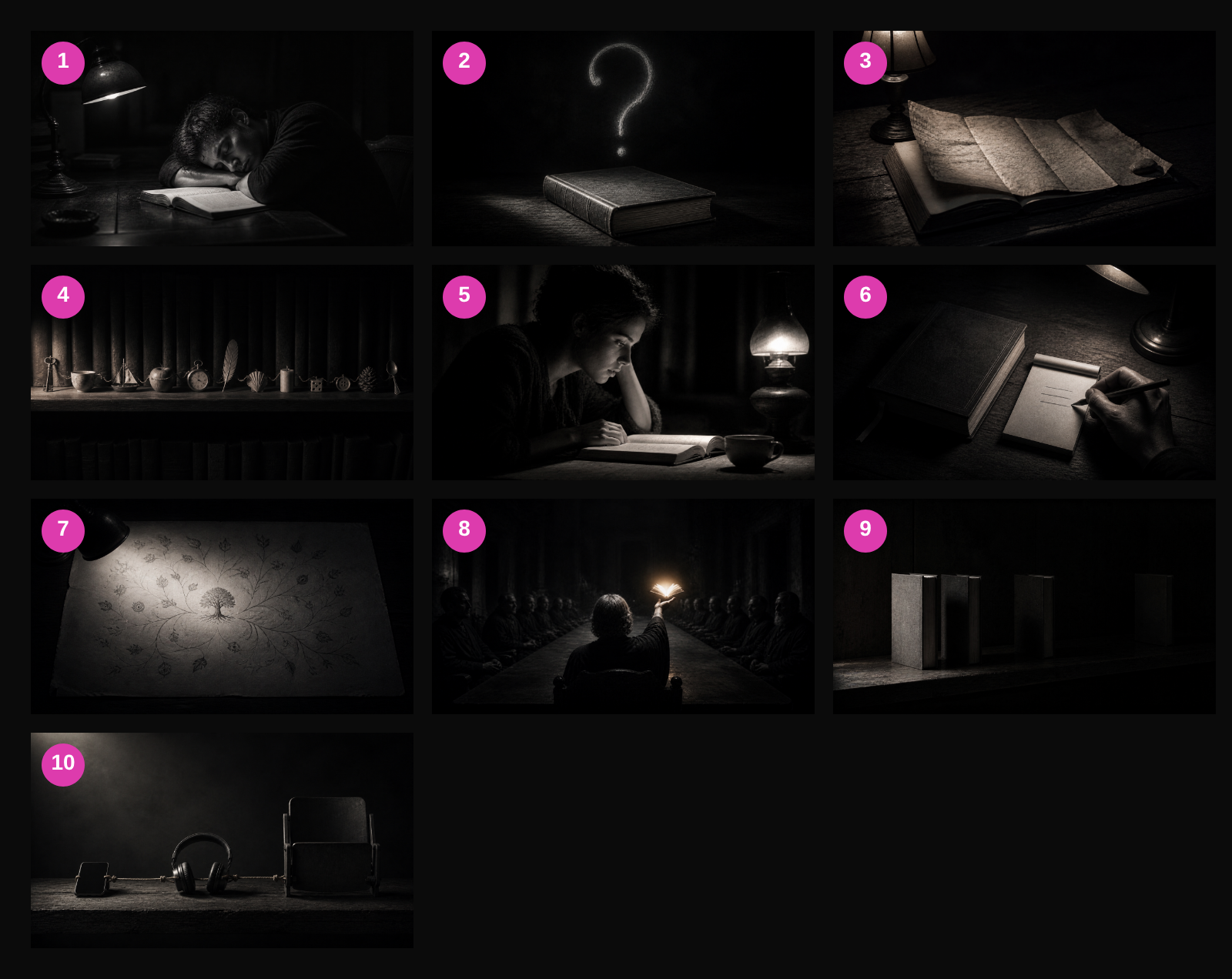
- Ordinary reading fails because it is passive: nothing is primed, processed or reviewed. Image: a reader asleep over an open book.
- Prime before you open the book: what do you want from it? Image: a closed book with a question mark hovering above the cover.
- Read the contents and index first to build a map of the territory. Image: a map unrolled across the first pages of a book.
- Chain the chapter titles into one story so the whole book has a spine. Image: a dozen odd objects linked in a line along a bookshelf.
- Read with curiosity, like a novel, not with effort. Image: a reader leaning forward, eyebrows up, a cup of tea forgotten.
- Stop at the end of each chapter and abstract three ideas. Image: a hand writing three short lines on a notepad beside a closed chapter.
- Build one mind map per book as you go. Image: a central picture with branches spreading across a desk.
- Use one idea within forty-eight hours. Image: a person in a meeting holding a book-shaped idea in their hand.
- Review the chain at one hour, one day, one week and one month. Image: four small books on a shelf, each slightly further from the last.
- The same system works for articles, podcasts and talks. Image: a phone, headphones and a lecture hall seat with the same chain running through them.
Sources
- Mark Channon, How to Remember Anything (Hodder Education)
Loci
Build the memory palace in this article inside Loci — store your locations, link images, and rehearse with spaced repetition.
Try it in LociMemory School community
Learn directly with Mark inside the Memory School community on Skool — monthly lessons, practice, and Q&A.
Join Memory SchoolAbout the author
Mark Channon
Grand Master of Memory (1995). Author of three books on memory published by Hodder and Nick Hern. Creator of BBC1's Monkhouse's Memory Masters. Memory coach on Channel 4's Can I Improve My Memory?
Read full bio →