
How to Remember Anything
How to Memorise Dates and Historical Events
A date is two things at once: an event and a number. Memorise each with the right tool, join them with a reference story, and the date locks in. Here is the method.

Dates are a particular kind of memory problem, because a date is really two things stuck together: an event, which is meaningful and pictureable, and a number, which is abstract and slippery. Remembering that the Battle of Hastings happened is easy. It is the 1066 that refuses to stick. Memorise the two halves with the right tool, join them with a reference story, and the whole date locks in.
This is how memory competitors handle historical dates, and how a student can memorise fifty dates for an exam in an afternoon rather than grinding through flashcards for weeks. The method combines the number systems with reference stories and, when you need a long sequence, a memory palace: a set of locations held in order in your mind, each one able to carry an image.
Here is how to turn a date into an image, how to join it to its event, how to keep a whole timeline in order, and how to make it all stick.
Why dates are hard
A date fails to stick for the same reason any number fails: the digits are abstract. But dates have a second difficulty. You are not just trying to remember a number, you are trying to remember a number and bind it to a specific event so that one reliably triggers the other. Recall the event without the number is useless in an exam. So is recalling the number without knowing which event it belongs to.
The method below solves both problems. It gives the number a picture, gives the event a picture, and fuses the two so that thinking of one summons the other.
Step 1: Turn the number into an image
First, convert the year into an image using whichever number system you are comfortable with.
For most dates, the major system is the best tool, because it gives you a single rich image per two digits. The major system turns digits into consonant sounds (0 is s or z, 1 is t or d, 2 is n, 3 is m, 4 is r, 5 is l, 6 is j, sh or ch, 7 is k or g, 8 is f or v, 9 is p or b), and you fill in vowels to make words. The Major System Explained has the full code.
So 1066 might break into 10 and 66, giving you "dice" (10) and "judge" or "choo-choo" (66), depending on your matrix (your fixed set of images for 00 to 99). You can drop the leading "1" for dates in the last millennium, since it is usually obvious from context, and just encode the last two or three digits. 1066 then becomes just 66, a single image.
If you have not learned the major system yet, the number shape system, which turns each digit into a picture that looks like it, works for shorter encodings. 1066 could be pencil (1), Polo (0), bag (6), bag (6). It is fiddlier for four digits, which is exactly why the major system is worth learning for serious date work.
Step 2: Turn the event into an image
Next, turn the event itself into a clear image. This is usually the easy half, because events are concrete.
The Battle of Hastings becomes a battle scene, or an arrow striking an eye (the famous image of King Harold's death), or anything vivid that says "Hastings" to you. If the name needs a trigger, use a sound image, a picture of something that sounds like the name: Hastings might become a man "hastening," rushing about in a panic.
Step 3: Join them with a reference story
Now fuse the event image and the number image into a single reference story, a small scene that refers to both.
For the Battle of Hastings in 1066: an arrow strikes a knight in the eye (Hastings, 1066), and as he falls he lands on a giant judge (66) who is presiding over the battlefield. See it, and say aloud "Hastings, 1066." The arrow-in-the-eye triggers the event, the judge triggers the number, and saying it aloud binds them.
This is the heart of the method. The reference story is a signpost pointing at both halves of the date at once. With a few repetitions you stop needing the story and simply know that Hastings was 1066.
Remember to use the MIN rule, Minimum Images Necessary. You do not need to encode the "10" of 1066 if the century is obvious. Encode only what you might forget.
Step 4: Keep a whole timeline in order
A single date is a reference story. A whole timeline is a sequence of reference stories, and to keep them in order you place each one on a node (a single location) in a memory palace.
Build a memory palace (a building you know, with an image left at each set spot as you go round it) or a journey (the same idea laid along a route) with one location per date. Place the Hastings reference story on location one, the next event's story on location two, and so on. Now you can walk the timeline in order, and each location hands back its date. You can also jump straight to any point: "what was the fifth major event?" goes straight to location five.
This is how a student memorises an entire syllabus of dates. Each date becomes a reference story, the stories sit in order on a palace, and the whole timeline can be recited forwards, backwards, or from any starting point.
For long historical sequences, the journey method scales further than a single building, and LOCI gives you as many locations as you need, in palaces it builds from Google Street View or with AI.
Step 5: Make it stick
Dates, like all memorised information, fade without review. Use the spaced schedule: review an hour after learning, the next day, a week later, and a month later. For a timeline you want to keep permanently, refresh it occasionally, perhaps once a quarter.
Each review is quick. Walk your date palace, see each reference story, and say each date aloud. If a date has faded, rebuild its story bigger and louder than before until the scene comes back to life.
A worked example: a short timeline
Let us memorise three dates as a sequence, placed on the first three locations of a memory palace.
Location 1 (front door): 1066, Battle of Hastings. An arrow strikes a knight in the eye on your doorstep, and he topples onto a judge (66) blocking the door.
Location 2 (hall table): 1666, the Great Fire of London. The table is ablaze, a great fire, and dancing in the flames is another judge (66), fiddling while it burns.
Location 3 (stairs): 1815, Battle of Waterloo. Water pours down the stairs (Waterloo) and at the bottom a tot (15) is paddling, while a doll (15) floats past.
Walk the three locations, see each scene, and say each date and event aloud. Three dates, in order. Extend the palace and you extend the timeline.
Memorising a whole exam syllabus of dates
Students preparing for history exams often face dozens of dates, and the cramming approach, reading a list over and over, is slow, miserable, and unreliable. This method turns that into an afternoon's work that lasts.
Here is the workflow.
Chunk the dates by topic or era. Group your dates into natural blocks, a particular war, a reign, a decade, a movement. Each block gets its own area of a memory palace, a room or a stretch of street, so the topics do not blur together.
Turn each date into a reference story. For every date, build the event image, build the number image, and fuse them. Use the MIN rule: only encode the digits you might forget. If every date in a block is in the same century, do not bother encoding the century, just the last two digits.
Place the stories in order on the palace. Walk the relevant area of your palace and place each reference story on a location, in chronological order. Now the sequence is built into the route, so you know not just the dates but the order they happened in.
Test in both directions. Walk the timeline forwards, then backwards, then jump to random points. Bidirectional testing exposes any weak links, which you then strengthen by dialling up the image: bigger, brighter, louder.
Review on a schedule. An hour later, the next day, a week later, a month later. Each review is a quick walk through the palace.
A student who does this can hold an entire exam's worth of dates, recall them in order, place any event in its correct sequence, and walk into the exam calm because the whole timeline is rehearsed and located rather than crammed and fragile.
A note on remembering the order, not just the dates
One advantage of placing dates in a memory palace that is easy to miss: you are memorising the sequence for free.
Because each date sits at a fixed location in order, you do not just know that Hastings was 1066 and the Great Fire was 1666, you know which came first, what came between them, and roughly how far apart they were on your mental route. For history, where understanding the order and relationship of events matters as much as the bare dates, this is a real bonus. The palace gives you chronology as well as facts, in a single piece of work.
The same method handles birthdays and anniversaries, which are usually a day and a month rather than a year.
Encode the day and month as number images, and join them to an image of the person. For a friend whose birthday is the 14th, encode 14 (a "tyre" or a "door" depending on your system) and embed it in a vivid image of them. For the month, you can either encode it as a number (March is 3) or use a seasonal image (March as a daffodil, December as a Christmas tree).
Storing the dates of the people who matter, in a small dedicated memory palace, means you never again rely on a calendar reminder to remember the people closest to you.
Practise it today
Pick five dates you actually want to know, historical or personal. For each, turn the number into an image, turn the event or person into an image, and join them with a reference story. Place the five stories on the first five locations of a memory palace. Say each date aloud as you build it.
Test yourself an hour later, then tomorrow. You may be surprised how readily dates stick once you stop trying to remember bare numbers and start turning each one into a small scene that points at both the event and the year at once.
Memory map
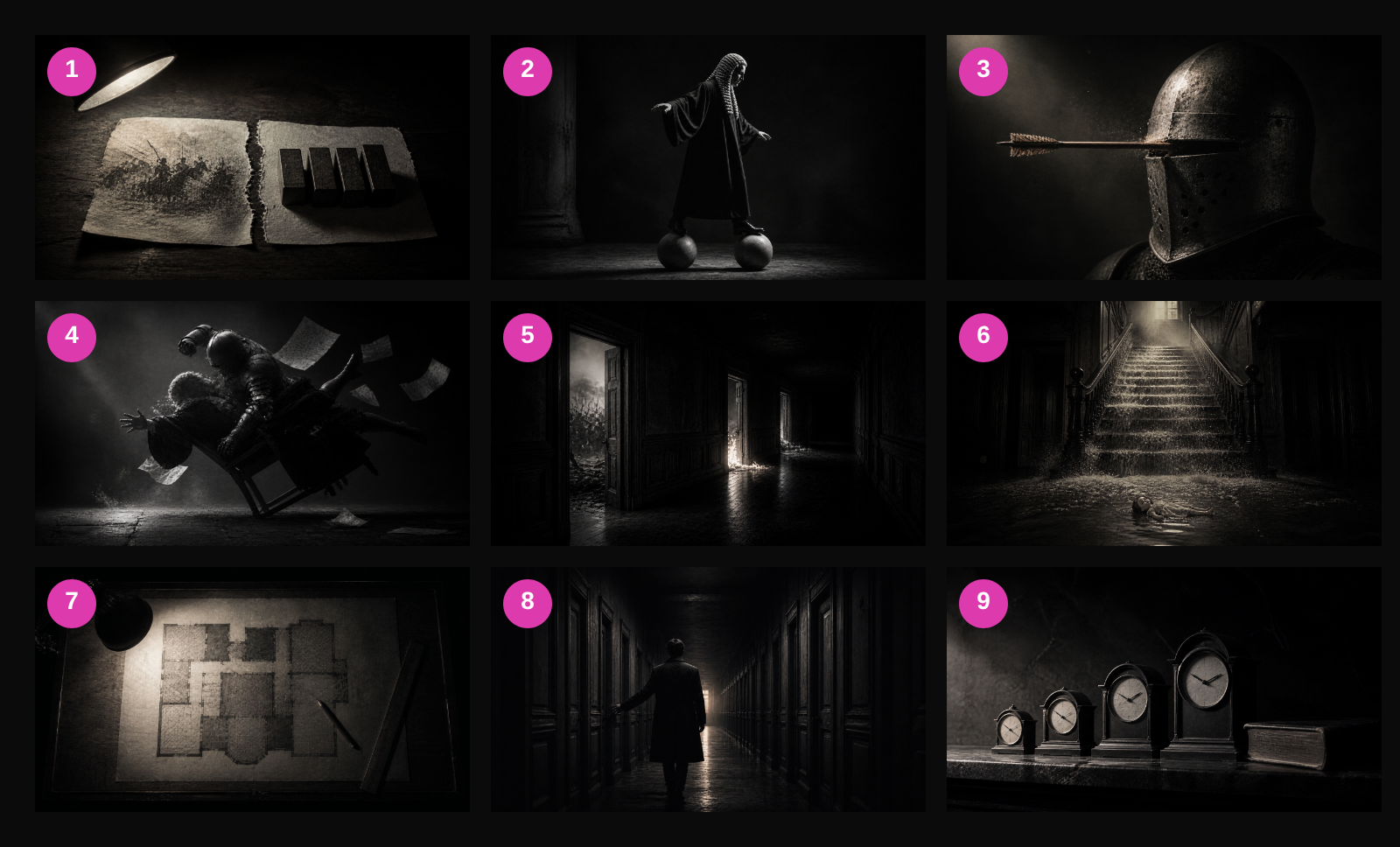
- A date is two things: an event you can picture and a number you cannot. Image: a battle scene on one side of a torn page, four bare digits on the other.
- Turn the number into an image with the major system; drop the century if it is obvious. Image: a judge in a wig standing on the number 66.
- Turn the event into an image. Image: an arrow striking a knight's helmet.
- Join them in one reference story and say the date aloud. Image: the fallen knight landing on the judge.
- Keep a timeline in order by placing each story on a memory palace location. Image: a hallway with a battle, a fire and a flood at successive doors.
- Worked example: Hastings on the doorstep, the Great Fire on the hall table, Waterloo pouring down the stairs. Image: water cascading down a staircase with a doll floating at the bottom.
- For a syllabus: chunk by era, one palace area each, test both directions. Image: a floor plan with rooms shaded for different centuries.
- The palace gives you the order of events for free, not just the dates. Image: a corridor of doors with a figure walking it in sequence.
- Review at one hour, one day, one week and one month. Image: four clocks on a mantelpiece beside a history book.
Sources
- Mark Channon, How to Remember Anything (Hodder Education)
Loci
Build the memory palace in this article inside Loci — store your locations, link images, and rehearse with spaced repetition.
Try it in LociMemory School community
Learn directly with Mark inside the Memory School community on Skool — monthly lessons, practice, and Q&A.
Join Memory SchoolAbout the author
Mark Channon
Grand Master of Memory (1995). Author of three books on memory published by Hodder and Nick Hern. Creator of BBC1's Monkhouse's Memory Masters. Memory coach on Channel 4's Can I Improve My Memory?
Read full bio →