
How to Remember Anything
How to Memorise Phone Numbers
A phone number is just a string of digits, which is exactly why it slips away. Turn the digits into pictures and the number sticks. Here is how.

We have handed phone numbers over to our devices so completely that you may not be able to recite your partner's number, let alone a friend's. With a mobile in your pocket, that is mostly fine. Until the moment your phone is dead, lost, or in someone else's hands and you need a number you do not have.
Holding a handful of important numbers in your own head is a small, useful skill, and it is easy to build.
A phone number is hard to remember for the same reason all numbers are: the digits are abstract. There is no picture, no sound, no story. The fix is to turn the digits into pictures and link the pictures together.
Why phone numbers slip away
When you read a phone number, your eyes see a string of shapes with nothing for the brain to grab. Your working memory, which holds only a handful of items for a few seconds, juggles the digits briefly and drops them the moment you are distracted.
The answer is to give the digits a form your brain is good at holding: pictures, linked into a small story or placed in a memory palace. A memory palace is a set of locations held in order in your mind, such as the rooms of your home, with one picture left at each.
The quick method: number shape and rhyme
If you want to start today with no setup, use the number shape system and the rhyme list.
With the number shape system every digit is a picture that looks like it:
- 0 Polo mint, 1 pencil, 2 swan, 3 snake, 4 sail, 5 hook, 6 bag, 7 axe, 8 snowman, 9 balloon
With the rhyme list every digit is a picture that rhymes with it:
- 0 hero, 1 bun, 2 shoe, 3 tree, 4 door, 5 hive, 6 sticks, 7 heaven, 8 plate, 9 wine
Take the digits two at a time. Use the shape picture for the first digit and the rhyme picture for the second, and make them do something to each other. 38 is a snake wrapped around a plate. 01 is a Polo mint stuck on a bun. So the code 3801 is a snake wrapped around a plate, knocking a Polo mint off a bun.
That is perfect for short numbers, a PIN or an extension, and for numbers you only need for a short while. For a full phone number it works, but it gets long.
The powerful method: the major system
For numbers you want to keep, the major system is the better tool.
The major system turns each digit into a consonant sound: 0 is s or z, 1 is t or d, 2 is n, 3 is m, 4 is r, 5 is l, 6 is j, sh or ch, 7 is k or g, 8 is f or v, 9 is p or b. Add vowels and pairs of digits become words, so a long number becomes a short run of pictures.
Take a number ending 34 92 17.
- 34 is a mare
- 92 is a pen
- 17 is a tack
A wild mare chews a giant pen, which leaks ink onto a sharp tack on the floor. Six digits, three pictures, one short scene.
There's a catch. To use it on the fly you need a ready-made picture for every pair from 00 to 99. That takes a few hours to design and a few weeks to recall at speed. Once it is in place, it handles any number you need. The Major System Explained sets it out in full.
A full worked example
Let us memorise a complete UK mobile number with the major system: 07911 123 456.
Every UK mobile starts 07, so you can skip that part or give it one fixed picture you reuse every time. Break the rest into pairs: 91, 11, 23, 45, 6.
- 91 is a bat
- 11 is a tot
- 23 is a gnome
- 45 is a rail
- 6 is a shoe
A tiny tot swings a cricket bat and knocks a garden gnome clean off a railway rail, and the gnome lands in a giant shoe. Picture it, say the digits aloud as you reach each picture, and the number is stored. Five pictures instead of eleven.
Visual embedding for short numbers
For short, fixed numbers such as a PIN or a card number, visual embedding gives you the same structure every time.
Take a main image, the thing the number belongs to, and fix the digit pictures onto it in set positions: on top, on the sides, through the middle, on the bottom. For a four-digit card code, imagine the card the same size as you. Put the first picture on top like a head, the next on the sides like arms, the next through the middle like a belt, and the last at the bottom like feet. Then step back and see the whole card as one image. Say the number aloud and interact with each part: touch the head, shake the hands, straighten the belt, clean the shoes.
Build a phone book in a palace
If you want to hold several numbers, give them a home. Use a small memory palace, your living room works well, and give each person one location.
At the first location, picture the first person and build their number into the scene around them. At the second, the second person and their number. And so on. To recall someone's number, walk to their spot, see them, and read the number out of the scene.
A sensible goal is the five or six numbers that matter: the people you would need to reach if your phone vanished.
Use your voice and your fingers
The pictures are the map. Two more things get a number in quickly.
Say it and hear it. Saying a number out loud is the usual way to learn one. Do it with the pictures in mind: walk the scene, say the digits, and hear yourself say them. You can chunk them as you go, 079, 11, 123, 456, the way you would read it to someone.
Tap it out. As you recall the number, literally tap the digits on your phone's keypad. Your finger learns the sequence too: the visual pattern of where it goes on the keypad, up, across, down to the 0. Now you have a picture, a sound and a movement for the same number.
Put all three together and a number goes in very quickly. Once you know it, you will bypass the pictures altogether. You will just know it. The pictures help you get there much faster.
How to make them stick
Recall the number an hour later, the next day, a week later and a month later. Each time you pull it back, it gets stronger. If you have stored someone's number this way, dial it from memory once or twice.
Practise it today
Pick one number you actually want to know by heart. Use shape and rhyme if you want to start in the next five minutes, or the major system if you are ready to build your matrix. Build the pictures, say the digits aloud, tap them out on the keypad, and test yourself an hour later.
Do one number a day for a week. MindForge (mindforge.memoryschool.com) has daily number practice if you want a routine to follow.
Memory map
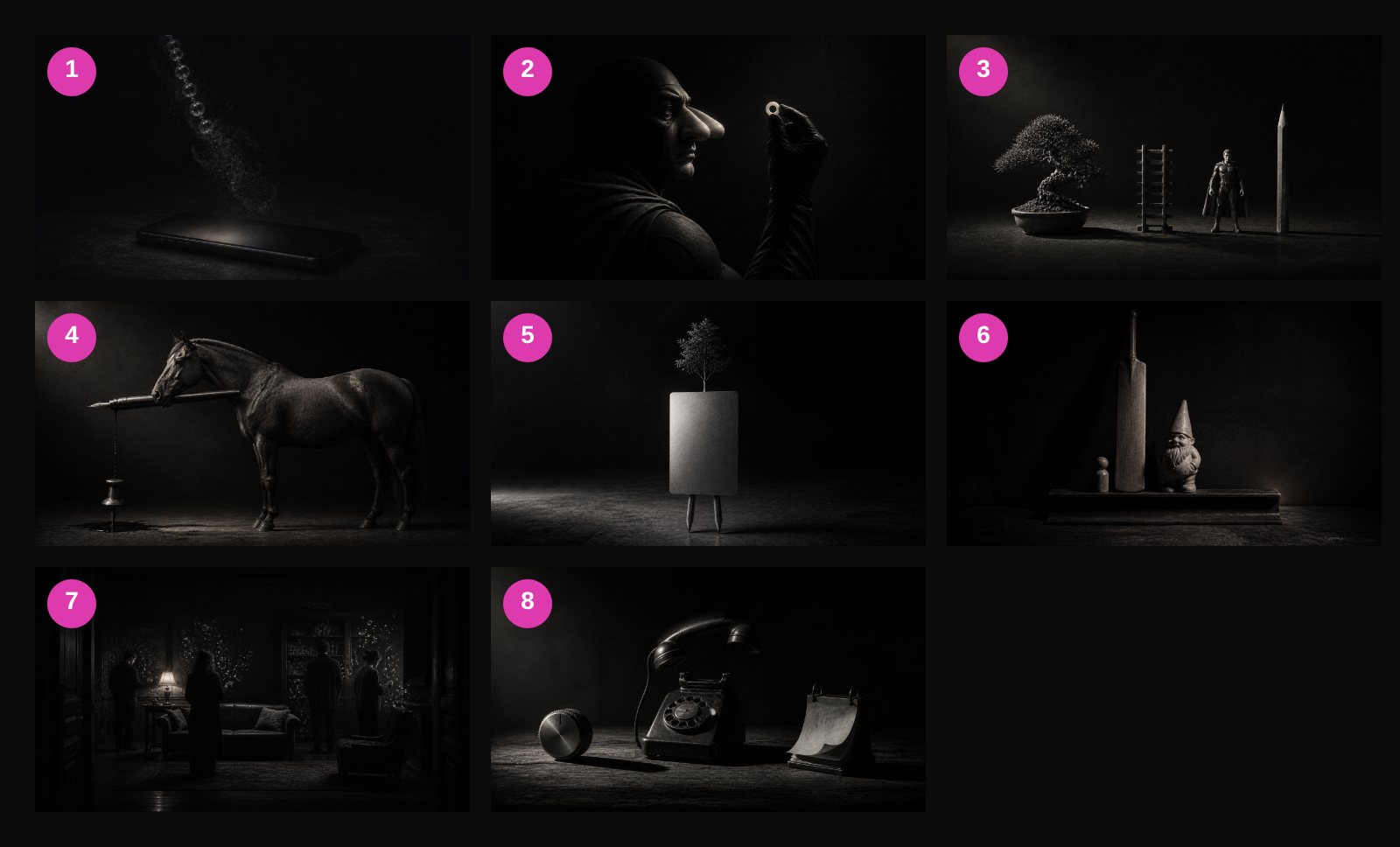
- Phone numbers slip because digits are abstract and working memory drops them in seconds. Image: a string of glowing dots fading as a phone screen goes dark.
- Quick method: shape for the first digit, rhyme for the second. Image: a snake wrapped around a dinner plate.
- 3801: a snake around a plate knocks a Polo mint off a bun. Image: a snake coiled on a plate, flicking a mint off a bread bun.
- Powerful method: the major system, one picture per two digits. Image: a wild mare chewing a giant pen that leaks onto a tack.
- The catch: a few hours to build your 00 to 99 pictures, a few weeks to get fast. Image: a workbench covered in a hundred small blank cards, a few already sketched on.
- A full mobile: a tot, a bat, a gnome, a rail and a giant shoe. Image: a tiny child swinging a cricket bat at a garden gnome on a railway rail.
- Visual embedding: head, sides, middle, feet on one main image. Image: a credit card the size of a person with a snake for a head and pencils for feet.
- A phone book palace: one person per location, their number in the scene. Image: a living room with a friend standing at each piece of furniture.
- Say it, hear it, tap it out on the keypad; once you know it, you no longer need the pictures. Image: a finger tracing a pattern across a glowing phone keypad.
Sources
- Mark Channon, How to Remember Anything (Hodder Education)
Loci
Build the memory palace in this article inside Loci — store your locations, link images, and rehearse with spaced repetition.
Try it in LociMemory School community
Learn directly with Mark inside the Memory School community on Skool — monthly lessons, practice, and Q&A.
Join Memory SchoolAbout the author
Mark Channon
Grand Master of Memory (1995). Author of three books on memory published by Hodder and Nick Hern. Creator of BBC1's Monkhouse's Memory Masters. Memory coach on Channel 4's Can I Improve My Memory?
Read full bio →