
Memory Palace
The Method of Loci Explained: The Ancient Memory Technique Still Used by World Memory Champions
The method of loci is the ancient name for the memory palace. Where it came from, how Roman orators used it, and why memory champions still rely on it today.

If you've spent any time reading about memory techniques, you'll have come across the phrase method of loci. Strip away the Latin and it just means "the method of places", and it's the foundation that every other memory technique sits on top of.
It is the technique worth reaching for before any other. Here is what the method of loci really is, where it came from, why it's still used by world memory champions in 2026, and how it relates to the modern "memory palace" you may have heard about.
What Is the Method of Loci?
The method of loci is a memory technique in which you associate information you want to remember with a sequence of well-known locations along a mental journey. Those locations are your nodes, your "memory files." The journey can be a series of rooms in your home, a walk to work, a route around a familiar town, or even a virtual journey built in LOCI, which builds a memory palace from Google Street View or with AI.
To recall the information, you mentally retrace your steps. Each location triggers the image you placed there, which in turn triggers the fact, idea or word the image represents.
Today the method is best known as the memory palace, a set of mental files you walk in order. The principle is identical to what the ancient Greeks taught.
The Origin Story: Simonides of Ceos
Every history of the method of loci begins with the same story.
Around 500 BCE, an Ancient Greek poet named Simonides of Ceos was performing at a banquet for a Thessalian nobleman called Scopas. Partway through the recital, Simonides was called outside, two men, he was told, were waiting to speak with him. He went out. No one was there.
While he stood outside, puzzled, the roof of the banquet hall collapsed and crushed everyone inside. The bodies were so badly disfigured that the grieving families couldn't identify their relatives. Simonides could. Standing among the rubble, he closed his eyes and saw the table in his mind, and exactly where each guest had been sitting.
That single moment of recall gave him a reputation as the inventor of the art of memory. The technique he had unconsciously used, anchoring memories to specific physical locations, became known as the method of loci, and it spread quickly through the ancient world.
How Roman Orators Used It
Two centuries later, the method of loci had become standard training for any Roman who needed to speak in public. And public speaking in Rome was a serious business. A senator was expected to deliver speeches that ran for one, two, sometimes three hours, with no notes. The political career of a man like Cicero literally depended on his memory.
The Roman approach was elegant. An orator would mentally walk through a familiar building, their own villa, the forum, a temple, and at each location place an image representing one section of the speech. To deliver the speech, they would walk the same route in their mind, picking up each "argument" in turn.
This is exactly the technique world memory champions use today. The only thing that's changed is the content. Where Cicero used the method of loci for political speeches, modern competitors use it to memorise shuffled decks of cards, hundreds of binary digits, and long strings of random nouns.
Why It Still Works in 2026
We know more about the brain now than the Romans did, and the neuroscience explains why this technique has survived for two and a half thousand years without anyone improving on it.
The hippocampus, a structure in the brain shaped roughly like a seahorse, plays a key role in two things: forming new memories, and spatial navigation. Place cells, nerve cells in the hippocampus that track where you are, fire when you're in a familiar location. When you imagine walking through a place you know, those same neural patterns light up. The method of loci hijacks that system. It gives every piece of new information a "where," and the where is processed by the brain's most powerful memory machinery.
The brain-imaging research backs this up: after six weeks of training with the method of loci (40 sessions of 30 minutes), ordinary people's brain networks started to resemble those of memory champions (Dresler, Konrad and colleagues, 2017). The technique doesn't just feel like it's working; you can see the change in how the brain connects up.
Method of Loci vs. Memory Palace vs. Journey Method
These terms get used interchangeably and it can be confusing, so here is the difference.
- Method of Loci is the umbrella term. It covers any memory technique that uses locations to store information. This is the academic, historical name.
- Memory Palace is a sub-type of the method of loci where your locations are inside a building, your home, your office, a school, a museum, or somewhere you have explored virtually. The Romans called this approach the Roman Room when the palace was a single room.
- Journey Method is another sub-type where your locations are spread along a route, rather than inside a single building. Your walk from the train station to the office. A run you do regularly. The drive between two towns.
In practice, a mix of the two works well. Use memory palaces for blocks of related information, and journeys for very long sequences where you need 50, 100 or 200 locations.
What You Can Memorise With the Method of Loci
The method of loci works for:
- Speeches and presentations, including TED-style talks that run 20+ minutes, delivered without notes
- Scripts and monologues, for working actors and anyone who has to speak someone else's words
- Anatomy and exam content, a whole written syllabus held room by room
- The periodic table, by placing each element at a numbered location, you get the atomic number for free
- Names, combined with face-association, you can hold 30 to 50 names in a room
- Foreign-language vocabulary, perfect for breaking new words into their prefix, root and suffix
A Worked Example: Memorising a Mini Sequence
Here is how the method of loci actually works in practice. Pick three rooms you know: your living room, your kitchen, your bedroom. In each one, pick five items that you can name in order, going clockwise around the room. That's 15 memory files, your first small memory palace.
Now say you want to memorise the first five planets of our solar system: Mercury, Venus, Earth, Mars, Jupiter.
On the first item of your living room (let's say the sofa), imagine a courier dressed as the Roman god Mercury, sprinting across the cushions with a package. Make him huge. Make him out of breath.
On the second item (maybe the coffee table), imagine the planet Venus literally on top of it, but it's also Venus the woman, like the Botticelli painting. The two ideas are stuck together.
On the third item (the TV), imagine a globe of the Earth bursting out of the screen, smashing the glass.
On the fourth item (the bookshelf), imagine a chocolate Mars bar the size of a person, oozing caramel onto the books.
On the fifth item (the lamp), imagine Jupiter, the giant, swirling, red-spotted gas giant, replacing the lampshade entirely.
Now look up from the page. Walk around your living room in your mind. What's on the sofa? The coffee table? The TV? The bookshelf? The lamp?
You've just used the method of loci to memorise the first five planets in order. With practice you can extend this to fifty items, a hundred, a thousand.
The Roman Room Variant
The Roman Room is the simplest method of loci variant and a great place for absolute beginners to start. Here's the process:
- Choose a room you know well
- Pick five items in clockwise order, chair, curtains, table, TV, bookcase, for example
- Memorise the sequence by mentally running through it three times
- Repeat for three more rooms, you now have 20 memory files
- Use those 20 files to store anything you want to remember
Twenty items per memory palace, three palaces, sixty items in all: that is a comfortable first project once the palaces are solid.
The Journey Method Variant
For larger memory palaces, switch to the journey method. Pick a starting location and a finishing location, your home and your office, say, then fill in 30, 50, 100 nodes along the route. The advantage of the journey method is that you can build very long routes while still memorising at high speed.
A useful tip: when you're creating a long journey, choose the start and end points first, then go back and fill in the gaps. If you target 50 nodes and end up with 30, walk the route again, you'll find newsagents, lamp posts, doorways and bus stops you skipped first time round.
You don't have to walk every route either. LOCI builds routes from Google Street View or generates whole palaces with AI, so almost any street in the world, or one that never existed, becomes a ready-made memory palace.
How to Start Using the Method of Loci Today
If you want to start using the method of loci right now, here's the shortest possible path:
- Pick one room you know well
- Choose five items in clockwise order
- Pick five things you actually need to remember, five points for a meeting, five items for the shop, five facts for an exam
- Imagine each one of those things doing something vivid and silly on each of the five items
- Test yourself
That's the entire technique. Everything else, memory palaces, the journey method, the Roman Room, the chain method (where each item is linked to the next in a short, vivid story), is a variation on those five steps.
For the full step-by-step walkthrough, including how to lock a palace in for the long term, read How to Build a Memory Palace: A 7-Step Beginner's Guide (With Worked Examples).
Memory map
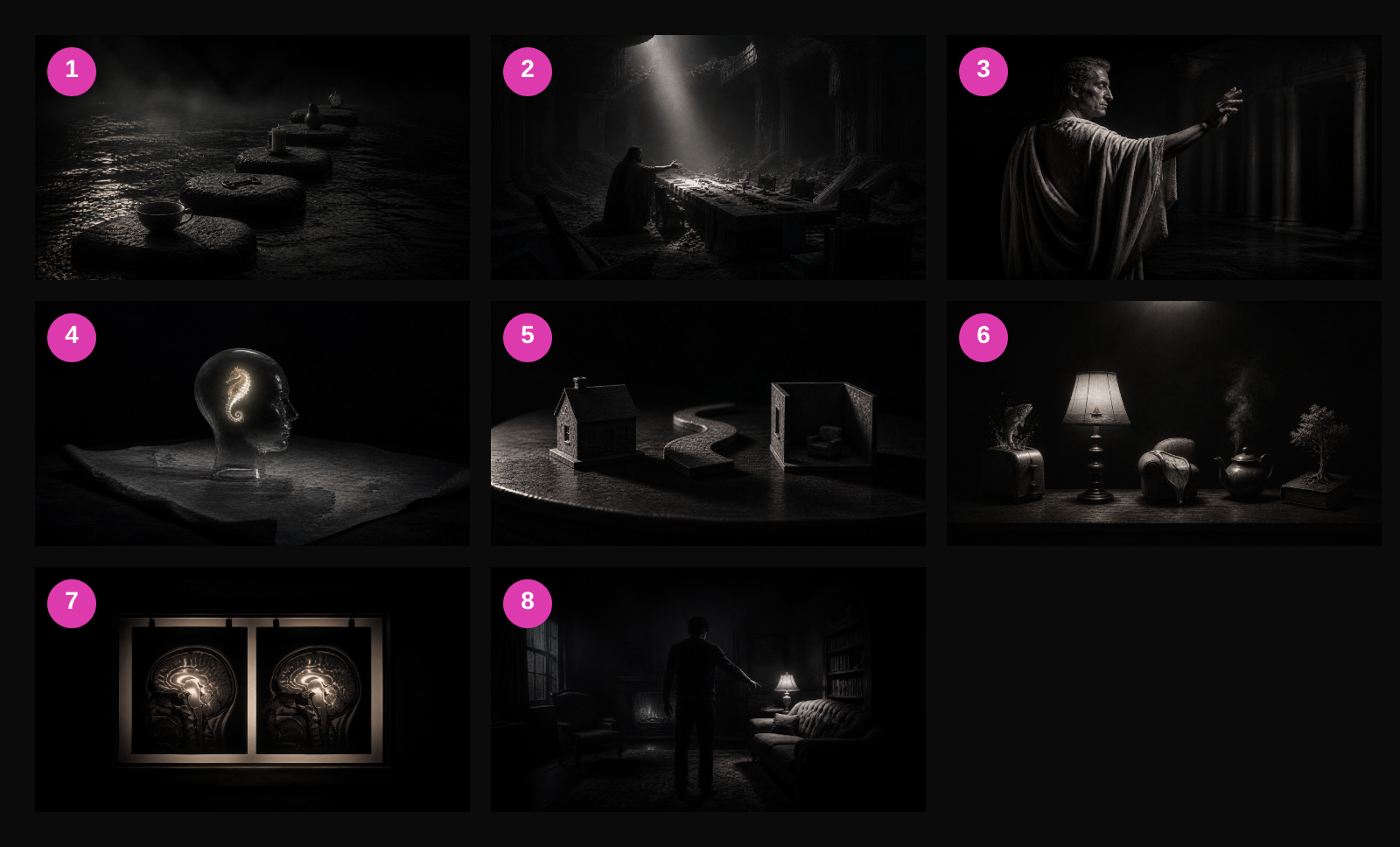
- The method of loci attaches information to a sequence of locations along a mental journey. Image: a line of stepping stones across a stream, a small object balanced on each.
- Simonides identified the dead of a collapsed banquet by remembering where each guest sat. Image: rubble and dust, a man kneeling and gesturing to empty places at a long table.
- Roman orators walked their villas in their minds to deliver speeches for hours without notes. Image: a toga-clad speaker, eyes half closed, one hand tracing an invisible corridor.
- The hippocampus handles both new memories and navigation, which is why place and memory are linked. Image: a seahorse shape glowing inside a translucent head, a map beneath it.
- Memory palace, journey method and Roman room are variants of the same method. Image: a house, a winding road and a single room, side by side.
- A worked example: a short sequence placed on five spots in a room. Image: five household objects, each with something impossible happening on it.
- Six weeks of daily practice makes an ordinary brain look like a champion's on a scan. Image: two brain scans side by side, the second lit in the same places as the first.
- Start today: one room, five locations, five things you need to remember. Image: a person standing in their own living room, pointing at five spots in turn.
Sources
- Mark Channon, How to Remember Anything (Hodder Education)
- Cicero, De Oratore, Book II (the Simonides story); Frances Yates, The Art of Memory (1966; Pimlico edition 1992)
- Dresler, M., Shirer, W. R., Konrad, B. N. et al. (2017). Mnemonic training reshapes brain networks to support superior memory. Neuron, 93(5), 1227 to 1235. https://doi.org/10.1016/j.neuron.2017.02.003
Frequently asked questions
Are you old school? Get Mark's book Improve Your Memory and dive in depth.
Loci
Build the memory palace in this article inside Loci — store your locations, link images, and rehearse with spaced repetition.
Try it in LociMemory School community
Learn directly with Mark inside the Memory School community on Skool — monthly lessons, practice, and Q&A.
Join Memory SchoolAbout the author
Mark Channon
Grand Master of Memory (1995). Author of three books on memory published by Hodder and Nick Hern. Creator of BBC1's Monkhouse's Memory Masters. Memory coach on Channel 4's Can I Improve My Memory?
Read full bio →