
Memory Techniques
The PAO System Explained
PAO stands for Person, Action, Object. It is the advanced number and card system memory athletes use to compress long sequences into rich, combinable images. Here is how it works.

PAO stands for Person, Action, Object. It is the system serious memory athletes use to memorise long numbers and shuffled decks of cards at high speed, and it is the natural next step once you have the major system working (a code that turns each digit into a consonant sound, so numbers become words you can picture). It looks complicated from the outside. The underlying idea is simple, and once it clicks, it roughly triples how much you can pack into a single mental image.
PAO is an advanced technique. It takes real setup, and it is only worth the effort if you intend to memorise a lot of numbers, compete in memory competitions, or memorise cards. If you just want to remember the occasional phone number, the major system or the number shape system, where each digit becomes a picture it looks like (1 a pencil, 2 a swan), is plenty. But if you want to go further, this is the system that takes you there.
The problem PAO solves
With the major system you hold a fixed picture for each pair of digits, 00 to 99. That is already powerful. A ten-digit number becomes five images, which you chain together into a story or place on a memory palace, a route you know well with one image set down at each stop.
But memory athletes want to go faster and pack more in. PAO does this by giving each two-digit number not one attribute but three: a Person, an Action, and an Object. Then, instead of using one number per image, you combine three numbers into a single composite image, taking the Person from the first, the Action from the second, and the Object from the third.
The result: a six-digit number collapses into a single vivid scene. A whole deck of cards collapses from 52 images into roughly 17. Fewer images means fewer locations, faster encoding, and more compact recall.
How PAO builds on the major system
PAO is not a replacement for the major system. It is built on top of it.
You start, as always, with the major system code, where each digit maps to a consonant sound (0 is s or z, 1 is t or d, 2 is n, 3 is m, 4 is r, 5 is l, 6 is j, sh or ch, 7 is k or g, 8 is f or v, 9 is p or b). From that code you build a word for each two-digit number from 00 to 99.
In a plain major system you stop there: one image per number. In PAO you go further and attach a fixed Person, a fixed Action, and a fixed Object to each two-digit number.
A simple way to begin is to assign each two-digit number a Person and an Object first, then add an Action later. For 49 you might have a cowboy (person) and a rope (object). For 94 you might have Homer Simpson (person) and a beer (object, from his drinking). Once you have those, the fun is in combining them.
How combining works
This is the heart of PAO. You take the Person from one number and the Object (or Action) from another, and fuse them into one image.
Using the example above:
- 49 is a cowboy with a rope
- 94 is Homer Simpson with a beer
Now combine. The number 4994 becomes a cowboy (person of 49) drinking a beer (object of 94). The number 9449 becomes Homer Simpson (person of 94) with a rope (object of 49). Same four digits, different order, completely different image. The person tells you the first pair, the object tells you the second pair.
Take it one step further and add an Action to each number, and you get a full Person, Action, Object for every two-digit number. Now a six-digit number becomes one composite scene: the Person from the first pair, performing the Action from the second pair, on the Object from the third pair.
So 49 94 17 might become a cowboy (person of 49) drinking (action of 94) a duck (object of 17). Six digits, one image. That is the compression PAO gives you.
Building your own PAO list
This is the work. There is no shortcut, but it is a one-time investment that serves you for years.
-
Make sure your major system is solid first. You need to be able to convert any two-digit number to its consonant sounds instantly. PAO sits on top of this. If the foundation is shaky, build it before going further.
-
Assign a Person to every number from 00 to 99. Use the major system sounds to suggest the person. 10 (t, s) might be Tom Cruise. 33 (m, m) might be a mummy. Use vivid, distinct people: celebrities, family, fictional characters, anyone you can picture clearly and tell apart.
-
Assign an Action and an Object that naturally belong to that person. Tom Cruise might be running (action) with a film camera (object). The mummy might be staggering (action) wrapped in bandages (object). Keeping the action and object connected to the person makes the whole set far easier to learn.
-
Drill the list in chunks of ten. Test yourself: given a number, fire back the person, action, and object. Given a person, fire back the number. Build it ten numbers at a time, testing each chunk before moving on.
If you commit to it, expect a working PAO list within a few weeks of daily practice. It is the same six-week curve as everything else in memory training: the brain measurably reshapes itself around the system with consistent practice.
A fuller worked example
Let us memorise a longer number with a full Person, Action, Object system to see the compression in action. Take 49 94 17 21 33 76.
In our example list:
- 49 is a cowboy (person), lassoing (action), with a rope (object)
- 94 is Homer Simpson (person), drinking (action), a beer (object)
- 17 is a duck (person), waddling (action), with a quack (object)
- 21 is a nun (person), praying (action), with beads (object)
- 33 is a mummy (person), staggering (action), in bandages (object)
- 76 is a chef (person), chopping (action), with a knife (object)
Now group the six numbers into two composite images, each taking a Person from the first number, an Action from the second, and an Object from the third:
- 49 94 17: a cowboy (person of 49) drinking (action of 94) a quack, picture a rubber duck (object of 17). One scene.
- 21 33 76: a nun (person of 21) staggering (action of 33) with a knife (object of 76). One scene.
Six two-digit numbers, twelve digits in total, collapsed into two vivid scenes that you place on two locations of a memory palace. Without PAO, those twelve digits would have been six separate images. With PAO, they are two. That halving, or with full triples, thirding, is the point of PAO.
Starter PAO vs full PAO
You do not have to build the full Person, Action, Object set on day one. There is a sensible halfway house.
Starter PAO (Person and Object only). Assign each two-digit number just a Person and an Object. This already lets you combine the person of one number with the object of another, halving your image count. 4994 becomes a cowboy with a beer, 9449 becomes Homer Simpson with a rope. This is much less to build than a full PAO and delivers most of the benefit for everyday number work.
Full PAO (Person, Action, Object). Add an Action to each number once the persons and objects are solid. Now you can combine three numbers into one scene, which is the level competitive memorisers use. This takes the most crafting and is really only worth it if you intend to compete or memorise large volumes of numbers regularly.
Build starter PAO first. Live with it for a while. Add actions only when you need the extra compression. There is no prize for building a full PAO system you never use.
PAO is the standard system for memorising a deck of cards at speed. Every card from the two of clubs to the ace of spades gets its own Person, Action, and Object.
To memorise a deck, you take the cards in groups of three. The Person comes from the first card, the Action from the second, the Object from the third. Three cards become one composite scene, which you place on a single location in your card memory palace.
A 52-card deck has its last card sitting alone or paired depending on your exact method, but broadly the deck collapses from 52 images to around 17 or 18 composite scenes. Your palace needs far fewer locations, you encode faster, and recall is more compact. This is how competitors get a deck off the table in well under a minute.
The catch is the same as with numbers: you have to build and drill a full 52-card PAO set first. That is the price of admission to serious card memorisation. Build the simpler one-image-per-card system first (covered in How to Memorise a Deck of Cards), get comfortable, then graduate to PAO when you want to push your times down.
Is PAO worth it for you?
Be honest about your purpose before you invest the hours.
PAO is worth it if you intend to compete in memory competitions, memorise long numbers regularly as part of your work or study, or take card memorisation seriously. For those goals, PAO is the difference between competent and fast.
PAO is overkill if you just want to remember the occasional phone number, PIN, or date. For everyday number memory, the number shape system and the plain major system do the job with far less setup.
The honest test is the one that applies to all of creative memorisation, the whole approach of turning information into vivid images: identify your purpose first. If you have a real reason to memorise a lot of numbers or cards, PAO delivers enormous benefits and the setup pays for itself many times over. If you do not, spend your time elsewhere.
Where to go from here
PAO sits at the top of the number and card techniques. Below it are the foundations you need first: the major system for the code, the memory palace for storage, and the deck of cards method for the basic card-memorisation workflow.
If you have those in place and you want to go faster, building a PAO list is the upgrade. Start with persons and objects, add actions once those are solid, and drill in chunks of ten. It is the most setup-heavy technique in memory sport, and for anyone serious about numbers or cards, it is also the most rewarding.
Memory map
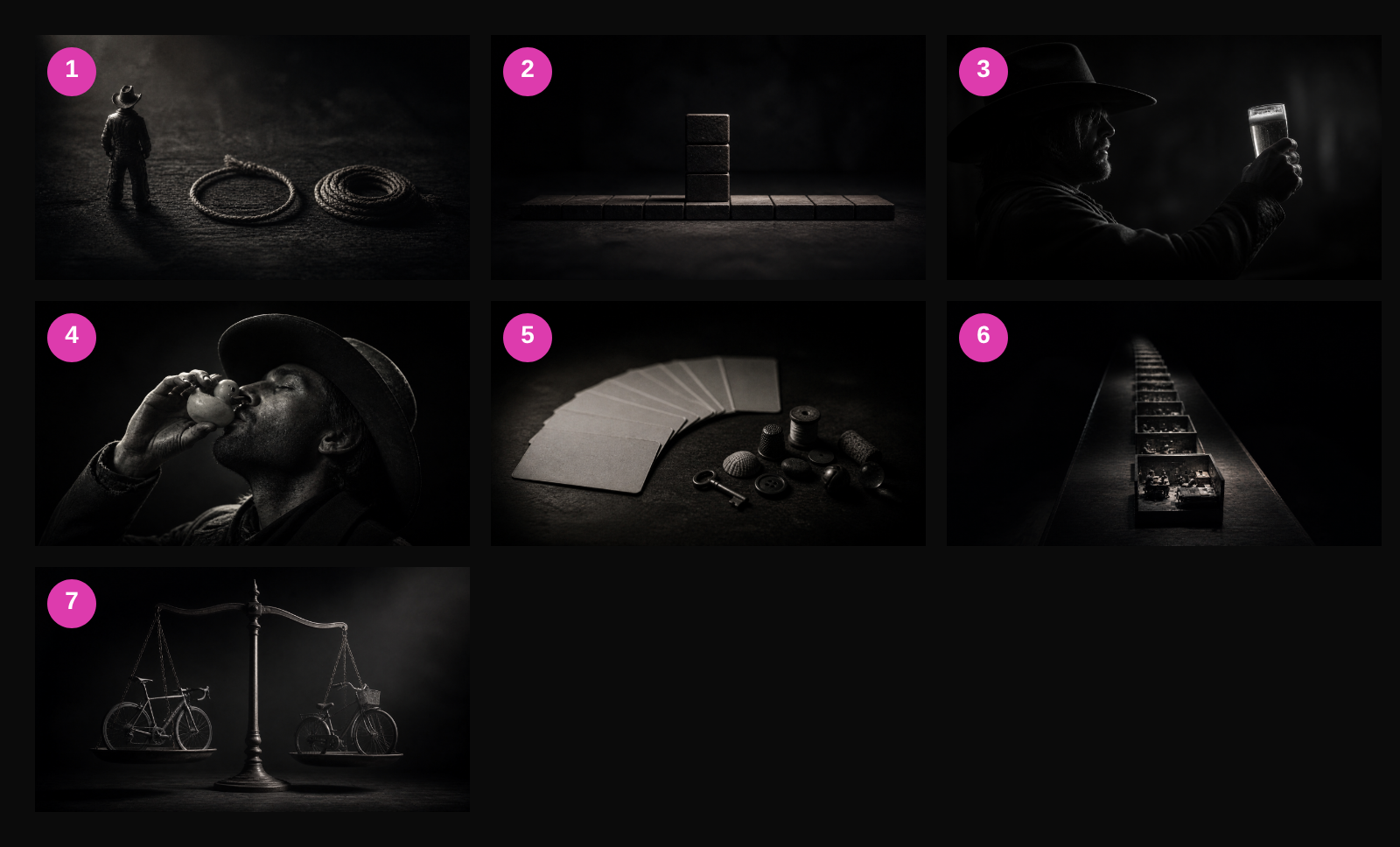
- PAO gives each two-digit number a person, an action and an object. Image: a cowboy, a lasso loop and a coiled rope laid in a row.
- It is built on top of the major system. Image: a stack of three blocks standing on a wide base of ten numbered tiles.
- Combine the person of one number with the object of another to halve your images. Image: a cowboy lifting a glass of beer.
- With actions added, three numbers become one scene. Image: a cowboy drinking from a rubber duck.
- Build it in chunks of ten, persons and objects first, actions later. Image: ten portrait cards fanned out beside ten small objects.
- For cards, three cards become one scene and a deck becomes about seventeen. Image: a long table with seventeen small dioramas on it.
- Worth the setup only if you memorise many numbers or compete; otherwise the number shape system is enough. Image: a set of scales with a racing bike on one side and a city bike on the other.
Sources
- Mark Channon, The Memory Workbook (Hodder Education)
Loci
Build the memory palace in this article inside Loci — store your locations, link images, and rehearse with spaced repetition.
Try it in LociMemory School community
Learn directly with Mark inside the Memory School community on Skool — monthly lessons, practice, and Q&A.
Join Memory SchoolAbout the author
Mark Channon
Grand Master of Memory (1995). Author of three books on memory published by Hodder and Nick Hern. Creator of BBC1's Monkhouse's Memory Masters. Memory coach on Channel 4's Can I Improve My Memory?
Read full bio →