
Memory Training
How to Memorise a Deck of Cards
Memorising a shuffled deck of cards looks like a magic trick. It's actually three small techniques stacked on top of each other. Here's the exact system.

Memorising a shuffled deck of 52 cards is the iconic memory-sport feat. Done well, it looks like a magic trick. Once you understand the mechanics, it stops being magic and becomes carpentry: three small techniques stacked on top of each other, each one boring on its own, devastating in combination.
This is how memory competitors do it. The Guinness World Records mark for a single shuffled deck is under 14 seconds (13.96 seconds, Zou Lujian, 2017). You start with the same technique, and with practice it scales all the way to that level, or stays comfortable at "memorising a friend's deck in a couple of minutes," depending on how far you want to take it.
You will learn the three techniques, set up your card-image system, build a card palace, encode a deck, and get a realistic six-week practice plan.
The three techniques you will combine
There are no shortcuts here. Memorising a deck rests on three things, each of which is a separate skill.
- A fixed image for every card. Every one of the 52 cards is assigned a specific person, action, and object that you know by heart. The eight of clubs is always the same image. The queen of hearts is always the same image. No exceptions.
- A memory palace. A journey through places you know, with at least 26 locations (or 52 if you are not pairing cards) that you can recall in order. You picture one card image at each location, so your palace becomes the storage system.
- A pairing or tripling system. Cards are usually memorised in pairs or triples. Two or three cards are combined into a single composite image to compress the deck and reduce the number of locations you need.
Without all three, you cannot get a deck off the table in under a minute. With all three, the only thing standing between you and a memory sport medal is practice.
Step 1. Assign an image to every card
This is the upfront investment. The full method uses the PAO system, where every card has a Person, an Action, and a thing they are using (an Object). You will learn PAO properly in The PAO System Explained. For your first deck, a simpler version is plenty.
Pick one vivid image for each card. A neat way to generate the images is the major system, which swaps each digit for a consonant sound so that numbers can become words (The Major System Explained covers it in full). Here the suit determines the first letter, the value determines the second.
A simple convention:
- Hearts start with H
- Diamonds start with D
- Spades start with S
- Clubs start with C
- The card value is the second letter, using the major system (Ace is T, 2 is N, 3 is M, 4 is R, 5 is L, 6 is J or SH, 7 is K, 8 is F, 9 is P, 10 is S)
So the 5 of Hearts is HL: "hall." The 8 of Spades is SF: "safe." The 3 of Clubs is CM: "comb."
For face cards (Jack, Queen, King) pick a strong, fixed image. The King of Hearts might be a real king you know, a historical figure with red robes, or a film character. The Queen of Spades might be a famous female villain. Whatever feels vivid and unmistakable.
The system is less important than picking one and sticking to it. Build the full 52-image set once and keep it.
A worked sample from the start of a hearts suit:
- Ace of Hearts: HT (hat)
- 2 of Hearts: HN (hen)
- 3 of Hearts: HM (ham)
- 4 of Hearts: HR (hare)
- 5 of Hearts: HL (hall)
- 6 of Hearts: HJ (hedge)
- 7 of Hearts: HK (hike)
- 8 of Hearts: HF (hoof)
- 9 of Hearts: HP (hoop)
- 10 of Hearts: HS (hose)
Build the full 52 in an afternoon. Drill them with flashcards for a week and they become automatic.
Step 2. Build your card palace
You need a memory palace dedicated to cards. 26 locations is enough if you are memorising in pairs. 52 if you are going one card at a time. For your first attempt, build a 52-location palace.
Choose a journey you can recall reliably. Your home is usually not big enough for 52 locations on its own, so extend out to the front garden, the road, the corner shop, the local park. Or pick any town in LOCI, which builds memory palaces from Google Street View, and walk 52 stops along its streets; a few seconds on each is enough to fix the order, and you never need to have been there.
If building a 52-location palace from scratch feels intimidating, LOCI will build one for you from a real street or with AI. Walk through it a few times and the locations are yours, no construction needed.
Lock the route in until you can walk it forwards, backwards, and to any given location on demand. This palace will get reused for every deck you ever memorise. The upfront investment in building it well pays off across thousands of decks.
Step 3. Encode the deck
Now you put it all together. Shuffle the deck. Flip the first card. Convert it to its fixed image. Place that image at location 1 of your palace, interacting vividly with the location.
Flip the second card. Convert it. Place at location 2.
Keep going.
For your first attempt, give yourself no time pressure. Aim for 15 minutes to memorise a full deck. Once you have done that once, target 10 minutes. Then 5. Then under 2.
After encoding, walk your palace mentally and read off the cards in order. The first time you get all 52, you will know something has changed. It is one of those memory moments that recalibrates what you think you are capable of.
A worked example
Say the first three cards off the shuffle are 5 of Hearts, 8 of Spades, 3 of Clubs.
- 5H is hall
- 8S is safe
- 3C is comb
Say location 1 of your palace is your front door. See a long hallway extending out from the door at a weird angle, stretching impossibly into the distance.
Location 2 is the doormat. A heavy steel safe is dropped onto the doormat, denting it. You can hear the thud.
Location 3 is the hallway radiator. A giant comb is wedged behind the radiator, pulling it off the wall. The teeth of the comb are scraping the paint.
Three locations, three cards. Repeat 49 more times.
The whole deck takes ten to fifteen minutes the first time. With practice and the PAO system you will get under five minutes within a few weeks. The fastest competitors are well under a minute, but that is a different sport.
How to pair cards (and why)
Once the basic technique feels comfortable, you compress the deck by combining two cards into a single composite image. This is where the PAO system comes in.
In a PAO system, each card has three attributes.
- A Person (e.g. the 5 of Hearts is a famous female singer)
- An Action (e.g. the 5 of Hearts is singing into a microphone)
- An Object (e.g. the 5 of Hearts is a microphone)
When you pair two cards, you take the Person from the first card, the Action from the second card, and the Object from a third card (or just the second card, depending on whether you are using PAO doubles or triples).
The result. A deck of 52 cards becomes 17 or 26 composite images instead of 52 single images. Your palace needs fewer locations. Encoding is faster. Recall is more compact.
PAO is the system that gets serious memorisers under a minute. It is also more setup work and not necessary for your first few decks. Build the simple version first. Move to PAO when you are ready to push.
A realistic six-week practice plan
Around six weeks of consistent practice is when memory techniques start to feel automatic. Here is a six-week plan that gets you from zero to a comfortable full-deck memorisation.
Week 1. Build your 52-card image set. Drill it twice a day with flashcards. Aim for instant recall in any order.
Week 2. Build your 52-location palace. Walk it forwards and backwards every day. Test random-access recall.
Week 3. Memorise 13 cards at a time. One suit per session. No time pressure. Just lock in the technique.
Week 4. Memorise half a deck (26 cards) in a single session. Time yourself loosely. Aim for under 10 minutes.
Week 5. Full deck. First few attempts will feel slow and you will lose a few cards. Note where you lost them and strengthen the weak locations.
Week 6. Full deck, daily. Track times. Aim for under 7 minutes by the end of the week.
After six weeks of this schedule, the technique is no longer a technique. It is just how you handle cards. You will find yourself watching a card trick on television and unconsciously encoding the cards on screen.
MindForge (mindforge.memoryschool.com) has structured drills that walk you through this six-week curve and track your progress.
Where to go from here
If you want to keep going, the obvious next reads are The PAO System Explained for the compression upgrade, The World Memory Championships Explained (by Someone Who Competed in 1995) for the sport around it and how the Grand Master title works, and Speed Cards Explained: How a Pack Gets Memorised in Under a Minute for the elite end of the field.
If you are curious rather than competitive, you have already learned the same technique memory competitors use. The difference between you and them is repetition. That is it.
That is what memory sport comes down to. It is not talent. It is a system, run on repeat, until it becomes who you are.
Memory map
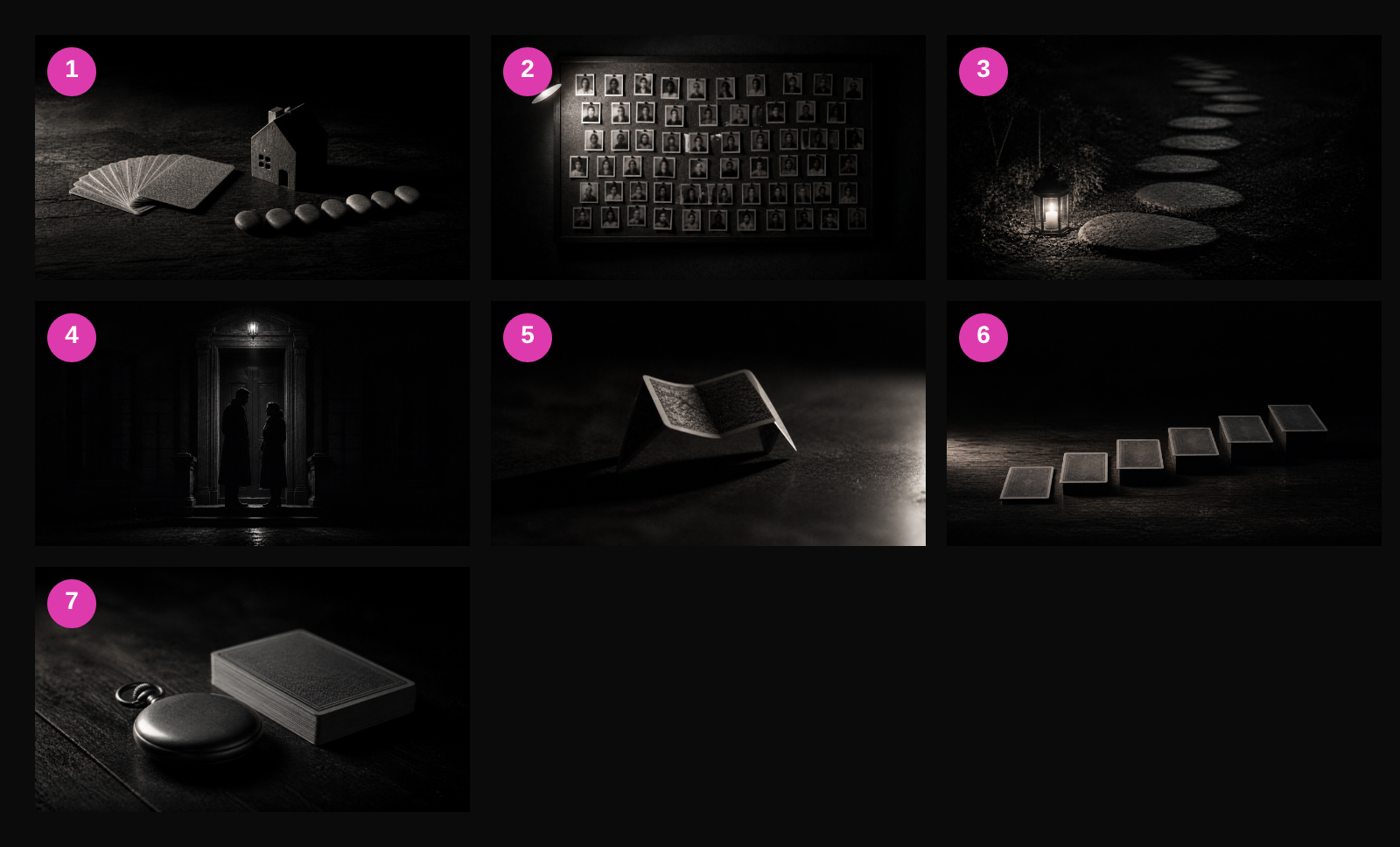
- Memorising a deck combines three techniques: a card image set, a memory palace and the major system. Image: a fanned deck, a house and a row of digits laid out together.
- Give every card an image: suit for the first letter, value for the second via the major system. Image: fifty-two small portraits pinned around a board.
- Build a card palace with at least twenty-six locations you can recall reliably. Image: a long garden path with numbered stepping stones.
- Encode the deck by placing card images, in pairs, on each location. Image: two card figures interacting on a doorstep.
- Pairing cards halves the locations you need and speeds you up. Image: two playing cards fused into one strange creature.
- A six-week plan: images, then palace, then a suit, half a deck, a full deck, daily timing. Image: six playing cards laid in a row, each marked with a week.
- Speed comes last; accuracy and a solid palace come first. Image: a stopwatch face down beside a neatly ordered deck.
Sources
- Mark Channon, The Memory Workbook (Hodder Education)
- Mark Channon, How to Remember Anything (Hodder Education)
- Guinness World Records, fastest time to memorise and recall a deck of playing cards (Zou Lujian, 13.96 s, 2017): https://www.guinnessworldrecords.com/world-records/67743-fastest-time-to-memorize-and-recall-a-deck-of-playing-cards
Loci
Build the memory palace in this article inside Loci — store your locations, link images, and rehearse with spaced repetition.
Try it in LociMemory School community
Learn directly with Mark inside the Memory School community on Skool — monthly lessons, practice, and Q&A.
Join Memory SchoolAbout the author
Mark Channon
Grand Master of Memory (1995). Author of three books on memory published by Hodder and Nick Hern. Creator of BBC1's Monkhouse's Memory Masters. Memory coach on Channel 4's Can I Improve My Memory?
Read full bio →