
Memory Techniques
The Peg System Explained
A peg system gives you a fixed set of mental pegs to hang information on. The body system, the rhyme list, and the number shape system are all peg lists. Here is how they work.

A peg system is one of the simplest and most useful ideas in memory training. The principle is right there in the name. You have a set of mental "pegs," fixed in your mind and known by heart, and you hang the things you want to remember off them. To recall the information, you run through your pegs in order, and each one hands back what you hung on it.
The body system, the rhyme list, and the number shape system are all peg systems. They differ only in what the pegs are made of: parts of your body, images that rhyme with numbers, or images that look like numbers. Once you understand the underlying idea, all three become easy, and you can build your own.
Here is what a peg system is, the three main peg lists, a worked example, and where peg systems fit alongside the memory palace, the technique of leaving images at stops along a route in your mind.
What a peg system is
A peg system works like a memory palace: a fixed, structured set of mental "files" that you can store information in and retrieve it from. The peg list is one of the simplest sets of this kind: you create an association between a peg (the node) and the item you want to remember.
Peg systems and memory palaces follow the same three steps:
- Identify a set of images (your nodes) that follow a fixed sequence. For a peg list, these are your pegs.
- Memorise the sequence of your nodes so it is automatic.
- Connect the information you want to remember to each node.
The beauty of a peg system over a simple chain, a story that links each item to the next, is that the pegs are permanent. You learn them once and reuse them forever. And because each peg has a fixed position, you can recall the information in or out of sequence. Ask yourself "what is on peg four?" and the answer comes straight back, without walking through pegs one, two, and three first.
The body system
The body system is the best place to start with peg lists, because the pegs are already attached to you. Rather than using locations along a journey, you use locations on your body, starting at the feet and working upward.
A standard body system runs:
- Feet
- Knees
- Thighs
- Behind
- Waist
- Chest
- Neck
- Face
- Hair
- Ceiling (just above you)
Ten pegs, in a fixed order, that you always have with you because they are your own body. To use them, you attach a vivid image of each thing you want to remember to the matching body part.
A worked example: the body system in action
Let us use the body system to memorise a real list. Here are the Best Picture winners from 2001 to 2010. Read along and bring each image to life on the matching body part.
- Gladiator swords stuck in your feet
- A big squidgy brain between your knees
- Dancing girls and boys on your thighs
- A golden ring on your behind
- A money belt with a million dollars around your waist
- A car crashing into your chest
- Tombstones weighing down your neck and shoulders, someone has departed
- You are growing a beard on your face, suddenly very old
- A dog slamming about on your hair and head
- Lockers all over the ceiling
What have you just memorised? Not random images, but a mental map of the Best Picture winners:
- Gladiator
- A Beautiful Mind
- Chicago
- The Lord of the Rings: The Return of the King
- Million Dollar Baby
- Crash
- The Departed
- No Country for Old Men
- Slumdog Millionaire
- The Hurt Locker
Recalling the real information
There is one essential step that makes peg lists work, and it is the easiest one to skip. The images are only triggers. To turn the squidgy brain back into "A Beautiful Mind," you have to do this:
See the image of the brain, bringing it to life in your mind. At the same time, say the film aloud, "A Beautiful Mind." Not inside your head, out loud. While you do this, think about the film itself. If you have not seen it, take a guess at what it could be about.
By seeing the image, saying the real information aloud, hearing yourself say it, and thinking about what it means, you create a new memory with multiple connections. Repeat four or five times and it consolidates, settling into long-term memory. Do this for all ten and you will have the full list in a few minutes.
The rhyme list
The rhyme list uses images that rhyme with the numbers 0 to 10.
- 0 is a hero
- 1 is a bun
- 2 is a shoe
- 3 is a tree
- 4 is a door
- 5 is a hive
- 6 is sticks
- 7 is heaven
- 8 is a plate
- 9 is wine
- 10 is a hen
These pegs are numbered, which gives them an advantage over the body system: you instantly know that the item on peg seven is the seventh item, because seven is heaven. Useful when the position matters, such as remembering the order of your meetings for the day.
The number shape system
The number shape system uses images that look like the digits.
- 0 is a Polo mint
- 1 is a pencil
- 2 is a swan
- 3 is a snake
- 4 is a sail
- 5 is a hook
- 6 is a bag
- 7 is an axe
- 8 is a snowman
- 9 is a balloon
- 10 is Laurel and Hardy
Like the rhyme list, the number shape system is numbered, so it doubles as a way of remembering short numbers as well as a peg list for ordered information. The Number Shape System has the full set if you want to go deeper.
How to memorise a peg list (any peg list)
The process for locking in any peg list, or the locations of a memory palace, is always the same:
- Get into a relaxed, focused state.
- Imagine your first peg vividly and say its name aloud.
- Repeat for each peg in the list.
- Now run through the sequence in reverse.
- Repeat the forwards and backwards run three times.
- Chunk the pegs into smaller groups, such as one to five and six to ten.
- Run through each group forwards and backwards in your mind as fast as you can.
- Finally, run the whole list forwards and backwards at speed until the sequence is solid.
For a ten-peg list, this whole process takes a couple of minutes. After that, the pegs are yours to reuse.
A worked application: the order of your day
One of the most practical uses of a numbered peg list, the rhyme list or the number shape system, is remembering the order of your day. The value depends on how busy you are, but having your schedule at your fingertips creates a real sense of control, especially when you are working back to back.
Imagine your day has these items in order: a catch-up with a team member, a project review with your manager, a call with a potential client, a meeting with a designer, lunch with a colleague, your monthly stakeholder meeting.
Using the rhyme list, attach each one to its numbered peg, picturing the scene in the place it will happen:
- 1 (bun): your team member is eating a massive bun
- 2 (shoe): your manager is reviewing the project inside a giant shoe
- 3 (tree): your potential client is calling you from up a tree
- 4 (door): the designer is showing you website designs painted on a door
- 5 (hive): you are having lunch surrounded by a buzzing hive
- 6 (sticks): your stakeholders are meeting in a den built of sticks
Because the pegs are numbered, you instantly know that the project review is the second item of the day, because two is a shoe. Take two minutes at the start of each day to do this and you carry your schedule in your head. The associations are simple, so this can be done at high speed.
A second worked example: an order at the table
Peg lists shine for any short, ordered list. Here is a sociable one to practise with: remembering what a group of people ordered.
Say six friends order, in turn: a pizza, a curry, a steak, a salad, soup, and a burger. Hang each order on a body-system peg, in order:
- Feet: you are standing in a giant pizza
- Knees: a curry is dripping down your knees
- Thighs: a steak is sizzling on your thighs
- Behind: you are sitting on a bowl of salad
- Waist: a belt of hot soup around your waist
- Chest: a burger strapped to your chest
When the food arrives, walk your body from the feet up and read off the orders in sequence. It is a fun way to practise, and a useful skill when you are buying a round and refuse to write it down.
Peg systems and the memory palace are close relatives: both are fixed sets of mental files. The difference is scale and structure.
Peg systems are small and self-contained. Ten pegs on the body, ten on the rhyme list, ten on the number shape system. They are perfect for short lists you want to recall in or out of order, and they are always available because the pegs live in your head or on your body.
The memory palace and the journey method, a palace laid out as a route from one place to another, scale far larger, into the hundreds of locations, which makes them the right tool for long sequences and big bodies of knowledge. The trade-off is that you have to build and lock in the route first.
A good rule of thumb: reach for a peg list when you need a quick, reusable set of ten or so slots, and reach for a memory palace when you need real scale. Many memorisers use both, with the body system as a permanent, always-on set of pegs for short lists and a library of palaces for everything larger.
Cleaning a peg list for reuse
Because peg lists are permanent, you will reuse the same pegs over and over for different information. Usually this is fine, because temporary images fade within a few days when you only intended to keep them briefly. If you want to reuse a peg list immediately, before the old images have faded, create an eraser image. Imagine wrapping each peg in clear cellophane, something with a feeling of nothingness, and say the word "erase" as you do. This dulls the old associations and clears the pegs for new information.
Where to go from here
Peg systems are the gateway to the whole world of memory systems. Once the body system feels natural, the obvious next steps are the number shape system for short numbers, the memory palace for scale, and the major system, where every digit has its own consonant and long numbers become words you can picture, for serious number work.
Start with the body system today. Lock in the ten pegs, then use them to memorise a real list, ten things you actually need to remember. The first time you run your body from feet to ceiling and the whole list comes back in order, you will understand why this two-thousand-year-old idea has never been improved on. It was simply waiting for you to hang something on it.
Memory map
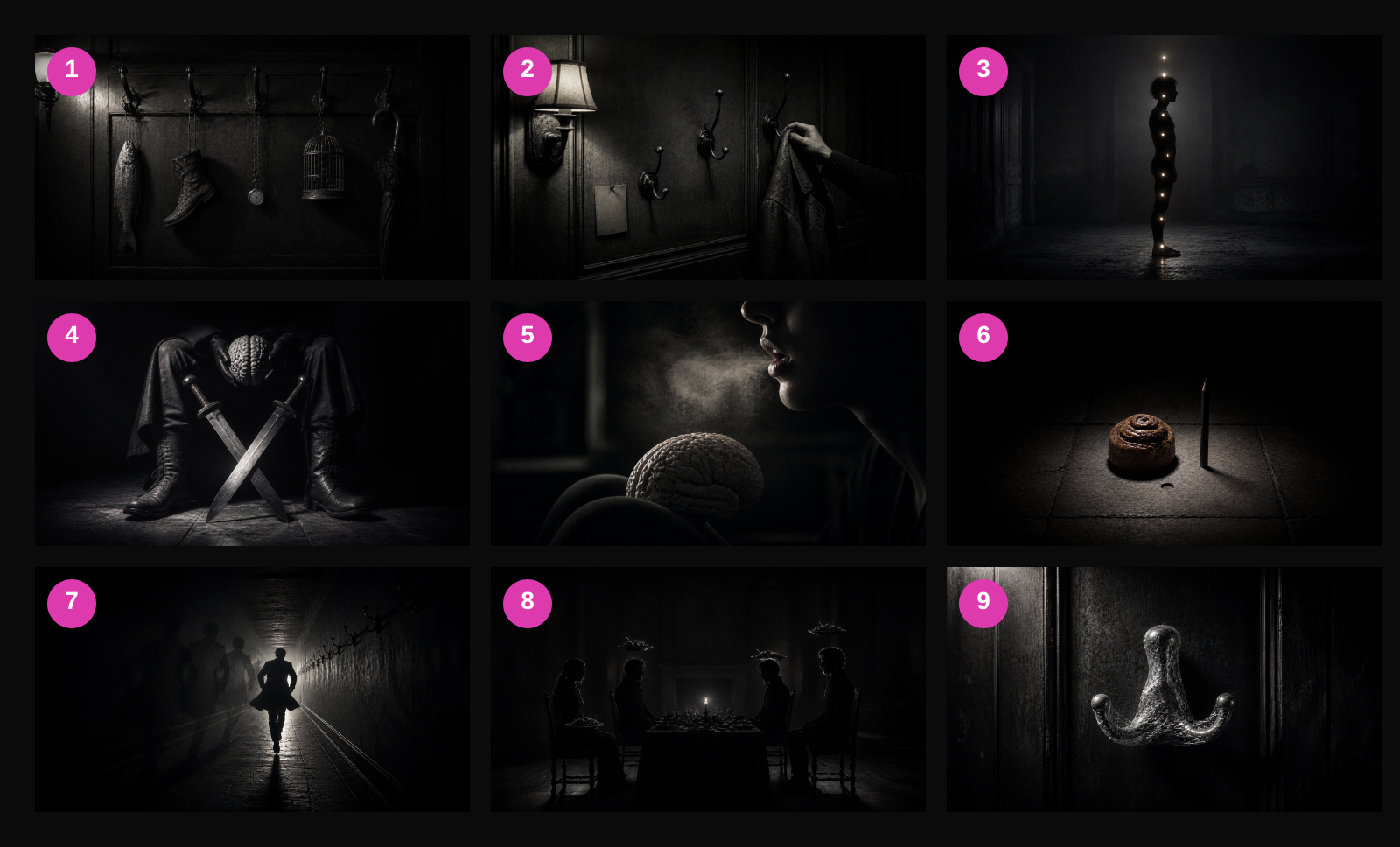
- A peg system is a fixed set of mental pegs you hang information on. Image: a row of brass coat hooks, each holding something strange.
- Peg lists and memory palaces follow the same three steps: fix the pegs, learn the sequence, attach the information. Image: three hooks, a numbered list, and a hand hanging a coat.
- The body system runs feet, knees, thighs, behind, waist, chest, neck, face, hair, ceiling. Image: a human outline with ten small glowing markers from feet to the air above the head.
- Worked example: the Best Picture winners hung on the body. Image: gladiator swords at the feet and a squidgy brain between the knees.
- See the image and say the real information aloud at the same time. Image: a mouth speaking while a brain floats between two knees.
- The rhyme list and number shape system are numbered pegs. Image: a bun and a pencil both standing on a tile marked by a single dot.
- Lock in any peg list by running it forwards, backwards, in chunks, then at speed. Image: a person pacing a short line of hooks, then sprinting it.
- Use pegs for the order of your day or a table's order of food and drink. Image: a dinner table where each guest's meal floats above a body part.
- Clean a peg list for reuse by wrapping each peg in clear cellophane and saying erase. Image: a coat hook wrapped in clear film, empty.
Sources
- Mark Channon, How to Remember Anything (Hodder Education)
Loci
Build the memory palace in this article inside Loci — store your locations, link images, and rehearse with spaced repetition.
Try it in LociMemory School community
Learn directly with Mark inside the Memory School community on Skool — monthly lessons, practice, and Q&A.
Join Memory SchoolAbout the author
Mark Channon
Grand Master of Memory (1995). Author of three books on memory published by Hodder and Nick Hern. Creator of BBC1's Monkhouse's Memory Masters. Memory coach on Channel 4's Can I Improve My Memory?
Read full bio →