
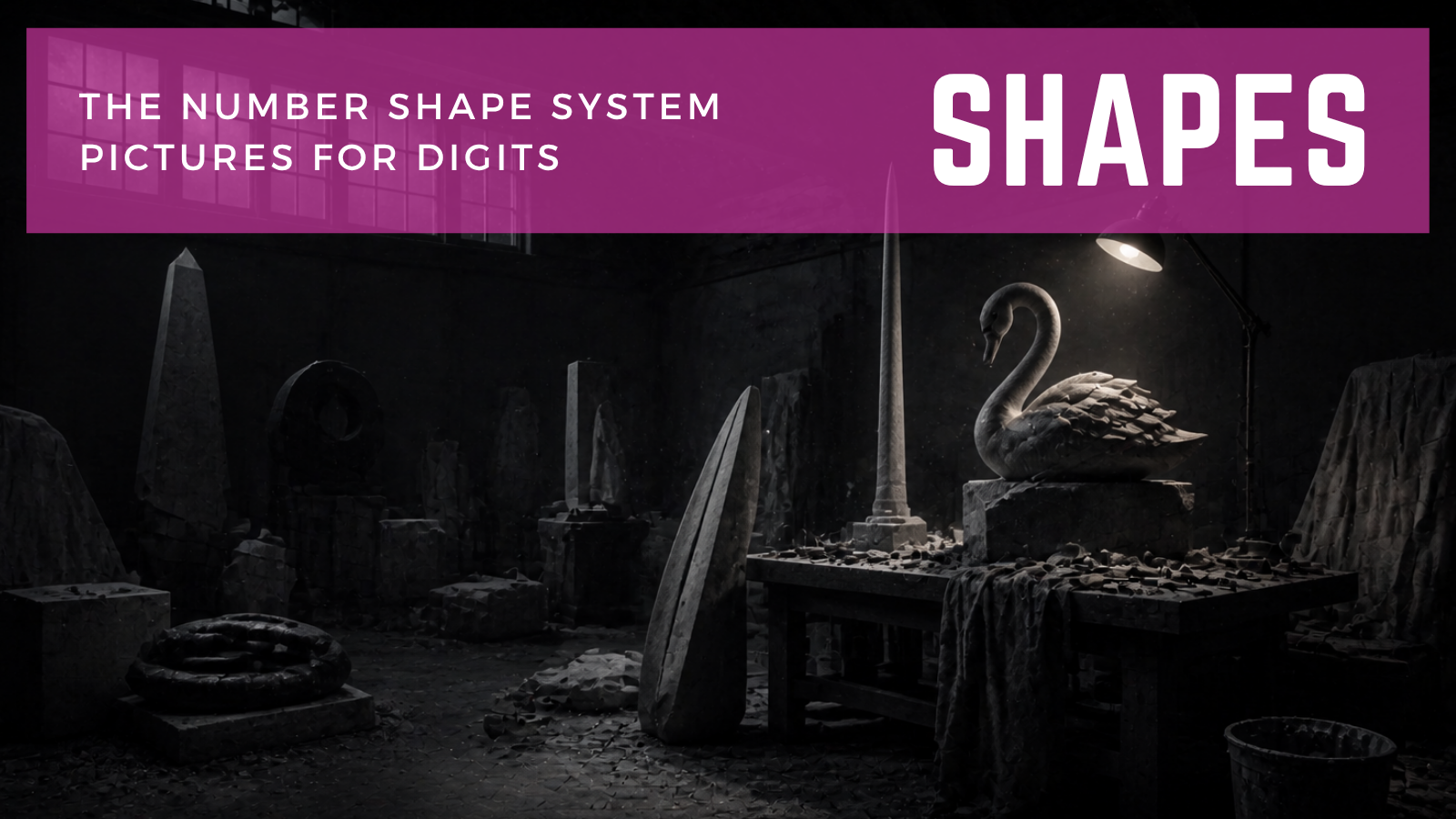
Memory Techniques
The Number Shape System
The number shape system turns each digit into a picture that looks like it. A simple way to start remembering numbers, great for short numbers and for teaching children.

Numbers are hard to remember because they are abstract. The digit 7 has no smell, no sound, no story, nothing for your brain to grab onto. The number shape system fixes that by turning each digit into a picture that looks like the digit itself. Once 7 is an axe and 2 is a swan, a string of digits becomes a string of pictures, and pictures are something your brain is good at.
It is one of the simplest memory techniques there is. You can learn the list in a few minutes. It is great for short numbers and for children, and it is a good first step before the major system, a code that turns every pair of digits into a word.
What the number shape system is
The number shape system is a peg list. A peg list is a fixed set of images you know by heart, and you "hang" the thing you want to remember off each one. Here, the pegs are pictures that look like the digits 0 to 9.
It belongs to the same family as the rhyme list (where the image rhymes with the number) and the body system (where the pegs are parts of your body). All three work the same way.
It also uses the same four ingredients as all creative memorisation: getting into the right state, using your imagination, making strong associations, and looking for meaning. The images are the raw material. Your imagination is what makes them stick. Creative Memorisation: The Four Ingredients That Make Anything Memorable goes into all four.
The number shape images
Each picture is chosen because it looks like the digit when you write it.
- 0 is a Polo mint
- 1 is a pencil
- 2 is a swan
- 3 is a snake
- 4 is a sail
- 5 is a hook
- 6 is a bag
- 7 is an axe
- 8 is a snowman
- 9 is a balloon on a string
- 10 is Laurel and Hardy: a thin 1 and a round 0, like the comedy double act
Read the list a couple of times, then test yourself out of order. What is 6? What is 3? What is 9? When each image comes to you straight away, you are ready to use it.
Pick one image per digit and stick with it. If a different picture works better for you, use it, but once 2 is a swan, keep it a swan.
How to use it on a real number
To memorise a number, swap each digit for its picture and link the pictures into a short story. The story does not need to make sense. It just needs to be vivid.
Let us memorise the number 3 8 2 7 1.
- 3 is a snake
- 8 is a snowman
- 2 is a swan
- 7 is an axe
- 1 is a pencil
Picture this. A snake coils itself around a snowman and squeezes until its carrot nose pops off. The nose lands on a swan, which flaps away in a panic, straight into an axe stuck in a tree stump. Balanced on the axe handle is a pencil, scribbling in the air.
Visualise it two or three times, saying the digits aloud as you see each picture. Then look away. The number is 3 8 2 7 1.
Give your images movement, as if you are watching a film rather than looking at a photograph. And make each one do something to the next: wrap it, knock it, balance it. Pictures that interact hold together. Pictures sitting side by side fall apart.
If an image will not stick, use the dial-it-up technique. Imagine a dial in front of you that runs from one to ten. Notice where the image sits, say a four, then turn it up to a seven and let it brighten.
A longer example
A six-digit code: 9 4 0 6 2 1.
- 9 is a balloon
- 4 is a sail
- 0 is a Polo mint
- 6 is a bag
- 2 is a swan
- 1 is a pencil
A bright red balloon is tied to the top of a sail, dragging a small boat across the water. Caught on the sail is a giant Polo mint, spinning like a wheel. The Polo rolls off and drops into a shopping bag. Out of the bag pokes a swan, and clamped in its beak is a pencil, scribbling on the side of the bag.
Visualise it, say the digits, look away: 9 4 0 6 2 1.
The rhyme list, and using both together
The number shape system has a close cousin, the rhyme list, where the picture rhymes with the number.
- 0 is a hero
- 1 is a bun
- 2 is a shoe
- 3 is a tree
- 4 is a door
- 5 is a hive
- 6 is sticks
- 7 is heaven
- 8 is a plate
- 9 is wine
- 10 is a hen
The two work well together on two-digit numbers. The first digit gets its shape, the second gets its rhyme, and the two pictures interact. 11 is a pencil eating a bun. 15 is a pencil stuck in a beehive. 24 is a swan crashing into a door. It is a fun way to help children with their multiplication, and How to Memorise Numbers tells how I used it with my son.
The same trick works for a PIN. 7246 becomes an axe kicking a shoe (72), then a sail made of sticks (46). Two pictures instead of four, and they do not blur together.
Where the number shape system fits
The number shape system is good for short numbers and as a first taste of turning numbers into pictures. Because you only have one image per digit, long numbers become long chains of small pictures, and it starts to creak.
If you want to be great at numbers, the system you really want to learn is the major system. It gives you one picture for every two-digit number from 00 to 99, so a long number becomes a short run of rich images. There's a catch: it takes a few hours to design your pictures from 00 to 99, and a few weeks to recall them at speed. The Major System Explained has the full code.
Real uses
Think about where small numbers show up in your day, and start there. Perhaps:
The order of your day. Give each meeting or task a number shape picture: your first task sits on a pencil, your second on a swan, and so on.
Short codes and PINs. Two pictures, using shape for the first digit and rhyme for the second.
Locker numbers, door numbers, gate numbers. The small numbers you only need for a few hours.
Teaching children. Multiplication especially.
A daily warm-up. Turn the numbers you see around you, prices, registration plates, page numbers, into quick pictures.
Practise it today
Learn the ten images and test yourself out of order. Then find a real number you want to remember, a PIN, a door code, a date, and build a story for it.
Do one new number a day for a week. After that, the digit-to-picture step starts to run on its own. When you want to go further, move on to the major system. For guided practice, MindForge (mindforge.memoryschool.com) runs short daily number drills.
Memory map
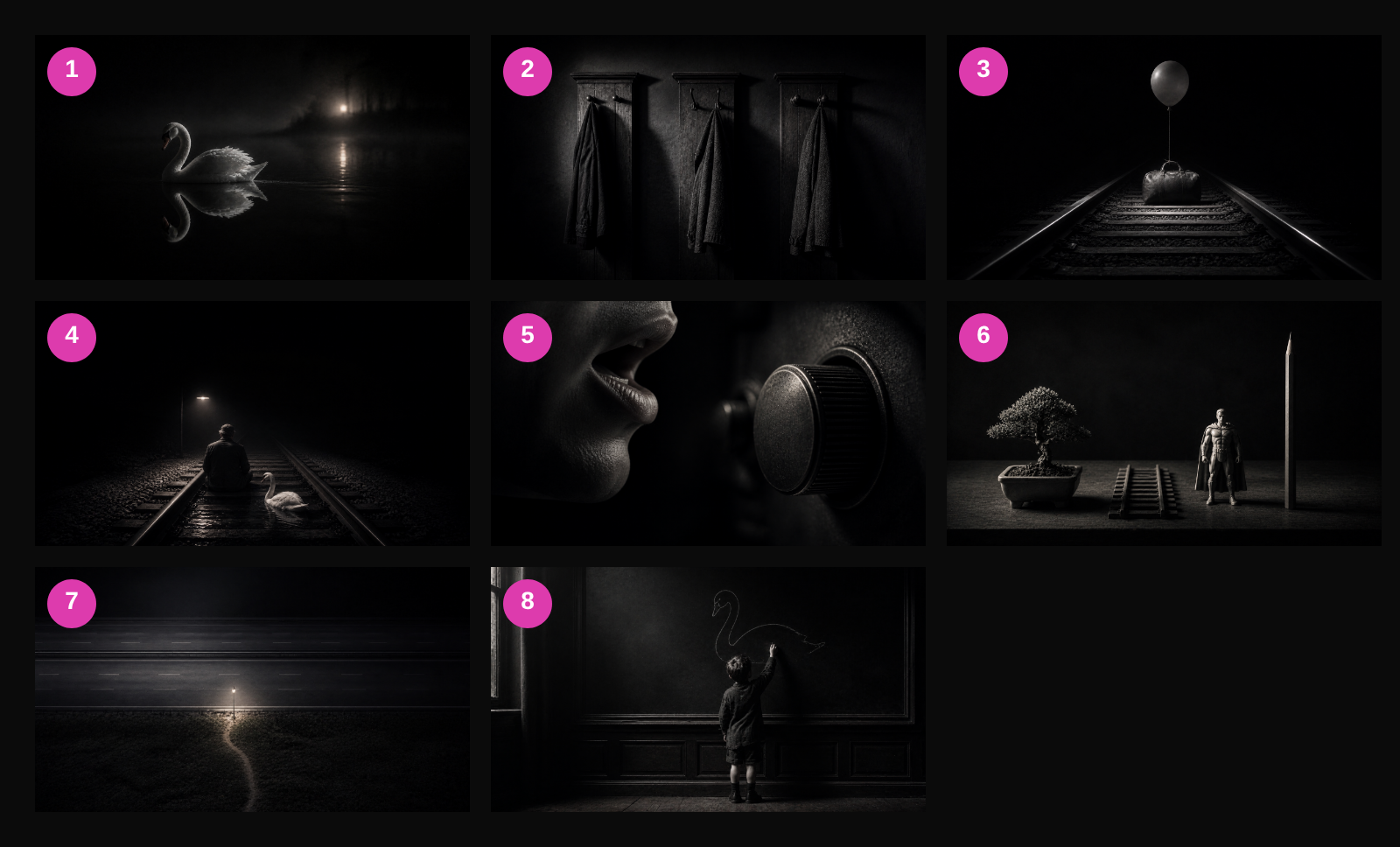
- The number shape system turns each digit into a picture that looks like it. Image: a swan gliding on dark water, its neck curved like the digit two.
- It is a peg list, like the body system and the rhyme list. Image: three coat racks side by side, a different kind of hook on each.
- The images: Polo, pencil, swan, snake, sail, hook, bag, axe, snowman, balloon, Laurel and Hardy. Image: a snowman holding an axe, a snake coiled at its feet.
- A number becomes its pictures, tied together in a moving story. Image: a snake squeezing a snowman until its carrot nose pops off.
- Make the pictures move and act on each other; dial up any image that will not stick. Image: a volume dial turned high beside a swan flapping into an axe.
- Use shape for the first digit and rhyme for the second: 11 a pencil eating a bun, 24 a swan crashing into a door. Image: a swan crashing beak-first into a red front door.
- Good for short numbers; the major system is the one to learn for long ones. Image: a short footpath meeting a wide motorway.
- Use it for the order of your day, PINs, locker numbers, teaching children and daily warm-ups. Image: a child giggling at a pencil munching a bun.
Sources
- Mark Channon, How to Remember Anything (Hodder Education)
Loci
Build the memory palace in this article inside Loci — store your locations, link images, and rehearse with spaced repetition.
Try it in LociMemory School community
Learn directly with Mark inside the Memory School community on Skool — monthly lessons, practice, and Q&A.
Join Memory SchoolAbout the author
Mark Channon
Grand Master of Memory (1995). Author of three books on memory published by Hodder and Nick Hern. Creator of BBC1's Monkhouse's Memory Masters. Memory coach on Channel 4's Can I Improve My Memory?
Read full bio →