
Memory Training
Memory Games for Adults That Actually Train Your Memory
Memory games for adults often train you to be good at the game. These ones train your memory, because they are built on the disciplines memory champions compete in. Twelve games, no app required.

Memory games for adults often have a problem: they train you to be good at the game. Play a matching-pairs app for a month and you will get better at matching pairs. Whether that does anything for the memory you use at work, in a meeting, or when you meet twelve people at once is a different question, and the honest answer from the research is: not much. Skills transfer when the game and the real task share a method. Flipping cards shares nothing with remembering a name.
These games are different, because they are not puzzles invented for an app. They are the disciplines memory athletes compete in at the World Memory Championships, adapted for training. Every one of them uses the same techniques you would use in real life, so getting better at the game is getting better at memory. Most need nothing more than a pen, a pack of cards or a few friends.
They are grouped like a memory workout: warm-ups to get you in the zone, speed games to train fast encoding, and stamina games to build endurance. Pick one from each for a twenty-minute session.
A word on the techniques underneath
Every game here assumes you are using memory techniques, not brute repetition. Turn things into images. Link images in stories. Place them on a peg list (a numbered set of images you learn once and reuse) or in a memory palace (any set of fixed places you hang images on, such as a route through somewhere you know). Say the real information aloud. If you are new to this, read Memory Techniques: The Complete Guide first, then come back. Playing these games without the techniques is like going to the gym and standing next to the weights.
Warm-up games (two to five minutes)
1. Energise. Not strictly a game, but it comes first. Stand up, move, take a few deep breaths, drop your shoulders. Memorising works best in a relaxed, focused state, and you cannot get there sitting hunched over a phone. One minute.
2. Story cubes. Roll a handful of picture dice and link the images into a single story as fast as you can. Then recite the images in order. This warms up the image-making and association muscles that every other game uses. If you do not have story cubes, open a book at random and link the first five nouns you see.
3. Sound cards. My favourite warm-up for anyone learning the major system. Take a pack of cards and remove the picture cards, leaving ace to ten in each suit, with ten standing for zero. Shuffle. Start a stopwatch. Turn the cards over one at a time and say aloud the consonant sound each number makes in the major system: one is t, two is n, three is m, and so on. Aim to get through the pack in one minute. It drills the code until it is reflex, which is what makes the number games below possible.
4. Recognition drill. Glance at a tray or table of objects for ten seconds. Look away. Name them. Add an object and go again. It trains the habit of deliberate attention, which is the step that slips first in real life.
Speed games (five minutes each)
These are timed. The clock is the point: it trains you to encode quickly and under a little pressure, which is exactly the condition you face when someone introduces six people in a row.
5. Five-minute words. Write or generate a list of random words. Memorise as many as you can in five minutes, in order, using a chain or a palace. Then write them out. Score one point per word in the correct position. Beginners manage twenty to thirty. With practice, sixty-plus.
6. Five-minute numbers. A grid of random digits. Memorise as many as you can in five minutes using your number system, in rows, and write them back. This is the discipline that turns the major system from theory into a tool. Start with one row of twenty digits and build.
7. Five-minute cards. Shuffle a pack. Memorise as much of it as you can in five minutes using your card images (one fixed picture for each of the 52 cards) on a palace. Deal a second pack to check. Half a pack is a fair start; a full pack in five minutes is a serious milestone.
8. Five-minute names. The most directly useful game on the list. Take photographs of faces with names underneath, from a magazine, a team page, or a names-and-faces set, and memorise as many as you can in five minutes. Cover the names, look at the faces, recall. This is the exact skill you need at a conference, and it responds to practice faster than any other.
Stamina games (fifteen to thirty minutes)
Longer sessions train sustained focus, the ability to hold a technique steady for a long time without the images getting sloppy. Do one of these two or three times a week.
9. Whose round? A sociable one you can play any time you are out. Ten people around a table order food and drink. Memorise who ordered what, both items, without writing anything down. When the food arrives, match it up. At home, write ten names with a meal and a drink each and give yourself fifteen minutes. Diane had the pepperoni pizza and a diet Coke; Marcia the spaghetti bolognese and red wine; Robert the mussels and white wine. The game trains you to attach several pieces of information to one person, which is exactly what remembering client details or stakeholder preferences requires.
10. Twenty foreign words. Pick a language and twenty words you do not know. Memorise the words and their meanings using reference stories: a quick scene joining a sound image for the foreign word (something it sounds like) to a natural image for the meaning (a picture of the thing itself). Test an hour later and the next day. This is vocabulary learning as a sport, and it is the fastest way to build the image-making skill that underpins everything else.
11. The TED talk. Watch a fifteen-minute talk. Memorise its structure and key points on a memory palace as you watch. Then deliver the talk back, out loud, from the palace. This trains you to capture and hold a long argument in real time, the skill behind remembering everything in a meeting or a lecture.
12. Thirty-minute numbers or cards. The endurance versions of games six and seven. A memory athlete's stamina event. Thirty minutes of digits or several packs of cards, placed on long palaces, recalled in full. You will not start here, but it is where the training leads, and it is a remarkable feeling the first time you recall three hundred digits in order.
How to turn the games into a workout
Playing one game occasionally does little. Playing a short, varied set regularly does a great deal.
Before you start, build a stock of memory palaces, around a hundred locations to begin with. If you are training daily, aim for three hundred, so you can rotate palaces and give old images time to fade between uses. Write each game on a card, colour-coded as warm-up, speed or stamina, and deal yourself a different set each session.
Fifteen minutes a day, three to five times a week, for the first three weeks. Then up to thirty minutes, with a stamina game two or three times a week. Record your scores. Nothing keeps you playing like watching your five-minute words go from twenty-two to forty-one.
Give it six weeks. In one study, six weeks of memory palace training, around 40 sessions of half an hour, was enough to shift beginners' brain networks towards the patterns seen in memory champions (Dresler and colleagues, 2017). The games are how you put in those sessions.
What about brain training apps?
The question comes up every time, so briefly: most of them train you to be good at the app, for the reason given at the start. The exceptions are the ones built on real memory techniques, where the drill and the skill are the same thing. MindForge is built to be exactly that, a memory gym that runs the games above with the six-week structure built in and your scores tracked. Judge an app by whether it teaches you a method you could use with a pack of cards and no app at all.
Start today
Pick one warm-up and one speed game. Fifteen minutes. Sound cards and five-minute words is a good first pair. Write your score down. Tomorrow, beat it.
Memory games for adults do not need to be a puzzle app on the sofa. The ones that work are the ones champions use, and the only equipment you need is a pack of cards, a pen, and ten minutes of focus you were going to spend on your phone anyway.
Memory map
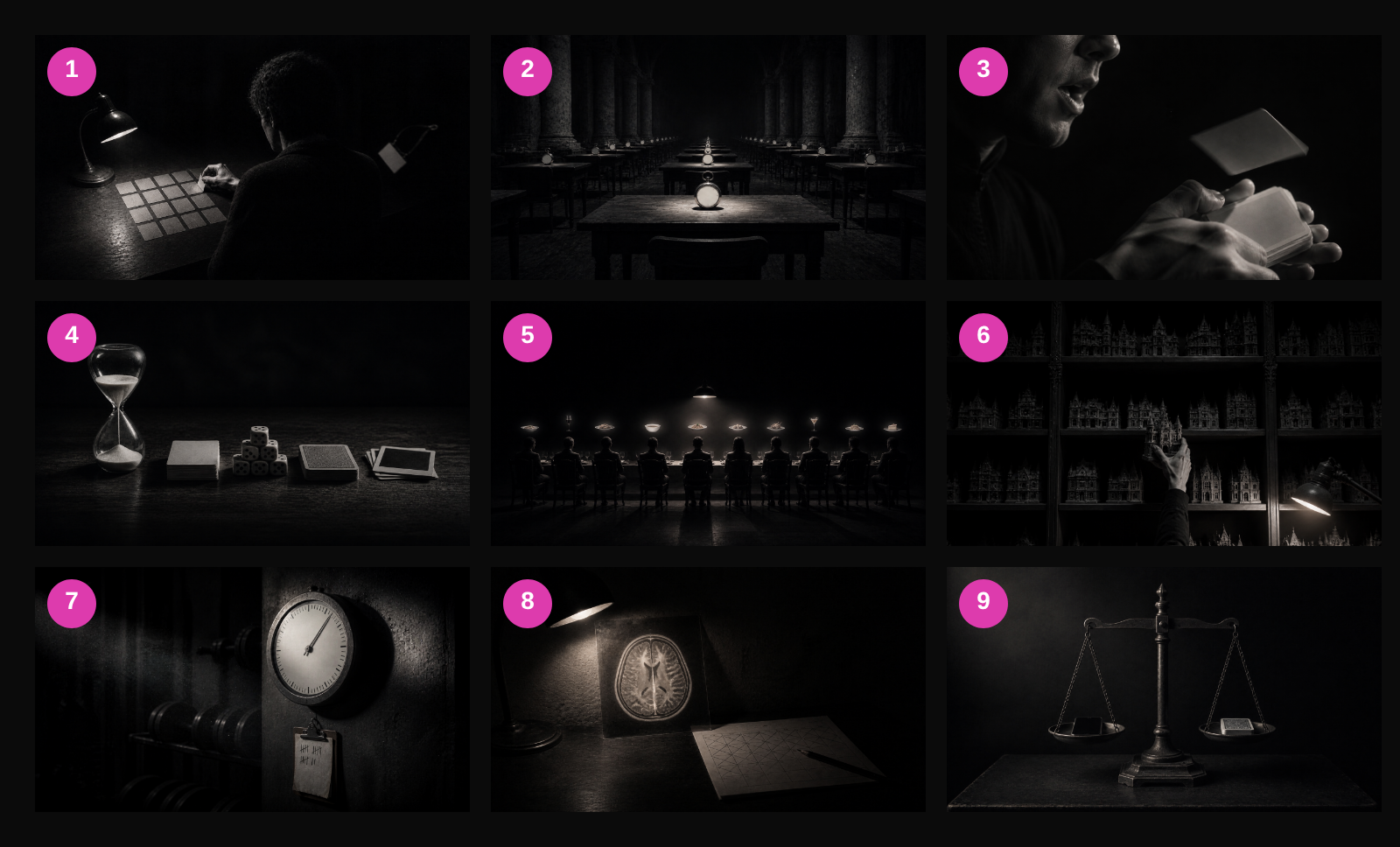
- Memory games often train you to be good at the game, not at memory. Image: a person flipping matching cards while a name tag floats away unnoticed.
- These games are the World Memory Championship disciplines, adapted for training. Image: a championship hall with a stopwatch on every desk.
- Warm-ups: energise, story cubes, sound cards, recognition drill. Image: a pack of cards being flipped while a mouth says "t, n, m".
- Speed games: five-minute words, numbers, cards, names. Image: a five-minute hourglass next to four small piles.
- Stamina games: Whose Round?, twenty foreign words, the TED talk, thirty-minute numbers. Image: a long dinner table with ten people and their orders floating above their heads.
- Build 100 to 300 memory palace locations before you start, and rotate them. Image: a library of small palaces on a shelf, one being taken down.
- Fifteen minutes a day, three to five times a week, then thirty. Image: a gym timer and a scorecard.
- About 40 half-hour sessions over six weeks shifted beginners' brain networks towards memory champions' (Dresler, 2017). Image: a brain scan with a 42-day calendar beside it.
- Judge an app by whether its method works with a pack of cards and no app. Image: a phone and a pack of cards on a scale, balanced.
Sources
- Mark Channon, The Memory Workbook (Hodder Education)
- Dresler, M., Shirer, W. R., Konrad, B. N., Müller, N. C. J., Wagner, I. C., Fernández, G., Czisch, M., and Greicius, M. D. (2017). Mnemonic training reshapes brain networks to support superior memory. Neuron, 93(5), 1227 to 1235. https://doi.org/10.1016/j.neuron.2017.02.003 (the home for this study is The Memory Athlete Brain Study (Dresler 2017) Explained)
Loci
Build the memory palace in this article inside Loci — store your locations, link images, and rehearse with spaced repetition.
Try it in LociMemory School community
Learn directly with Mark inside the Memory School community on Skool — monthly lessons, practice, and Q&A.
Join Memory SchoolAbout the author
Mark Channon
Grand Master of Memory (1995). Author of three books on memory published by Hodder and Nick Hern. Creator of BBC1's Monkhouse's Memory Masters. Memory coach on Channel 4's Can I Improve My Memory?
Read full bio →