
Study and Learning
How to Remember Definitions and Facts (The Reference Story Method)
Definitions, vocabulary and paired facts are the hardest things to remember by repetition. A reference story fixes that: a small set of images that points at the real information. Here is the method.

Some information comes in pairs. A foreign word and its meaning. A term and its definition. A capital and its country. An inventor and their invention. These pairs are some of the hardest things to remember by repetition, because there is no natural story connecting the two halves. A reference story fixes that.
A reference story is a small set of images that refers to the real information. The phrase is exact: the story does not contain the information, it refers to it, like a signpost pointing at a destination. You build the story, the story triggers the memory, and the memory hands back the real fact. With repetition the story fades into the background and you simply know the answer.
This is one of the most useful techniques in all of creative memorisation, the approach of turning what you learn into vivid, meaningful images (Creative Memorisation: The Four Ingredients That Make Anything Memorable explains it), and it is the workhorse behind vocabulary learning, exam terminology, and general knowledge.
What a reference story is
When you want to remember a piece of information, you usually need to turn it into an image. Sometimes the image is obvious. The word "apple" already is an image. But often there is no instant association, or the word is abstract and refuses to become a picture. That is where reference stories come in.
A reference story is built from one or more images that point at the real information. Take remembering that the Russian for "cow" is "karova." You build a story: a cow with a car embedded in its head. The cow is the natural image for the meaning. "Car-over" is a sound-image that points at "karova." Put them together and you have a reference story: a cow with a car over its head. See the cow, hear "car-over," and you arrive at "karova means cow."
The story is not the fact. It is the route to the fact. And once you have walked that route a few times, you stop needing it, in the same way you stop needing directions to a place you have driven to ten times.
The two kinds of image
Reference stories are built from two kinds of association. Learning to switch between them fluently is the single most important skill in creative memorisation.
Natural-image associations are images sparked off directly by a memory, a sense, or an emotion. They come to you naturally when you think about the word. For the word "awesome," the first image that comes to mind might be an awesome tidal wave, so you use the tidal wave. For "fearless," a fearless lion, or someone you know who was fearless. These are deeply personal. Your natural images will be different from anyone else's, and they will always work better for you than borrowed ones.
Sound-image associations are images that sound similar to the information you are memorising. You use these when there is no natural image, which happens often with foreign words and abstract terms. "Madagascar" has no obvious picture, but it breaks into "mad-gas-car," which you can absolutely see. "Capitulate" starts with "cap," so your image is a cap. Because capitulate means to surrender, you imagine a cap kneeling with its hands clasped, giving up. Now you remember the word and its meaning in one image.
Most reference stories use a mix. The natural image carries the meaning, the sound image carries the word, and together they point at the full fact.
Always say it aloud
There is one rule that matters more than any other when building a reference story, and it is the easiest one to forget: when you look at your mental image, say the real word out loud.
The more obscure the word, the more important this is. When you see the cow with the car over its head and say "karova" aloud, you create connections between the image, the sound of the word in your own voice, and the meaning, all at once. This is active testing, and it is what locks the story in. Building a reference story silently is far weaker than building it out loud. If you cannot speak, whisper. If you cannot whisper, mouth the word. But say it.
Encoding and decoding
It helps to think of reference stories as a two-way process.
Encoding is turning the information into a reference story. The steps:
- Identify the information you want to remember.
- Reflect on possible natural images and sound images.
- Build your reference story, using either a narrative or visual embedding (more on both below).
- Actively test the story by reciting it aloud, writing it down, or using it. As you do, you must mentally see the images while you say the real information.
Decoding is turning the story back into the information. The steps:
- A question or a need to recall triggers the memory of the story.
- You decode the story into its parts and read off the meaning.
- With repetition, you bypass the story entirely and just know the information.
The fact that decoding eventually skips the story is the whole point. Reference stories are training wheels. They hold you up while the real knowledge embeds, then quietly come off.
Narratives vs visual embedding
There are two ways to assemble the images in a reference story.
Narratives form a micro-story that connects the images in a sequence. They do not have to follow any consistent pattern and can be different every time. A cow looking up at the sky sees a car jumping over the moon. Narratives are flexible and playful, and they suit information where the connection between elements is loose.
Visual embedding follows the same fixed pattern every time, usually top to bottom or left to right. You take a main image and embed up to three smaller images on it in fixed positions: head, middle, feet. Then you zoom back and see the whole thing as one picture. Visual embedding is consistent and fast. It is ideal for small, fixed chunks of information where you want a reliable, repeatable structure.
A worked visual embedding: to remember that karova means cow, take the cow as your main image, embed the car on its head, zoom back, see the whole picture, and say "cow, karova" five to twenty times at speed.
A worked set: inventors and their inventions
Reference stories shine on the kind of paired general knowledge that exams and quizzes love. Here is a short set of inventors and their inventions, each turned into a reference story.
- Electric battery, Alessandro Volta. Alice in Wonderland sitting in the sand with a high-voltage battery. "Alice-in-the-sand-ro" points at Alessandro, the voltage points at Volta.
- Photography, Fox Talbot and Daguerre. A fox down the Talbot pub waving a dagger, being photographed. The fox and the pub point at Fox Talbot, the dagger at Daguerre.
- Miners' lamp, Humphry Davy. Humpty Dumpty wearing a miner's lamp. Humpty points at Humphry, and you add a "Davy" lamp.
- Electromagnet, William Sturgeon. William fishing for sturgeon with an electromagnet.
For each one, see the story, say the real information aloud, "Alessandro Volta, electric battery", and think about what it means. Build the story, test it out loud, and the pairing locks in. Notice how a sound image (Alice-in-the-sand-ro) carries the unfamiliar name while a natural image (the battery) carries the invention. That combination is the engine of every reference story.
The power of questions
There is a quiet skill underneath all of this that is worth naming: asking the right questions. Questions are the guiding force for your associations. Your brain works like a search engine, ask it a question and it returns an answer, so the quality of your associations depends on the quality of the questions you ask while building them.
Useful questions to keep in your back pocket while encoding:
- What does this remind me of?
- What is the best way to connect this?
- How can I make this funnier, scarier, or stranger?
- How can I intensify this?
- If I were that object, what would I do?
- Where is the best place for this?
Ask with a feeling of expectation. If you expect an answer, one will come. It may not always be the answer you wanted, but you will get a response, and with practice the responses get faster and better. Learning to ask these questions almost automatically is one of the things that separates someone who finds memory techniques a struggle from someone for whom they feel easy.
The temptation when you first learn reference stories is to build one for everything. Resist it. Use the MIN rule: Minimum Images Necessary.
If you already know something, there is no need to encode it. If one image can trigger everything you need, that is enough. Your goal is always the minimum number of images necessary to spark off the key information. Over-encoding leads to frustration and a head full of stories you do not need. A good question to ask before building any story is simply: do I actually need this, or do I already know it?
Dialling up a weak story
If a reference story will not stick, dial it up. Imagine a dial in front of you running from one to ten. Notice how vivid the story is, perhaps it is sitting at a four. Turn the dial up to seven, wait a moment, and watch the images get bigger, brighter, louder, more real. This simple technique makes a weak story memorable in seconds, by accessing the unconscious rather than forcing the image consciously.
Where reference stories earn their keep
Reference stories are the right tool for any information that comes in pairs or needs a definition attached.
Foreign-language vocabulary. The classic use. A word and its meaning, joined by a sound image and a natural image. They get a word in faster than a flashcard does.
Exam and professional terminology. Medical, legal, scientific, and business terms with their definitions all suit reference stories. Build the story once, test it aloud, review it on a schedule.
General knowledge. Capitals and countries, inventors and inventions, dates and events. The inventors set above is the pattern: a sound image for the unfamiliar name, a natural image for the thing, fused into one scene.
Word roots, prefixes, and suffixes. Encode a root once and it pays off across dozens of words. This is the fastest way to expand a working vocabulary.
To store a long list of reference stories in order, attach each one to a location you already have, on a peg list (a fixed set of images for the numbers one, two, three and onwards) or in a memory palace (a familiar route whose stops each hold one image). The reference story carries the fact, the pegs or the palace carry the sequence.
Practise it today
Take ten random words you do not know, foreign vocabulary works well, and build a reference story for each. Use a natural image where one springs up, a sound image where it does not. Say the real word aloud as you see each story. Test yourself an hour later, the next day, and a week later.
You may be surprised how many stick after a single building, and how quickly the stories themselves fall away to leave just the knowledge. That is reference stories doing their job: a temporary bridge between something abstract and something your brain can hold, built in seconds and gone once it is no longer needed.
Memory map
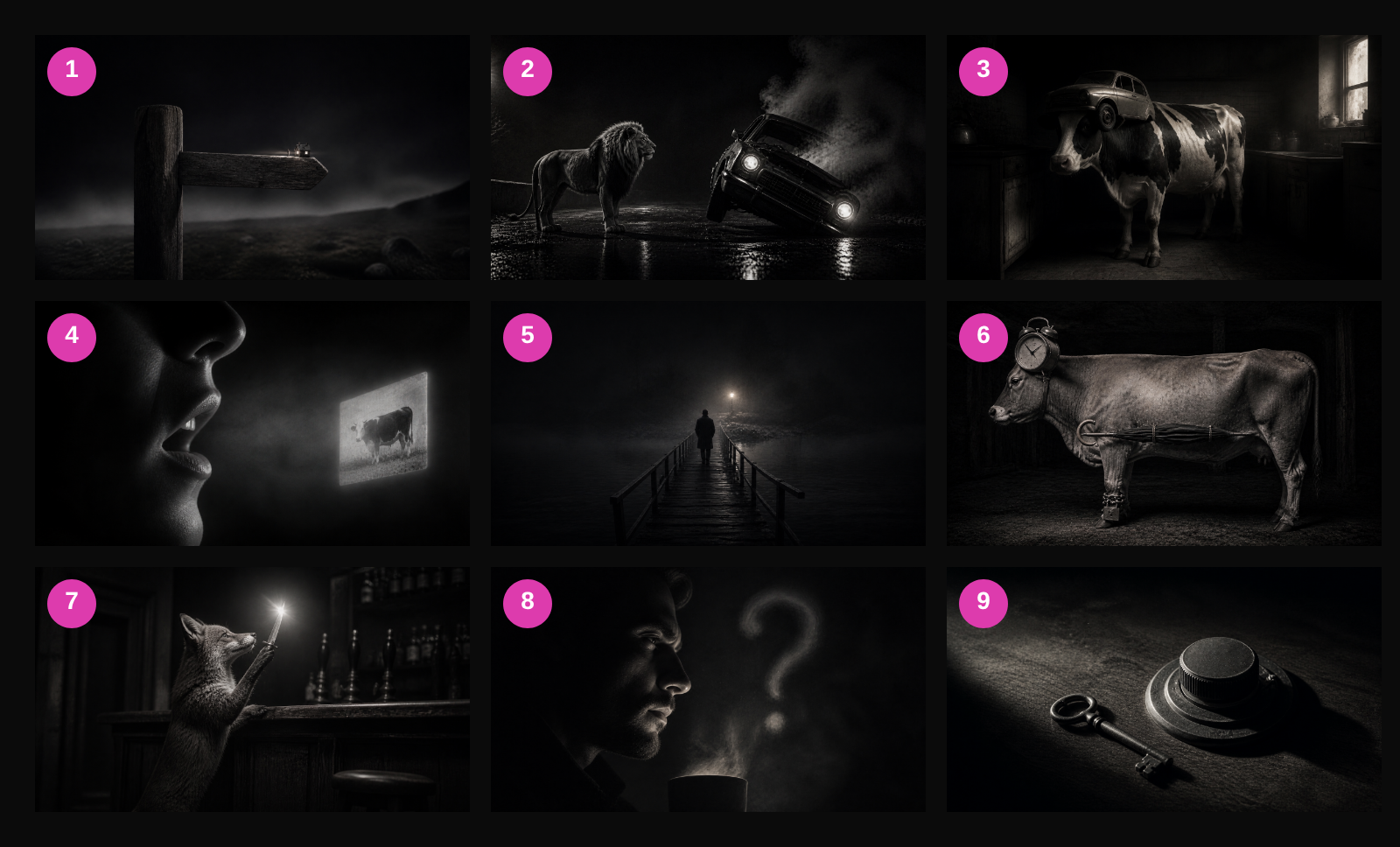
- A reference story is a small set of images that points at the real information. Image: a signpost whose arm is a tiny vivid scene.
- Natural images come from meaning; sound images come from how the word sounds. Image: a lion beside a mad gas car.
- Karova: a cow with a car over its head means the Russian for cow. Image: a cow in a kitchen with a small car wedged on its head.
- Always say the real word aloud as you see the image. Image: a mouth mid-word beside a floating picture.
- Encoding turns information into a story; decoding turns the story back, until you no longer need it. Image: a bridge being walked across, then fading as the walker reaches the far side.
- Narratives are flexible mini stories; visual embedding fixes images top, middle and bottom on one main image. Image: a cow with three small objects fixed to its head, belly and hooves.
- Worked set: Alice in the sand with a battery, a fox in a pub with a dagger. Image: a fox at a pub bar waving a dagger as a flash goes off.
- Ask questions as you build: what does this remind me of, how can I make it stranger? Image: a face lit from underneath, a question mark forming in steam.
- Use the MIN rule and dial up any story that will not stick. Image: a single key beside a volume dial turned high.
Sources
- Mark Channon, The Memory Workbook (Hodder Education)
- Mark Channon, How to Remember Anything (Hodder Education)
Loci
Build the memory palace in this article inside Loci — store your locations, link images, and rehearse with spaced repetition.
Try it in LociMemory School community
Learn directly with Mark inside the Memory School community on Skool — monthly lessons, practice, and Q&A.
Join Memory SchoolAbout the author
Mark Channon
Grand Master of Memory (1995). Author of three books on memory published by Hodder and Nick Hern. Creator of BBC1's Monkhouse's Memory Masters. Memory coach on Channel 4's Can I Improve My Memory?
Read full bio →