
Memory Techniques
Creative Memorisation: The Four Ingredients That Make Anything Memorable
Every memory technique is built from the same four ingredients: flow, imagination, association and meaning. What each one does, the research behind meaning, and how to put all four to work on anything you need to learn.

Memory is an act of creation. When you remember something, you are not playing back a recording. You are building it again. And when you set out to memorise something on purpose, the most reliable way to do it is to create: to make the information into something your brain wants to keep.
That is creative memorisation. The idea is not new; people have written about the art of memory in different ways for two and a half thousand years. This is one way of putting it together, as four ingredients:
- Flow: the right state to memorise and to recall.
- Imagination: bringing information to life with your senses.
- Association: connecting it to what you already know.
- Meaning: making it matter, which is what makes it stick.
Then spaced retrieval practice, pulling it back out of your head at gaps that grow over time, moves it into long-term memory.
Imagination and association get information in fast and let you hold far more of it. Meaning makes it last. Flow is what lets the other three work at all. Every memory technique, from a single mnemonic (any device that makes something easier to recall, like a rhyme) to a memory palace of hundreds of images (pictures you place at points along a route you know, then walk in your mind), is these four ingredients in a different arrangement.
Ingredient 1: Flow
Before you imagine or connect anything, get into the right state. The best state to memorise in is calm, absorbed and curious, and the same goes for recall.
Stress works directly against you. The prefrontal cortex, which you need for focus and for holding information while you work with it, is sensitive to pressure: even mild stress can impair it quickly (Arnsten, 2009). If you have ever had a word, a name or a line vanish the moment the pressure came on, that is what happened. The memory was there. The state was wrong.
Flow is the opposite of that state. It is the absorption you feel when a task has your full attention and stretches you without overwhelming you; Mihaly Csikszentmihalyi found people are most engaged when challenge and skill are matched like this (Csikszentmihalyi, 1990). For memorising, you want relaxed and focused at the same time: no tension in the body, full attention on the thing in front of you.
Get there on purpose. A few slow breaths before you start. Clear the desk and the phone. Lower the stakes in your head: you are making pictures, not sitting an exam. Get curious about the material, because curiosity is the quickest route into absorption. How to Focus Better: A Memory Coach's Method has more ways in.
Ingredient 2: Imagination
Imagination is your ability to bring your senses together to bring something to life, so it becomes real and tangible in your mind. Not just a cow, but a cow the size of a bus, steaming in the cold, chewing loudly, looking at you.
Imagination is what turns information into an experience, and you remember experiences far better than information.
If you feel you cannot visualise, that is fine. You do not need to see anything in 3D. There is a different way in for everyone. Some people hear the scene, some feel it, some talk it through out loud, and each of those creates the connection somewhere in the mind. Use whichever sense comes easiest and add the others as you go.
Exercise: pick up any object on your desk. Study it for thirty seconds. Then close your eyes and rebuild it with every sense: its weight, temperature, smell, the sound it makes when you tap it. Now give it arms, legs and a face, and ask it what it wants. That small piece of nonsense is the skill every memory technique depends on.
Ingredient 3: Association
Your brain is an association machine. Everything you know is connected to other things you know, and you find a memory by following a connection to it. Association is your ability to make those connections on purpose.
The quickest way to do that is to ask questions:
- What does this remind me of?
- What does it sound like?
- How can I make this funnier, scarier or stranger?
- What happens next?
- If you were that object, what would you do?
- Where would this fit best?
Here is how it works on a pair of words you want to link: krypton and plug. Krypton suggests kryptonite. Kryptonite suggests Superman. So: Superman, wearing a plug made of kryptonite, trying to throw it off before he collapses. Two unrelated words, one scene, and now each one brings back the other.
Association is a curious habit as much as a creative one. The more you ask "what does this connect to?", the faster the connections come.
Ingredient 4: Meaning
Meaning is the ingredient that makes memories stick. When you think about what something means, rather than what it looks or sounds like, you remember it better. And when you build an image for it and link it to what you already hold, you give it meaning, even if it had very little to begin with.
The research: Craik and Tulving, 1975
- In short: People answered a quick question about each word on a list: how it looked, how it sounded, or what it meant. They were not told there would be a memory test. Words they had thought about for meaning were remembered far better.
- What they did: Each word came with a yes or no question about its typescript (is it in capital letters?), its sound (does it rhyme with this word?) or its meaning (does it fit this sentence?). Then came a surprise test, usually picking the original words out of a longer list. Later experiments checked whether the gain came from the time spent on a word or from the kind of thinking done.
- Who was involved: Fergus Craik and Endel Tulving at the University of Toronto, across ten experiments; 20 students took part in the first and 24 in the second.
- What they found: In the second experiment, words answered "yes" were recognised 15% of the time after a question about the typescript and 81% after a sentence question. Time was not the reason: a slow, difficult question about the letters still led to worse memory than a quick sentence question. Words that fitted the question did better than words that did not.
- What they concluded: How well something is remembered depends on the kind of processing it gets, not how long you spend on it. A richer, more connected encoding (the way the word is taken in and stored), where the word forms one meaningful unit with what it is linked to, works best.
It is a set of lab experiments on single, common words, mostly tested by recognition over a short delay, so it describes word memory rather than every kind of learning. The effect has been replicated widely since. It did not test mnemonics or memory palaces.
What I take from it
Meaning makes memories stick. The study shows it in its simplest form: a moment spent on what a word means beats a long stare at what it looks like.
Every memory technique works the same way. When you turn a word into an image and connect it to something you already know, you are giving it meaning, and the stronger the fit between the new thing and what you link it to, the better it holds. That is why a messy table works for mesa and a random picture would not.
Meaning also goes beyond the word itself. When information matters to you, because you need it, because it connects to something you care about, it gets more of your attention and more connections. One quick question before you learn anything: what does this mean to me, and what will I do with it?
Metaphor is one of the fastest ways to get there. Playing Gus in Pinter's play The Dumb Waiter, one thought gave me the character's physicality: Gus is a friendly gorilla. A single picture carried a mass of information into the body, because it carried meaning.
Then: spaced retrieval
The four ingredients get information in and make it last. Spaced retrieval practice moves it into long-term memory: you pull it back out of your head, at gaps that widen over time, before you look at the answer. There are a few ways to do it. The Forgetting Curve (and How to Beat It) covers the options, The Testing Effect (Roediger and Karpicke 2006) Explained shows why recall beats rereading, and The Spacing Effect (Cepeda 2006) Explained shows how to set the gaps.
Putting the four together
Say you need to learn a new word in Spanish: mesa, table.
- Flow: you take a breath, put the phone face down and get curious about the word.
- Imagination: you see a huge table, food piled on it, sauce dripping off the edge, a sticky mess.
- Association: "mesa" sounds like "mess-a". The mess is on the table. The sound is now tied to the meaning.
- Meaning: you picture your own kitchen table in that state, which links the new word to something you know well. You say "mesa, table" aloud while you see it.
- Spaced retrieval: an hour later, the next day and a week later, you ask yourself "table?" and wait for mesa to come back before you check.
Five seconds of creating, a few seconds of recall each time, and the word is yours.
Memory techniques are thinking tools
Memorising for memory's sake is pointless. Everything has to mean something. The reason to learn a palace, a chain (a story that links each image to the next) or a number code is not to perform party tricks. It is that the act of creating images, connections and meaning makes you understand the material better, think about it more clearly, and use it.
That is also why memory reaches further than facts. Your habits are memory. Your reactions are memory: a conditioned response is a memory that fires before you can think (Conditioned Response: How Your Brain Learns to React Without You covers it). Your beliefs about what you can do are built from memories of what you have done. The same four ingredients that help you learn a word can help you change how a situation feels to you, which is where How to Memorise a Dance Routine and Animal Magic: Beat Paralysis by Analysis With Analogy Learning take them.
Try it: the pair game
Here are eight pairs of words. For each one, get into a calm, focused state, find an image for each word, connect the two into one scene, make it vivid, and say the two words aloud while you see the scene.
- pyramid and camera
- laptop and ribbon
- phone and sing
- pencil and trumpet
- lightning and green
- friend and armour
- weights and sea
- gift and product
Give yourself five minutes. Then cover the list, look at the first word of each pair, and write down its partner. Check yourself again tomorrow without looking first.
Where to go next
Mnemonics: The Complete Guide to Making Anything Memorable shows how the four ingredients build every kind of mnemonic, from a rhyme to 732 digits. Memory Techniques: The Complete Guide maps the techniques themselves. For physical skills, How to Memorise a Dance Routine shows the ingredients working in the body.
Memory map
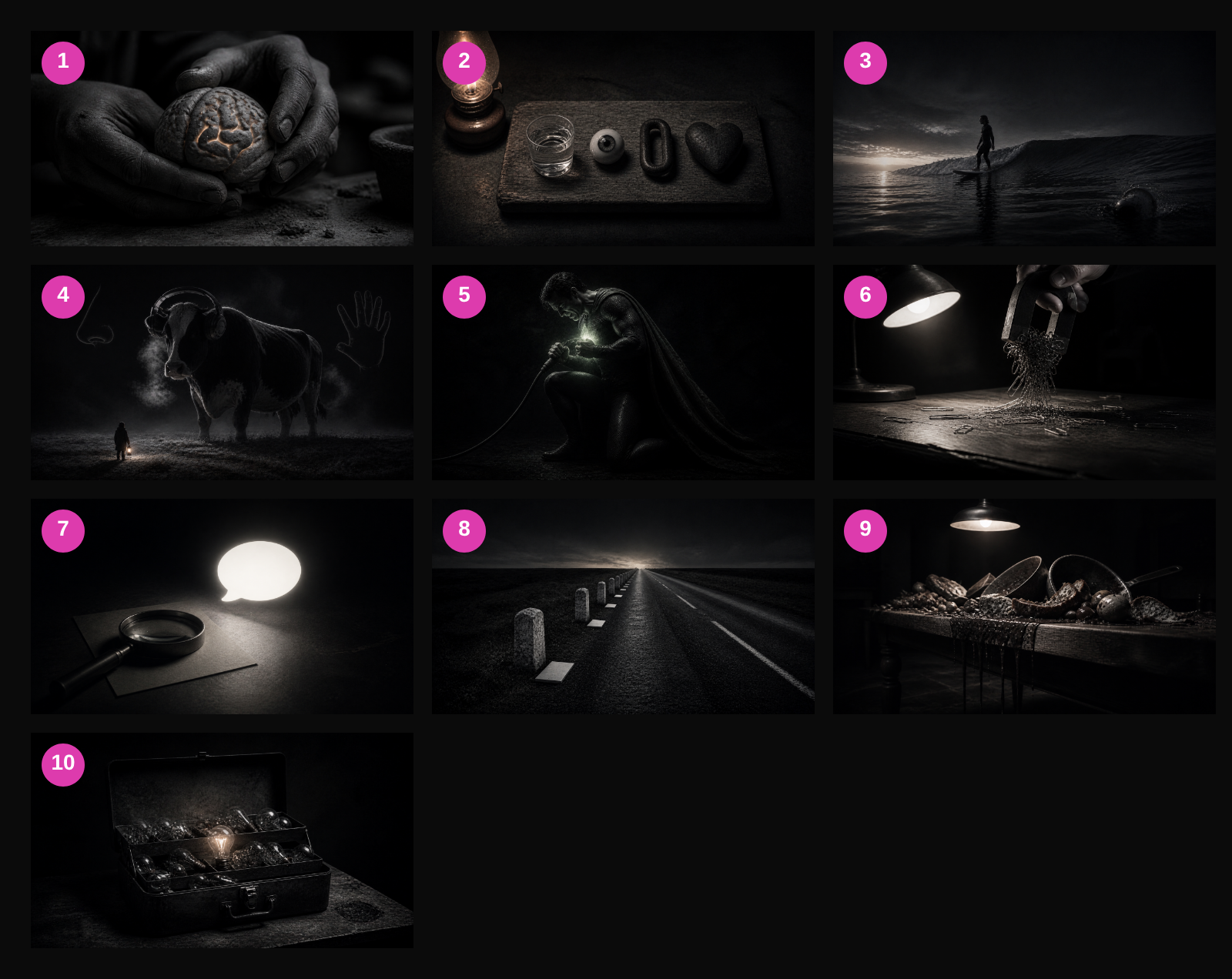
- Memory is an act of creation: to memorise, create. Image: a sculptor shaping a glowing lump of clay into a small brain.
- The four ingredients of creative memorisation. Image: a chopping board laid out with a glass of calm sea water, an eye, a chain link and a red heart.
- Flow: stress impairs the prefrontal cortex, so get calm, absorbed and curious first. Image: a surfer gliding along a smooth wave, a frantic alarm clock sinking behind them.
- Imagination brings information to life with every sense, and there is a way in for everyone. Image: a cow the size of a bus steaming in the cold, with headphones, a nose and a hand drawn around it.
- Association: ask what it reminds you of, what it sounds like, what happens next. Image: Superman struggling with a plug made of glowing green crystal.
- Meaning makes memories stick. Image: a heart-shaped magnet pulling paper clips off a desk.
- Craik and Tulving 1975: thinking about meaning beat thinking about looks or sound, and time was not the reason. Image: a magnifying glass resting on a word while a quick sentence bubble glows brighter beside it.
- Spaced retrieval carries it into long-term memory. Image: flashcards set out along a country road, the milestones between them growing further apart.
- Mesa: a messy table, said aloud, recalled next day. Image: a kitchen table piled with food and sauce dripping off the edge.
- Memory techniques are thinking tools; memory for memory's sake is pointless. Image: a toolbox full of light bulbs instead of tools.
Sources
- Mark Channon, How to Remember Anything (Hodder Education)
- Mark Channon, The Memory Workbook (Hodder Education)
- Craik, F. I. M., and Tulving, E. (1975). Depth of processing and the retention of words in episodic memory. Journal of Experimental Psychology: General, 104(3), 268 to 294. https://doi.org/10.1037/0096-3445.104.3.268
- Arnsten, A. F. T. (2009). Stress signalling pathways that impair prefrontal cortex structure and function. Nature Reviews Neuroscience, 10(6), 410 to 422. https://doi.org/10.1038/nrn2648 (the home for this study is How to Focus Better: A Memory Coach's Method)
- Roediger, H. L., III, and Karpicke, J. D. (2006). Test-enhanced learning: taking memory tests improves long-term retention. Psychological Science, 17(3), 249 to 255. https://doi.org/10.1111/j.1467-9280.2006.01693.x (the home for this study is The Testing Effect (Roediger and Karpicke 2006) Explained)
- Cepeda, N. J., Pashler, H., Vul, E., Wixted, J. T., and Rohrer, D. (2006). Distributed practice in verbal recall tasks: a review and quantitative synthesis. Psychological Bulletin, 132(3), 354 to 380. https://doi.org/10.1037/0033-2909.132.3.354 (the home for this study is The Spacing Effect (Cepeda 2006) Explained)
- Csikszentmihalyi, M. (1990). Flow: The Psychology of Optimal Experience. Harper and Row. https://worlddatabaseofhappiness.eur.nl/publications/flow-the-psychology-of-optimal-experience-441
Loci
Build the memory palace in this article inside Loci — store your locations, link images, and rehearse with spaced repetition.
Try it in LociMemory School community
Learn directly with Mark inside the Memory School community on Skool — monthly lessons, practice, and Q&A.
Join Memory SchoolAbout the author
Mark Channon
Grand Master of Memory (1995). Author of three books on memory published by Hodder and Nick Hern. Creator of BBC1's Monkhouse's Memory Masters. Memory coach on Channel 4's Can I Improve My Memory?
Read full bio →