
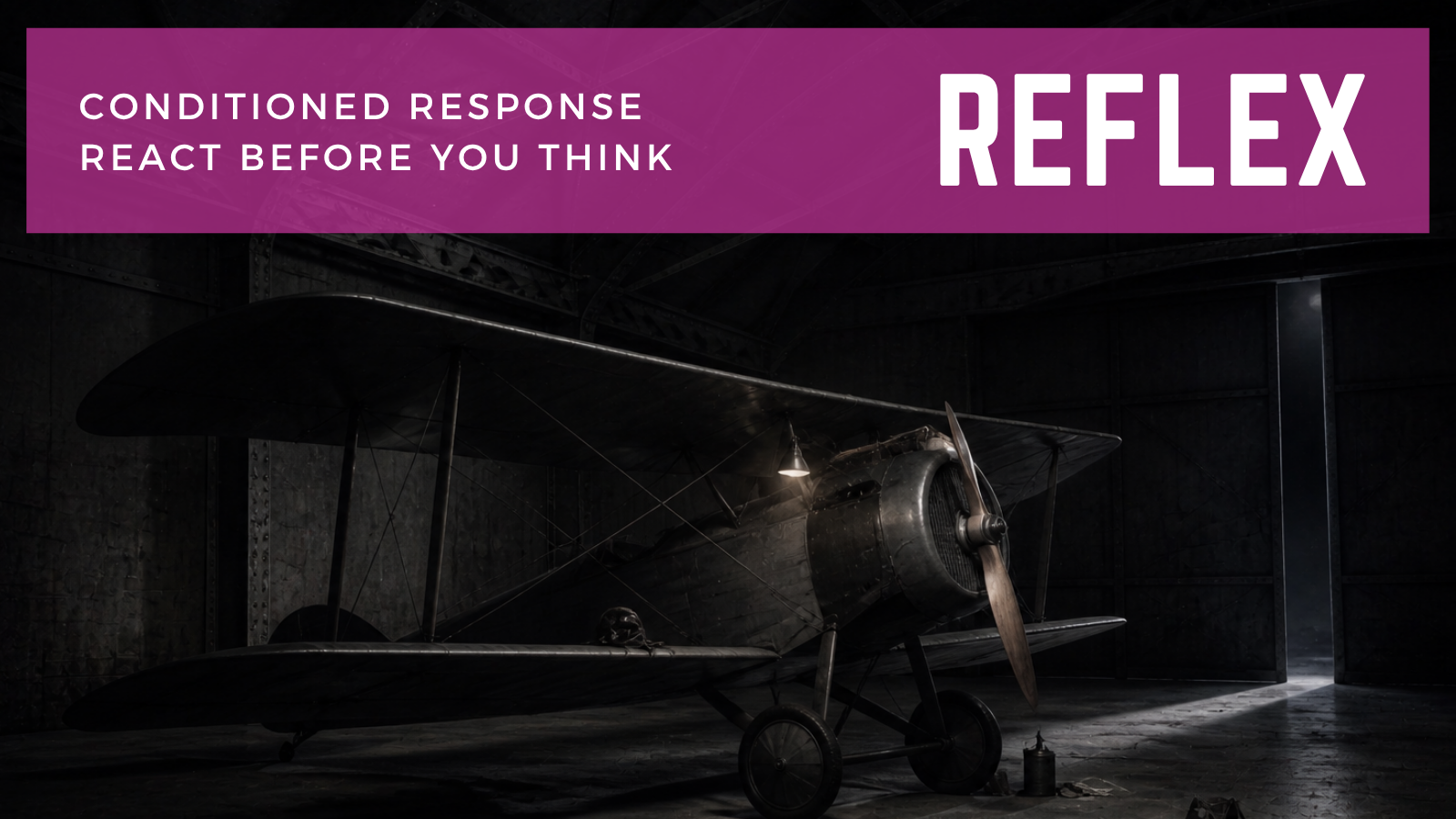
How Memory Works
Conditioned Response: How Your Brain Learns to React Without You
A conditioned response is a memory that fires as a reaction before you have time to think. Where it comes from, how advertisers use it on you, and how to recondition a response you do not want, from a power dive in a two-seater plane.

A conditioned response is a habitual reaction to a stimulus. You see a police car flashing in your mirror and, before you have had a single conscious thought, you have checked your speed, scanned the road and slowed down. Or panicked. Whatever your response was, you did not choose it in the moment. It was conditioned, somewhere in your past, and it fired on its own.
You might not think of that as memory. It is. It is one of the non-conscious forms of long-term memory, alongside procedural memory and priming, and it quietly shapes more of your behaviour than the conscious kind does. It is also, once you understand it, something you can work with rather than be run by. I learned that in a two-seater plane.
Where conditioned responses sit
Long-term memory splits into conscious and non-conscious. The conscious half, declarative memory, holds your facts and your experiences, and you make an effort to retrieve them. The non-conscious half, non-declarative memory, works without any effort at all. It includes procedural memory (how to ride a bike), priming (why a word you saw a minute ago comes to mind first), and conditioned responses (why your stomach drops when you hear a certain ringtone).
The classic demonstration is Pavlov's dogs, from the Russian physiologist Ivan Pavlov's experiments, which learned to salivate at the sound of a bell because the bell had repeatedly come just before food. The bell meant nothing on its own. After enough pairings, the dogs' bodies responded to the bell as if it were the food. A neutral stimulus had been attached to an automatic reaction.
That is the whole mechanism, and it is running in you constantly. Something happens alongside a strong feeling, often enough or intensely enough, and from then on the something triggers the feeling by itself.
The power dive
About fifteen years before I wrote The Memory Workbook, I got into a two-seater plane with a pilot friend. I had flown many times, never had a problem, always enjoyed it. He told me he was going to do a power dive and explained exactly what would happen. Then we went into the dive, and I felt an instant and completely irrational fear.
Logically I knew he had control. My amygdala, the brain's specialist for emotional matters, thought otherwise. The internal alarm fired with a vengeance, and it fired "fear".
For a long while after that, every time I got on a plane I felt anxious in my gut, worse if the ride was bumpy. The memory of that dive and the emotion attached to it brought back a physical reaction, every time, with no conscious decision from me. I had been conditioned to respond to flying in a particular way, by one intense experience.
That is how most unwanted conditioned responses are made. Not through repetition, like Pavlov's bell, but through a single event with enough emotion behind it. One bad presentation and the sight of a lectern tightens your chest. One humiliating exam and the smell of a sports hall makes your mind go blank. The amygdala learns fast when it is frightened.
How I reconditioned it
I decided I had to change the response. On the next bumpy flight, I put on headphones and played, loudly, the Kaiser Chiefs' album Employment.
The effect was immediate. The music changed my state, and I found myself zoning into the rhythm of the plane bumping up and down rather than bracing against it. After about ten minutes I felt stronger, and then something odd happened: I started enjoying the flight, waiting for the next bump. Memories of listening to that album and the way it had made me feel came flooding back, and they gave me a different response to attach to the same stimulus. Strength and fun instead of fear.
I had not argued myself out of the fear. You cannot. The amygdala does not listen to arguments. I had paired the stimulus, turbulence, with a new, stronger emotional state, and let the pairing do the work. Same mechanism as the original conditioning, pointed in a better direction.
Advertisers know this
If you want to see conditioning done deliberately and at scale, watch advertising. The approach is two-step. First, prime you: get the product into your awareness so you start noticing it. Then condition you: pair it, over and over, with feelings you want. Attractive people, laughter, relief, status. After enough pairings the product itself triggers a flicker of the feeling, and the feeling says "buy me".
None of this requires your consent or even your attention. It is non-conscious memory being written by someone else. Knowing that it happens does not make you immune, but it does let you notice when a reaction you are having belongs to a feeling you were sold rather than one you formed.
Your own conditioned responses
Here is an exercise worth doing. For each of these areas, notice the first feeling or memory that comes up. Not what you think about it; what you feel, instantly.
Learning. Studying. Reading. Exams. Career. Relationships. Money. Health.
Whatever came up first, that is a conditioned response. If "exams" produced a tightening in your stomach, that reaction was installed by some past exam and has been firing ever since, including when you sit down to revise, which is a large part of why revising can feel so unpleasant. Tick which of pleasure, pain or emotion sits behind each one.
Then ask the useful question: what could you do to improve your current association with each area, even the ones that are already positive? What would it be like to live with the new associations? How would your decisions change?
This is not positive thinking. It is memory work. You are identifying which stimuli have been paired with which feelings, and choosing to pair some of them with something better.
Conditioning on purpose
The same mechanism that gave me a fear of turbulence can be used deliberately, and it is one of the most practical tools in the whole of memory training.
Conditioning a state. There is an exercise for creating flow, the absorbed state where the work seems to carry you. You recall a time you were completely in the zone, rebuild it with all your senses until the feeling is at a nine or ten, and then pair it with a small physical trigger and a word. Repeat until the feeling and the trigger are welded together. If the state is intense and real enough, you have created a conditioned response, and from then on the trigger brings the state back on demand (the full exercise is in How to Focus Better: A Memory Coach's Method). Before a talk. Before an exam. Before a difficult conversation.
Conditioning a habit. Habits are conditioned responses to a cue. The Tiny Habits method, the behaviour scientist BJ Fogg's way of building habits, works precisely because it respects the mechanism: anchor the new behaviour to an existing routine, make it tiny, and celebrate immediately so a positive feeling is paired with the action. The celebration is the conditioning step. Skip it and the habit does not wire in.
Conditioning a memory trigger. When you learn to remember names, the hardest part is not the technique, it is remembering to use it in the moment. The fix is a conditioned trigger: a small nudge, attached to the act of meeting someone, that fires the right mindset before you have thought about it. Once it is wired, you do not decide to pay attention. You just do.
The practical takeaway
Three things to carry out of this.
Most of your instant reactions are memories. They were installed by past experiences, often single intense ones, and they fire before thought. That is not weakness. It is how the system works.
You cannot reason a conditioned response away, but you can recondition it. Pair the same stimulus with a new, stronger state, repeatedly. Music, movement, a vivid memory, a physical anchor. Let the pairing do what argument cannot.
You can condition on purpose. States, habits and memory triggers are all conditioned responses you build deliberately. The flow anchor and Tiny Habits are the two to start with.
I still fly. I no longer brace. Somewhere in my head, turbulence is permanently paired with a very loud indie album and the feeling of waiting for the next bump. That is a conditioned response. I just happened to choose it.
For the surrounding systems, Types of Memory: Working, Short-Term, Long-Term and More shows where conditioning sits, and What is Priming in Psychology? The Memory You Never Notice covers its close cousin. For the deliberate version, How to Focus Better: A Memory Coach's Method walks through the anchoring exercise in full.
To see conditioning put to work on everyday memory, How to Remember Things: Keys, Errands and What You Came In For shows you how to condition three small habits in a week, so the keys, the errands and the doorway moment stop catching you out.
Memory map
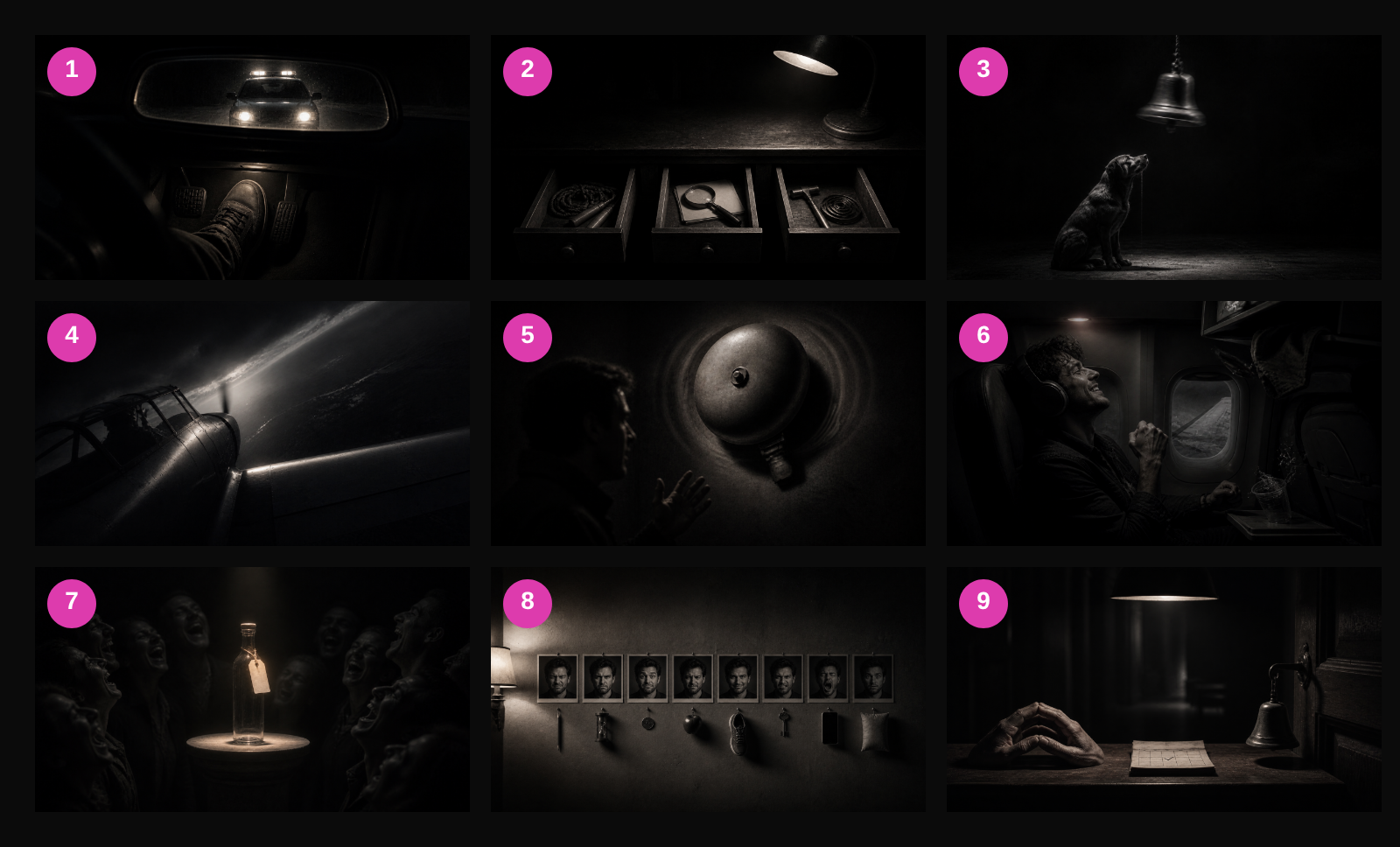
- A conditioned response is a habitual reaction to a stimulus, fired before thought. Image: a police car in a rear-view mirror and a foot already lifting off the pedal.
- It is non-conscious long-term memory, alongside procedural memory and priming. Image: three drawers under a desk marked "skills", "priming", "reactions".
- Pavlov's dogs: a neutral bell paired with food until the bell alone triggered the response. Image: a dog drooling at a ringing bell with no food in sight.
- One intense event can condition a response in a single pairing. Image: a two-seater plane tipping into a dive, a stomach dropping.
- The amygdala learns fast when frightened and does not listen to arguments. Image: an almond-shaped alarm bell ringing over a calm, ignored speech bubble.
- Recondition by pairing the stimulus with a stronger new state. Image: headphones on, Kaiser Chiefs loud, a plane bouncing through turbulence, a grin.
- Advertisers prime you to notice, then condition you to feel "buy me". Image: a product surrounded by laughing faces, a price tag glowing.
- Audit your own responses: learning, exams, money, health. Image: eight words on a wall, each with a small face showing the instant feeling.
- Condition on purpose: a flow anchor, a tiny habit, a memory trigger. Image: a hand making a small signal, a tick on a calendar, a small bell by a front door.
Sources
- Mark Channon, How to Remember Anything (Hodder Education)
- Pavlov, I. P. (1927). Conditioned Reflexes (Oxford University Press)
- Fogg, B. J. (2019). Tiny Habits (Houghton Mifflin Harcourt)
Loci
Build the memory palace in this article inside Loci — store your locations, link images, and rehearse with spaced repetition.
Try it in LociMemory School community
Learn directly with Mark inside the Memory School community on Skool — monthly lessons, practice, and Q&A.
Join Memory SchoolAbout the author
Mark Channon
Grand Master of Memory (1995). Author of three books on memory published by Hodder and Nick Hern. Creator of BBC1's Monkhouse's Memory Masters. Memory coach on Channel 4's Can I Improve My Memory?
Read full bio →