
Focus and Concentration
How to Focus Better: A Memory Coach's Method
Focus is not willpower. It is a state you can get into on purpose, a habit you can condition, and a skill the research says trains in two weeks. The method, from someone who has needed it on stage in front of two thousand people.

I was in Scrooge at the Dominion Theatre in London, covering (understudying) the part of Tom Jenkins, who leads the big number, "Thank You Very Much". One night I went on. Anthony Newley was playing Scrooge, there were about 2,000 people out front, and just before my entrance I dried, which is theatre slang for forgetting your lines. Completely. I turned to Jennie Dale, who was behind me, and asked what my line was. She didn't know.
I knew those lines. I blanked because my mind had gone elsewhere. My attention had left the stage before I had even walked onto it.
In that moment there are two ways it can go. You panic, everything falls apart, and you freeze. Or you bring your attention back and get very present. I chose the second, and it took about two seconds. I focused on why my character was there: to get the crowd going, then sing the song. I went on, improvised the first bit, someone shouted back, I started riffing, and the lines came back on their own.
The lesson I took from that night is this: the state you are in decides what happens next.
Search for how to focus better and the tips are familiar: try harder, remove distractions, use a timer. They help, but they treat focus as willpower, and focus is a state. You are either in a state where attention holds and thinking is clear, or you are in a state where it scatters, and no amount of gritting your teeth moves you from one to the other.
Memory is impossible without focus, so you cannot train one without the other. Here is the method. It is built on three ideas: get into the right state deliberately, train the underlying capacity, and condition focus so it arrives on cue rather than on demand.
What is actually happening when you cannot focus
Picture the moment you blank in front of a room. You are speaking, you lose the thread, and the harder you try to find it the worse it gets. Rabbit in the headlights. You may have had the same thing in an exam or a driving test.
What happened is physiological. Anxiety and stress, even mild stress, impair the prefrontal cortex, the part of the brain where your higher thinking happens. The amygdala gets louder, and the amygdala is interested in fight or flight, not in your next point. That is when the inner voice says "get me off this stage." You have not lost your memory or your intelligence. You have lost access to them, because you are in the wrong state.
Everyday distraction is a milder version of the same thing. Low-level stress, a crowded working memory, a brain that has learned to expect interruption. The executive, the part of working memory that directs attention, has too many claims on it and not enough capacity left for the task.
So the first lever is not effort. It is state.
Step 1: Know what your focused state feels like
Contrast the blank with its opposite. Think of a time when things were just happening for you. The right words came. You moved naturally. You felt confident and present, with a lightning focus and a sense of certainty. Athletes call it being in the zone. The psychologist Stefan Engeser describes it as complete immersion without self-consciousness but with a deep sense of control. Stanislavsky, the great actor and director, called it the condition that frees the body of tension and energises the creative faculties.
That is flow, and it is the state you are looking for whenever you need to focus. Everyone has had it: giving a talk, playing sport, teaching a child something, deep in a piece of work. The question is whether you can get back to it on purpose.
Step 2: Build an anchor for it
You can, and the method is conditioning. Here is the exercise.
Sit somewhere quiet. Recall a time when you were in flow. If nothing comes, recall a time you were doing something you love. Rebuild the memory in detail, with every sense. What is happening in your body? What kind of words are you using? What pictures are in your mind? Where in your body is the feeling most intense? Stay with that spot.
Now give the feeling an action. Something small and repeatable. Bring your hands together so your fingertips touch and say the word "flow". Hold the state and the action together. Let the feeling build to a nine or ten, then release.
Repeat this several times over a few days. What you are doing is pairing a physical trigger with a mental state until they are welded. If the state is intense and real enough, the trigger alone will start to bring it back. Before a meeting, before you open the document, before you walk on stage: fingertips, "flow", and the state arrives.
This is a conditioned response, built deliberately. It works for the same reason a certain song can change your mood in three seconds. You have simply chosen the song.
Step 3: Train the capacity, not just the moment
An anchor gets you into the state. Training raises how much the state can hold.
The capacity in question is working memory, and specifically its central executive, the part that decides what gets attention. The encouraging news is that it responds to training quickly. In a study at the University of California, two groups of students took two-week courses. One group did nutrition. The other did mindfulness. The mindfulness group came out with increased focus, reduced mind wandering, and better working memory and verbal reasoning. Two weeks.
The practice itself is simple. A few minutes a day of attending to your breath and, each time the mind wanders, noticing and returning. That return is the rep. You are not trying to stop the mind wandering; you are training the executive to notice the wander and bring attention back. Every return strengthens the muscle, and the muscle is the same one you use to hold a thought in a noisy meeting.
If daily mindfulness feels like a commitment you will not keep, use a tiny habit. Anchor it to something you already do. After I finish lunch and put my plates away, I will take one deep breath. Celebrate: a small inner "yes, done" that links the habit to a good feeling. That is the whole habit on day one. Within days it is automatic, and once it is automatic it grows on its own. A three-minute breathing space is far easier to arrive at from one breath than from a resolution.
Step 4: Give the executive less to carry
Focus fails most often not because attention is weak but because it is overloaded. The workspace is small, and it is easy to fill it with things that do not need to be there.
Stop holding information in your head. Every item you are trying to remember is a slice of attention you cannot spend on thinking. Put it somewhere. A note, or a memory palace, a familiar route in your mind where each stop holds one image. Free the workspace and focus returns on its own.
One task. The executive can direct attention to one thing at a time. Two tasks means switching, and every switch costs capacity and leaves a residue. Phone face down, one window, one thing.
Prime your attention before you start. Ask what you want from the next hour. What is interesting here? What am I looking for? Questions point your attention at what matters, the same way buying a new car suddenly makes you see that car everywhere. A primed brain holds focus because it knows what it is focusing on.
Step 5: Reframe what distraction means
One last piece, and it comes from actors who dry on stage. When you lose your place, you have not forgotten. You did not recall the thing at the moment you needed it. The distinction matters, because "I have forgotten" is a verdict and "I did not recall it just then" is a description of a moment that will pass. The first triggers the amygdala. The second lets the prefrontal cortex stay online long enough to find the thread.
The same reframe applies to focus. You did not fail to focus. Your attention moved, as attention does, and you are now bringing it back. That is not a lapse. It is the rep. People who focus well are not people whose minds never wander. They are people who have stopped treating the wander as a crisis.
The method in brief
- Recognise the blank for what it is: the wrong state, not a lack of ability.
- Know what your flow state feels like and build an anchor for it: fingertips, "flow".
- Train the executive with a few minutes of mindfulness a day; the research says two weeks is enough to see it.
- Offload what you are holding, do one thing, prime your attention with questions.
- Reframe wandering as the rep, not the failure.
None of this is willpower. It is state, training and conditioning, which is how every other skill is built. Focus is no different.
If you want the memory side of this, What is Working Memory? explains the workspace in detail and how to stop overloading it. If you want the conditioning side, Conditioned Response: How Your Brain Learns to React Without You covers how anchors are built. And for getting into flow before a performance, How Actors Learn Lines Fast: The Seven-Step Recipe (From Learning Your Lines) sets out the actor's version.
Memory map
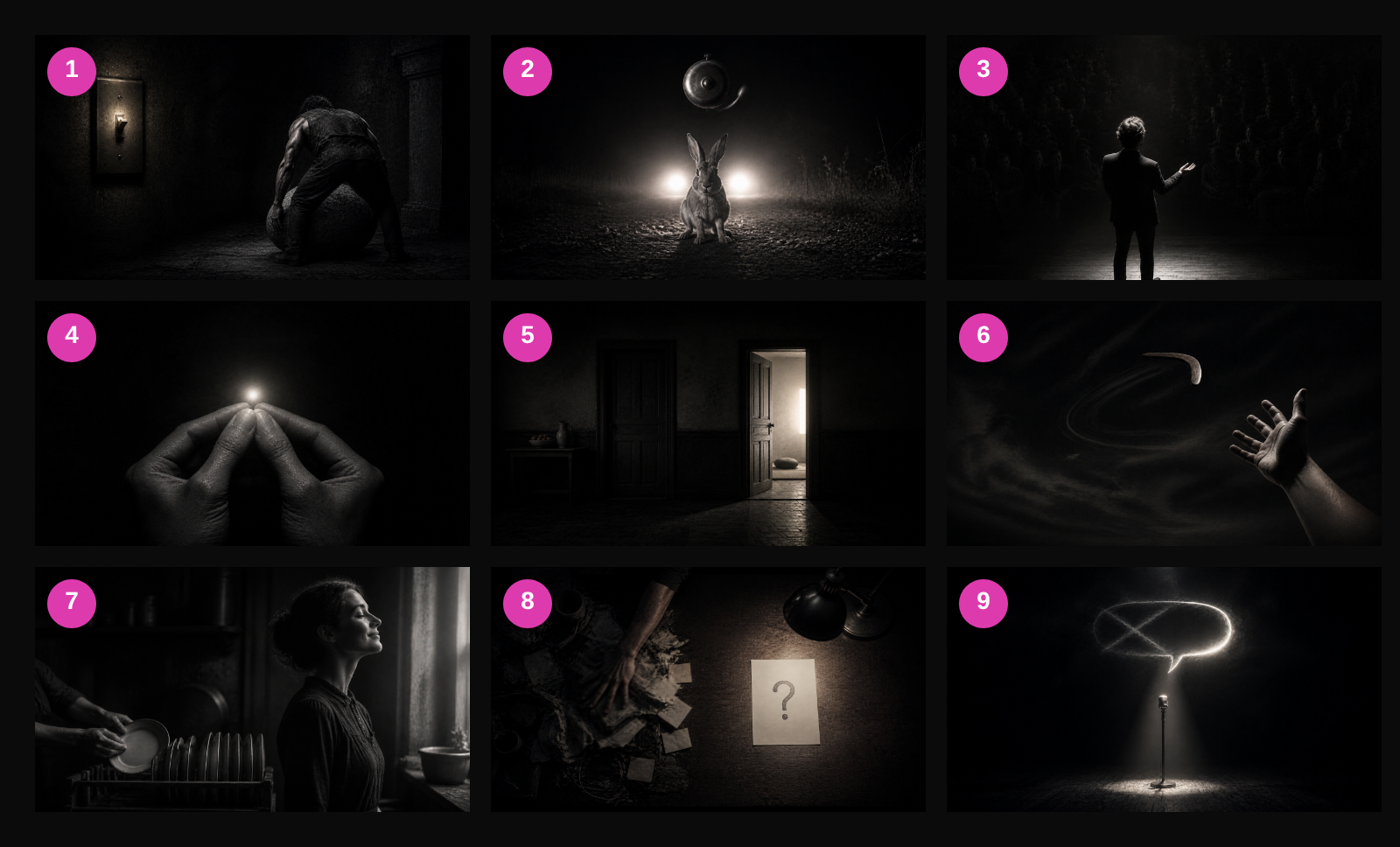
- Focus is a state, not willpower. Image: a light switch labelled "state" beside a person straining to lift a weight labelled "willpower".
- The blank: stress impairs the prefrontal cortex and the amygdala gets louder. Image: a rabbit frozen in headlights with a small alarm bell ringing in its head.
- Flow is complete immersion with a deep sense of control. Image: a speaker mid-sentence, relaxed, the room leaning in.
- Build an anchor: recall flow in full detail, touch fingertips, say "flow", repeat. Image: two hands with fingertips touching and a glowing word above them.
- Two weeks of mindfulness measurably improved focus and working memory. Image: two classroom doors, "nutrition" and "mindfulness", with a brighter light behind the second.
- Each return from a wandering mind is the rep that trains the executive. Image: a boomerang coming back to a hand, again and again.
- A tiny habit: after lunch, one deep breath, celebrate. Image: a plate being put away and a chest rising.
- Offload what you are holding, do one thing, prime with questions. Image: a cluttered desk being cleared to a single sheet with a question written on it.
- "I did not recall it just then" keeps the thinking brain online. Image: a speech bubble crossing out FORGOT and writing NOT YET.
Sources
- Mark Channon, The Memory Workbook (Hodder Education)
- Mrazek, M. D., Franklin, M. S., Phillips, D. T., Baird, B. and Schooler, J. W. (2013). Mindfulness training improves working memory capacity and GRE performance while reducing mind wandering. Psychological Science, 24(5), 776 to 781. https://doi.org/10.1177/0956797612459659
- Engeser, S. (ed.) (2012). Advances in Flow Research (Springer)
- Gordon, M. (1988). The Stanislavsky Technique: Russia (Applause Theatre Books)
- Arnsten, A. F. T. (2009). Stress signalling pathways that impair prefrontal cortex structure and function. Nature Reviews Neuroscience, 10(6), 410 to 422. https://doi.org/10.1038/nrn2648
Loci
Build the memory palace in this article inside Loci — store your locations, link images, and rehearse with spaced repetition.
Try it in LociMemory School community
Learn directly with Mark inside the Memory School community on Skool — monthly lessons, practice, and Q&A.
Join Memory SchoolAbout the author
Mark Channon
Grand Master of Memory (1995). Author of three books on memory published by Hodder and Nick Hern. Creator of BBC1's Monkhouse's Memory Masters. Memory coach on Channel 4's Can I Improve My Memory?
Read full bio →