
How Memory Works
Types of Memory: Working, Short-Term, Long-Term and More
Memory is not one thing. It is several kinds, running on different systems in the brain. The map neuroscientists use, what each type does, and which one to train for the job in front of you.

When I wrote How to Remember Anything, I opened the chapter on memory with a line from a reference book: that the memory researcher Endel Tulving had identified 256 types of memory. It is a memorable line. It is also wrong, and the correction is more useful than the original.
Tulving did write a chapter called "Are there 256 different kinds of memory?" The title is a question. He was poking at how many labels memory researchers had invented, not announcing that the brain holds 256 separate systems. The field really does carve memory up in a crowded number of ways.
So which types matter? The map most neuroscientists work from is short. Working memory, which includes short-term memory, holds what you are thinking about right now. Long-term memory splits in two. The conscious half holds your experiences (episodic memory) and your facts (semantic memory). The non-conscious half holds your skills (procedural memory), the quiet influence of what you have just seen (priming) and your learned reactions (conditioned responses). Emotion runs through all of them.
The lesson behind the map is this: memory is not one thing, so "I have a bad memory" is never the whole story. Different kinds of memory run on different systems, and once you know which kind a task needs, you know how to train it.
The research behind the map
The research: Squire, 2004
- In short: A review by the neuroscientist Larry Squire of how the idea of separate memory systems developed, and where it stands. Memory divides into conscious memory for facts and events, and several non-conscious kinds, each relying on different brain systems.
- What they did: Traced the history of the memory systems idea through decades of research and summarised the current view. It is a narrative review, not a new experiment.
- Who was involved: No participants. Larry Squire, drawing on research with healthy volunteers, patients with amnesia and animals.
- What they found: From about 1980, the evidence converged on one split. Declarative memory, for facts and events, is the kind you can consciously bring to mind, and it depends on the hippocampus (a small, curved structure deep inside each side of the brain) and nearby areas. The non-conscious kinds, which include skills and habits, priming, conditioning and emotional responses, draw on other systems, such as the amygdala (the brain's emotional alarm), the striatum and the cerebellum.
- What they concluded: Memory is not one thing. Different kinds run on different brain systems.
It is the standard textbook map, built on decades of patient and animal research. Two cautions come with it. The systems overlap and work together, so no type of memory lives in one spot. And the split between episodic and semantic memory is usually credited to Tulving rather than to Squire.
The patient who made the conscious half so clear was H.M. After surgery in 1953 that removed both his hippocampi and tissue around them, he could no longer form new long-term memories of facts and events (Scoville and Milner, 1957).
What I take from it
Keep the terms simple on purpose: the subject is vast, and a common language makes it usable. A short table of conscious and non-conscious types is enough, then an exercise to find each one in your own life.
The map matters because each type responds to a different kind of training. Facts and words are declarative, and that is where memory techniques do their work. Skills are procedural, and they are built by doing them. A reaction that fires before you can think is conditioned, and it changes only when you give it a new association. Creative memorisation, the approach of turning what you learn into vivid, connected images that mean something to you, draws on each of these types at once: episodic, semantic, procedural, emotional, priming and conditioned response. That is the idea behind it, and there is a worked example further down.
Working memory
Working memory is your ability to focus attention, hold information in mind and manipulate it. You need it to weigh things up and make decisions. Short-term memory is folded into it here, because in practice you are almost always holding something new while reaching into what you already know.
The best-known model of how it works is Baddeley and Hitch's, from 1974: an attention controller with a store for sounds and a store for images, to which Baddeley added an episodic buffer in 2000 that ties them together. It is covered in full in What is Working Memory?
Working memory is small. Miller's famous "seven plus or minus two" was a rough estimate; the core limit looks closer to four chunks (a chunk is a group of items you hold as one). Why, and how chunking gets round it, is in The Magical Number Seven, and Why It Is Really Four.
That limit is why a long number, a list of instructions or a room full of new names feels impossible. You are trying to carry more than the workspace holds. Memory techniques move the information out of working memory and into long-term memory, which frees the workspace for thinking.
Attention is the gatekeeper here. In a 2013 study of 48 students, two weeks of mindfulness training improved working memory compared with a nutrition class (Mrazek and colleagues), and Can Mindfulness Improve Working Memory? (Mrazek 2013) Explained breaks it down.
Try it: next time a list of instructions feels too long to hold, stop at three or four items, picture each one as an image on a spot in your kitchen, then take the rest.
Short-term memory
Short-term memory is the brief holding of something new, a car registration or a phone number you have just heard, with nothing yet to anchor it.
Think of a children's water-pen drawing mat. Whatever you draw fades unless you keep going over it. Rehearsal is the going over. Stop rehearsing and the picture goes.
The classic measurement is Peterson and Peterson's 1959 study. When people were stopped from rehearsing, recall of three letters fell from about two thirds after 3 seconds to about one in seven after 18 seconds. Peterson and Peterson (1959): How Fast Short-Term Memory Fades has the full breakdown.
Try it: the next time you need to hold a number for a minute, do not just repeat it. Turn each digit into its shape (1 a pencil, 8 a snowman) and link them into one scene. The Number Shape System has the full set.
Long-term memory: conscious and non-conscious
Long-term memory is the deep store. In tests, no one has yet found its limit: in one 2008 study, people shown 2,500 objects picked out the exact ones they had seen about nine times in ten (Brady and colleagues).
It splits the way Squire does. Conscious memory is the kind you make an effort to remember. Non-conscious memory is the kind you do not try to remember, but you do. Implicit vs Explicit Memory: Knowing How and Knowing That goes deeper into the split.
Episodic memory
Episodic memory is the timeline of your own experiences: what happened yesterday, your last holiday, an early day at school. Each memory is tagged with a time and a place.
It is usually your strongest memory, and memory techniques lean on it. They dress a dull fact up as a vivid scene in a specific place, so your episodic memory will carry it.
Semantic memory
Semantic memory is your knowledge of facts: that Rome is the capital of Italy, that "korova" is Russian for "cow". Unlike episodic memory, it is not tagged to a moment. You know the fact, but you will probably not have an experience linked to it.
Names, dates, vocabulary and figures live here, and this is the type that slips away without help. It is also the type memory techniques help most, because a mnemonic gives a bare fact the image and location it lacks. Episodic vs Semantic Memory: The Difference and Why It Matters compares the two in full.
Procedural memory
Procedural memory is "how to" information in your body: tying your shoelaces, touch typing, riding a bike, playing a sport. It is built by repetition, and once built it lasts.
You cannot talk your way into a skill; you have to do it. Procedural Memory Explained covers how skills move from effort to automatic.
Priming
Priming is the effect something you have just met has on your response to what comes after it: for example, recognising "nurse" faster straight after seeing "doctor" (Meyer and Schvaneveldt, 1971). You do not know it is happening.
You can run this as a test on yourself. Study a list of words; later, fill in word stems (the first few letters of a word) as fast as you can, and the words you were shown are more likely to come to mind. What is Priming in Psychology? The Memory You Never Notice has the research and how to use it.
Conditioned response
A conditioned response is a habitual reaction to a stimulus. Take a police car flashing in your mirror: in a split second you check what is around, slow down and let it pass, or perhaps panic. Whatever the response, it has been conditioned.
Pavlov showed the principle a century ago: dogs learn to salivate to a signal that predicts food, a simple form of learning that works without conscious recall. Squire's map files it with the non-conscious kinds of memory.
It is easy to forget that a reaction is a memory at all, yet it can shape how you feel about learning, exams, reading, even money. Conditioned Response: How Your Brain Learns to React Without You shows how one forms and how to recondition it.
Emotional memory: the thread through all of them
Emotional memory earns its own entry, because it acts on all the others. It is a powerful motivator, primer and conditioner. It strengthens episodic and semantic memories. Too much negative emotion, though, brings anxiety and stress and stops memory performing. You need the right balance.
The research backs the first half: emotion strengthens memory because the amygdala signals the hippocampus to store arousing events more firmly (McGaugh, 2004).
Every memory technique uses this. When you are told to make an image funny, exaggerated or a little ridiculous, you are recruiting emotion to mark the memory as worth keeping.
How the types work together: a worked example
The types are not sealed boxes. A good technique recruits several at once. Here is what happens when you memorise one fact properly.
Suppose you want to remember that the Spanish word for "table" is "mesa".
You read the word and hold it in working memory. On its own it would slip away within seconds, so you act before it fades.
You build a reference story, a small scene that joins the new word to what it means: a giant table with a big mess all over it. "Mess-a" is the sound image, a picture that sounds like the word, pointing at "mesa"; the table is the meaning. Building it draws on your semantic memory, because you already know what a table is.
You make the mess overflowing, sticky and embarrassing. That recruits emotion and marks the trace as important.
You put the messy table on a spot in a memory palace (a route through somewhere you know, with one image held at each spot along it). Now the bare fact has a place and a scene, which dresses it up as something close to an episodic memory.
You say "mesa, table" aloud while you see it, which adds a sound thread.
One small fact, woven through working, semantic, emotional and quasi-episodic memory, plus sound. That is why a well-built mnemonic can stick after one go while rereading the word ten times does not. It is not more effort. It is more of your memory doing the work.
Recognition vs recall
One more distinction, because it explains a common frustration.
Recognition is knowing something when you see it. Recall is producing it from nothing. Recognition is far easier, which is why you know a face instantly but cannot find the name, and why multiple-choice questions feel easier than a blank page.
When a name will not come, the memory is usually there; you would recognise it the moment someone said it. What is missing is a path to produce it. The location, image and story in a memory technique are that path.
It is also why testing yourself beats rereading. In Roediger and Karpicke's studies, students who practised recalling material remembered far more a week later than those who simply read it again. The Testing Effect (Roediger and Karpicke 2006) Explained has the details.
Memory is a skill
The type behind "I have a bad memory" is usually semantic memory, and that is the type that responds best to training. In one brain-imaging study, about 40 half-hour memory palace sessions over six weeks shifted novices' brain networks towards the pattern seen in memory athletes (Dresler and colleagues, 2017). The Memory Athlete Brain Study (Dresler 2017) Explained breaks it down.
So the answer to "what type of memory do I have?" is all of them. The useful question is which one the job in front of you needs.
How to use it this week
Start with two exercises, then put the map to work.
- Find each type in your own life. Write down one example of each: episodic (your last holiday), semantic (a fact you know cold), procedural (a skill you do without thinking), priming (a moment you were nudged without noticing) and conditioned (a reaction that fires before you can think). Seeing your own examples makes the map real.
- Score yourself. Draw a line from 1 to 10 for each type. Decide what a 1 and a 10 would mean for you, mark where you are now, then mark where you would like to be. Come back to it in a month.
- Match the method to the type. For a fact or a name, build an image and place it in a palace. For a skill, practise it in short, frequent sessions. For a reaction you do not like, give the trigger a new association (Conditioned Response: How Your Brain Learns to React Without You walks through how).
- Test, do not reread. Cover the answer and produce it. Then check.
If you want somewhere to start, How to Build a Memory Palace: A 7-Step Beginner's Guide (With Worked Examples) shows the technique that puts most of these types to work at once.
To see the map at work on real jobs, How to Remember Names: A Five-Step Framework That Actually Works trains semantic memory on the people you meet, How to Memorise a Dance Routine builds procedural memory one section at a time, and How to Remember Things: Keys, Errands and What You Came In For turns the small daily slips into habits you can condition in a week.
Memory map
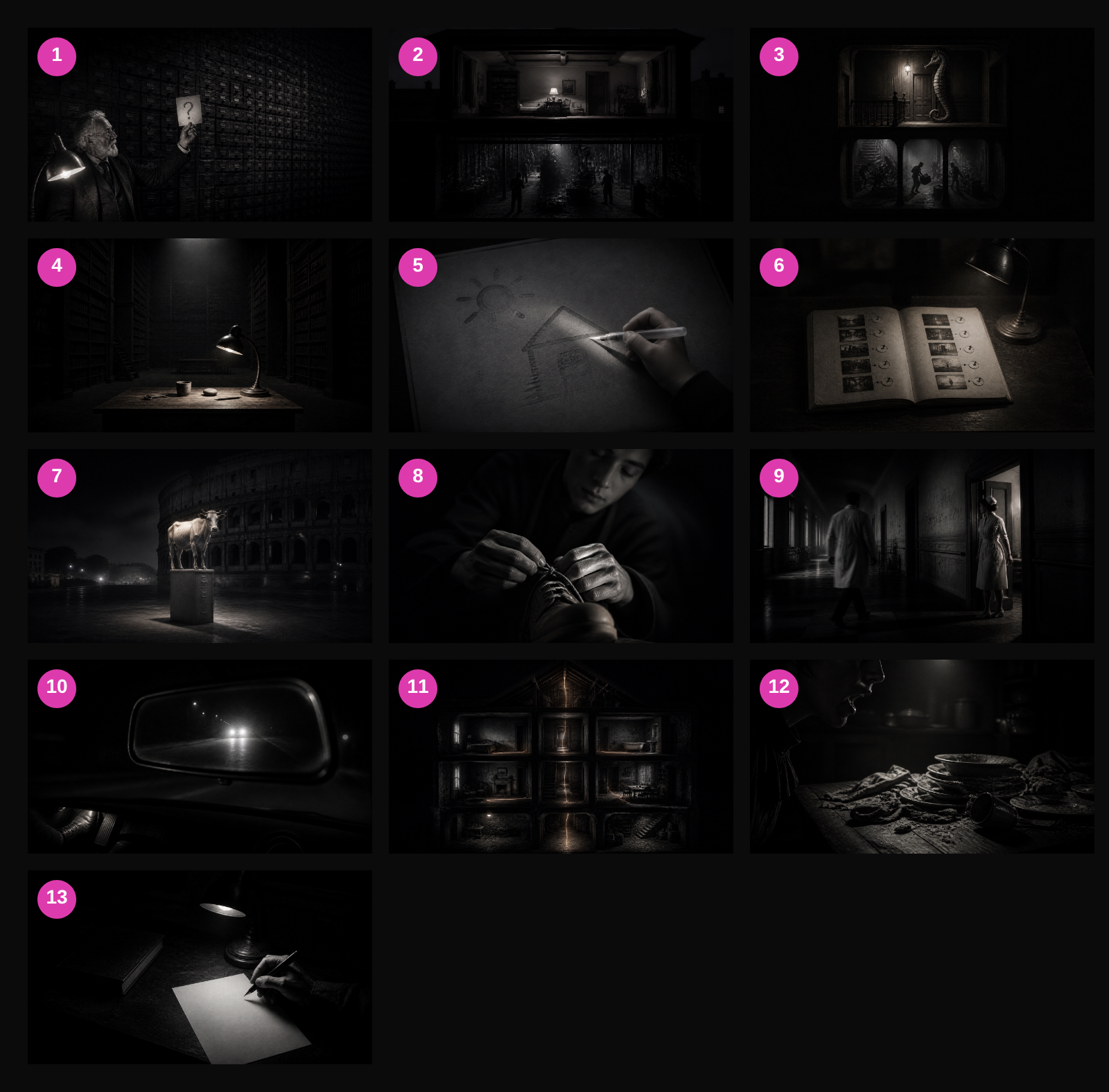
- Tulving asked whether there are 256 kinds of memory; he did not find 256. Image: a professor holding up a giant question mark in front of a wall of 256 tiny drawers.
- Squire's map: facts and events you can bring to mind, plus a non-conscious side for skills, priming and reactions. Image: a house with a bright lit upstairs and a busy, dim basement.
- The conscious half depends on the hippocampus; the non-conscious kinds draw on other systems. Image: a seahorse guarding the upstairs door while workers bustle in the basement below.
- Working memory is the small workspace, about four chunks. Image: a tiny desk with four objects on it in front of a vast library.
- Short-term memory fades within seconds unless you go over it. Image: a child's water-pen drawing fading on a mat.
- Episodic memory is your timeline of experiences, tagged with a time and a place. Image: a diary whose pages are small photographs, each with a clock and a map pin.
- Semantic memory is facts with no moment attached, and the most trainable. Image: a cow standing on a filing cabinet in the middle of Rome.
- Procedural memory is skill in the body, built by repetition. Image: hands tying a shoelace with eyes closed.
- Priming is the quiet nudge of what you have just seen. Image: a doctor walking past a nurse who instantly turns round.
- A conditioned response fires before you can think. Image: blue lights in a rear-view mirror and a foot lifting off the accelerator.
- Emotion runs through every type and marks what to keep. Image: a red thread running through every room of the house.
- One fact, properly built, uses several types at once. Image: a kitchen table piled with mess, a mouth beside it saying the word.
- Recall is harder than recognition; test by producing, not rereading. Image: a blank page with a pen poised, a closed book beside it.
Sources
- Mark Channon, How to Remember Anything (Hodder Education)
- Mark Channon, The Memory Workbook (Hodder Education)
- Squire, L. R. (2004). Memory systems of the brain: a brief history and current perspective. Neurobiology of Learning and Memory, 82(3), 171 to 177. https://doi.org/10.1016/j.nlm.2004.06.005
- Tulving, E. (2007). Are there 256 different kinds of memory? In J. S. Nairne (Ed.), The Foundations of Remembering: Essays in Honor of Henry L. Roediger, III. Psychology Press. https://www.routledge.com/products/9781138006218
- Scoville, W. B., and Milner, B. (1957). Loss of recent memory after bilateral hippocampal lesions. Journal of Neurology, Neurosurgery and Psychiatry, 20(1), 11 to 21. https://doi.org/10.1136/jnnp.20.1.11
- Baddeley, A. D., and Hitch, G. (1974). Working memory. In G. H. Bower (Ed.), The Psychology of Learning and Motivation, Vol. 8, 47 to 89. Academic Press. Baddeley, A. (2000). The episodic buffer: a new component of working memory? Trends in Cognitive Sciences, 4(11), 417 to 423. https://doi.org/10.1016/S1364-6613(00)01538-2 (the home for this model is What is Working Memory?)
- Miller, G. A. (1956). The magical number seven, plus or minus two. Psychological Review, 63, 81 to 97. https://doi.org/10.1037/h0043158. Cowan, N. (2001). The magical number 4 in short-term memory. Behavioral and Brain Sciences, 24(1), 87 to 114. https://doi.org/10.1017/S0140525X01003922 (the home for these is The Magical Number Seven, and Why It Is Really Four)
- Mrazek, M. D., Franklin, M. S., Phillips, D. T., Baird, B., and Schooler, J. W. (2013). Mindfulness training improves working memory capacity and GRE performance while reducing mind wandering. Psychological Science, 24(5), 776 to 781. https://doi.org/10.1177/0956797612459659 (the home for this study is Can Mindfulness Improve Working Memory? (Mrazek 2013) Explained)
- Peterson, L. R., and Peterson, M. J. (1959). Short-term retention of individual verbal items. Journal of Experimental Psychology, 58(3), 193 to 198. https://doi.org/10.1037/h0049234 (the home for this study is Peterson and Peterson (1959): How Fast Short-Term Memory Fades)
- Brady, T. F., Konkle, T., Alvarez, G. A., and Oliva, A. (2008). Visual long-term memory has a massive storage capacity for object details. PNAS, 105(38), 14325 to 14329. https://doi.org/10.1073/pnas.0803390105
- Meyer, D. E., and Schvaneveldt, R. W. (1971). Facilitation in recognizing pairs of words: evidence of a dependence between retrieval operations. Journal of Experimental Psychology, 90(2), 227 to 234. https://doi.org/10.1037/h0031564 (the home for this study is What is Priming in Psychology?)
- Pavlov, I. P. (1927). Conditioned Reflexes (G. V. Anrep, Trans.). Oxford University Press. https://psychclassics.yorku.ca/Pavlov/
- McGaugh, J. L. (2004). The amygdala modulates the consolidation of memories of emotionally arousing experiences. Annual Review of Neuroscience, 27, 1 to 28. https://doi.org/10.1146/annurev.neuro.27.070203.144157
- Roediger, H. L., III, and Karpicke, J. D. (2006). Test-enhanced learning: taking memory tests improves long-term retention. Psychological Science, 17(3), 249 to 255. https://doi.org/10.1111/j.1467-9280.2006.01693.x (the home for this study is The Testing Effect (Roediger and Karpicke 2006) Explained)
- Dresler, M., Shirer, W. R., Konrad, B. N. et al. (2017). Mnemonic training reshapes brain networks to support superior memory. Neuron, 93(5), 1227 to 1235. https://doi.org/10.1016/j.neuron.2017.02.003 (the home for this study is The Memory Athlete Brain Study (Dresler 2017) Explained)
Loci
Build the memory palace in this article inside Loci — store your locations, link images, and rehearse with spaced repetition.
Try it in LociMemory School community
Learn directly with Mark inside the Memory School community on Skool — monthly lessons, practice, and Q&A.
Join Memory SchoolAbout the author
Mark Channon
Grand Master of Memory (1995). Author of three books on memory published by Hodder and Nick Hern. Creator of BBC1's Monkhouse's Memory Masters. Memory coach on Channel 4's Can I Improve My Memory?
Read full bio →