
How Memory Works
The Misinformation Effect: Loftus and Palmer's Car Crash Study
One word in a question made people remember broken glass that was never there. What Loftus and Palmer found, how information that arrives later slips into a memory, and how to protect what you remember in meetings, notes and interviews.

Start with an easy one. Coat hanger. What do you see? A picture arrives straight away, but it is not the same picture for everyone. Some people see a wooden coat hanger. Some see a wire one. Nobody said wooden or wire. Your mind filled that in.
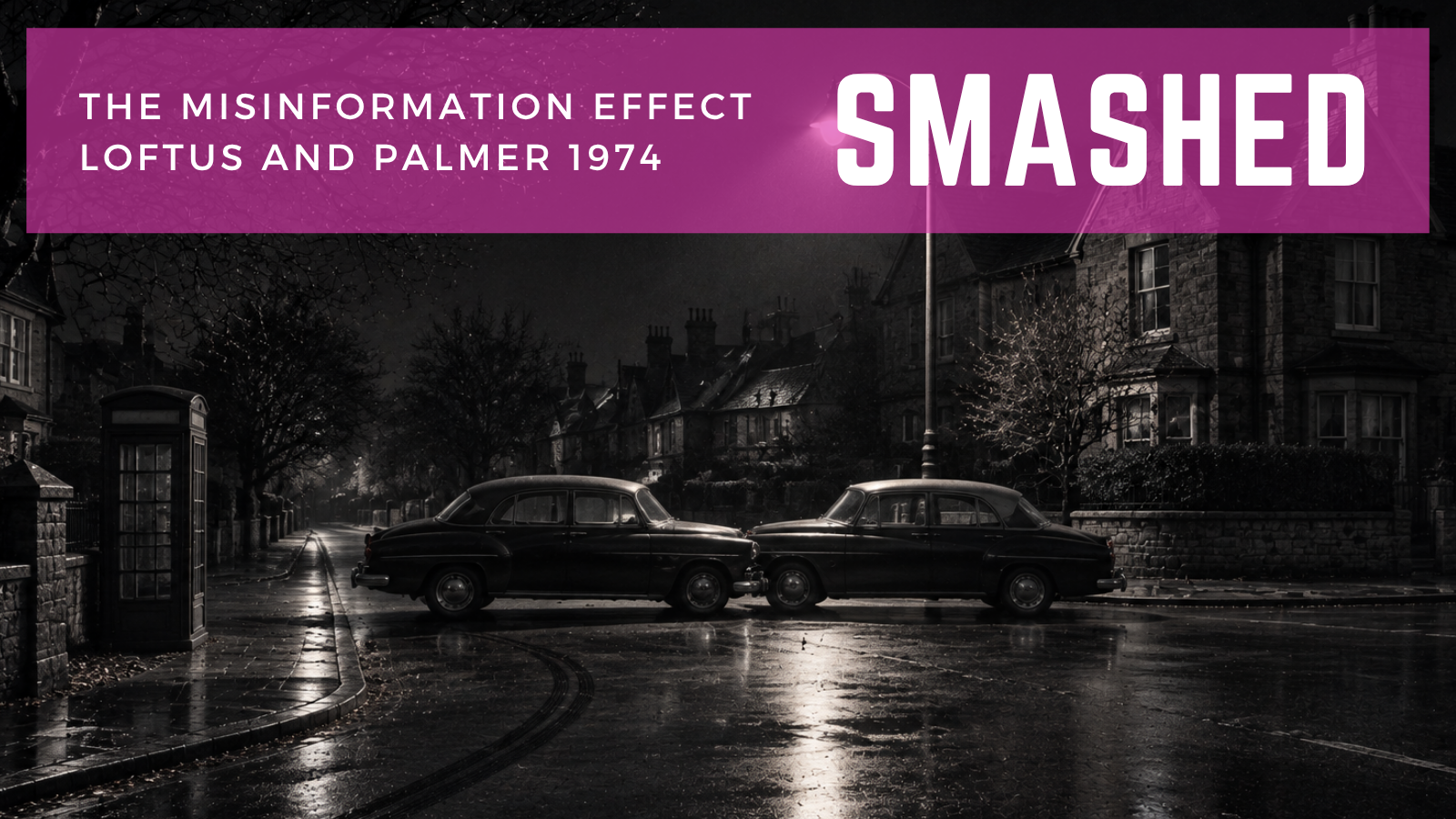
In 1974 the psychologists Elizabeth Loftus and John Palmer showed that the same filling-in happens to memories of things people actually saw. They showed films of car accidents and asked how fast the cars were going when they "smashed" into each other, or "hit" each other. "Smashed" brought higher speed estimates, and a week later more people remembered seeing broken glass. There was none. That is the misinformation effect: information that arrives after an event, even a single word in a question, can change the memory of the event itself.
Here are the two studies at the heart of it, and then the practical part: what to do about it in meetings, after you witness something, when you revise and when you ask someone else what happened.
Why it matters
It is natural to trust your memory of things you saw with your own eyes. A meeting, a conversation, a bump in a car park. You rarely stop to ask where each detail came from.
But a memory of an event keeps taking in information after the event is over. The questions someone asks you. Another person's version. The minutes. The news. Your own notes. Some of that is accurate and some is not, and the research says it can blend into what you remember without a seam. If you are a manager writing up a meeting, a student revising from someone else's summary, or anyone who has to say what happened, that is worth knowing.
The two studies
The research: Loftus and Palmer, 1974
- In short: Changing one word in a question about a car crash changed how fast people thought the cars were going, and made them more likely to remember broken glass that was never there.
- What they did: People watched films of car accidents. They were asked how fast the cars were going when they "smashed", "collided", "bumped", "hit" or "contacted" each other, with only the verb changing between groups. A week later they were asked whether they had seen any broken glass.
- Who was involved: Elizabeth Loftus and John Palmer at the University of Washington, with participants in two experiments. You will see participant numbers and broken glass percentages quoted for this study; they could not be confirmed from the paper, so they are left out here.
- What they found: The stronger the verb, the higher the speed estimate. And people asked the "smashed" question were more likely, a week later, to report seeing broken glass, although there was none in the film.
- What they concluded: The wording of a question asked after an event can change the memory of the event itself. The paper's title says it neatly: "Reconstruction of automobile destruction".
The research: Loftus, Miller and Burns, 1978
- In short: Misleading information given after an event got merged into people's memory of what they had seen, and it worked best when it came just before they were tested.
- What they did: People watched a series of slides showing a car hitting a pedestrian. Afterwards they were given information about it that was consistent with the slides, misleading, or irrelevant. Then recognition tests asked them to pick out what they had actually seen.
- Who was involved: Elizabeth Loftus, David Miller and Helen Burns at the University of Washington, with 1,242 participants across five experiments and a pilot.
- What they found: Misleading information made people less accurate at picking out what they had really seen. The effect was bigger when the misleading information came just before the test than when it came straight after the event. Demand effects, people simply going along with what they thought the researchers wanted, did not explain it.
- What they concluded: New information that arrives after an event is integrated into the memory of the event.
If you have read about this study before, you have probably met the version with a stop sign and a yield sign: the slides show one, the question mentions the other. Loftus describes that kind of experiment herself in the Radiolab episode below. It is the well-known version, but it is not in the summary of the paper, so treat it as the textbook telling rather than a confirmed detail.
▶ Watch: Radiolab, Memory and Forgetting (57 minutes)
The episode covers her work on altering details of witnessed events, and then goes further, into planting whole false memories.
What kind of evidence this is
The 1974 paper is a classic: two experiments, with sample sizes that could not be confirmed. The wider misinformation effect it started has been replicated many times since. The 1978 paper is stronger on its own: over a thousand people, five experiments, and the foundation of decades of work. Both used films and slides in a laboratory, not real crashes with real stakes.
Loftus later showed that suggestion could go further than a detail and plant an entire childhood event; that study has its own article, Lost in the Mall: How False Memories Are Planted.
What I take from it
Go back to the coat hanger. One word went in and a whole picture came out, with details nobody gave you. In memory techniques you use that on purpose. You choose the word, you build the image, you decide what goes in it. That is the strength of the method.
What Loftus and Palmer show is the same engine running when someone else chooses the word. "Smashed" is a picture word. It brings speed and noise and damage with it, and a week later the damage is in the memory. Nobody lied to those people. A question did the work.
So the rule is simple: when it matters, get your own version down before other people's versions arrive, and check against the source, not against what feels right. It is the same reason to make your own pictures when you use memory techniques: a picture you choose feels personal, and personal pictures tend to stick. That said, when people are starting out, being given images can be really valuable, because coming up with them is one of the biggest blockers. It is why LOCI turns a YouTube video, a book or your own material into key ideas and images for you. Turning words, ideas and phrases into pictures is the core skill, and it gets easier with practice. The feeling of being sure tells you how vivid a memory is. It does not tell you where the details came from.
The 1978 timing finding is the most useful day to day. Misleading information did more damage when it came just before the test. One application, not the study's own: the last thing you read before you have to remember something should be the original, not someone's summary of it.
What it does not show
- That memory is useless, or that witnesses are always wrong. It shows memory can be shaped after the event, not that it always is.
- That everyone changes their memory. "Smashed" made false reports more likely. It did not make everyone see glass.
- Exact percentages. The figures often quoted for the 1974 study were not confirmed, so treat any you see with care.
- What happens in real crashes or real courtrooms. These were laboratory films and slides. The principle has held for decades; the precise size of the effect in real life is a different question.
- That a confident memory is a false one. Feeling sure is not proof either way. Check, do not assume.
How to use it this week
In meetings
- Write your own notes before anyone else's arrive. Two minutes at the end, from memory: what was decided, who is doing what, by when. Do it before the minutes, the group chat or the corridor recap.
- When the minutes land, compare. Where they differ from your notes, go to a record, an email or the person who said it. Do not just adopt the version that arrived last.
- Summarise with neutral words. "The client queried the price" leaves room. "The client hammered us on price" plants a picture in everyone who reads it.
If you witness something
- Get it down first. Write or voice-record what you saw as soon as you can, before you talk it through with anyone or read about it.
- Keep two columns. What I saw. What I heard afterwards. It is surprising how quickly the second leaks into the first.
- Hold your certainty lightly. Vivid is not the same as accurate.
When you revise notes
- Check against the source, not against what feels right. When you test yourself and something comes back, confirm it in the book, the script or the original slides.
- Finish on the original. If you have been revising from a summary, a friend's notes or a video about the topic, make the last pass before the exam the source itself.
- Ask yourself neutral questions. "What happened in chapter three?" rather than "Why was the treaty a disaster?" The second has already decided the answer.
When you ask someone else what happened
- Start open. "Tell me what happened." Then "What did you see?" Then the specifics.
- Keep loaded verbs out of your questions. "How fast was the car going?" not "How fast was it going when it smashed into the van?"
- Do not feed the detail you are hoping to hear. If you mention it first, you may get it back.
- Note your questions alongside the answers, so you can see later which details came from them and which came from you.
If a memory can take in new details after the fact, it matters what happens each time you bring it back, which is the subject of Memory Reconsolidation: Why Recalling a Memory Changes It. For the 1930s experiments that first showed memory rebuilds rather than replays, read Bartlett's War of the Ghosts: Why Memory Is Reconstruction. And for the bigger picture of how memory is built and used, start with How Memory Works (A Practical Guide).
A name is a small memory that is easy to overwrite: catch it half-heard, or let someone else supply it, and the wrong version is the one you keep. How to Remember Names: A Five-Step Framework That Actually Works helps you catch it cleanly the first time.
Memory map
- One word builds a picture, with details nobody gave you. Image: a wooden coat hanger and a wire coat hanger floating side by side above a puzzled face.
- Loftus and Palmer, 1974: films of car crashes and a question about speed. Image: a small cinema screen showing two toy cars rolling towards each other.
- Only the verb changed: smashed, collided, bumped, hit or contacted. Image: five different hands meeting five different ways, from a gentle touch to a fist on a table.
- Stronger verbs gave higher speed estimates. Image: a speedometer needle swinging further each time a hammer comes down.
- A week later, "smashed" brought memories of broken glass that was never there. Image: a clean road sparkling with imaginary shards that vanish when you look closely.
- Loftus, Miller and Burns, 1978: 1,242 people, slides of a car hitting a pedestrian, then misleading information. Image: a slide projector beam with a stranger slipping an extra slide into the tray.
- Misleading information worked best just before the test. Image: a whisper in someone's ear as they walk through an exam hall door.
- Later information is merged into the memory of the event. Image: two colours of paint swirled together in a single pot.
- Get your version down before other people's arrive. Image: a person scribbling in a notebook at the end of a table while others are still packing up.
- Finish on the original, not the summary. Image: a student closing a stack of photocopies and opening one old hardback book.
- Ask open questions and keep loaded verbs out. Image: an interviewer holding out an open palm instead of a pointing finger.
Sources
- Loftus, E. F., and Palmer, J. C. (1974). Reconstruction of automobile destruction: an example of the interaction between language and memory. Journal of Verbal Learning and Verbal Behavior, 13(5), 585 to 589. https://doi.org/10.1016/S0022-5371(74)80011-3
- Loftus, E. F., Miller, D. G., and Burns, H. J. (1978). Semantic integration of verbal information into a visual memory. Journal of Experimental Psychology: Human Learning and Memory, 4(1), 19 to 31. https://doi.org/10.1037/0278-7393.4.1.19
- Loftus, E. F., and Pickrell, J. E. (1995). The formation of false memories. Psychiatric Annals, 25(12), 720 to 725. https://doi.org/10.3928/0048-5713-19951201-07
- Bartlett, F. C. (1932). Remembering: A Study in Experimental and Social Psychology. Cambridge University Press. https://www.cambridge.org/core/books/remembering/introduction-by-walter-kintsch/F0D79E0E3DD1933FAB3117BB9D1CFA44
- Radiolab (2007, re-released 2024). Memory and Forgetting. WNYC Studios. https://www.youtube.com/watch?v=Oywd34Hmfq4
Loci
Build the memory palace in this article inside Loci — store your locations, link images, and rehearse with spaced repetition.
Try it in LociMemory School community
Learn directly with Mark inside the Memory School community on Skool — monthly lessons, practice, and Q&A.
Join Memory SchoolAbout the author
Mark Channon
Grand Master of Memory (1995). Author of three books on memory published by Hodder and Nick Hern. Creator of BBC1's Monkhouse's Memory Masters. Memory coach on Channel 4's Can I Improve My Memory?
Read full bio →