
How Memory Works
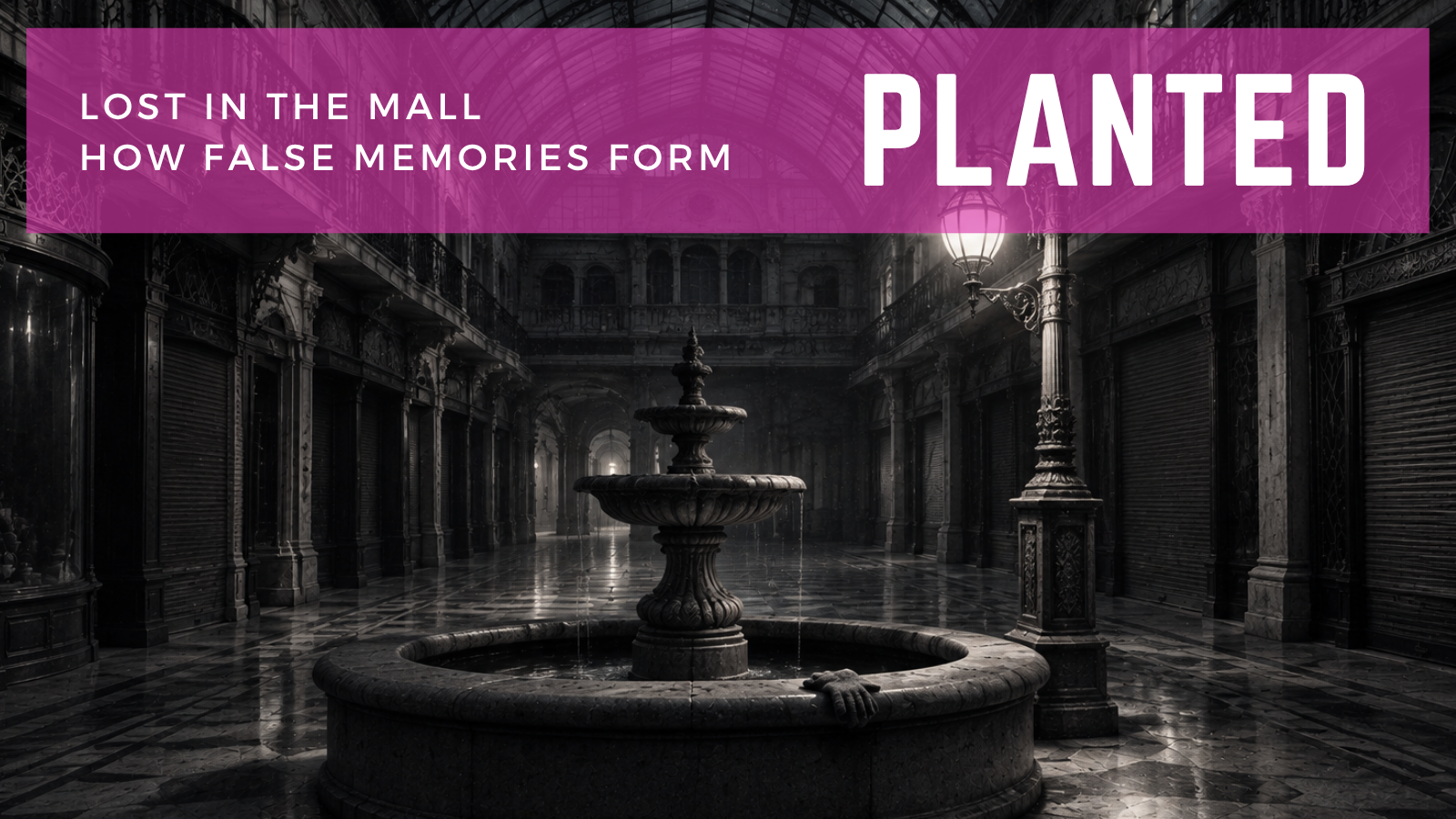
Lost in the Mall: How False Memories Are Planted
In 1995 researchers mixed real childhood stories from people's families with one invented one, and a quarter of those people came to remember getting lost in a shopping mall. The lesson: memories are fluid and can be influenced. What the study found, what the 2023 replication added, and what it does not show.
Years ago I worked on a hidden camera show presented by Ainsley Harriott. My job was to learn the lives of about five people who had been invited to watch a TV recording. I played a security guard. While they were mingling outside, before they went in, I would walk up and say, "Hey, John, how are you doing? I haven't seen you since school."
None of them had ever met me. I have a Scottish accent and I was five or six years older than most of them. But I started with things that were true: the name of their maths teacher, details from their school days. They would say, "Yeah, I remember that." Then, bit by bit, I added things that were not true, about the two of us. By the end, four of the five believed they actually knew me.
It was entertainment, but it shows the lesson of this research in real life. Memories are fluid, and they can be influenced. In 1995, the psychologists Elizabeth Loftus and Jacqueline Pickrell did something very like it under controlled conditions. They gave people three true childhood stories from their relatives and one invented one, about getting lost in a shopping mall at about five. A quarter of them came to remember at least part of it.
A much larger replication in 2023 found about a third.
Why this study matters
Before 1995, research had already shown that details of a memory could be changed after the event. Loftus and Palmer's 1974 car crash study is the famous example, and The Misinformation Effect: Loftus and Palmer's Car Crash Study covers it. Changing a detail is one thing. The bigger question was whether you could give someone a memory of a whole event from their own childhood that never took place.
That question matters well beyond the laboratory. Courts, therapists and families all lean on what people remember about the past. It also matters to anyone learning anything, because it goes to the heart of a belief that is easy to hold without thinking: if I can remember it clearly, it must have happened.
The research
The research: Loftus and Pickrell, 1995
- In short: People were given four short stories about their own childhood. Three were true. One, about getting lost in a shopping mall, was invented. After two interviews, a quarter of them reported remembering at least part of the invented event.
- What they did: Relatives supplied true events from each participant's early life. Each participant then received a booklet with three of those true events and one invented event: being lost in a shopping mall at about the age of five and rescued by an older person. They were interviewed twice about all four.
- Who was involved: Elizabeth Loftus and Jacqueline Pickrell at the University of Washington, with 24 participants and their relatives.
- What they found: 6 of the 24 people, 25%, came to report a full or partial memory of being lost in the mall.
- What they concluded: A whole false memory of a childhood event can be implanted by suggestion from a trusted source.
The research: Murphy and colleagues, 2023
- In short: A team in Ireland repeated the study with five times the number of participants and fixed their rules in advance. About a third formed a false memory, most of them partial.
- What they did: They kept the original structure, three true events and one invented, with two interviews, and preregistered their coding rules. That means they published how they would decide what counted as a false memory before they saw any results, so nobody could move the goalposts afterwards.
- Who was involved: Gillian Murphy at University College Cork, Ciara Greene at University College Dublin and colleagues, with 123 pairs of participants and relatives.
- What they found: 35% were coded as having a false memory of the invented event: about 27% partial and about 8% full. By the end, 14% said they remembered the event, and a further 52% said they believed it had happened.
- What they concluded: The original finding holds, at a higher rate, in a sample five times larger. It was published in the journal Memory.
The first study was small: 24 people. On its own, a landmark but a thin one. The second was preregistered, five times the size, and it confirmed the result. So the core claim, that a false childhood memory can be planted in a good number of ordinary people, now rests on a strong replication, not on one small study.
The episode of the science podcast Radiolab on memory and forgetting gives this work a full segment, from changing the details of a witnessed event to planting a whole childhood one. It is one of the clearest tellings there is.
▶ Watch: Radiolab, Memory and Forgetting (57 minutes)
What I take from it
The core lesson of this research is simple: memories are fluid, and they can be influenced. They are not stored like a recording and played back. They are rebuilt, and what other people tell us, especially people we trust, can become part of what we rebuild.
The hidden camera show and the mall study work the same way. Start with details that are true, from a source the person trusts, and the invented part rides in alongside them. That is my reading of why both worked: the true details did the persuading.
Three points from the research are worth holding on to.
The source was family. The invented story did not come from a stranger. It sat in a booklet beside true stories from people the participants trusted. Much of what we know about our early childhood reaches us the same way: a story told at Christmas, a photo, a parent saying "you loved that beach".
Believing is not remembering. The 2023 numbers split the two neatly. Only 14% said they remembered the event, and another 52% said they believed it happened without remembering it. You can be sure something happened and have no memory of it at all.
Vivid is not proof. A memory that comes back in colour, with detail, feels true. Most of the false memories in 2023 were partial, but some were full, and you could not tell them apart by how they felt to the person holding them.
The same flexibility is what makes memory techniques work. In a memory palace, where you hold what you are learning as vivid images placed at spots along a familiar route, you invent freely, because nothing in a palace claims to be history. Outside a palace, anything you need to be true gets checked against a source.
What the lost in the mall study does not show
This research has been dragged into some fierce arguments, so it is worth being careful.
- It does not show that recovered memories are false. In the 1990s there were bitter disputes over memories of childhood harm recovered in adulthood, and this study was pulled into the middle of them. What it shows is that false memories can be implanted. It does not show that every recovered memory is false, and it cannot tell you whether any particular memory is true.
- It does not show that everyone is open to it. Three quarters of participants did not form a false memory in 1995, and about two thirds did not in 2023.
- It does not show that people fully remembered the event. Most of the false memories in 2023 were partial: fragments, a feeling, a scene they could half picture.
- It does not mean you have a poor memory. Suggestion worked on ordinary people with ordinary memories. Being open to it is part of how memory works, not a sign that yours is failing.
- It does not mean your memories are mostly wrong. The studies show what happens when someone deliberately plants a story. They do not measure how accurate everyday memories are.
How to use it this week
You cannot switch off the creative side of memory, and you would not want to. You can use it on purpose and guard against it where it counts.
- Invent freely inside a palace. Add whatever makes a location vivid, even a detail you know was never there. A palace is a tool, not a record. If you want to try it, How to Build a Memory Palace: A 7-Step Beginner's Guide (With Worked Examples) walks you through one from start to finish.
- Ask where a memory came from. Pick one early memory you are sure of. Ask yourself: do I see it from my own eyes, or do I see a photo of it? Did I ever hear the story told? You are not trying to prove it false, only to notice where it came from.
- Split remembered from believed. When something matters, such as a date, who said what in a meeting, or where you left the passport, say to yourself which it is. "I remember doing it" and "I am sure I did it" are different claims.
- Check against a record. Emails, diaries, photos, the minutes, the script. For anything you will act on or repeat to others, the record wins over the feeling.
- Recall, then check straight away. When you practise recalling something you are learning, compare it with the source immediately afterwards and fix anything that drifted. That way the version that gets stored again is the right one.
- Be careful what you tell other people about their past. A confident "you were there, you loved it" from someone they trust is exactly the kind of story these studies used. Ask them what they remember before you tell them what you remember.
Where to go next
For the bigger picture of why memory rebuilds rather than replays, start with How Memory Works (A Practical Guide). The 1932 work that first showed people reshaping a story as they retold it is in Bartlett's War of the Ghosts: Why Memory Is Reconstruction. If you want to know why a memory can shift every time you use it, go to Memory Reconsolidation: Why Recalling a Memory Changes It. And for how one word in a question can change what a witness saw, see The Misinformation Effect: Loftus and Palmer's Car Crash Study.
To keep facts that must be exact from drifting, How to Memorise Dates and Historical Events ties each event to its year with a reference story, one small vivid scene that links the two, which you can check against the source.
Memory map
- On a hidden camera show, true school details led four of five strangers to believe they knew me. Image: a security guard in a peaked cap greeting a surprised guest like an old friend outside a TV studio.
- Memories are fluid and can be influenced: start with true details and the invented part rides in. Image: a river carrying a toy boat that someone has slipped in among real ones.
- In 1995, three true childhood stories were mixed with one invented one. Image: four small paper booklets on a kitchen table, one of them glowing slightly brighter than the rest.
- The invented event: lost in a shopping mall at about five, rescued by an older person. Image: a small child standing alone by a fountain in a busy shopping centre, an older woman bending down to take their hand.
- A quarter of 24 people came to remember at least part of it. Image: four chairs in a row, one of them occupied by someone gazing into the distance.
- In 2023 a preregistered replication with 123 pairs found about a third. Image: a sealed envelope pinned to a noticeboard before a crowd of people arrives.
- Most false memories were partial, a scene half pictured. Image: a jigsaw of a shopping mall with half the pieces missing.
- Believing is not remembering: 14% remembered, 52% more believed. Image: one person pointing at a clear photograph, another nodding at a blank frame.
- The source was trusted family, beside true stories. Image: a grandparent showing a photo album to a grown-up child on a sofa.
- It shows false memories can be planted, not that recovered memories are false. Image: a gardener planting one seed in a large, already blooming garden.
- Invent inside a palace; check against a record outside it. Image: a person hanging bright props along a corridor, then sitting at a desk checking a diary.
- Recall, then check straight away, so the right version is stored again. Image: someone closing a book, speaking aloud, then opening it to compare.
Sources
- Loftus, E. F., and Pickrell, J. E. (1995). The formation of false memories. Psychiatric Annals, 25(12), 720 to 725. https://doi.org/10.3928/0048-5713-19951201-07
- Murphy, G., Dawson, C. A., Huston, C., Ballantyne, L., Barrett, E., Cowman, C. S., Fitzsimons, C., Maher, J., Ryan, K. M., and Greene, C. M. (2023). Lost in the mall again: a preregistered replication and extension of Loftus and Pickrell (1995). Memory, 31(6), 818 to 830. https://doi.org/10.1080/09658211.2023.2198327
- Loftus, E. F., and Palmer, J. C. (1974). Reconstruction of automobile destruction: an example of the interaction between language and memory. Journal of Verbal Learning and Verbal Behavior, 13(5), 585 to 589. https://doi.org/10.1016/S0022-5371(74)80011-3 (the home for this study is The Misinformation Effect: Loftus and Palmer's Car Crash Study)
- Bartlett, F. C. (1932). Remembering: A Study in Experimental and Social Psychology. Cambridge University Press. https://www.cambridge.org/core/books/remembering/introduction-by-walter-kintsch/F0D79E0E3DD1933FAB3117BB9D1CFA44 (the home for this work is Bartlett's War of the Ghosts: Why Memory Is Reconstruction)
- Radiolab (2007, re-released 2024). Memory and Forgetting. WNYC Studios. https://www.youtube.com/watch?v=Oywd34Hmfq4
Loci
Build the memory palace in this article inside Loci — store your locations, link images, and rehearse with spaced repetition.
Try it in LociMemory School community
Learn directly with Mark inside the Memory School community on Skool — monthly lessons, practice, and Q&A.
Join Memory SchoolAbout the author
Mark Channon
Grand Master of Memory (1995). Author of three books on memory published by Hodder and Nick Hern. Creator of BBC1's Monkhouse's Memory Masters. Memory coach on Channel 4's Can I Improve My Memory?
Read full bio →