
Memory Palace
The Roman Room Method
The Roman room is the simplest memory palace variant. A single room you can picture clearly, used to store information at five clockwise locations. The fastest way to start memorising with structure.

The Roman room is the simplest version of the memory palace, the technique of fixing things in mind by picturing them at set spots you can visit in order. One room you know well. Five locations chosen in clockwise order. Five pieces of information stored against them. Done in ten minutes flat.
It is the perfect starting point for anyone new to memory techniques. Small enough to build in a single sitting, large enough to be useful, and the same underlying mechanism that scales all the way up to deck-of-cards memorisation, hour-long speeches, and entire degree courses.
Why it is called the Roman room
The technique gets its name from Roman orators, who built memory rooms in their minds to hold the structure of long speeches. A senator preparing for a court appearance might furnish a mental room with statues, paintings, and items of furniture. Each piece would represent a section of his argument. He would then "walk" the room as he spoke, using the items as cues for what came next.
Cicero, the Roman statesman and orator, wrote about this approach in De Oratore. The unknown author of the Rhetorica ad Herennium gave the most detailed surviving description in the first century BCE. Trained Roman speakers could deliver multi-hour arguments without notes by walking through carefully designed mental rooms.
Two thousand years later the technique still works exactly the same way. Only the décor has changed. The principle that won court cases for Cicero is the same principle world memory champions use to memorise shuffled decks of cards in under thirty seconds today.
Why a single room is the right place to start
There are three reasons the Roman room is the perfect first memory palace.
It is small. Five locations. You cannot get lost. You cannot get overwhelmed. The whole thing is built and tested inside ten minutes.
It is easy to set up. When you start with a room you already know, it is already in your head, so you can skip straight to placing information rather than learning the space first. That is the only reason to begin here. It is not that memory palaces require a familiar place (they do not, as you will see once you move on to virtual palaces, built from places you explore on a screen), it is that a known room removes one thing to think about while you are learning the technique.
It teaches every principle you need. Picking locations in a fixed order, attaching vivid images, walking the route mentally, testing yourself, reviewing on a schedule. Everything you will later do in a 100-location journey palace, you first practise here on five locations.
If you have never used memory techniques before, building a Roman room is your first afternoon of training. By tomorrow you will already be doing things you did not think you could do.
How to build a Roman room
The whole thing fits on the back of an envelope.
- Pick a room you know well. Your living room, your kitchen, your bedroom, your office, your favourite café.
- Stand at the doorway in your mind.
- Looking around the room in a clockwise direction, pick the first five distinctive items.
- Write them down in order, numbered 1 to 5.
A typical living room might give you: sofa, curtains, coffee table, TV, bookcase. A kitchen might give you: fridge, sink, kettle, hob, oven. A bedroom might give you: bed, lamp, wardrobe, mirror, dressing table.
That is a Roman room. Five locations. Your first memory palace, a set of places you can call up in order and use again and again.
The clockwise direction matters. It gives your route a fixed, automatic order. Every time you walk the room mentally, you go the same way around. Once that rhythm is locked in, the locations come back in sequence without effort.
Locking the room in
Before you use the room to store information, the room itself needs to be automatic. Spend two minutes doing this.
Close your eyes. Picture yourself at the doorway. Name each location aloud, in order, as you "look" at it. Now run through them in reverse. Then forwards again, fast. Three forwards-backwards passes and you know the room.
Some people prefer to draw the room out on paper the first time, marking the five locations in clockwise order. That is fine, but the goal is for the room to live entirely in your head, not on the page. Throw the diagram away once you know the room.
Using the room
To memorise five pieces of information.
- Turn each piece into a vivid image.
- Place one image on each location in your room.
- Have the image do something to the location: sitting on it, breaking it, spilling over it. Beside it is not enough.
- Walk the room to test.
Here is a worked example. Say you need to remember five points before a meeting. The agenda is: budget, hiring, the office move, the Q3 report, the team offsite.
- Sofa. A giant piggy bank is squashing the sofa, coins pouring out of the slot, the wooden legs splintering. (Budget.)
- Curtains. A row of paper CVs is hanging from the curtain rail like washing on a line, blowing in a breeze. (Hiring.)
- Coffee table. The table is being lifted up by removal men in overalls who are tipping it sideways. (Office move.)
- TV. The screen is glowing red and a paper document marked "Q3 REPORT" is bursting out of the front of the screen, breaking the glass. (Q3 report.)
- Bookcase. A tiny team of people in matching t-shirts is having a picnic on top of the bookcase, with a barbecue and beach umbrellas. (Team offsite.)
Five seconds per location. Twenty-five seconds total. The list stays with you for the meeting and the next few days.
When you arrive at the meeting, walk the room mentally and the agenda surfaces in order. No notes. No glancing at your phone. You look fully present because you are fully present.
Why five?
You do not have to use five locations. But chunks of five are where the human brain works best.
Working memory holds four to seven items comfortably. Five is the sweet spot. It is also the number of fingers on one hand, which makes it easy to count off if you are checking yourself.
For longer lists you do not need more locations per room. You need more rooms.
Four rooms multiplied by five locations each gives 20 memory files, a file being one spot that holds one image. Eight rooms by five gives 40. Sixteen rooms by five gives 80. The pattern is identical at every scale. The Roman room is the unit cell. The bigger palaces are just built out of multiples of it.
Expanding the Roman room
When you outgrow your first Roman room, the technique scales naturally.
Add a second room. Walk through the doorway into it. Pick another five locations in clockwise order. Now you have ten memory files in two connected rooms.
Add a third room. Then a fourth.
Once you have four rooms by five locations, you have a 20-file memory palace. Enough for a presentation, a chapter of a book, or a complete vocabulary set for a foreign-language session.
Push further and you have built a full memory palace.
Push further still by walking out the front door and onto the street, picking locations along the way, and you have built a journey method palace that can hold hundreds of items.
The Roman room is the seed crystal. Every memory palace, every journey method, every memory-athlete performance grows out of the same simple idea. A place whose locations you can recall, a clear order, and vivid images placed deliberately.
Real uses for a Roman room
Five-location memory rooms are perfect for short, ordered lists that you only need to keep in your head for a few days. Some examples.
Your five points before a meeting. Walk in with the agenda already in your head. You will look more prepared and more present than the rest of the room.
Your five-item shopping list. No notes app. No scribbled paper. Just walk the room as you walk the aisles.
The five key ideas of a chapter you are reading. Place one idea per location as you read. Walk the room to review.
The five questions you want to remember to ask in an interview. Critical situations like this is where the technique really earns its keep. You can take notes, but you cannot read them mid-question.
The five steps of a recipe you do not want to keep checking. Useful when your hands are wet or covered in flour.
The five names of new colleagues on your first day. Image-based name mnemonics placed on the room locations.
The five things you want to say in a wedding speech. This is one of the highest-leverage uses for ordinary people, and it is the kind of memory work that changes your relationship with public speaking.
Anywhere you would normally write a list on the back of your hand, a Roman room does it better. And once the rooms become a habit, your hand never needs the ink again.
Common Roman room mistakes
Three things to avoid as you start.
Picking locations that move. A vase on a table is fine. A child or pet who might not be there is not. Locations need to be stable.
Picking locations too close together. If two locations are within a few centimetres of each other, the images will bleed into one another. Choose locations that are clearly distinct in space.
Making the images too small or too quiet. Vivid means exaggerated. The piggy bank should not be sitting daintily on the sofa. It should be crushing the sofa, with coins exploding everywhere, in colour, loudly. Big, weird, exaggerated, ridiculous. That is what sticks.
Where to go from here
The Roman room is everyone's first memory palace, but it is rarely anyone's last. Once it feels comfortable, the natural next reads are How to Build a Memory Palace: A 7-Step Beginner's Guide (With Worked Examples) for the full-scale building palace and its worked examples, and The Journey Method Explained for sequences too long to fit in a building.
If you want a head start on the palace-building stage, LOCI will build rooms and journeys for you, from Google Street View or generated with AI, that you can walk through and adopt as your own memory palaces.
The Roman room is the first memory palace any beginner should build. It is also one you will keep using for small, time-bounded lists. The same simple shape that taught Cicero to deliver hour-long speeches in 50 BCE will get you through the supermarket without forgetting the milk. Two thousand years on, it has not been beaten.
Memory map
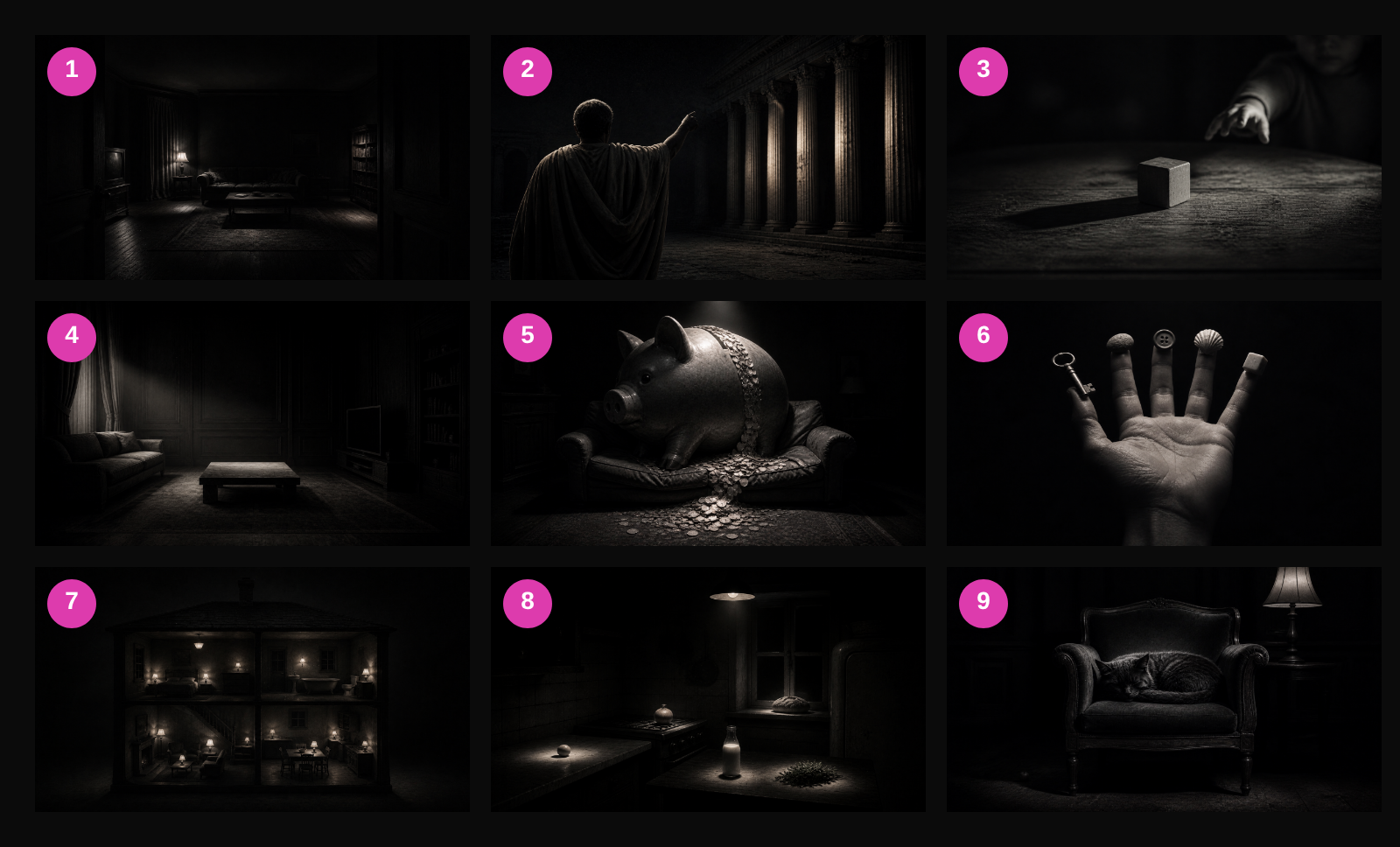
- The Roman room is the simplest memory palace: one room, five locations, clockwise. Image: a living room with five spots glowing in a circle.
- It is named for the Roman orators who used the rooms of their own homes. Image: a Roman figure standing in a courtyard, pointing at five columns.
- A single room is the right start: small, quick to set up, and it teaches every principle. Image: a child's first building block on an empty table.
- Pick five fixed items in order; lock them in with eyes closed. Image: a sofa, curtains, coffee table, television and bookcase, each lit in turn.
- Place one vivid image per location, interacting with it. Image: a giant piggy bank squashing a sofa, coins spilling from the slot.
- Five works because it fits working memory and tests in seconds. Image: an open hand with five fingers, a small object on each tip.
- Expand by adding rooms, five locations each, in a fixed order. Image: a house cut away to show four rooms, each with five bright spots.
- Use it for meeting points, shopping lists, interview questions, recipes and speeches. Image: a kitchen with five ingredients on five surfaces.
- Avoid locations that move, locations too close together, and images too small to notice. Image: a cat on a chair beside a tiny apple nobody would see.
Sources
- Mark Channon, How to Remember Anything (Hodder Education)
- Cicero, De Oratore, Book II (the Simonides story); Frances Yates, The Art of Memory (1966; Pimlico edition 1992)
Loci
Build the memory palace in this article inside Loci — store your locations, link images, and rehearse with spaced repetition.
Try it in LociMemory School community
Learn directly with Mark inside the Memory School community on Skool — monthly lessons, practice, and Q&A.
Join Memory SchoolAbout the author
Mark Channon
Grand Master of Memory (1995). Author of three books on memory published by Hodder and Nick Hern. Creator of BBC1's Monkhouse's Memory Masters. Memory coach on Channel 4's Can I Improve My Memory?
Read full bio →