
Memory Palace
The Journey Method Explained
The journey method is a memory palace that runs along a route rather than inside a building. It's how you memorise a long list in a single sequence. The technique to use when you need scale.

A memory palace, where you turn each thing you want to remember into an image and leave it at a set spot inside a building you know, works beautifully for 20, 30, maybe 50 items. Push past that and you start to run out of locations. A typical home only has so many rooms, and a typical room only has so many distinctive items.
When you need to memorise hundreds of items in a single sequence, you switch to the journey method. Same underlying principle as a memory palace, but instead of one building you use a route. A walk, a run, a drive. With as many locations as you need.
This is the technique world memory champions use for binary digits, deck after deck of cards, and hour-long performances of memorised poetry. It scales like nothing else. It is also the right tool for anyone who wants to memorise a whole book, a whole subject, a whole career's worth of professional knowledge.
A short history
The journey method is one of the oldest variants of the method of loci, the ancient memory technique traditionally traced back to the Greek poet Simonides of Ceos around 500 BCE.
The Greeks and Romans tended to build their memory locations inside buildings: a villa, a temple, a public forum, the senator's own house. The principle was identical to what we now call the journey method, but the scale was usually a single grand interior.
By the medieval period, scholars were building memory journeys that wound through entire cities and along pilgrimage routes. Some of the most extraordinary surviving memory manuals describe journeys that span dozens of miles of imagined countryside, each with hundreds of locations.
The modern revival of memory techniques in the 1990s, led by writers like Dominic O'Brien and Tony Buzan, formalised the journey method as a named technique alongside the memory palace. Memory competitors still use versions of it today.
How the journey method works
The journey method has three parts.
- Pick a route. A walk you do regularly, a route to school as a child, a holiday town you remember vividly, or a route you have never walked in person but have explored in LOCI, which builds a palace from Google Street View. Familiarity is optional. What matters is that you can run the locations in order, and a few minutes of observation locks that in.
- Choose specific points along the route as your locations. Each location is a "memory file" where you will store one piece of information.
- Place vivid images at each location. To retrieve, you walk the route in your mind. The locations trigger the images. The images trigger the information.
A useful trick for building a big journey. Start with the end points and fill in the gaps. Pick the beginning and pick the end. Walk between them slowly in your mind and note every distinctive thing you pass. If you wanted 50 locations and only got 30 on the first pass, walk it again. There are always lampposts, shop fronts, doorways, bus stops, and benches you missed.
What counts as a location
Anything you can instantly recognise on the route counts. The bar at the corner of your street. The lamppost outside the chemist. The red door three houses down. The bench by the tennis court. The corner where you turn left to get to the station.
Each location should be a specific point, not a general area. Not "the park" but "the wooden bench under the oak tree at the entrance to the park." The more specific the location, the stronger the memory. Vagueness at this stage is the single biggest source of failure later.
A useful rule of thumb. If you cannot picture the location with your eyes closed in less than a second, it is too vague. Pick a more specific point.
A worked example
Say your route is from your front door to your local train station. As you walk it mentally, the locations you pull out might be:
- Front door
- Garden gate
- The corner with the lamp post
- The fence outside the school
- The chemist's window
- The post box
- The roundabout
- The Tesco entrance
- The flower bed outside Tesco
- The pedestrian crossing
- The pub on the corner
- The station entrance
- The ticket barriers
- The bench on platform 1
- The bench on platform 2
- The bridge over the tracks
In 90 seconds you have 16 locations. Extend the journey to the office on the other end and you will easily clear 50. Take a journey through a town you lived in as a child and you will easily clear 100.
That is enough to memorise a Shakespeare sonnet, the names of 50 colleagues, or the first hundred elements of the periodic table.
When to use a journey versus a memory palace inside a building
Both are variants of the method of loci, but they are best at different things.
A memory palace inside a building suits 5 to 30 items, especially when you want clean topic separation. One room for one topic. If your material falls into three categories, three small palaces is the right shape.
A journey method palace suits 30 to 500 items in a single long sequence, especially when the information naturally has an order. The periodic table in order. Every UK Prime Minister back to Walpole. Every chapter of a book in sequence. Every line of a long monologue.
In practice, a mix works well. Small palaces for topic-organised information. Long journeys for sequenced information.
Building your first journey
For your first journey, a route you have walked, driven, or cycled many times is the quickest to set up, because the locations are already in your head. Sit down with your eyes closed and walk it. As you pass each distinctive feature, name it out loud and assign it a number. If you would rather use somewhere new, open LOCI, pick a route, and observe each location for a few seconds to lock it in. Both approaches work.
Aim for 36 locations on your first journey. That is enough to be useful and not enough to be intimidating. If you naturally end up with more, keep them. Memory athletes typically use journeys of 100 to 500 locations, but you do not need that scale on day one.
Once the journey is built, lock it in by running it forwards and backwards three times. Then chunk it into blocks of five. That is how you will later retrieve it.
Set a timer for one minute and try to name every location in order. Then in reverse order. Then jump randomly: "what is location 23? What is location 9?" If you can do all three smoothly, the journey is ready to use.
Memorising onto the journey
Once the journey is solid, placing information works exactly like a memory palace. Turn each item into a vivid image. Place one image per location. Make it interact with the location. Not just near it, but doing something to it.
For long sequences, chunk the encoding too. Place five images. Test those five. Place the next five. Test those. Test all ten together. Place, test, place, test: a little at a time.
The same review schedule applies as any other memory palace work. Review one hour after building. Review the next day. Review a week later. Review a month later. Each review takes 30 seconds to a few minutes. After four reviews the information is in long-term memory and will stay there for years with only occasional refreshes.
The LOCI upgrade
The single biggest upgrade to the journey method in the last decade is being able to walk streets you have never visited. LOCI does this with Google Street View, and can also generate a palace with AI when you want one built to order.
You are no longer limited to routes you have personally walked. Pick any town, any street, anywhere on the planet, and walk it on screen until you know it. A fifteen-minute virtual walk through a town you find interesting gives you 50 to 100 brand new memory locations you can use for years.
A journey palace in a town you have never physically visited works as well as the route you walked as a child. Once the locations are in your head, the brain cannot tell the difference between routes you walked in person and routes you walked through a screen.
For an even faster path, let LOCI build the journey for you and turn your notes, a book or an article into images along it. You still walk it and say it aloud; the app just removes the setup.
Multiple journeys and journey libraries
Once you have one journey, build another. And another. Over time you can build a library of separate journeys, each one dedicated to a specific kind of information.
A typical setup might look like:
- Journey 1. Home to school as a child. 100 locations. Used for memorising poetry.
- Journey 2. A holiday town in Italy. 80 locations. Used for memorising historical dates.
- Journey 3. A route through Manhattan built in LOCI. 150 locations. Used for decks of cards.
- Journey 4. A route around your current home town. 60 locations. Used for short-term study material that gets recycled.
The journeys themselves do not interfere with each other once they are well established. Each one has a distinctive starting point, so the moment you mentally "step on" to a journey, you know which one you are using.
Temporary versus permanent journeys
A useful distinction.
Temporary journeys are for short-term content. A single exam, a single audition, a single presentation. After two to three days without review, the images fade naturally and the journey is ready to be reused. Do not fight this. Use it.
Permanent journeys hold the knowledge you will use for years, the core of a profession or a subject. A walk-through once a quarter keeps them solid.
A typical memoriser might have ten permanent journeys for serious knowledge and dozens of temporary journeys that recycle constantly as material comes and goes.
When the journey method goes wrong
A few failure modes worth flagging.
You cannot recall the locations reliably. If you have to stop and think about whether the chemist comes before or after the post box, the journey is not locked in yet. The fix is not necessarily a more familiar route; it is spending a few more minutes observing each location in order until the sequence comes back automatically.
The locations are too vague. "The park" is not a location. "The wooden bench under the oak tree" is. Push for specificity.
You skipped chunking. Trying to place 50 images in one go without testing in chunks of five almost always loses some. Chunk and test.
You skipped review. Without the spaced review schedule, even a well-built journey decays. Four short reviews and you are set for years.
You used the same journey for two competing pieces of content too close together. Wait two to three days between uses of a temporary journey, or build a second one.
Where to go from here
The journey method is one of the highest-leverage techniques in memory training. It is also one of the most rewarding to master, because the moment it clicks you realise you have just unlocked effectively unlimited storage.
Next reads. How to Build a Memory Palace: A 7-Step Beginner's Guide (With Worked Examples) for the building-based variant, with worked walkthroughs you can borrow. The Roman Room Method for the smallest, simplest version. How to Memorise a Deck of Cards for the iconic application of the journey method.
That is the real power of the journey method. Effectively unlimited storage. Effectively unlimited recall. And the route is already there, waiting for you to use it.
Memory map
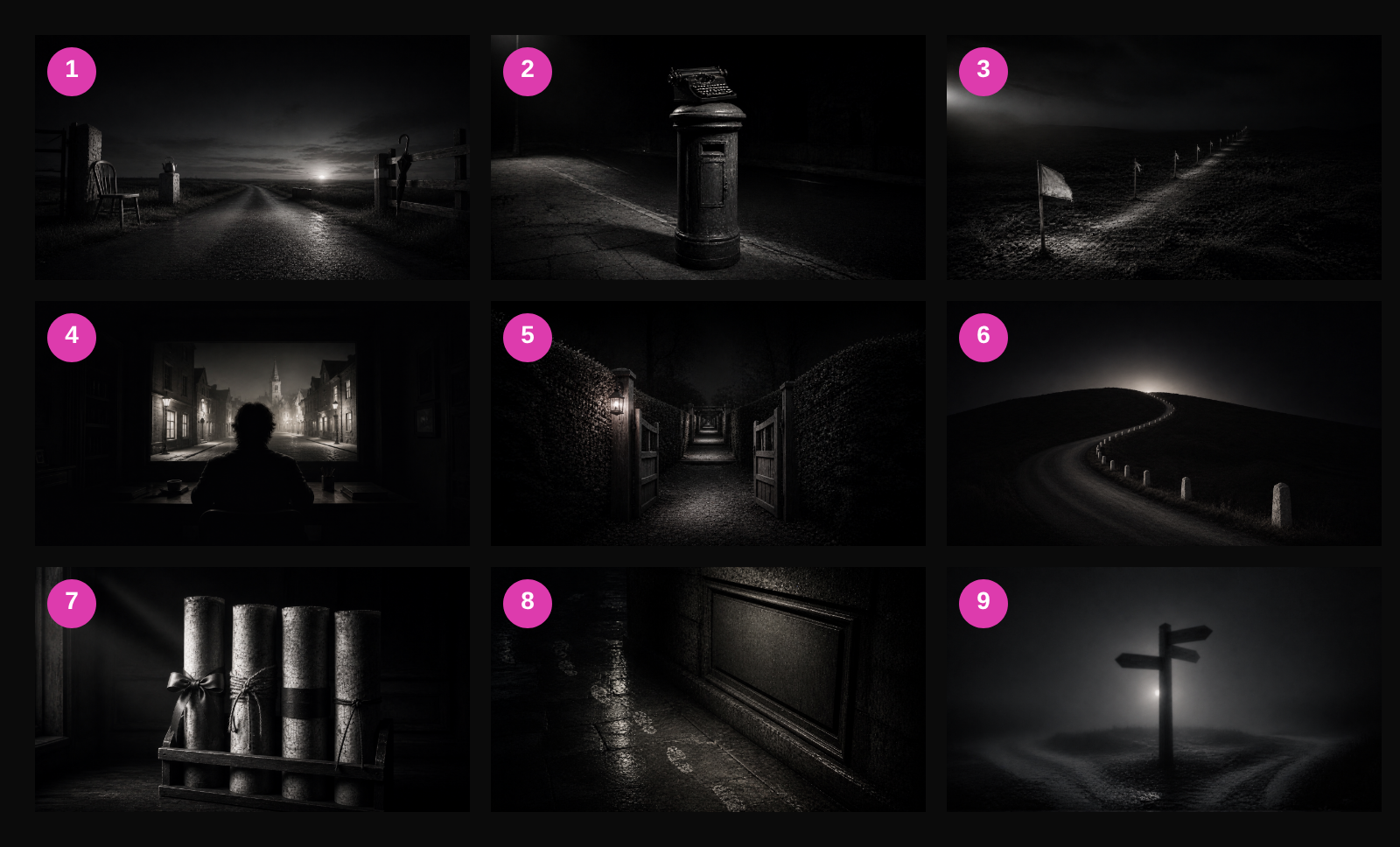
- The journey method is the method of loci laid along a route rather than inside a building. Image: a long country road with objects placed at every landmark.
- A location is any point you can recognise instantly: a bench, a shop door, a postbox. Image: a red postbox with a strange object balanced on top.
- Pick a start and finish, then fill in the locations between them. Image: two flags at either end of a path, pins appearing along it.
- The route does not need to be one you have walked; LOCI gives you any town in the world, or an AI-built one. Image: a person at a screen, a foreign high street glowing on it.
- Lock the journey in by chunking into fives and running it forwards and backwards. Image: a path divided into short sections by small gates.
- Journeys scale to hundreds of locations where a single room cannot. Image: a winding road disappearing over a hill, numbers along its edge.
- Keep a library of journeys for different kinds of material. Image: four rolled maps in a rack, each tied with a different ribbon.
- Temporary journeys fade in a few days; permanent ones need the review schedule. Image: chalk footprints on a pavement beside a brass plaque.
- It fails when locations are vague, chunking is skipped or two uses are too close together. Image: a blurred signpost in fog.
Sources
- Mark Channon, How to Remember Anything (Hodder Education)
Loci
Build the memory palace in this article inside Loci — store your locations, link images, and rehearse with spaced repetition.
Try it in LociMemory School community
Learn directly with Mark inside the Memory School community on Skool — monthly lessons, practice, and Q&A.
Join Memory SchoolAbout the author
Mark Channon
Grand Master of Memory (1995). Author of three books on memory published by Hodder and Nick Hern. Creator of BBC1's Monkhouse's Memory Masters. Memory coach on Channel 4's Can I Improve My Memory?
Read full bio →