

Memory Training
The Daily Memory Workout
Memory is a skill, and like any skill it responds to training. Here is how to build a daily memory workout, warm-ups, speed games, and stamina sessions, and make it a habit that sticks.

When it comes to improving your memory there is bad news and good news, and they are the same fact seen from two sides. The bad news is there is no magic bullet. Improving your memory is a skill, and like any skill it takes time, effort, and commitment. The good news is that improving your memory is a skill, which means it is something anyone can learn. All you need is a set of compelling reasons and some good habits and routines.
This is the part of memory training people skip. They learn the memory palace, seeing each thing to remember as an image parked at a spot along a mental route, feel the rush of memorising something impressive, and then never practise again. The techniques fade, and they conclude the techniques "did not work." Memory, like fitness, is kept rather than acquired. A daily memory workout is how you keep it.
Here is how to build one: how to think about it, how to structure warm-ups, speed games, and stamina sessions, how much to do, and how to turn the whole thing into a habit that actually sticks.
Think of it like training for a marathon
The most useful way to think about a memory workout is to treat it like physical training.
If you went out and ran every day, you would get fitter, learn about yourself, discover how far you can push, and open your eyes to your potential. But the people who keep it up are usually the ones training towards something, a race, a marathon, a specific goal. With a focused outcome comes motivation, and with motivation comes results.
Your memory workouts work the same way. Train without a purpose and you will drift. Train towards something, a specific exam, a body of professional knowledge, a memory competition, or simply the goal of being the person who never forgets a name, and the practice sustains itself. Before you build a workout, get clear on why you are doing it.
There is also a hard scientific reason to commit. In 2017 a team led by Martin Dresler, with the memory athlete Boris Konrad, scanned people before and after six weeks of mnemonic training, practice in memory techniques (40 sessions of 30 minutes) and found their brain networks had shifted towards the pattern seen in memory champions, with the gains still there four months later. Six weeks of regular practice changes how your brain connects up. The workout is not a metaphor.
Preparation: build your memory palaces first
Before you start working out, you need somewhere to put things. Build a stock of places to store images in order, in advance: memory palaces, journeys (routes from one place to another), and peg lists (short numbered sets of images, such as parts of your body).
Around 100 memory files, single locations that each take one image, is enough to get started. If you are training every day, aim for more, around 300, so that you can rotate your palaces and give the images time to fade between uses. A temporary palace clears itself within a few days when you only intended to keep the information briefly, which means a large stock of palaces lets you train daily without old images interfering with new ones.
If images get stuck and you want to reuse a palace before they have faded, clean it with an eraser image, a picture you lay over each location to wipe it (The Peg System Explained shows one). The old associations dull and the palace is ready for new information.
The three kinds of workout
A complete memory workout, modelled on the disciplines at the World Memory Championships, has three components. You do not do all three every day, you mix them.
Warm-ups. Short, gentle exercises to get you into the memory zone before a session. Converting random numbers you see into images, a quick recognition drill, a minute of story cubes (dice with pictures instead of numbers), or a brief mindfulness exercise to settle your focus. Warm-ups prime your imagination and your attention, the two engines of all memorising.
Speed games. Short, timed challenges that train rapid encoding. Five minutes memorising as many random words as you can. Five minutes of numbers. Five minutes of a shuffled deck of cards. Five minutes of names and faces. Speed games train you to encode fast and under a little pressure, which is exactly the skill you need when information comes at you in real life.
Stamina games. Longer sessions that train sustained focus and large-scale memorising. Thirty minutes of numbers. Thirty minutes of cards. Twenty foreign words. A full TED talk memorised. Stamina sessions build the endurance to handle big bodies of information, an exam syllabus, a long script, a professional knowledge base.
A balanced week mixes all three: warm up before each session, do speed games most days, and fit in a stamina session a couple of times a week.
The games behind the workout
The workout structure comes from the disciplines used at the World Memory Championships, adapted for training rather than competition. It is worth knowing the games themselves, because they give you a ready-made menu to draw from.
The World Memory Championships have run since 1991, and their events are the template for the games below. The sport is now practised in dozens of countries, and to become an official Grand Master of Memory you have to perform at a serious level across several disciplines, memorising long sequences of numbers, multiple packs of cards, and a single shuffled pack at speed. The World Memory Championships Explained (by Someone Who Competed in 1995) tells the full story.
The disciplines translate neatly into training games:
Numbers. Memorise as many random digits as you can in a set time, using your number system (a fixed image for each digit or pair of digits) and a memory palace. A five-minute version is a speed game, a thirty-minute version is a stamina session.
Cards. Memorise a shuffled deck, or as much of one as you can, against the clock. Five minutes for speed, a full deck timed for stamina.
Names and faces. Memorise as many names paired with faces as possible in a set time. One of the most directly useful disciplines for everyday life.
Words. Memorise a list of random words in order. A pure test of the chain method, linking each word to the next in a story, and the memory palace.
Foreign words, spoken numbers, and longer-form challenges round out the menu and stretch different skills.
Pick from these the games that train the skills you most want in real life. If your goal is networking, weight your training towards names and faces. If it is exams, towards words and numbers. The games are a means to your actual purpose, not an end in themselves.
A warm-up worth doing
Before any session, a short warm-up gets you into the zone. A few options:
- Energise. A minute of movement and a few deep breaths to get blood flowing and shoulders down, since memorising works best in a relaxed, focused state.
- Story cubes or random words. Roll some story dice or pick random words and link them into a quick chain, just to get your imagination moving.
- Recognition drills. Glance at a small set of items, look away, and recall them, building the habit of deliberate attention.
- A mindfulness minute. A short breathing exercise to settle your focus. Research has shown that even brief, regular mindfulness practice improves working memory and reduces mind-wandering, which underpins everything else you do in the session.
Two or three minutes of warm-up makes the speed and stamina work that follows noticeably sharper.
The single biggest mistake people make is overdoing it at the start, the same mistake as the New Year gym member who trains too hard, aches for a week, and quits. Start small and build.
For the first three weeks, aim for around 15 minutes a day, three to five times a week. That is enough to get you into the swing of it and leave you wanting more, rather than dreading the next session. After three weeks, you can build up to around 30 minutes for warm-up and speed sessions, with a stamina session up to three times a week.
Keep it varied. Doing the same workout every day gets stale. One simple approach: write each warm-up, speed game, and stamina game on a card, colour-coded by type, and deal yourself a fresh selection each day. Variety keeps the practice interesting and trains a broader range of skills.
Record your results. Note your scores, set targets, and track your progress. The motivation that comes from seeing your numbers improve is one of the strongest forces keeping you in the habit.
Make it a habit with the Tiny Habits method
Knowing what to do is not the hard part. Doing it consistently is. One of the most reliable methods for building a new habit is the Tiny Habits method developed by the behaviour scientist BJ Fogg.
Tiny Habits has three parts, which you can remember as A, B, C:
Anchor. An existing routine or event that reminds you to do the new behaviour. Something you already do reliably, like finishing your morning coffee or sitting down at your desk.
Behaviour. A tiny version of the habit you want, small enough that it takes almost no willpower. Not "do a 30-minute memory workout," but "memorise one phone number" or "convert one number I can see into an image."
Celebration. Something you do immediately afterwards to create a positive feeling, even just saying "good job." The celebration is what wires the habit in.
So your memory habit might be: "After I pour my morning coffee, I will memorise one new item, and then I will smile and tell myself I did well." Start that small, and from what I have seen it starts to feel easier within days. Becoming fully automatic takes longer: in one study of new daily habits, it took anywhere from 18 to 254 days, with a median of 66 (Lally and colleagues, 2010). As it gets easier, it naturally grows. The one item becomes five, the two minutes become fifteen. The trick is to start far smaller than feels worthwhile, because a tiny habit you actually do beats an ambitious one you abandon.
A sample first week
To make it concrete, here is a realistic first week.
- Day 1. 5-minute warm-up (convert numbers you see into images) plus a 5-minute words speed game.
- Day 2. 5-minute warm-up plus a 5-minute numbers speed game.
- Day 3. Rest, or a 5-minute warm-up only.
- Day 4. 5-minute warm-up plus a 5-minute names-and-faces speed game.
- Day 5. 5-minute warm-up plus a 5-minute cards speed game.
- Day 6. A single 15-minute stamina session, 20 foreign words or a short talk.
- Day 7. Rest, and review your results from the week.
Anchor each session to an existing routine, keep the behaviour small, and celebrate every time. Build from there.
Beyond the workout: a memory-friendly life
A memory workout sits inside a wider lifestyle, and a few everyday factors support everything you do.
Sleep is when your brain consolidates new memories, so protecting your sleep protects your memory directly. Physical exercise benefits the brain as well as the body. Mindfulness practice, even a short daily session, has been shown to improve focus and working memory, which underpins all memorising. None of these replace the techniques, but they create the conditions in which the techniques work best.
The bottom line
Improving your memory is a skill, which is the best possible news, because skills are learnable and trainable by anyone. The path is not a magic technique you learn once. It is a set of compelling reasons, a stock of memory palaces, a varied daily workout of warm-ups, speed games, and stamina sessions, and a tiny, anchored habit that keeps you coming back.
Start with 15 minutes, a few times a week, anchored to something you already do, and celebrate every session. Give it six weeks and the research says your brain will have measurably changed. Give it longer and a trained memory simply becomes part of who you are. Like a runner who no longer has to talk themselves into the run, you will reach the point where the workout is not a chore you do but a thing you are.
Memory map
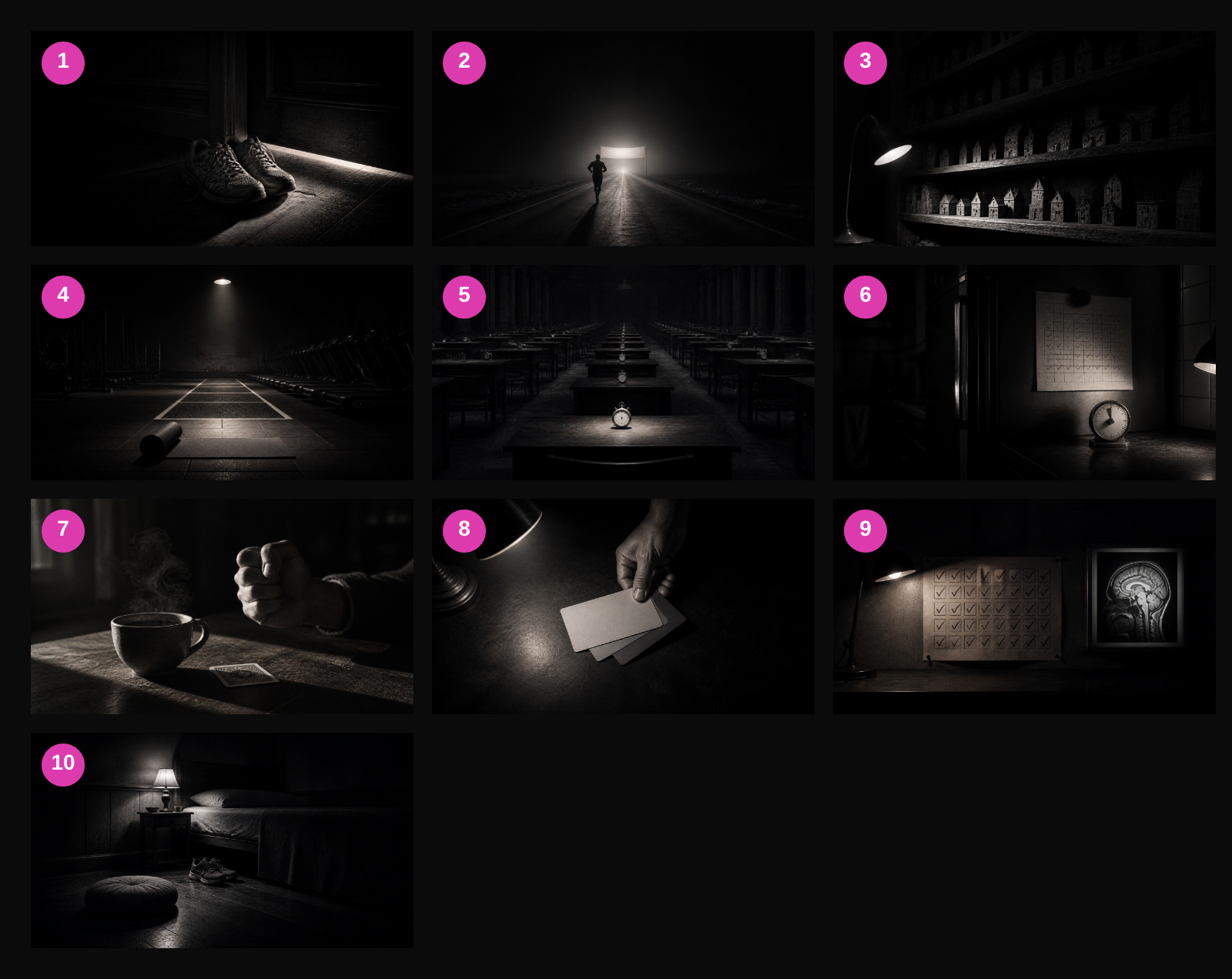
- Improving your memory is a skill, which means it takes practice and anyone can learn it. Image: a pair of trainers by a front door at dawn.
- Train it like a marathon: towards a goal, not aimlessly. Image: a runner on a long road with a finish banner far ahead.
- Build around a hundred memory palace locations first, three hundred if you train daily. Image: a shelf of small model houses, dozens deep.
- Three kinds of workout: warm-ups, speed games, stamina games. Image: a gym with a stretching mat, a sprint track and a long treadmill.
- The games come from the World Memory Championships: numbers, cards, names, words. Image: a championship hall of desks each with a stopwatch.
- Fifteen minutes a day, three to five days a week for three weeks, then up to thirty. Image: a kitchen timer and a tick chart on a fridge.
- Make it a habit with Tiny Habits: anchor, behaviour, celebration. Image: a coffee cup set down, one small card memorised, a fist pumped.
- Keep it varied: deal yourself a different workout from colour-coded cards each day. Image: a hand dealing three coloured cards onto a desk.
- Six weeks of daily practice measurably rewires the brain. Image: a six-week planner fully ticked beside a glowing brain scan.
- Sleep, exercise and mindfulness support everything else. Image: a bed, a pair of running shoes and a cushion in a quiet corner.
Sources
- Mark Channon, The Memory Workbook (Hodder Education)
- Dresler, M., Shirer, W. R., Konrad, B. N. et al. (2017). Mnemonic training reshapes brain networks to support superior memory. Neuron, 93(5), 1227 to 1235. https://doi.org/10.1016/j.neuron.2017.02.003
- Fogg, B. J. (2019). Tiny Habits (Houghton Mifflin Harcourt)
- Lally, P., van Jaarsveld, C. H. M., Potts, H. W. W., and Wardle, J. (2010). How are habits formed: Modelling habit formation in the real world. European Journal of Social Psychology, 40(6), 998 to 1009. https://doi.org/10.1002/ejsp.674 (the home for this study is How Habits Form in the Brain)
Loci
Build the memory palace in this article inside Loci — store your locations, link images, and rehearse with spaced repetition.
Try it in LociMemory School community
Learn directly with Mark inside the Memory School community on Skool — monthly lessons, practice, and Q&A.
Join Memory SchoolAbout the author
Mark Channon
Grand Master of Memory (1995). Author of three books on memory published by Hodder and Nick Hern. Creator of BBC1's Monkhouse's Memory Masters. Memory coach on Channel 4's Can I Improve My Memory?
Read full bio →