
Memory Training
The World Memory Championships Explained (by Someone Who Competed in 1995)
What happens at the World Memory Championships, the ten disciplines, how the titles work, why the sport now has two world championships, and why, for me, it was never about the competition.

In 1995 I spent a year making a television programme about memory and then found out whether I could do it myself at a world-class level. The programme was Bob Monkhouse's Memory Masters, a BBC1 game show I devised in which ordinary contestants learned a feat of memory, the muscles of the body, say, with their origins and actions, and then went up against a genuine expert, such as a London taxi driver who had done the Knowledge, the exam on every street in central London that black-cab drivers must pass. Eight million people watched it. Working on it, I met Tony Buzan, who had founded a competition four years earlier for the people who did this sort of thing seriously, and he suggested I enter.
So that year I sat in a hall in London at the World Memory Championships and competed. I came sixth, and I became one of the first eight people to be awarded the title Grand Master of Memory, ranked third in the world as a Grand Master. Here is what the championships are, what you actually do there, how the titles work, and what the sport has to teach anyone who simply wants a better memory.
How it started
The World Memory Championships were created in 1991 by Tony Buzan, the creator of mind maps, and Raymond Keene, the chess grandmaster. Buzan's question was simple: when there are competitions for almost everything else, why are there none for memory, the most important function of the brain? They invited the best memorisers they could find to London for the first championship. Its first winner was Dominic O'Brien, who went on to take the title eight times.
The sport grew from there: according to the World Memory Sports Council, some 35 countries have taken it up.
The ten disciplines
A championship runs over several days and tests memory in ten ways. Each discipline is a memorisation period followed by a recall period, and every one of them is scored, so the overall champion is the best all-rounder, not the best at any single thing.
Hour numbers. An hour to memorise as many random digits as you can, presented in rows. Scored in rows: a single error in a row costs you half of it, two errors cost the row.
Five-minute numbers. The sprint version. Same scoring, five minutes.
Spoken numbers. Digits read aloud at one per second, with no chance to look back. The cruellest discipline, because one lapse in attention ends your run.
Binary digits. Thirty minutes of ones and zeros. Competitors convert them to decimal chunks in their heads and store those.
Hour cards. An hour to memorise as many shuffled packs of cards as you can, in order.
Random words. Fifteen minutes to memorise columns of unconnected words, in sequence.
Names and faces. Fifteen minutes with a sheet of photographs and names, then the faces again, blank, to be named. The discipline closest to everyday life, and a hard one to score well in.
Historic dates. Five minutes to memorise invented events paired with years.
Images. A grid of abstract or random pictures to be memorised in order.
Speed cards. Always last. One shuffled pack, memorised as fast as you can, then reproduced by arranging a second pack to match. The most watched event, because it is the only one that comes down to a stopwatch.
If you have read anything else on this site, you will recognise that every discipline is a version of something people want in real life: numbers for work, names at events, facts and dates for study, sequences for presentations. The championships are simply those tasks with the stabilisers off.
How the titles work
Grand Master of Memory used to be awarded on a set of standards for numbers and cards, achieved at officially arbitrated events.
The system has since been reorganised to look more like chess. Under the World Memory Sports Council's rules (as of 2021), International Grandmaster goes on points, to competitors with at least 6,500 championship points at the World Memory Championships. Grand Master goes to the top five finishers there who are not already Grand Masters and have at least 5,500 points. International Master is still a set of standards: 1,400 digits in an hour, 14 packs in an hour and a single pack in 40 seconds, plus at least 3,000 points at each championship that counts. The International Association of Memory runs its own titles. As with any sport, the thresholds change, so check the current rules of whichever body you intend to compete under before you set a target.
Which brings up something that confuses newcomers to the sport.
Why there are two world championships
In 2016 a group of competitors launched the International Association of Memory, an independent federation, alongside the World Memory Sports Council. Since 2017 both have run their own world championships, with largely the same ten disciplines and slightly different rules and timings.
For a competitor this means two calendars, two sets of records and two routes to a title. For everyone else it changes nothing. The methods are identical, the people are often the same, and the standard at the top keeps climbing under both flags. The standard keeps rising: in 1995 I memorised 732 digits in an hour, and the International Master standard alone now asks for 1,400.
What it is actually like
You might imagine the hall is tense. It is quiet. Rows of desks, earplugs, people in hoodies staring at sheets of paper, the occasional hand going up for a question. Nobody looks like they are doing anything. Everything is happening behind the eyes.
What struck me most is that nobody there has a gift. Every single competitor is running a system: images for numbers, images for cards, a journey through familiar locations to put them on, and a rhythm of review during the memorisation period so the early images are still clear when the recall sheet arrives. From what I have seen, the differences between competitors are differences of system and practice. That is also why memory sport has produced so many good teachers. If you have built your own memory from parts, you can show someone else how.
Why bother, if you are not going to compete
What use is it to memorise a 400-digit number? On its own, not much. The use is what it does to your capability.
Memory training works like any other training. Stamina work takes you into territory far beyond anything daily life asks of you, and once you have been there, everything else becomes easier: the key figures in a meeting, the names around a dinner table, the visual cues for a presentation (a small image for each point).
Every competitor has their own reason for being there. For me, competition was never the point. I devised a game show, which was great fun, and it opened my eyes to something. I competed to see whether I could do it myself at a world-class level. Then I ran my first seminar, and that is when I realised this could be used in the real world, for real things and serious impact: changing careers, learning a new skill, memorising on the fly, conversations, pitches, whatever it is.
It feels a little like a superpower. That sounds like a cliché, but it really does, until you get used to it, and then it is just something you do. Once it is demystified, you see that yes, you learn systems, but really you are just using your brain in a more natural way. That has been my reason for doing this for the last 30 years, and for sharing it, so people can have a different level of confidence in their memory and go out and do the things they want to do.
That is the case for borrowing from the sport even if you never enter it.
How to start, whether or not you ever compete
The disciplines also make a training menu, and its shape still works.
Build your memory palaces first. A memory palace is a set of locations, in order, that you place your images on. Around a hundred locations is enough to start; three hundred lets you rotate them so yesterday's images do not get in the way when you reuse a route. Every discipline except names runs on these.
Learn a number system. The major system gives you an image for every pair of digits. Later, if you catch the bug, a person-action-object system lets you hold six digits in one picture.
Learn a card system. One image per card, fifty-two images, drilled until you no longer translate.
Then play the games. Five-minute words, five-minute numbers, five-minute cards, five-minute names, each scored the way the championships score them. Short sessions most days for the first few weeks, then one longer stamina piece a week once the games feel easy.
Enter something small. Many countries run national or regional championships, and many are open to anyone. You will learn more about your systems in one day of competition than in a month of practice, because competition shows you exactly where they break.
The thing I took away from 1995
I did not win, but being ranked third in the world as a Grand Master was pretty amazing, and I did it with three months of intensive training. I had been using memory techniques on and off for a number of years, but never at that level: to compete, I was training about four hours a day, sometimes six. Look, it's unlikely you would want to do that, and for everyday life there is no need to. I had found out what I went there to find out: that I could do it at a world-class level. Using it for real things came next, at my first seminar.
If you want to see the disciplines up close, Speed Cards Explained: How a Pack Gets Memorised in Under a Minute walks through the headline event and how competitors get a pack under a minute. For the training method, The Daily Memory Workout and Memory Games for Adults That Actually Train Your Memory set out the sessions. For the systems underneath, start with The Major System Explained for numbers and How to Memorise a Deck of Cards for cards. And if you want to build the locations that every discipline runs on, LOCI can make them for you, from Google Street View or with AI, and have your first palaces ready today.
Memory map
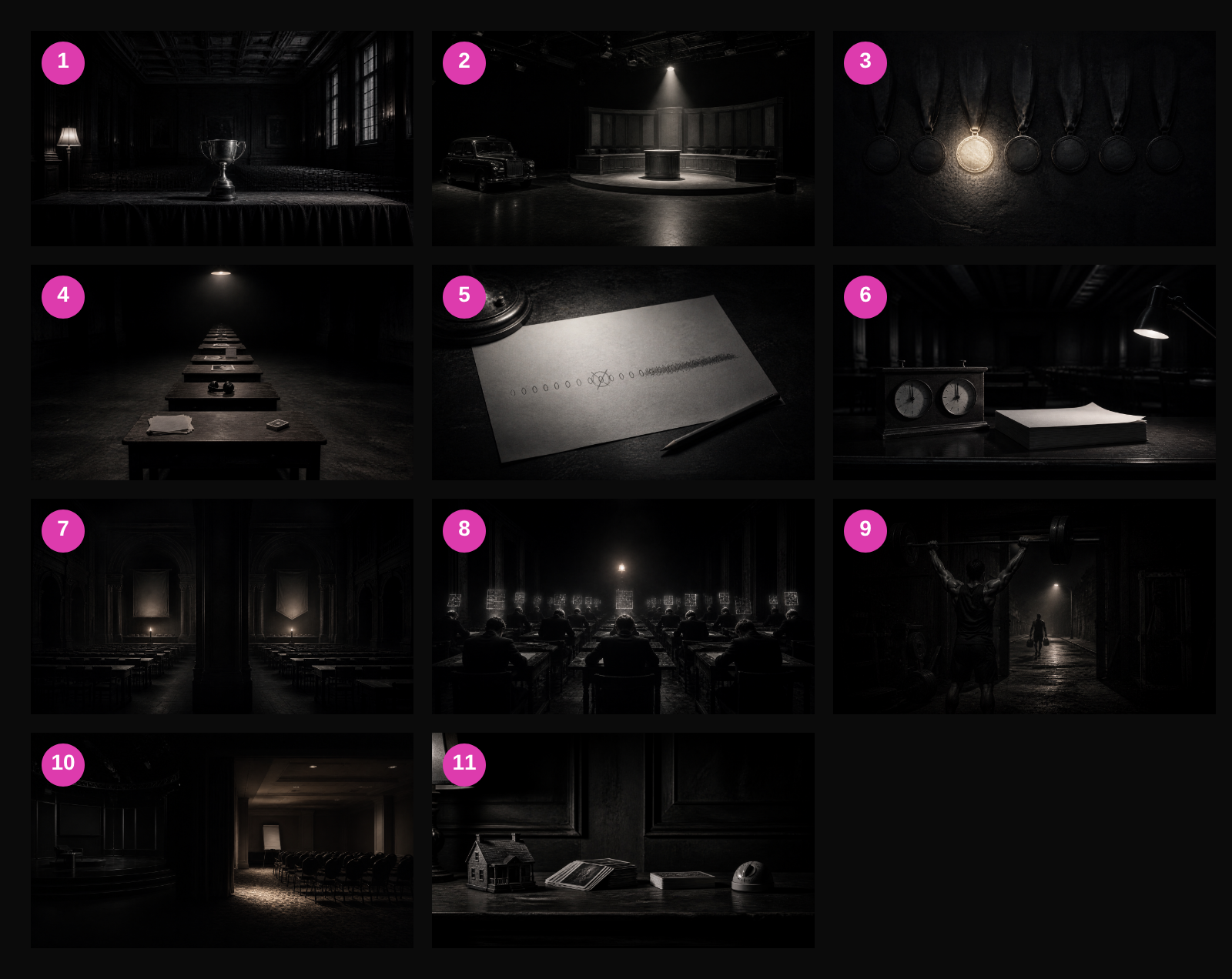
- Founded 1991 in London by Tony Buzan and Raymond Keene; Dominic O'Brien won the first and eight in all. Image: a trophy on a table in a 1991 London hall.
- Memory Masters, 1995: contestants learned a feat and faced an expert, such as a taxi driver with the Knowledge. Image: a game-show set with a black cab parked on one side.
- 1995: sixth in the competition; one of the first eight Grand Masters of Memory, ranked third in the world as a Grand Master. Image: eight medals in a row, the third one glowing.
- Ten disciplines: numbers (hour, five-minute, spoken, binary), cards (hour, speed), words, names and faces, dates, images. Image: ten desks in a row, each with a different sheet on it.
- Scoring is by row for numbers; one error costs half, two cost the row. Image: a row of digits with one red cross and half the row greyed out.
- Titles: Grand Master was a set of standards; now International Grandmaster and Grand Master go on points, International Master on higher standards. Image: a chess clock beside a stack of recall sheets.
- Two world championships since 2017 after the 2016 split; same disciplines, two flags. Image: two near-identical halls side by side under different banners.
- Nobody has a gift; everyone is running a system. Image: a quiet hall of competitors, each with a tiny glowing map above their head.
- Stamina work makes everything else easier; every competitor has their own reason. Image: a weightlifter who then carries the shopping home easily.
- My why: never the competition. I competed to see if I could do it at a world-class level; using it for real things came at my first seminar. Image: a game-show set, then a seminar room with the lights coming on.
- Start: a hundred locations, a number system, a card system, then the five-minute games. Image: a house, a numbered pack of pictures, a pack of cards and a five-minute timer in a row.
Sources
- World Memory Sports Council. NEW World Memory Champion Crowned (founding, Dominic O'Brien's titles, some 35 countries). https://www.worldmemorychampionships.com/?p=4406
- World Memory Sports Council, Chief Arbiter (2021, 7 February). Title rules: International Master, Grandmaster of Memory, International Grandmaster. https://www.worldmemorychampionships.com/?p=8752
- International Association of Memory. About us (launched 2016; first world championship, Indonesia, 2017). https://iam-memory.org/?p=446
Are you old school? Get Mark's book The Memory Workbook and dive in depth.
Loci
Build the memory palace in this article inside Loci — store your locations, link images, and rehearse with spaced repetition.
Try it in LociMemory School community
Learn directly with Mark inside the Memory School community on Skool — monthly lessons, practice, and Q&A.
Join Memory SchoolAbout the author
Mark Channon
Grand Master of Memory (1995). Author of three books on memory published by Hodder and Nick Hern. Creator of BBC1's Monkhouse's Memory Masters. Memory coach on Channel 4's Can I Improve My Memory?
Read full bio →