
Study and Learning
How to Memorise a Script for an Audition Overnight
The sides drop on Wednesday evening. The self-tape is due Thursday lunchtime. Here's the exact sequence that gets you word-perfect with hours to spare, without crying into your script.

The text message comes in at half past five. The sides, the pages of script you will audition with, are attached. The self-tape, the audition you film yourself and send in, is due by noon tomorrow. You open the PDF and there are four pages, two scenes, and a character you have not met before.
This is the moment panic sets in. It is also the moment a small, repeatable system saves you.
Here is the exact sequence. Done in order, the whole thing takes about three hours of work, plus a good night's sleep, plus thirty minutes in the morning.
Why read-and-repeat fails overnight
Before getting into the system, it helps to see why the usual approach fails.
If you have ever had overnight sides, this will look familiar. Read the script through. Read it again. Try to remember the first few lines. Read it again. Cover the first speech and try to recite it. Get most of it wrong. Read it again. Repeat for three hours.
This is read-and-repeat memorisation and it is one of the slowest and most fragile techniques known to humans. Three problems.
It skips the meaning step. Lines learned without understanding are lines that fall apart under pressure. The first time a casting director throws an unexpected note at you, the script unravels.
It builds false confidence. You can recite the lines fluently because you have just been reading them. The next morning, after sleep, they are gone or scrambled.
It produces robotic delivery. Read-and-repeat memorisation literally trains your mouth to say the words. When you get to the audition, the words come out the way you rehearsed them: flat, surface, recited. Casting directors spot this in seconds.
The system below fixes all three problems by separating the steps that read-and-repeat collapses into one.
The five-block evening plan
There are five blocks. Done in order, they total about three hours.
Block 1 (15 minutes). Prime, do not read.
Before you read the script properly, ask yourself a primer question. What will I gain from learning this well? What is interesting about this character? Sit with the questions for two minutes.
Then read the script once, slowly, without trying to memorise anything. Just feel the shape of it. What is the scene about? What is the relationship? What is your character doing in the room?
The point of this block is to wake your brain up to the material before you start trying to absorb it. Priming with a question raises your brain's interest level, which means it will pay better attention to everything that follows. It also pulls you out of the panic state that the late-arriving sides tends to create.
Block 2 (30 minutes). Connect.
Read the script again, this time underneath the lines. What does your character want in this scene? What are they not saying? What is the relationship to the other character? What is the emotional shape of the scene?
Write nothing down. Just keep asking why. Why is your character in the room? Why now? Why with this other person? Why this conversation? What does your character need by the end of the scene that they did not have at the start?
By the end of block 2 you should know what the scene is about, not just what it says. You should be able to summarise the scene in two or three sentences in your own words, without looking at the script.
This is the easiest step to skip, and it is the step that makes the rest of the system work.
Block 3 (45 minutes). Build the cues.
This is the memory work. For every line of your character's dialogue, build a small visual cue. A vivid mini-image that triggers the idea, intention, or meaning of that line.
Use the MIN rule, Minimum Images Necessary. If a line is naturally easy to remember ("yeah," "I don't know," "really?"), skip the cue. If a line is doing real work, build it a strong image.
Then place those cues, in order, on locations in a memory palace: a place you know well, whose spots you visit in a fixed order so each one can hold a cue. Your living room is fine. Walk the room clockwise, placing one cue on each item. If you do not yet have a palace built, the Roman room method gives you one in ten minutes (see The Roman Room Method).
The cue should be specific to the line's meaning, not just a literal picture of the words. If the line is "I never wanted any of this," the cue might be a hand pushing away a wrapped present. The image triggers the meaning, the meaning triggers the line, and the line comes out fresh each time you say it.
Block 4 (30 minutes). See the cue, say the line.
Walk your palace. For each cue, see it vividly and say the line out loud. If the exact words will not come, keep talking: say what the character means and carry on to the end of the scene.
Only then check the script. Strengthen weak cues by dialling them up: give the faint one a number out of ten, then turn it up until the scene is brighter and louder than it was. Repeat the whole scene three to five times.
The discipline of pushing through a fluffed line rather than stopping is what builds real confidence. Stopping every time you miss a word produces a false confidence that you know the lines. Pushing through produces the real thing, the kind that survives a forgotten word on stage.
Block 5 (20 minutes). Trigger letters and rehearse.
For the lines that are still not quite word-perfect, write them out as initial letters only. "D__ '_ c__ b______ i_'_ o___, s____ b______ i_ h_______" (Don't cry because it's over, smile because it happened).
Run the scene one more time, glancing at the letters when needed. The letters force you to retrieve the line rather than read it, which is what builds the memory.
Then put the script down. Do the scene out loud once more without any visual aid. Go to bed.
Sleep does more for line learning than three more hours of cramming ever will. Trust it. The brain consolidates everything you have done during the evening overnight. By morning, the lines will have moved from short-term to long-term memory.
The morning sequence
The next morning, thirty minutes before you film, run this sequence.
- Walk the palace once. Three minutes. The lines will mostly be there.
- Identify the cues that have faded. Rebuild them with the dial-it-up technique.
- Run the scene out loud once, no script. Improvise through anything that will not come.
- Run it once more with the script as backup. Check for the few remaining word-perfect details.
- Stretch, breathe, get into flow, the relaxed but alert state where the words come without forcing. Two minutes of slow breathing. Drop the shoulders. Roll the neck.
By this point the lines are not in your head. They are in your body. The cues are still available as a safety net but you almost certainly will not need them.
Bringing the palace into the room
The biggest mistake at this stage. You rehearsed at home, but you are filming in your kitchen, or in a friend's hallway, or in an actual audition room. Your palace is somewhere else.
The fix is to lay the palace over the room you are actually in. As you set up to film, mentally place your familiar living-room locations around the actual space you are in. The sofa is over to your left. The bookcase is behind you. The TV is over the camera. The cues are sitting on each one, exactly where you left them.
This takes practice. Done well, it means you can use your visual cues in the audition without ever leaving the present moment. Your eye contact stays on the reader. Your delivery stays alive. The cues are operating in the background, like a tour guide who only steps in when you need them.
When you only have two hours, not overnight
Sometimes the sides arrive even later. In that case, compress.
- Block 1, 5 minutes.
- Block 2, 15 minutes.
- Block 3, 30 minutes.
- Block 4, 20 minutes.
- Block 5, 10 minutes.
That is 80 minutes of work, leaving you 40 minutes for a quick break, food, and a final run-through.
The technique still works. You just have less margin and you will rely more heavily on the cues during the take itself. That is fine. The cues are there for a reason.
If you have only one hour, drop block 5 entirely and trust the palace. The trigger letters become useful only when you have time to polish, and a one-hour version of this work is more about getting the bones in place than the final coat of paint.
A worked example
Say the sides are a 90-second scene with eight of your lines. Here is what that evening might look like in practice.
5:30 PM. Sides arrive. You skim once. You go for a 10-minute walk to clear your head and prime with the question "what will I gain from learning this well?"
6:00 PM. Block 1 begins. You read the scene slowly. You spot that your character is essentially asking for forgiveness without admitting wrong. That is going to inform every line.
6:15 PM. Block 2 begins. You read again, this time interrogating the why. Why does your character refuse to apologise outright? What are they afraid of? What do they want by the end of the scene? You decide they are terrified of losing the other character's respect.
6:45 PM. Block 3 begins. Eight lines, eight cues. You build each cue from the meaning, not the words. You place the cues clockwise around your living room.
7:30 PM. Block 4 begins. You walk the palace and say each line. Three of the eight lines come out perfectly first time. Two are close but not quite. Three are off. You strengthen the weak cues, dial them up, and run the scene again. Round three you get all eight.
8:00 PM. Block 5 begins. You write trigger letters for the two lines that still feel shaky. Run the scene one more time with the letters. Then once more without any aid. Done.
8:20 PM. Script down. Light dinner. Bed by 10:30.
Next morning, 11:00 AM. Run the morning sequence. Film the self-tape at 11:30. Sent before noon.
This is the rhythm. The system is rigid enough to be trusted under pressure and flexible enough to fit the actual scene in front of you.
What not to do
A few habits that make the overnight job harder than it needs to be.
Read-and-repeat from page one. It feels like progress. It is not. Spend the first 45 minutes connecting with the material, not memorising it.
Skip the priming and connection steps and go straight to memorising. The lines will not stick because they do not yet mean anything to you. Meaning is the glue. Without it, the words slide off.
Stop every time you fluff a line. It builds a false sense of confidence and trains your brain to expect failure mid-scene. Push through. Check after.
Stay up past midnight grinding. Sleep is part of the technique, not an obstacle to it. Whatever is in your head at midnight will be deeper in your head by 8 AM. Whatever is not in your head at midnight is unlikely to get there with another two hours of staring at the page.
Forget to bring the palace into the room. You rehearsed in your living room. The self-tape is in a different space. Spend 30 seconds mentally importing your familiar locations into the actual room before you press record.
Where to go from here
The overnight system is a compressed version of the full Learning Your Lines recipe. For the long-form approach (used for theatre runs, longer-form TV, and longer rehearsal processes), the natural next read is How Actors Learn Lines Fast: The Seven-Step Recipe (From Learning Your Lines).
If you want help drilling the underlying memory techniques (palaces, chains where each image links to the next, visual cues) so they are second nature by the time the next late-arriving sides come in, mindforge.memoryschool.com is built for exactly this.
The actors who get good at the overnight self-tape are the actors who have a process they trust. Once you have one, the panic stops. The text message at half past five becomes a problem you have already solved.
Memory map
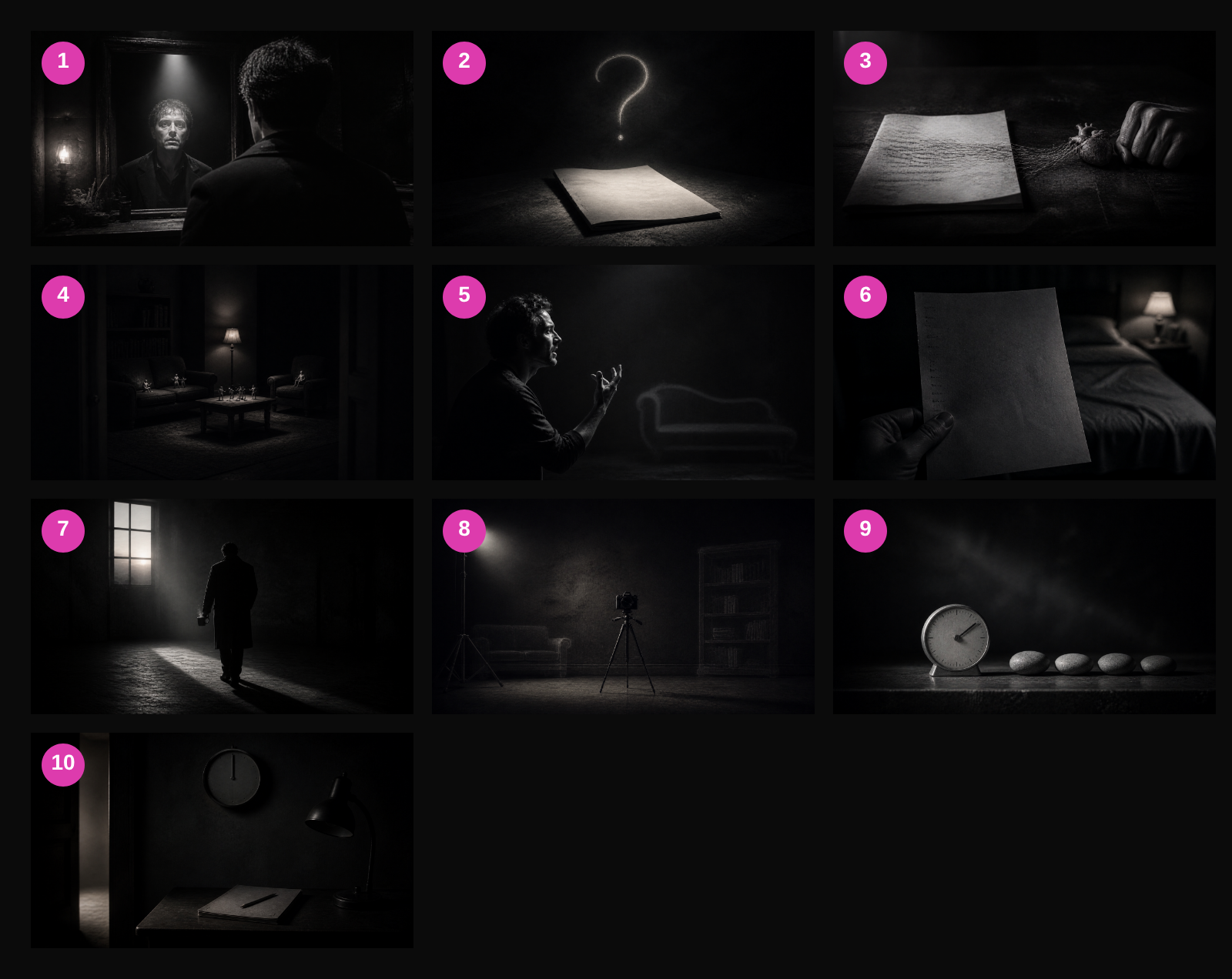
- Overnight line learning fails when it skips meaning and builds false confidence. Image: an actor reciting fluently to a mirror, then blank under a studio light.
- Block one: prime, do not read. Ask what the scene is about and what you want from it. Image: a script face down with a question mark drawn in the air above it.
- Block two: connect with the meaning, intention and emotion of each line. Image: a page with threads running from the words to a heart and a clenched fist.
- Block three: build one mini story per line and place it on a small palace. Image: a living room with a tiny scene playing on every piece of furniture.
- Block four: see the cue, say the line, improvise rather than stop. Image: an actor mid-sentence, eyes on an invisible sofa, mouth open.
- Block five: trigger letters and a rehearsal, then sleep. Image: a page with only first letters visible, a bed in the background.
- The morning sequence: walk the palace, run the scene, tighten the words last. Image: a sunrise through a window, an actor pacing with a coffee.
- Bring the palace into the self-tape room: lay your furniture over the real space. Image: a camera on a tripod with a faint sofa and bookcase ghosted around it.
- With two hours, cut to prime, connect, cues and one run. Image: a kitchen timer at two hours beside four stones.
- Do not read and repeat, do not stop on every fluff, do not grind past midnight. Image: a clock showing midnight with a script closed beneath it.
Sources
- Mark Channon, Learning Your Lines (Nick Hern Books): https://www.nickhernbooks.co.uk/learning-your-lines
Loci
Build the memory palace in this article inside Loci — store your locations, link images, and rehearse with spaced repetition.
Try it in LociMemory School community
Learn directly with Mark inside the Memory School community on Skool — monthly lessons, practice, and Q&A.
Join Memory SchoolAbout the author
Mark Channon
Grand Master of Memory (1995). Author of three books on memory published by Hodder and Nick Hern. Creator of BBC1's Monkhouse's Memory Masters. Memory coach on Channel 4's Can I Improve My Memory?
Read full bio →