
Study and Learning
How Actors Learn Lines Fast: The Seven-Step Recipe (From Learning Your Lines)
Mark Channon's seven-step process for getting off-book quickly and confidently, drawn from his book Learning Your Lines (Nick Hern Books).

Every actor gets asked the same question: How do you remember so many lines? And every actor gives roughly the same answer: I don't know, I just do.
When you are learning lines during a four-week rehearsal period, it really is just what you do. The pressure shows up somewhere else, in time-constrained situations. Self-tapes that arrive on Tuesday for a Thursday deadline. Auditions where you got the sides (the pages of script you will read) two hours ago. TV shoots where the schedule rewrites scenes the night before. Theatre work where the cast list has dropped you into something opening in three weeks.
In those situations, having a system is everything. That system is the seven-step recipe from Learning Your Lines (Nick Hern Books).
Let's get into it.
Why a Recipe, Not a Trick
A note on framing before we start. The word here is recipe, not technique or system, and there's a reason.
A recipe is a set of ingredients combined in a specific order. The first time you follow it, it probably won't turn out exactly as the picture in the cookbook. With practice, your skill improves. After enough time, you can experiment, remove what doesn't work for you, add what does, and eventually create something that feels like yours.
That's exactly what this is. Seven ingredients, combined in order. Follow the recipe first. Make it yours later.
The seven steps are:
- Memory Strategies, your foundation
- Prepare, get into flow
- Prime, raise your interest
- Connect, meaning, intention, emotion
- Make It Stick, visual cues and the memory palace
- Rehearse, move the lines from your head into your body
- Audition & Performance, confidence in the room
Let's walk through each.
Step 1: Memory Strategies (Your Foundation)
Before you start working on any specific scene, you need a working set of memory tools. Three in particular.
Creative Memorisation is the umbrella term for the recipe that boosts your memory and makes what you learn stick. It has four key ingredients: flow, imagination, association and meaning. Without these, no memory technique works. With them, every technique works better. For more on all four see Creative Memorisation: The Four Ingredients That Make Anything Memorable.
The Chain Method is the strategy that uses your visual memory to remember sequences. You take key ideas, turn them into images, and connect those images in a memorable story. For the full technique see The Chain Method: How to Remember Lists Without Building a Memory Palace.
The Memory Palace uses your visual and spatial memory. You take a journey in your mind, around your home, from the train station to work, back in time to your route to school as a kid, or even a town you have never visited, built from Google Street View in LOCI, and place the things you want to remember on locations along that journey. As long as you can recall the locations, the palace works. For the foundations see What is a Memory Palace? A Beginner's Guide to the World's Oldest Memory Technique and How to Build a Memory Palace: A 7-Step Beginner's Guide (With Worked Examples).
For actors specifically, you'll typically want around ten memory palaces, roughly 200 memory files in total (a memory file is one spot in a palace that holds one cue), to handle self-tapes, auditions and short scenes. Temporary palaces fade naturally after 2 to 3 days without review, so the same palaces get reused constantly.
For longer theatre runs or chunky TV/film shoots, build a few permanent palaces you'll keep clean and reuse for that specific job.
Step 2: Prepare (Get Into Flow)
This is the easiest step to skip. Don't.
Before you pick up the script, before you read a single line, before you even think about memorising, get yourself into the right state. The right state is flow: that relaxed, energised, present-tense state where time disappears and things feel easy.
If you've been on stage and had a scene go beautifully without remembering exactly how, that was flow. If you've finished a take feeling like you weren't really doing anything, just being, that was flow. It's the state where your prefrontal cortex, the front part of your brain that handles deliberate thinking, stops second-guessing you and your unconscious takes over.
Trying to learn lines without flow is like trying to ice-skate on gravel. Everything is harder. Tension rises. The amygdala, your brain's alarm system, starts firing. Your higher thinking gets harder to reach. You read the same line eight times and absorb none of it.
The good news is flow can be cultivated. A few minutes of breath work, a short walk, a stretch, a body scan, whatever gets your shoulders down and your breathing slow. Anchor the feeling so you can return to it on demand. Some actors press their thumb and forefinger together and say a single word ("flow," "open," "easy"). The gesture and the word become a trigger you can fire before any rehearsal, self-tape or audition.
This isn't woo. It's basic neuroscience. Even mild stress impairs the prefrontal cortex, where higher thinking happens. A calm, absorbed state gives it back.
Step 3: Prime (Raise Your Interest)
The next ingredient is priming, and once you understand priming, you'll never read a script the same way again.
Priming is the principle that exposure to one stimulus influences your response to another: see the word "doctor" and you recognise "nurse" a fraction faster. A close cousin is selective attention. Buy a new car and the next day you see it everywhere on the road. Did everyone suddenly buy the same car? No. Your brain got a signal, this is important, and started filtering for it. Both work on scripts, and here the combination goes by one name, priming.
The same principle applies to scripts. If you sit down and read a script flat, your brain gets no signal that any of it is important, and remembering it becomes a fight. If you prime your brain first, the script lands differently.
The simplest way to prime is with a primer question. Ask yourself, before you read the script:
- What will be the benefits of learning this script right now?
- What is one positive benefit this audition will give me?
These sound obvious. They are. But asking the question changes how you read.
For self-tapes and auditions where procrastination is the bigger enemy, try a slightly different primer activity:
- Start a 10-minute timer
- Sketch a simple image with the script's name and the character
- Write the cost of leaving it to the last minute on one side, stress, lack of preparation, regret
- Create a vivid future memory of that exact scene playing out (auditioning while underprepared, feeling that drop in your stomach)
- Write five benefits of starting now, preparation, confidence, freedom in the room
- Create a vivid future memory of that scene playing out
- Hold both in your mind. Choose your path.
The point isn't motivation in the cheesy sense. A pessimistic mindset helps you identify risk, but stay there too long and stress takes over. An optimistic mindset generates solutions and gets you moving. You want a balance, long enough in pessimism to register the cost, then a sharp shift to optimism for the actual work.
Step 4: Connect (Meaning, Intention, Emotion)
Here's a heretical thought: don't try to memorise anything yet.
The fourth step is connection, and it's the step that makes memorisation feel easy when you get to it. It's tempting to skip this and go straight to step 5. That's how you end up reading-and-repeating lines that don't stick.
When you read a fictional novel, you don't try to memorise it. The story comes to life, you empathise with the characters, you remember a surprising amount of detail without effort. Read a textbook with the same brain and the words slide off. The difference isn't the words. It's how you're reading.
Read your script the way you read a novel. Curiosity, not pressure. Experience, not absorption. Get underneath the lines:
- What is the character actually trying to do?
- What's the intention underneath each line?
- What's the relationship between the speakers?
- What's the emotional journey of the scene?
- What's not being said?
This is also where you do the deeper text work, character objectives, super-objectives, beat-by-beat actions, the through-line. Stanislavsky, Meisner, Method (the best-known schools of acting training), your gut, whatever process you use, this is where it lives. If you're in a longer rehearsal you'll keep digging here for weeks. If you're prepping a self-tape with an overnight turnaround, you may only have 30 minutes for the whole connect phase. That's still much better than zero.
By the end of step 4 you should know what the scene is about, what your character wants, why every line is being said, and approximately what the emotional shape feels like. You shouldn't have tried to memorise a single word yet.
Step 5: Make It Stick (Visual Cues and the Memory Palace)
This is where the memory work begins, and where you may well be gobsmacked by how fast lines can land when the previous steps are done.
The core tool here is visual cues. A visual cue is a small mental image (or mini-story) that triggers the memory of a specific line. Each line of dialogue gets one visual cue. You then place those cues on locations in a memory palace. To recall the line, you see the cue and speak the line aloud.
The five-step process for visual cues:
5a. Create a mini story for every line
The story should remind you of the idea, intention or meaning of the line, not necessarily the words. Use the MIN rule: Minimum Images Necessary. If a line is naturally easy to remember ("yes," "I don't know," "really?"), don't bother building a cue for it.
5b. See the cue, say the line
For each cue, hold the image in your mind and say the real line aloud. See the cue, say the line. This connects the image to the words in your brain. Repeat 4 to 5 times.
5c. Place the cues in your memory palace
Walk your palace mentally. At each location, place one cue. Focus only on attaching the images to the locations at this stage, don't try to recite the lines yet.
5d. Test the cues
Walk the palace again. Can you see each cue at each location? Yes? Move on. No? Strengthen the weak ones with the dial-it-up technique: picture a vividness dial, read where the weak cue sits, and turn it up a few notches.
5e. See the cue, recall the line
Now you try the lines. Walk the palace. See each cue. Speak the line aloud. If you can't remember it word-perfect, don't stop. Improvise around the meaning. Get to the end of the scene. Only then check the script and strengthen any weak spots. Repeat 3 to 5 times.
This non-stop approach matters. The instinct to grab the script every time you stumble manifests a false confidence that you know the lines. The discipline of pushing through builds real confidence, the kind that survives a forgotten word on stage.
Visual cue tips
A few hard-won principles:
- Don't just parrot. If you find yourself seeing the cue and reciting the line on autopilot, the cue has lost its meaning. See the cue, think about what it really means, then speak the line. The difference is the difference between repeating and creating.
- Improvise. It's fine to use your own words first. "Don't cry because it's over, smile because it happened" might become "you know the relationship wasn't right, you can learn and move on" the first few passes. Improvising builds confidence in the intention before you hone the exact words.
- Trigger letters. For the final word-perfect polish, write each line as its initial letters only: D__'_ c__ b______ i_'_ o___, s____ b______ i_ h_______. Walk the cue, glance at the letters, speak the line. Keeps "in, of, but, a, it's" all in the right place.
Bringing the palace into the room
When you arrive at the audition or the self-tape location, your palace is in the wrong space. The fix is to bring the palace into the room with you.
Try this: stand up, become aware of your surroundings. Imagine you're looking up at Big Ben. Where did you go? You left the room. You went somewhere else.
Now try: stand up, become aware of your surroundings. Imagine Big Ben is right here in front of you, close enough to touch. What changed? Big Ben is in the room with you. You haven't gone anywhere.
That's the technique. When you walk into the audition room, mentally place the locations of your palace around the actual room. The sofa, the bookshelf, the TV, the hallway table, all surrounding you in the new space. The visual cues sit on each. You play the scene without going anywhere in your mind.
This takes practice. With it, you can stay present and connected with your scene partner while still using your cues.
Step 6: Rehearse (Head to Body)
Step 5 gets the lines into your head. Step 6 moves them into your body.
This is the step where you mix all the ingredients together and cook them up. Whatever your process, Stanislavsky, Meisner, your gut, a hybrid, this is where everything you've explored fuses with the lines you've now memorised.
A few principles worth leaning on:
Run the scene through in different ways. Knock yourself off balance. Play it in different physical positions. Improvise between the lines (silently or out loud). Play it as a different character entirely, a serial killer, a lawyer, a homeless person, even if it has nothing to do with the actual scene. The aim is to see the dialogue from multiple angles and create new neural connections. By the time you come back to the actual playing of it, you understand the material from many directions, not one.
Don't learn other characters' lines. This is a personal opinion. I get asked about it constantly. My answer is: no, never. If you end up consciously or unconsciously playing the other characters' lines in your head, you can't be present, you can't listen, and you can't react. Leave room for the other person to surprise you.
Stay flexible. During a longer rehearsal you'll discover things, about the character, the relationship, the writing. You're free to adjust the visual cues, add new ones for rewritten lines, swap out cues that don't serve you anymore. The palace is a living tool, not a museum.
Step 7: Audition & Performance (Confidence in the Room)
The final step is the one that turns everything you've built into a confident performance.
By the time you arrive at the audition or the first night, the lines should be lifted off the page and lodged in your body. The visual cues become an emergency tool, not the primary one, they're there if you drop a line, but you don't need them moment-to-moment.
A few specific practices that help in the room:
Prime yourself for the audition. Use the same priming questions you used for the script. What is one positive benefit this audition will give me? What will I give as part of this process? Priming gets your brain thinking about benefits rather than worrying about what could go wrong.
Creative visualisation. Imagine the audition working out exactly as you'd like it. See your surroundings, your physical movement, what you say to yourself. Pair this with affirmations in present and past tense: I feel a deep sense of confidence. I'm here to demonstrate my best work. I always perform to my best ability.
A swish pattern (from NLP, neuro-linguistic programming) is a useful tool if you have a particular unwanted response, say, paralysing nerves before an audition. Bring the stressful scenario to mind. Then bring the positive version to mind, in full detail. Train your brain to swap one for the other on cue. I first learned this from Anthony Robbins' Personal Power in the early 90s; it's been a quietly useful tool ever since. It is a practitioner's tool from NLP (Richard Bandler, 1985) rather than a research-backed one, so treat it as that.
Bring the palace into the room (see step 5). The audition space is not the space you rehearsed in. Place your locations around you in the actual room as you enter.
The Six-Week Rule
How long until this feels natural? For actors, the first script tends to feel different within a week or two, and the process becomes second nature after around six weeks of using it on real material.
The six-week figure comes from practice rather than a measured study, and it lines up with the brain-imaging work of Boris Konrad and Martin Dresler, who found that six weeks of memory palace training (40 sessions of 30 minutes) shifted ordinary people's brain networks towards the pattern seen in memory champions.
The great news for actors: you'll have plenty of opportunity to practise. Every script, every audition, every rehearsal is a chance to run the recipe.
Where to Go Next
If you're new to the underlying techniques, work through these in order:
- What is a Memory Palace? A Beginner's Guide to the World's Oldest Memory Technique
- How to Build a Memory Palace: A 7-Step Beginner's Guide (With Worked Examples)
- The Chain Method: How to Remember Lists Without Building a Memory Palace
- How to Memorise a Speech with a Memory Palace (No Notes Needed)
Memory map
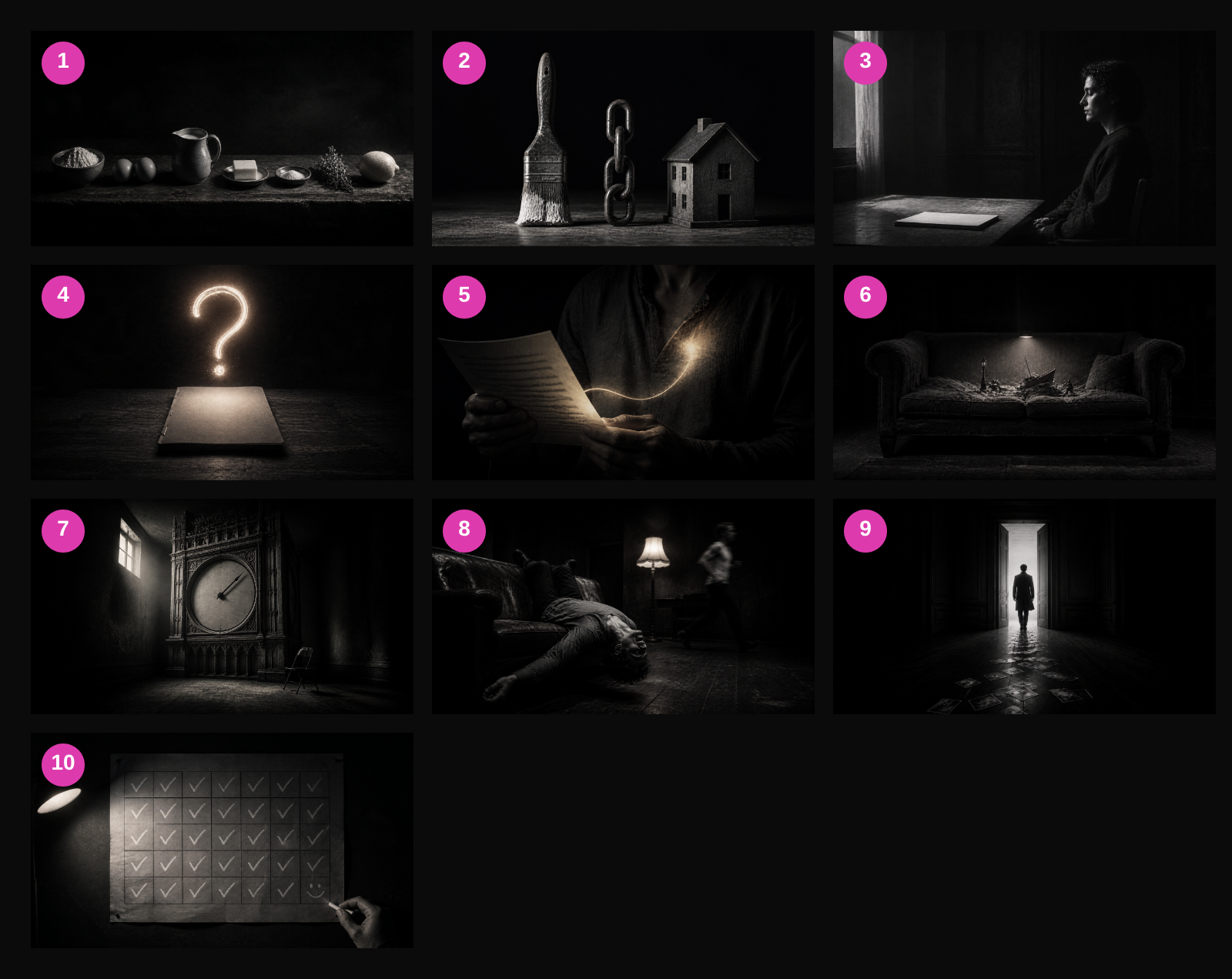
- Learning lines is a recipe of seven steps, not a trick. Image: seven ingredients laid out on a kitchen counter in order.
- Memory strategies: creative memorisation, the chain and the memory palace are the foundation. Image: a paintbrush, a chain and a house, side by side.
- Prepare: get into flow and reduce mind wandering before you open the script. Image: an actor sitting still with closed eyes, the script face down on the table.
- Prime: raise your interest with questions before you read. Image: a script with a question mark glowing above it.
- Connect: understand the meaning, intention and emotion of every line first. Image: two hands holding a page, a thread running from the words to a heart.
- Make it stick: a mini story for each line, placed on a palace, see the cue and say the line. Image: a sofa with a small vivid scene playing out on its cushions.
- Bring the palace into the audition room: Big Ben far away versus Big Ben right in front of you. Image: a clock tower standing in a small rehearsal room, close enough to touch.
- Rehearse: move the lines from head to body by running the scene in different ways. Image: an actor delivering lines upside down on a sofa, another pacing fast.
- Audition and performance: prime yourself, visualise it going well, let the cues fall away. Image: an actor walking into a bright room, leaving a trail of small pictures behind them.
- Six weeks of daily practice makes the method second nature. Image: a rehearsal calendar with six weeks ticked and a confident face in the last box.
Sources
- Mark Channon, Learning Your Lines (Nick Hern Books): https://www.nickhernbooks.co.uk/learning-your-lines
- Dresler, M., Shirer, W. R., Konrad, B. N. et al. (2017). Mnemonic training reshapes brain networks to support superior memory. Neuron, 93(5), 1227 to 1235. https://doi.org/10.1016/j.neuron.2017.02.003
- Gordon, M. (1988). The Stanislavsky Technique: Russia (Applause Theatre Books)
- Arnsten, A. F. T. (2009). Stress signalling pathways that impair prefrontal cortex structure and function. Nature Reviews Neuroscience, 10(6), 410 to 422. https://doi.org/10.1038/nrn2648
- Bandler, R. (1985). Using Your Brain for a Change (Real People Press)
Frequently asked questions
Are you old school? Get Mark's book Learning Your Lines and dive in depth.
Loci
Build the memory palace in this article inside Loci — store your locations, link images, and rehearse with spaced repetition.
Try it in LociMemory School community
Learn directly with Mark inside the Memory School community on Skool — monthly lessons, practice, and Q&A.
Join Memory SchoolAbout the author
Mark Channon
Grand Master of Memory (1995). Author of three books on memory published by Hodder and Nick Hern. Creator of BBC1's Monkhouse's Memory Masters. Memory coach on Channel 4's Can I Improve My Memory?
Read full bio →