
Focus and Concentration
What is Working Memory?
Working memory is the small mental workspace where thinking happens. What it is, why it fills up so fast, and how to stop it being the bottleneck for everything you learn.

Working memory is your ability to focus attention, hold information in your mind and manipulate it. It is where thinking actually happens. When you do a sum in your head, follow a set of directions, weigh up two options or try to hold a phone number long enough to dial it, you are using working memory. You need it to evaluate and to make decisions.
It is also tiny. That is the thing nobody tells you. The reason you lose track halfway through a long sentence, forget why you walked into a room, or feel your brain fill up ten minutes into a dense meeting is not that your memory is bad. It is that working memory holds a handful of things for a few seconds, and you have been asking it to hold more.
There are two ways to stop it being the bottleneck: train it, and stop overloading it in the first place.
The size of the workspace
Here is the practical picture. Short-term memory holds about four chunks, bundles of items held as a single unit (everyday digit span is nearer seven), and without rehearsal those items fade within seconds. A new PIN, a name you just heard, the start of a long instruction. If you do not do something with them, they are gone.
Working memory is short-term memory with a brain attached. It is the system that holds those few items while you work on them and, crucially, reaches into long-term memory to bring in what you already know. When you hear a phone number and notice that the first three digits are your old area code, that is working memory pulling a long-term memory into the workspace so the number is easier to hold. Short-term memory merges with longer-term memory and experience, and the mix is what we call working memory.
So the workspace is small, but it has a very large library next door. Almost every technique for improving working memory comes down to using that library better.
The four parts, and the captain of the Enterprise
The most useful model of working memory was proposed by Alan Baddeley in 1974 and has held up since. It has four parts, and the easiest way to remember them is a picture.
Imagine you are the captain of a starship. The Enterprise from Star Trek will do. You are in the captain's chair.
You are the central executive. The executive directs operations. It decides what to attend to, asks the questions and tells the rest of the system what to do. When you choose to focus on one voice in a noisy room, that is the executive at work.
To your left and right are speakers, playing on a loop. That is the phonological loop. It stores verbal information and rehearses it, which is what you are doing when you repeat "693, 693, 693" to yourself on the way to the till. Saying something over and over keeps it in the loop. Stop saying it and it drops out.
Above you is a 3D screen. That is the visuospatial sketchpad. It holds visual and spatial information: the layout of a room, the shape of a route, a picture you are building in your mind. This is where memory techniques do most of their work, because creating images is a visuospatial job.
Beneath you, on the arm of the chair, is a control panel. That is the episodic buffer, which Baddeley added to the model in 2000. It actively binds information from the loop, the sketchpad and long-term memory into episodes. It is the mixing desk. When a sound, a picture and a memory come together into one scene, the buffer did it.
Picture that bridge with real detail, the speakers, the screen, the panel, and you have Baddeley's model for life. More usefully, you have a way to think about your own thinking. When you are struggling to hold something, ask which part is overloaded. Usually it is the loop, because the natural habit is to hold everything by repeating it in words, and the loop is the smallest, leakiest part of the system.
Why it overloads
Working memory overloads for three reasons, and all three are fixable.
You are holding too much in words. Repeating things to yourself works for a phone number and fails for anything bigger. The loop is small. If a dense meeting leaves your head full, it is because you tried to keep the whole thing in the loop.
You are not using the library. New information that connects to nothing you already know has to be held entirely in the workspace. Information that connects to existing knowledge can lean on long-term memory, which has no practical limit. This is why experts seem to have better working memory in their field: they do not, they just have more to connect to.
Your attention is split. The central executive can only direct so much. Mind wandering, notifications, a second task running in the background: each one takes a slice of the executive's capacity and leaves less for the thing you are trying to hold. The research on this is clear and, for once, encouraging: a two-week mindfulness course has been shown to improve working memory and reduce mind wandering measurably. Focus is a trainable input.
How to get more out of it
Given that the workspace itself is small and roughly fixed, the gains come from how you use it.
Get the sketchpad involved. Instead of repeating something in words, turn it into a picture. A phone number becomes a scene of number images, pictures that stand for digits. A list becomes a chain of images, each one linked to the next in a little story. A set of points for a meeting becomes images on the body system, where parts of your own body, from head to toe, serve as fixed spots to hold them. The sketchpad holds a picture as one item where the loop would need five. This is the single biggest lever, and it is the reason every memory technique is visual.
Bind it into a chunk. The episodic buffer binds sound, picture and meaning into one episode. Use it deliberately. When you take in something new, think about what it looks like, connect the sound with an image, pull in what you already know about it, and ask what it means. Four separate things become one chunk, and one chunk costs one slot.
Offload to a memory palace. The real answer to a small workspace is to stop using it for storage at all. A memory palace (a familiar place whose spots each hold one image), or a peg list (a fixed set of images you already know by heart, to hang new items on), is long-term storage you can write to in seconds. Put the information there and the workspace is free for actual thinking. This is what separates someone who can hold a complex problem in their head from someone who cannot: the first has moved the pieces out of working memory and into a structure they can walk around.
Protect the executive. One task at a time. Phone face down. A short breathing exercise before the work that matters. The executive is the part that decides what gets attention, and everything else depends on it. The attention step in How to Remember Names: A Five-Step Framework That Actually Works, for instance, is nothing more than the executive being told to do its job for three seconds.
Train the skills that use it. Practice makes you better at the task you practise, and the research on brain-training games is clear that the gains rarely spread to general capacity or intelligence. So train what you actually need: memory drills, speed games with numbers and words, and the routine in The Daily Memory Workout. MindForge, the Memory School memory gym, is designed around exactly this: short daily sessions that push the sketchpad and the executive a little harder each time.
A quick test of your own
Try this. Read the following once and then look away: 6, 9, 3, 1, 4, 8, 2.
You may have got four or five. Now try the same seven digits with a picture, using shapes each digit resembles: a bag (6) with a balloon (9) tied to it, a snake (3) coiled round a pencil (1), a sail (4) on a snowman (8), and a swan (2) at the end of it. Read that twice, look away, and recite the digits.
You just moved seven items from the loop to the sketchpad and chunked them into three scenes. Same workspace, three times the capacity. That is the whole game.
Why this matters beyond memory
Working memory is not just about remembering. It is the capacity you use to reason, to weigh options, to follow an argument, to hold a plan in mind while you execute it. When it is overloaded you make worse decisions, not just worse recall. People who learn to protect it and offload from it do not only remember more. They think more clearly, because they have left room to think.
If you want to take this further, How to Focus Better: A Memory Coach's Method covers the executive side, What is a Memory Palace? A Beginner's Guide to the World's Oldest Memory Technique and How to Build a Memory Palace: A 7-Step Beginner's Guide (With Worked Examples) cover the offloading side, and Types of Memory: Working, Short-Term, Long-Term and More shows where working memory sits in the whole system.
Memory map
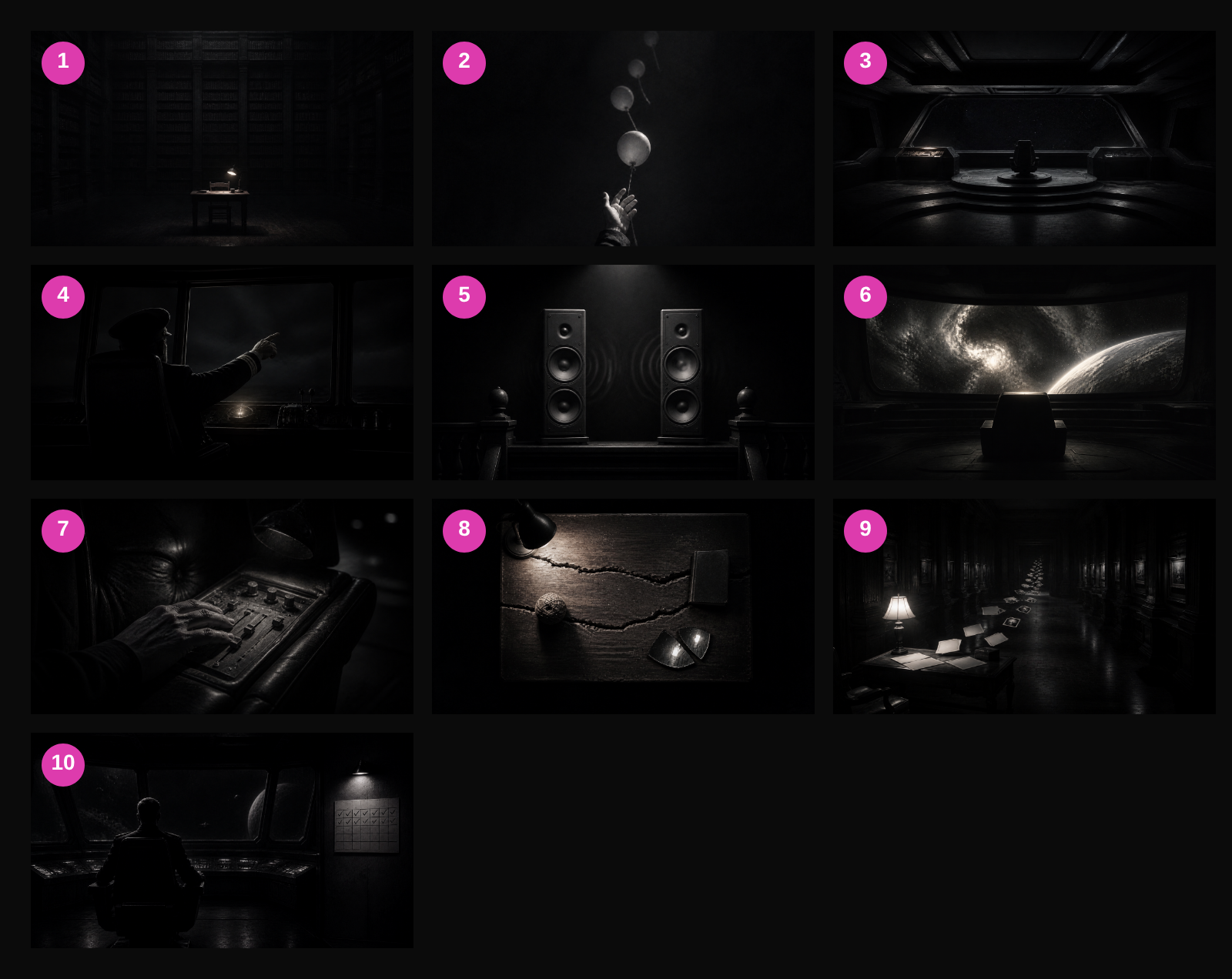
- Working memory is where thinking happens, and it is small. Image: a single tray on a captain's console with room for three or four items.
- Short-term memory holds about four chunks, and they fade within seconds. Image: four balloons slipping out of a hand one by one.
- Baddeley's model has four parts. Image: a starship bridge.
- The central executive is the captain. Image: a captain in the chair pointing and giving orders.
- The phonological loop is the speakers playing on repeat. Image: two speakers chanting "693, 693, 693".
- The visuospatial sketchpad is the 3D screen. Image: a huge screen above the bridge showing a vivid moving picture.
- The episodic buffer is the control panel that binds it all together. Image: a mixing desk on the arm of the captain's chair.
- Overload comes from holding too much in words, not using the library, and split attention. Image: three cracks in the workspace desk, each labelled.
- Move information from the loop to the sketchpad, chunk it, and offload it to a memory palace. Image: words turning into pictures and being filed into a palace.
- Focus is trainable: two weeks of mindfulness measurably improves working memory. Image: a calendar with 14 days ticked and the captain sitting calmly.
Sources
- Mark Channon, How to Remember Anything (Hodder Education)
- Baddeley, A. D. and Hitch, G. (1974). Working memory. In The Psychology of Learning and Motivation, Vol. 8, 47 to 89. Baddeley, A. (2000). The episodic buffer. Trends in Cognitive Sciences, 4(11), 417 to 423. https://doi.org/10.1016/S1364-6613(00)01538-2
- Melby-Lervåg, M., and Hulme, C. (2013). Is working memory training effective? A meta-analytic review. Developmental Psychology, 49(2), 270 to 291. https://doi.org/10.1037/a0028228
Loci
Build the memory palace in this article inside Loci — store your locations, link images, and rehearse with spaced repetition.
Try it in LociMemory School community
Learn directly with Mark inside the Memory School community on Skool — monthly lessons, practice, and Q&A.
Join Memory SchoolAbout the author
Mark Channon
Grand Master of Memory (1995). Author of three books on memory published by Hodder and Nick Hern. Creator of BBC1's Monkhouse's Memory Masters. Memory coach on Channel 4's Can I Improve My Memory?
Read full bio →