
How Memory Works
The Hippocampus and Memory
The hippocampus is the part of the brain you need to form new memories of facts and events. What the research shows, from the patient who lost his to a 2017 study in mice, what it does not show, and how to work with it.
Think back to the last holiday you took. Where you stayed, who you were with, what you ate on the first night. You can probably pull a surprising amount of that back, and it comes back as a scene: a place, a time, people in it.
New memories like that, of facts and of things that happened to you, depend on a small, curved structure deep inside each side of your brain called the hippocampus. Its name comes from the Greek for seahorse, which it loosely resembles. Without it, you could still remember much of your past, still hold a phone number for a few seconds, and still pick up a new physical skill. What you could not do is form new memories of facts and events.
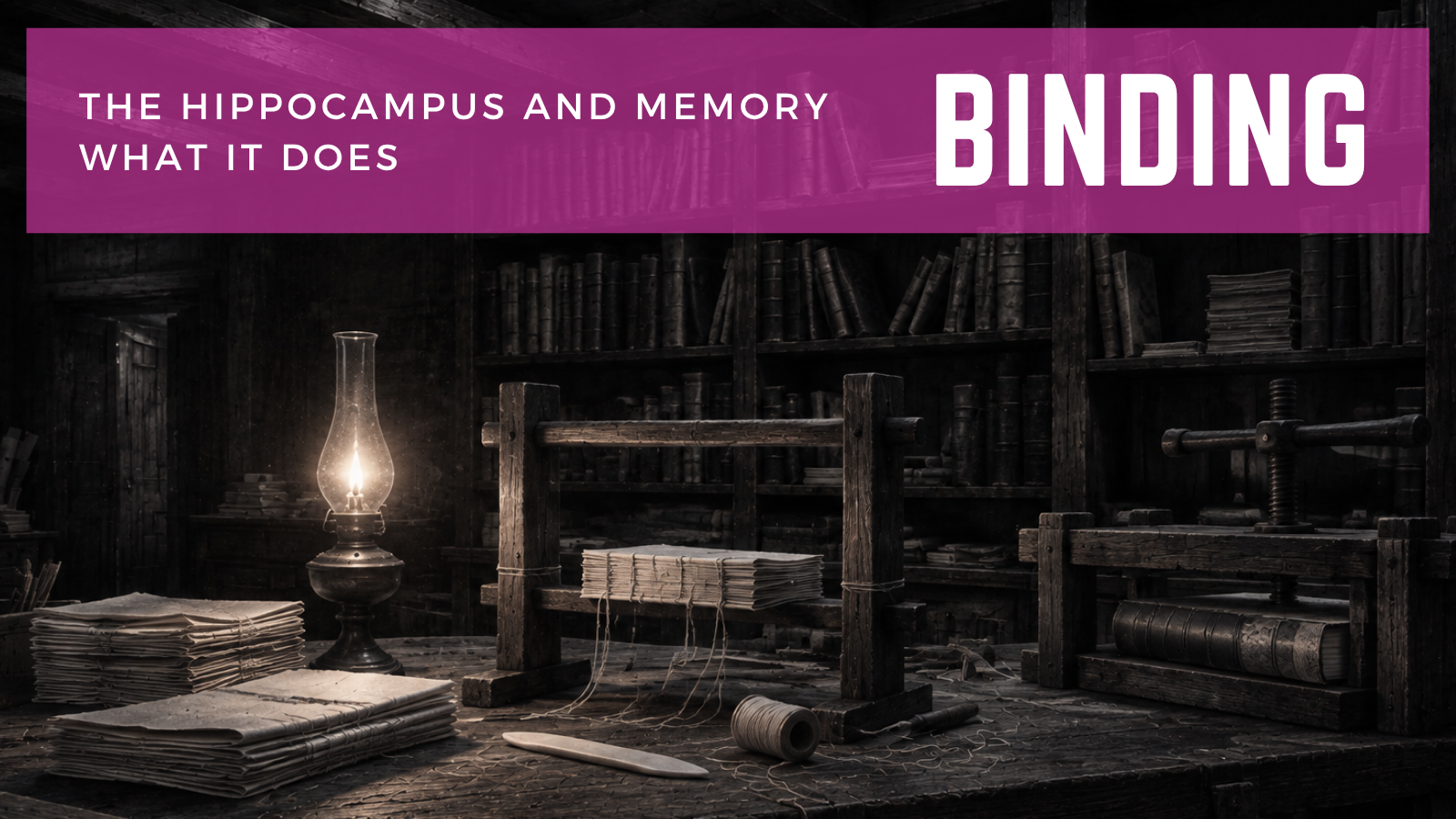
The core lesson is simple: the hippocampus is where new memories of facts and events are put together, but it is not where they live for ever. It binds the pieces of a new memory together while the memory is young, and over time the rest of the brain carries more of it.
Why it matters
If you know what the hippocampus does, a lot of memory advice suddenly makes sense. Why tying a fact to a place or an event seems to help it stick. Why coming back to something while it is new matters so much. Why a memory palace, which stores information on a route through places in your mind, can feel so natural the first time you try one.
It also clears away some myths. Memories are not filed in the hippocampus like folders in a cabinet. The hippocampus does not decide on its own what you keep. And a bigger hippocampus is not simply a better memory.
What the research says
Three studies tell most of the story: a patient who lost much of his hippocampus on both sides in 1953, a review that pulled together research on rats, monkeys and humans, and a 2017 study in mice that challenged the standard account of how memories settle in.
The research: Scoville and Milner, 1957
- In short: After surgery removed much of the hippocampus on both sides, a young man lost the ability to lay down new long-term memories of facts and events. The case showed how central the hippocampus is to making new memories.
- What they did: In 1953, to treat severe epilepsy, the surgeon William Scoville removed tissue from deep inside both sides of a patient's brain (the inner parts of the temporal lobes, the regions behind the temples), taking out much of the hippocampus on each side along with most of the amygdala, a small structure that handles emotional significance, and nearby tissue. The psychologist Brenda Milner then studied what had happened to his memory.
- Who was involved: Patients who had this kind of surgery; the clearest case was Henry Molaison, known in the research for decades only as H.M.
- What they found: He had severe amnesia for anything new. His early memories seemed normal, but he also lost memories from the years just before the operation. He could hold a short number in mind for minutes if nothing distracted him, and lost it the moment his attention moved on.
- What they concluded: The hippocampal region is essential for forming new long-term memories of facts and events, but not for holding something briefly in mind.
What kind of evidence is this? Mostly one case. That sounds thin, but Henry Molaison was studied for decades, and later research in other patients and in animals has kept pointing the same way. One thing to be careful of: the evidence that he could still learn new skills came from Milner's later work with him, not from this paper. Episodic vs Semantic Memory: The Difference and Why It Matters tells more of what he could still do.
The research: Squire, 1992
- In short: The hippocampus binds the pieces of a new memory together until the memory can stand on its own.
- What they did: Larry Squire brought together research on rats, monkeys and humans with damage to the hippocampus and the areas around it.
- Who was involved: No new participants. A review of studies of brain damage and behaviour across three species.
- What they found: Damage to this region harms memory for facts and events, while skills, habits and priming (the way an earlier exposure makes something easier to recognise later, without your noticing) are spared. The hippocampus is needed while a memory is being established, and becomes less important once the memory is settled in the cortex, the brain's wrinkled outer layer.
- What they concluded: The hippocampus forms and binds new memories of facts and events for a limited time.
What kind of evidence is this? A narrative review: one researcher drawing many studies together into a single account. Its strength comes from how consistent the findings were across three species.
The research: Kitamura and colleagues, 2017
- In short: In mice, a memory was laid down in the prefrontal cortex during the very first learning session, alongside the hippocampus, and took about two weeks to mature while the hippocampal version went quiet.
- What they did: Mice learned to fear a particular place after receiving mild foot shocks there. The researchers labelled the brain cells that were active during that learning, then tested the memory a day or two later and again about two weeks later, switching cells on and off with light and watching their activity.
- Who was involved: A team led by Takashi Kitamura in Susumu Tonegawa's lab at MIT, working with mice.
- What they found: Memory cells formed in the prefrontal cortex on day one, at the same time as those in the hippocampus. At first the prefrontal cells were silent: the place itself did not wake them up. Over about two weeks they matured, while the hippocampal memory cells went quiet. Memory cells in the amygdala, needed for the fear, were maintained throughout.
- What they concluded: The cortical memory is formed early, in an immature state, and matures with time, rather than being built later by a slow transfer from the hippocampus. The authors present it as a challenge to the standard model of how memories settle.
What kind of evidence is this? A strong study with a narrow scope: one lab, one task, in mice. It has not been tested in people, and it says nothing directly about studying or memory techniques.
What I take from it
The way I describe the 2017 finding is this. You form a memory in the hippocampus, and at the same time you form a kind of mirror memory in the prefrontal cortex. Over a couple of weeks, the balance between the two switches. That is a description of what happened in mice learning to fear a place, so hold it lightly. But it fits the picture from the other two studies: the hippocampus does its most important work while a memory is new, and then the rest of the brain carries more of the load.
I wrote in my books that the hippocampus catalogues and files new information. The research word is binding: it ties the pieces of a new memory together, the where, the when, the who and the what, so they can later be recalled (Squire, 1992).
When you turn a fact into an image and put it somewhere, in a room or along a route, you give it a where. From what I have seen, that is one of the quickest ways to make something new hold.
What the research does not show
A few confident claims about the hippocampus are worth dropping.
- It is not where memories are stored for good. Its role is time-limited. Older memories of facts and events depend far more on the cortex.
- It does not decide on its own what you keep. What gets kept depends on more than the hippocampus alone.
- Henry Molaison did not keep his whole past. His early memories seemed normal, but he lost memories from the years just before his operation. And the surgery removed more than the hippocampus.
- The 2017 study was in mice. It shows how one kind of memory settled in mice. It does not show that the same timeline holds in people, and it does not test revision or memory techniques.
- A bigger hippocampus is not simply a better memory. In London taxi drivers, the rear of the hippocampus was bigger than in non-drivers, bigger the longer they had driven, while the front was smaller (Maguire and colleagues, 2000). And trainees who qualified did slightly worse on one visual memory test (Woollett and Maguire, 2011). The London Taxi Driver Study (Maguire 2000) Explained has the full story.
The hippocampus and places
The taxi driver research points to the other thing the hippocampus is known for: spatial memory, your memory for where things are and how to get around. Drivers who spend years learning the streets of London show changes in the back of the hippocampus, and a follow-up study found the back of the hippocampus grew in trainees who qualified, and not in trainees who did not qualify or in non-drivers (Woollett and Maguire, 2011).
That link between new memories and places is the old idea behind the memory palace, which goes back to ancient Greece and Rome. You do not need to know the neuroscience to use one. But as I see it, it is a useful reason to trust the method: you are asking your memory to do something it is already practised at, remembering where things are.
How to work with your hippocampus
You do not need to think about your hippocampus to use it well. What you can do is give new information the shape it handles best.
- Give it a where. Tie new facts to a place: a room you know, a route you can picture, or a palace you build on the spot. Even a single location is better than none. What is a Memory Palace? A Beginner's Guide to the World's Oldest Memory Technique shows how.
- Make it an event. Facts on their own are slippery. Turn them into a scene with something happening in it, and the hippocampus has an event to bind, with a place, a moment and characters.
- Bring the senses in. The more of a scene you can see, hear and feel, the more pieces there are to tie together, and the more routes back to the memory.
- Come back while it is new. While a memory is new it still depends on the hippocampus (Squire, 1992), so that is the time to come back to it, and recall it rather than reread it. Spaced Repetition: The Complete Guide sets out how to space those visits.
- Sleep on it. Sleep after learning helps strengthen what you learned that day, and in deep sleep recently learned material is replayed (Rasch and Born, 2013). Sleep and Memory: Why the Night Does Half Your Learning explains what happens and how to use it.
Try it: a journey through the brain
One exercise I set for exactly this is a small memory palace of the brain itself, with three locations and a few structures on each. It is a good way to fix what you have just read.
- Location 1, the brain stem, which connects the brain to the spinal cord. Three items: the medulla, which looks after breathing, the heart and digestion; the pons, which links the brain stem to the cerebellum; and the midbrain, which among much else helps control movement. My example images: a medal, breathing with a beating heart; pins, joining the stem to the small brain; a midfielder controlling the movement of play.
- Location 2, the cerebellum, the small brain at the back, which co-ordinates movement and seems to play a part in learning.
- Location 3, the cerebrum, the large forebrain that sits over everything else. Its items include the thalamus, which routes most of what you sense on to the cortex; the amygdala, which flags emotional significance; and the hippocampus, with its key role in forming memories of facts and events.
Make your own images for locations 2 and 3. Then walk the route, say each structure and its job out loud, and only then check.
Where to go next
For the full taxi driver research, read The London Taxi Driver Study (Maguire 2000) Explained. For how the hippocampus fits into the wider map of memory systems, Types of Memory: Working, Short-Term, Long-Term and More and Episodic vs Semantic Memory: The Difference and Why It Matters.
To put the science to work in everyday life, How to Remember Things: Keys, Errands and What You Came In For shows how to give the small things in your day a where and a scene, and How to Remember Names: A Five-Step Framework That Actually Works does the same for the people you meet.
Memory map
- The hippocampus forms new memories of facts and events. Image: a small glowing seahorse curled deep inside a translucent head.
- It binds the pieces of a new memory together, and then the rest of the brain takes over. Image: a seahorse tying a bow around a bundle of photos while a twin bundle on a high shelf slowly lights up.
- After much of his hippocampus on both sides was removed in 1953, Henry Molaison could form no new long-term memories of facts and events. Image: a man reading the same newspaper headline with fresh surprise each morning.
- He could hold a number briefly, but lost it the moment his attention moved. Image: a number written in steam on a mirror, vanishing as he turns his head.
- Squire, 1992: the hippocampus is needed while a memory is new, and less once it is settled. Image: scaffolding coming down from a finished building.
- Kitamura, 2017: in mice, a second memory formed in the prefrontal cortex on day one and matured over about two weeks, as the hippocampal one went quiet. Image: a silent twin in the front of the head slowly opening its eyes over a two-week calendar.
- Binding, not filing: it ties the where, when, who and what together. Image: four coloured threads knotted into one rope.
- Myths to drop: not stored there for good, not the only judge of what you keep, bigger is not simply better. Image: three crossed-out signs on a seahorse's tank.
- The hippocampus is linked to spatial memory; taxi drivers' back hippocampus was larger. Image: a black cab with a map unfolding into a seahorse's tail.
- Give new facts a where and make them an event. Image: a fact card pinned to a door in a hallway, with a small scene playing out around it.
- While a memory is new, come back to it: recall, space it, sleep on it. Image: a calendar, a hand reaching into a head, and a moon over a pillow.
- A journey through the brain: brain stem, cerebellum, cerebrum, with the hippocampus in the third. Image: a medal, a pin and a midfielder on a plant stem, a small brain beside it, and a seahorse on top of a large dome.
Sources
- Scoville, W. B., and Milner, B. (1957). Loss of recent memory after bilateral hippocampal lesions. Journal of Neurology, Neurosurgery and Psychiatry, 20(1), 11 to 21. https://doi.org/10.1136/jnnp.20.1.11
- Squire, L. R. (1992). Memory and the hippocampus: a synthesis from findings with rats, monkeys, and humans. Psychological Review, 99(2), 195 to 231. https://doi.org/10.1037/0033-295X.99.2.195
- Kitamura, T., Ogawa, S. K., Roy, D. S., Okuyama, T., Morrissey, M. D., Smith, L. M., Redondo, R. L., and Tonegawa, S. (2017). Engrams and circuits crucial for systems consolidation of a memory. Science, 356(6333), 73 to 78. https://doi.org/10.1126/science.aam6808
- Maguire, E. A., Gadian, D. G., Johnsrude, I. S., Good, C. D., Ashburner, J., Frackowiak, R. S. J., and Frith, C. D. (2000). Navigation-related structural change in the hippocampi of taxi drivers. PNAS, 97(8), 4398 to 4403. https://doi.org/10.1073/pnas.070039597 (the home for this study is The London Taxi Driver Study (Maguire 2000) Explained)
- Woollett, K., and Maguire, E. A. (2011). Acquiring "the Knowledge" of London's layout drives structural brain changes. Current Biology, 21(24), 2109 to 2114. https://doi.org/10.1016/j.cub.2011.11.018 (the home for this study is The London Taxi Driver Study (Maguire 2000) Explained)
- Rasch, B., and Born, J. (2013). About sleep's role in memory. Physiological Reviews, 93(2), 681 to 766. https://doi.org/10.1152/physrev.00032.2012 (the home for this study is Sleep and Memory: Why the Night Does Half Your Learning)
Loci
Build the memory palace in this article inside Loci — store your locations, link images, and rehearse with spaced repetition.
Try it in LociMemory School community
Learn directly with Mark inside the Memory School community on Skool — monthly lessons, practice, and Q&A.
Join Memory SchoolAbout the author
Mark Channon
Grand Master of Memory (1995). Author of three books on memory published by Hodder and Nick Hern. Creator of BBC1's Monkhouse's Memory Masters. Memory coach on Channel 4's Can I Improve My Memory?
Read full bio →