
How Memory Works
Episodic vs Semantic Memory: The Difference and Why It Matters
Episodic memory is your timeline of experiences. Semantic memory is your store of facts. One holds on with no effort, the other fades fast. The gap between them is why memory techniques work.

Episodic memory is your memory of experiences: your timeline of events throughout your life, tagged with when and where they happened. Semantic memory is your knowledge of facts: things you know without any memory of learning them. They are both forms of conscious, long-term memory, they live side by side, and they behave completely differently. One looks after itself. The other is the one you mean when you say you have a bad memory.
Understanding the difference is not academic. It explains why you can recall your first day at school in colour but not the capital of Burkina Faso, and it points straight at the single most useful idea in memory training: if you want a fact to stick, dress it up as an experience.
Two quick tests
Take a minute and answer these, jotting a few key words for each.
What was one of your favourite holidays? What was the last film you went to see? What did you have for breakfast yesterday?
Now these. Who wrote the Harry Potter books? What is your partner's or a family member's birthday? What does the word mnemonic mean?
Notice how the two sets felt. The first set came back as scenes. You probably saw the holiday, felt something about the film, pictured yesterday's kitchen. The second set came back as bare answers, or did not come back at all. That felt difference is the difference between episodic and semantic memory.
Episodic memory: the diary you carry
Episodic memory relates to experiences and events that are time-tagged and include spatial information. Where you were, when it was, what it felt like. Oscar Wilde called memory the diary we all carry about with us, and episodic memory is exactly that: a diary written in scenes rather than words.
It is remarkably strong. Think of where you were when a major public event happened decades ago; the scene is likely still there. You can replay a conversation from years back, complete with the room and the light. You did not try to store any of it. The brain stores episodes by default, because an episode has everything the brain likes: a place, a time, movement, people, emotion.
That last ingredient does most of the work. The episodic memories that stand out are the ones that made you feel something. Joy, embarrassment, fear, surprise. Emotion is the brain's marker for "this matters, keep it."
Semantic memory: the facts without a story
Semantic memory is about your knowledge of facts. The elements of the periodic table. The capital of Italy. The fact that the prefix bi means two. The defining feature is that semantic memory is not tagged to a specific event. You know that Rome is the capital of Italy, but you almost certainly have no experience linked to learning it. It is just there, stripped of its origin.
That stripping is efficient, which is why the brain does it. You do not need to remember the classroom to use the fact. But it is also why semantic memory is fragile on the way in. A fact with no place, no time and no feeling has none of the hooks the brain uses to decide what to keep. Heard once, it is usually gone within a day. This is the forgetting curve, the pattern of fast early loss that slows over time, at its steepest.
So when someone says they have a terrible memory, what they almost always mean is that their semantic memory is untrained. Their episodic memory is fine. They just cannot get bare facts to stay.
The case that drew the line
The clearest evidence that these are separate systems comes from a patient known as H.M. In 1953, to treat severe epilepsy, surgeons removed part of his brain including the hippocampus, a small structure deep in the brain that is central to forming new memories. Afterwards, he could still remember events and facts from his past: his episodic and semantic memories from before the surgery were intact. He could hold a string of digits in mind until he was interrupted, so his working memory was fine too. And he could still learn new skills, because procedural memory, the memory for skills, does not depend on the hippocampus.
What he could not do was form any new declarative memory. No new facts. No new events. Every conversation vanished as soon as it ended. From H.M., scientists learned that the hippocampus is essential for laying down new episodic and semantic memories, and that these conscious memories are a different system from the non-conscious ones that survived.
For our purposes the lesson is simpler. Episodic and semantic memory go in through the same door. They just arrive in very different condition.
Why this is the most useful idea in memory training
Here is the move that the whole art of memory rests on.
Your episodic memory is strong because episodes have place, movement, people and emotion. Your semantic memory is weak because facts have none of those. So give the fact what the episode has. Turn it into a scene. Put it somewhere. Make it move. Make it funny or alarming. Say it out loud so it has a sound.
Take the prefix bi, meaning two. As a bare fact it will fade. As a scene, a bison riding a bicycle with two enormous wheels through your kitchen while you say "bi, two" aloud, it is an episode. It has a place (your kitchen), an image (the bison on the bicycle), a sound (your voice) and a feeling (it is ridiculous). Your episodic memory, the strong one, now holds a semantic fact.
Every memory technique is a version of this trick. A memory palace puts facts at spots along a route you know. A chain links them one to the next, giving them movement and story. A reference story gives them a picture and a sound. The techniques are not cleverness. They are a way of smuggling semantic information into the system that was built for episodes.
Making semantic information emotional
The emotional marker deserves its own mention, because it is the ingredient people under-use.
You can make semantic information more memorable by wrapping it in an emotional story: something funny, exciting or scary. The images that stick are never the sensible ones. They are the ones that make you laugh. If you have ever danced or practised a martial art, you may remember how the feeling in your body helped you remember the movements. The same applies to facts. A dull fact with a strong feeling attached is a fact your brain will keep.
So when you build an image for a fact, ask: how can I make this funnier, stranger, bigger, more alarming? That question is not decoration. It is the step that recruits the emotional system and turns a fact into something your brain treats as an event.
Where the two meet: creative memorisation
The method that uses this deliberately is called creative memorisation, and it draws on every type of memory at once (Creative Memorisation: The Four Ingredients That Make Anything Memorable sets it out). You take semantic content, give it the properties of an episode, and then do something with it so the learning cycle completes: you reflect on what it means, you say it aloud, you act on it.
The result is semantic knowledge that behaves like episodic memory. Durable. Vivid. Retrievable on demand. Students who use it stop describing themselves as having a bad memory, because the thing they struggled with was never their memory. It was that nobody had shown them how to hand facts to the system that actually remembers.
The practical takeaway
If you remember one thing, make it this. You have two conscious memory systems. One stores experiences and is excellent. One stores facts and is fragile. You cannot swap them, but you can disguise one as the other, and the disguise is the whole of memory technique.
Next time a fact will not stick, do not repeat it. Give it a place, a picture, a movement and a feeling. Say it out loud. Then let your excellent episodic memory do the job your fragile semantic memory could not.
For the wider map of memory systems, see Types of Memory: Working, Short-Term, Long-Term and More. For the technique that turns facts into scenes, see How to Remember Definitions and Facts (The Reference Story Method). And for the structure that gives every fact a place, start with What is a Memory Palace? A Beginner's Guide to the World's Oldest Memory Technique.
To use the disguise on real material, How to Remember Names: A Five-Step Framework That Actually Works turns a bare name into a small scene you can see, and How to Memorise Dates and Historical Events gives each year and event a picture so the fact comes back as an episode.
Memory map
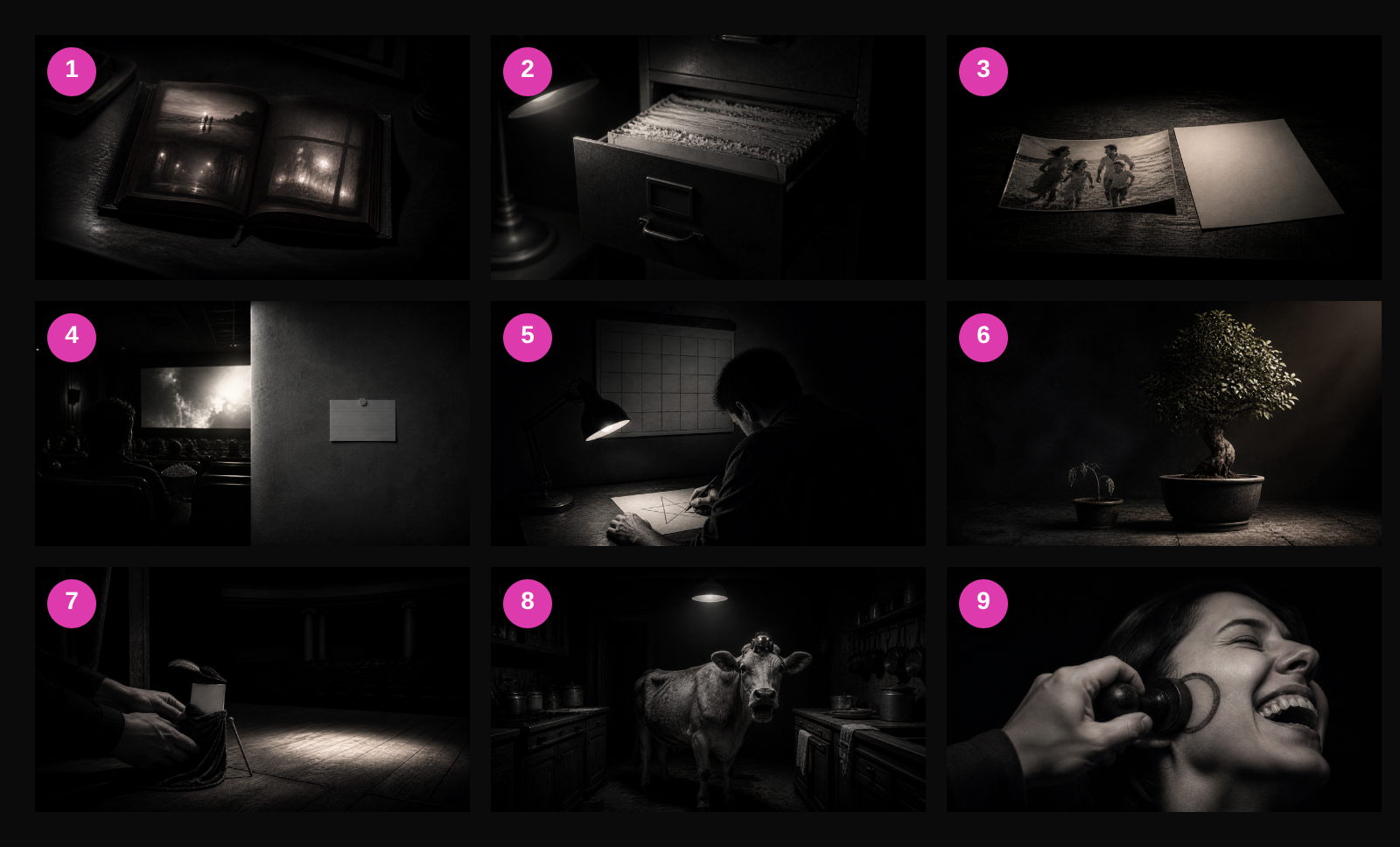
- Episodic memory is your timeline of experiences, tagged with when and where. Image: a diary whose pages are small movie scenes.
- Semantic memory is your store of facts, with no memory of learning them. Image: a filing cabinet of index cards, each with the top torn off.
- Episodes have place, movement, people and emotion; facts have none. Image: a vivid holiday photo beside a plain typed word.
- The two quick tests: holiday and film versus author and birthday. Image: a split screen, scenes on the left, bare words on the right.
- H.M. (1953) kept old memories and new skills but could form no new facts or events. Image: a man learning to trace a shape perfectly while a calendar behind him stays blank.
- Semantic memory is what people mean by a bad memory, and it is the trainable one. Image: a weak plant in a pot labelled "facts" next to a strong tree labelled "experiences".
- The core move: give a fact the properties of an episode. Image: a plain fact being dressed in a costume, handed a prop and pushed onto a stage.
- The prefix bi: a bison on a bicycle with two huge wheels, in your kitchen, said aloud. Image: exactly that.
- Emotion is the brain's marker for "keep this". Image: a stamp reading KEEP pressed onto a laughing face.
Sources
- Mark Channon, How to Remember Anything (Hodder Education)
- Scoville, W. B. and Milner, B. (1957). Loss of recent memory after bilateral hippocampal lesions. Journal of Neurology, Neurosurgery and Psychiatry, 20(1), 11 to 21. https://doi.org/10.1136/jnnp.20.1.11
Loci
Build the memory palace in this article inside Loci — store your locations, link images, and rehearse with spaced repetition.
Try it in LociMemory School community
Learn directly with Mark inside the Memory School community on Skool — monthly lessons, practice, and Q&A.
Join Memory SchoolAbout the author
Mark Channon
Grand Master of Memory (1995). Author of three books on memory published by Hodder and Nick Hern. Creator of BBC1's Monkhouse's Memory Masters. Memory coach on Channel 4's Can I Improve My Memory?
Read full bio →