
How Memory Works
The Magical Number Seven, and Why It Is Really Four
You have probably heard that we can hold seven things in mind. The later research puts the core limit nearer four chunks. What Miller and Cowan found, why the difference matters, and how chunking lets you carry far more than four.

You have probably heard that we can hold seven things in our heads at once. It is one of the best-known numbers in psychology, and it is not quite right.
In 1956 the psychologist George Miller described a "magical number seven, plus or minus two". It was a rough estimate. In 2001 another psychologist, Nelson Cowan, reviewed the evidence that had built up since and put the core limit at about four chunks, somewhere between three and five. A chunk is several pieces you hold as one. You really can repeat back about seven digits, but only because chunking and rehearsal (repeating them to yourself) stretch that smaller core.
Four sounds like bad news. It is not, because the word doing the work is chunk, and a chunk can be made bigger. Here is what the two papers say, what they do not say, and how to make your chunks bigger so that four slots carry a great deal more than four things.
Why the number matters
If you believe your head holds seven things, you will plan for seven. You will take in a list of seven new names at a meeting, or seven action points read out at the end of a call, and wonder why three of them vanished. Nothing is wrong with you. You were working to the wrong budget.
I gave the old figure myself. How to Remember Anything describes seven plus or minus two, five to nine items, because that was the standard line when I wrote it. The evidence now sits at three to four chunks. Getting the number right changes what you do in the moment: you stop trying to juggle and start grouping.
What the research says
The research: Miller, 1956, and Cowan, 2001
- In short: Miller's famous "seven, plus or minus two" was a loose estimate. A review of the later evidence by Nelson Cowan argued that, once rehearsal and chunking are controlled for, short-term memory holds about four chunks, three to five.
- What they did: Miller drew together findings on the limits of how much people can hold and judge at once. Cowan reviewed studies that were designed to stop people rehearsing or chunking, so that what was left was the core capacity.
- Who was involved: George Miller wrote the 1956 paper. Nelson Cowan wrote the 2001 review, drawing on many studies.
- What they found: Miller's seven was a rough, partly rhetorical figure. The core capacity is about four chunks. The limit applies to chunks, not raw items, so grouping material into meaningful units raises how much a person can hold. A digit span of about seven holds up, but it reflects chunking and rehearsal on top of the smaller core.
- What they concluded: Seven describes everyday digit span. About four describes core capacity.
It helps to know what kind of evidence this is. Miller's paper is a theory paper that pulled earlier findings together; Cowan's is a review of the evidence that came after. Together they are strong support for a small limit that chunking stretches. The exact number is still debated, so treat "about four" as the best current estimate of the core, and "about seven" as everyday digit span.
What I take from it
Three things, and they all change what you do.
Plan for four. Assume you can hold a handful of new things at once, and no more, and when you present to a room, assume the same of everyone in it. Anything beyond that gets written down or encoded straight away.
The limit counts chunks, not items. This is the part that makes the finding hopeful rather than depressing. Four slots is a small desk, but nobody said how much each slot can carry. A chunk can be a single digit, or it can be a word that stands for three digits. With the major system, which gives each digit a consonant sound so numbers become words, 357 becomes milk: three digits, one picture. The whole craft of memory, as I see it, is making each chunk bigger and more meaningful so the same few slots carry more.
Pictures make excellent chunks. A picture arrives whole, so it fills one slot however many digits it carries. Turn a handful of figures into a handful of pictures, place each one on a location in a memory palace (a route in your mind with an image waiting at each stop), and you carry the digits and their meanings without crowding the workspace. The Major System Explained walks through a real example: a startup's key monthly numbers held as pictures on one walk.
Cowan did not test number systems; the reason they work comes from practice, not from his review. His review measured the core with chunking taken away. Memory techniques put chunking back on purpose.
What it does not show
The number seven gets repeated so often that it has picked up some baggage. Here is what to leave behind.
- It is not a fixed capacity of five to nine items. That is the old line, and it is the one to drop. Short-term memory does not have seven boxes waiting to be filled.
- Miller did not prove the number seven. His figure was a rough estimate, and he was drawing results together rather than settling a measurement.
- Four is not a precise law either. The core sits at about three to five chunks, and researchers still argue over the exact figure. If someone tells you the brain holds exactly four things, they have overcorrected.
- A chunk is not free. Grouping only helps when the groups mean something. Split a long number into threes and you have helped yourself; split it at random and you have just made more pieces.
- It is not about long-term memory. These papers are about what you can hold in mind right now. What you can store for good is a different question, and the answer is far more generous.
That last point explains how memory techniques seem to break the limit. A number system can put several digits on a single location in a memory palace. That is not more items sitting in short-term memory. It is a technique packing the digits into pictures and storing them in long-term memory, which is a separate job.
How chunking works, and how to make chunks bigger
Chunking is grouping several small pieces into one bigger unit you can hold as a single thing. It is the reason a phone number is possible at all. Take a ten-digit number: 571-006-2213 is three chunks, not ten digits. You read three groups, you hold three groups, and you still have room to spare.
Memory techniques take that idea and push it further in three ways.
Sort before you store. Classification and chunking come first. Before you place anything, group it. A shopping list of fifteen things is fifteen slots. The same list sorted into the fridge, the bakery and the bathroom cabinet is three categories, each with a few items inside. Sorting is chunking by meaning.
Turn each group into a picture. A picture is a natural chunk because it arrives whole. With the number shape system, a single digit becomes an image of something it looks like: 1 is a pencil, 4 is a sail, 9 is a balloon. With the major system, two digits become one word, so 98 is beef and 64 is a chair. Push it one step further and three digits become one word, which is how 357 becomes milk. Each step up means fewer chunks for the same number of digits.
Give each chunk a home. Once a chunk is a picture, put it on a location in a memory palace. Now it is not in the workspace at all. You have moved it out of short-term memory and into a structure you can walk back through later, and those few slots are free for thinking about what the numbers mean.
How to Memorise Phone Numbers walks through numbers like these in full. What matters is the principle: four is a limit on chunks, so build bigger chunks.
How to use it this week
Here is a short plan you can try on real information from your own life.
- Count in chunks, not items. Next time someone gives you something to hold, a set of directions, a code, a list of jobs, count how many separate pieces it is. If it is more than four, do something with it straight away instead of hoping.
- Group numbers before you read them. Any long number, split it into threes or fours at natural breaks. Say each group aloud as a group, not as single digits.
- Sort lists by meaning. Before you try to remember a list, find the categories. From what I have seen, three groups of four beat twelve loose items.
- Make one picture per chunk. Use the number shapes if you are new to this; move on to the major system for pairs once you have built your 100 two-digit images (The Major System Explained shows how). Aim to see each picture clearly before moving on.
- Try it on figures you need at work. Pick four or five figures you need, such as monthly numbers, targets or prices. Give each its own picture and its own place in a palace. When you walk back through, let each picture remind you what the figure is for.
- Test it in a day. Walk the palace from memory and say each figure and what it stands for. Anything that did not come back needs a stronger picture.
Do this for a week and you may notice something. The limit does not go away; you just run into it less.
Where to go next
For the workspace itself, and how its parts share the load, read What is Working Memory? For how fast unrehearsed information slips out of that workspace, see Peterson and Peterson (1959): How Fast Short-Term Memory Fades. For the code behind 98 as beef and 357 as milk, The Major System Explained teaches it from scratch, with a real worked example, and How Memory Works (A Practical Guide) shows where short-term memory sits in the bigger picture.
To put chunking to work on the people you meet, How to Remember Names: A Five-Step Framework That Actually Works shows you how to turn each name into a single picture, one chunk per person instead of a string of sounds.
Memory map
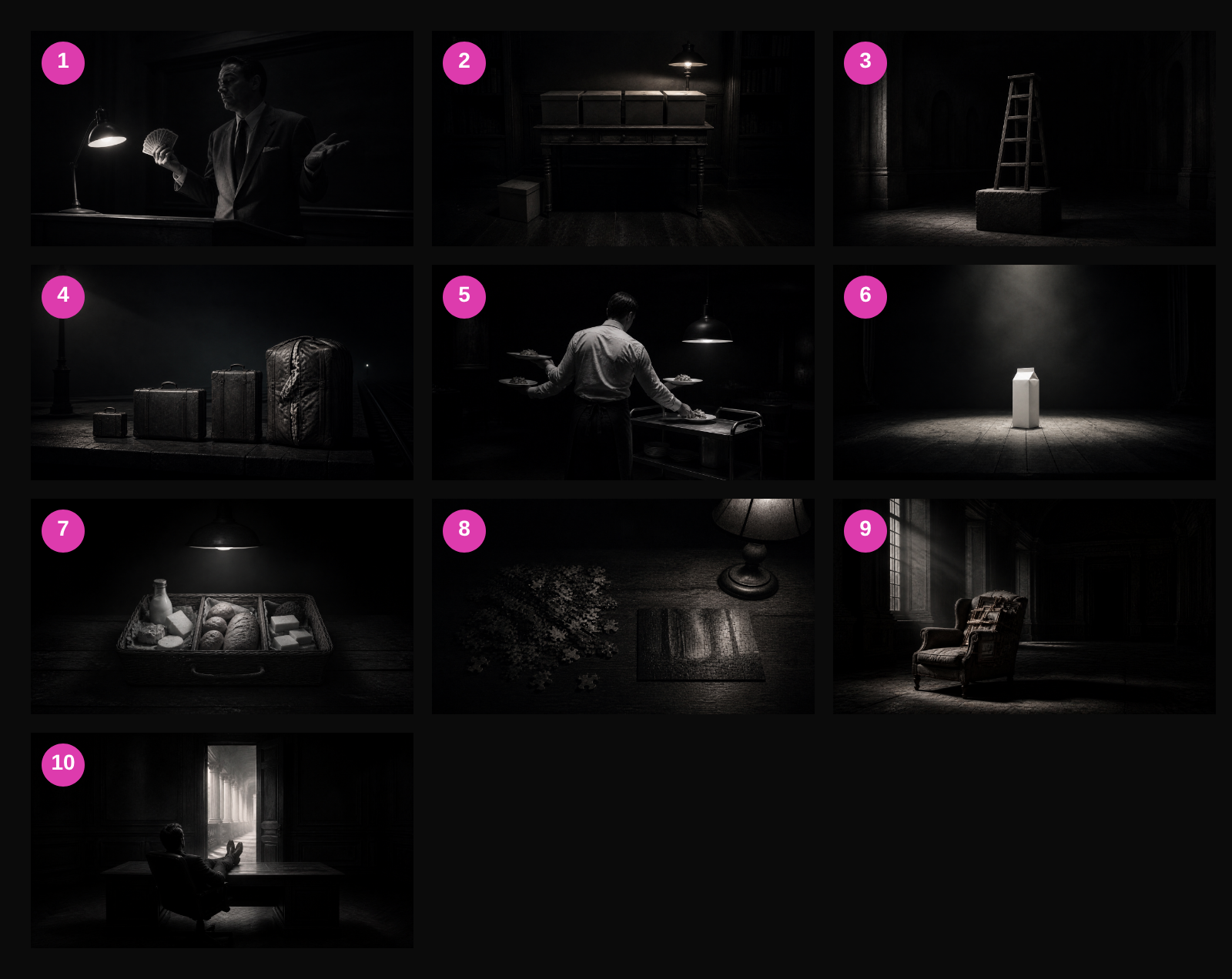
- Miller's "seven, plus or minus two" was a rough estimate from 1956. Image: a man in a 1950s suit holding up a hand of cards and shrugging.
- Cowan's 2001 review put the core limit at about four chunks, three to five. Image: a small desk with room for only four boxes on top.
- Seven is everyday digit span; four is the core underneath it. Image: a short wooden ladder standing on a solid block, the block clearly smaller than the ladder is tall.
- The limit counts chunks, not items. Image: four suitcases, one tiny and one so stuffed it is bursting at the seams.
- Plan for four and encode or write down the rest. Image: a waiter carrying four plates and setting the fifth on a trolley.
- One picture can carry several digits: 357 becomes milk. Image: a carton of milk standing on a stage in a spotlight.
- Sort before you store: categories are chunks. Image: a shopping basket split into three neat compartments of fridge food, bread and soap.
- Grouping only helps when the groups mean something. Image: a jigsaw cut into random shapes beside one cut into clean, picture-shaped pieces.
- Several digits on one location is a mnemonic in long-term memory, not short-term capacity. Image: a single armchair in a palace with a bundle of pictures tied to it with string.
- Give each chunk a home and the workspace is free to think. Image: a person sitting back in an empty, tidy office, feet up, with a palace door open behind them.
Sources
- Miller, G. A. (1956). The magical number seven, plus or minus two: some limits on our capacity for processing information. Psychological Review, 63, 81 to 97. https://doi.org/10.1037/h0043158
- Cowan, N. (2001). The magical number 4 in short-term memory: a reconsideration of mental storage capacity. Behavioral and Brain Sciences, 24(1), 87 to 114. https://doi.org/10.1017/S0140525X01003922
- Peterson, L. R., and Peterson, M. J. (1959). Short-term retention of individual verbal items. Journal of Experimental Psychology, 58(3), 193 to 198. https://doi.org/10.1037/h0049234. Broken down in full in Peterson and Peterson (1959): How Fast Short-Term Memory Fades.
Loci
Build the memory palace in this article inside Loci — store your locations, link images, and rehearse with spaced repetition.
Try it in LociMemory School community
Learn directly with Mark inside the Memory School community on Skool — monthly lessons, practice, and Q&A.
Join Memory SchoolAbout the author
Mark Channon
Grand Master of Memory (1995). Author of three books on memory published by Hodder and Nick Hern. Creator of BBC1's Monkhouse's Memory Masters. Memory coach on Channel 4's Can I Improve My Memory?
Read full bio →