
How to Remember Anything
How to Memorise a Speech with a Memory Palace (No Notes Needed)
How to deliver a speech, presentation or pitch without notes, by placing each section of your talk along a journey in your mind and walking it as you speak.

There's a moment in every presentation where you stop reading your slides and start speaking. Your eyes meet the audience. Your tone shifts. The room leans in. That moment is worth ten of the others, and it's the moment you lose when you're glued to a script.
A memory palace (a place you know well, such as your home, where you picture each point of your talk sitting at a spot along a route through it) lets you deliver a speech, presentation or pitch without notes while looking like you're making it up on the spot. It works for keynote talks, TV interviews, sales pitches, theatre monologues and boardroom presentations alike. Here it is, step by step.
Let's get into it.
Why Memorising a Speech is Easier Than You Think
Read it over and over, write it out, repeat it until it sticks: the familiar tips for learning a speech all aim at the words. That's the hardest possible way to do it.
Words are abstract. They have almost no hooks for your brain to grab onto. If you sit down and try to learn a 1,500-word speech line-for-line, you're working against the way your memory naturally functions, and you'll spend hours rehearsing, only to forget half of it under pressure.
The trick is to not memorise the words. Memorise the ideas. Once you know the ideas, the words follow, because you actually know what you're talking about.
This is what a memory palace does well. It stores ideas, not words. Each idea sits at a location, and the location triggers the idea in order. Your speech becomes a mental walk, and you're free to express each idea in whatever language feels right in the moment.
Intent, Meaning, Emotion, Action, Visual Cues
There is a simple "recipe" for memorising speeches and scripts. The key ingredients are:
- Your intent, what you want the audience to think, feel or do
- The meaning, what each section is actually saying
- Any emotions, what you want the audience to feel
- Physical actions, the gestures or movements that go with each section
- Creative visual cues, the images that trigger the section
Once these are in place, the rest of the process is:
- Prepare the speech in your own words
- Add the actual words of the script
- Cook it up, i.e. rehearse it, for the appropriate time
- Serve it with gusto
This is why some of the best speakers in the world look like they're improvising even when they're delivering exactly the speech they wrote. They are. The structure is fixed; the language is alive.
Step 1: Find the Key Beats of Your Speech
Read through your speech and identify the key beats, the major points you want to make, in order. A typical 20-minute talk has somewhere between 10 and 25 beats.
A beat might be:
- An opening hook (a story, a question, a statistic)
- A core argument
- A piece of evidence
- A counter-point
- A vivid example
- A call to action
- A closing line
Write the beats down as a numbered list. Don't worry about wording. Just nail the idea.
For example, here's a rough beat-list for a 5-minute pitch about a new product:
- Hook: the personal moment that started everything
- The problem most customers face
- Why existing solutions fail
- Our insight (the thing nobody else has spotted)
- How the product works
- Three real customer results
- What we're asking for
- Closing image
Eight beats. Eight images. Eight locations. That's the whole speech.
Step 2: Create a Visual Cue for Each Beat
Now turn each beat into a visual cue, a vivid mental image that triggers the idea.
The image doesn't have to be elegant. It doesn't even have to make sense to anyone else. It just has to be specific enough that when you see it, your brain produces the underlying idea.
Take the example list above:
- Hook → a hook from a fishing rod, with a tiny version of you dangling off it
- Problem → a tangled ball of phone cables on fire
- Why existing solutions fail → a leaky bucket pouring water onto thirsty customers
- Our insight → a giant lightbulb with eyes, looking surprised
- How the product works → a Rube Goldberg machine made of obvious parts
- Three customer results → three trophies stacked on top of each other
- The ask → an outstretched hand
- Closing image → whatever the actual closing image of your speech is
Apply the MIN rule, Minimum Images Necessary. You don't need a cue for every sentence. You need a cue for every beat. If a section is so obvious or so natural to you that you'll never forget it, skip the cue.
Step 3: Place the Cues in Your Memory Palace
This is the main step. Walk your memory palace mentally and place one visual cue on each location, in order.
If you haven't built a palace yet, read How to Build a Memory Palace: A 7-Step Beginner's Guide (With Worked Examples) first. For an 8-beat speech you need 8 locations. For a 20-beat keynote, you need 20.
As you place each cue, make sure it interacts with the location:
- "The fishing hook is dangling from my front door handle, slowly swinging."
- "The tangled phone cables are on fire on my hallway table, smoke rising."
- "The leaky bucket is balanced on my stairs, water trickling down each step."
The interaction is what makes the memory stick. Don't just put the image near the location, make the image happen to the location.
Place the cues in chunks of five. Test each chunk before moving on to the next. The whole process for an 8-beat speech usually takes around 5 to 10 minutes.
Step 4: Rehearse Using the iMind
This is the part that tends to get left out. You've placed the cues. You can mentally walk the palace. But you still need to actually deliver the speech, out loud, on your feet, with eye contact.
The answer is a technique called the iMind, the practice of projecting your images externally, into the real space in front of you, rather than retreating into your head to find them.
Here's how it works:
- Stand up as if you were about to give the talk
- Imagine that your memory palace wraps around you in the real space where you're standing
- As you reach each beat, your visual cue appears in front of you in the room, not inside your head
- You can point at it, gesture at it, move past it as you speak
- Tell the speech out loud, using the visual cues as the trigger for each section
The reason this matters is presence. If you have to close your eyes and retreat into a mental palace to find your next point, you've left the room. You're somewhere else. Your audience feels it instantly.
When the palace is projected externally, laid over the real room rather than kept somewhere in your head, you stay completely present, aware of your surroundings, free to react to your audience.
This takes practice. Deliver a speech three times using the iMind and it starts to feel natural.
Step 5: Bring the Palace Into the Room
The final piece of the puzzle is a bit of stagecraft.
When you walk into the actual room where you're delivering the speech, a conference hall, a meeting room, a TV studio, you'll be in a space your memory palace was never built in. If you're not careful, you'll mentally "leave" the real room to go and find your palace, and your delivery will suffer.
The fix is to bring the palace to you. Actors use a two-part exercise for this: picture Big Ben far away, then picture it standing in the room with you, and notice that only the second version keeps you present. The full version is in How Actors Learn Lines Fast: The Seven-Step Recipe (From Learning Your Lines). For a speaker the practical version is simpler.
Before you go on, stand at the lectern or in the spot you will speak from. Look at the real room. Then, one by one, place the locations of your palace onto that room. Your front door is the main entrance at the back. Your hallway table is the first row of seats. Your stairs are the aisle. Your sofa is the sound desk. Each one still carries its visual cue. You are not leaving the room to fetch your points; the points are sitting on the furniture in front of you.
That's the technique. When you walk into the room where you're delivering your speech, mentally bring the locations of your palace into that space. Your sofa, your bookshelf, your TV, your hallway table, all of them, surrounding you in the real room. On each one is your visual cue. You speak the speech without going anywhere.
This skill takes practice but pays off enormously. It's the difference between a speaker who looks like they're reading their notes off an invisible teleprompter and a speaker who looks like they're having a conversation with the audience.
A Worked Example: Memorising a 5-Minute Pitch
Here is what this looks like end to end, using the 8-beat pitch from earlier.
The palace: a familiar route through your living room, front door, hallway table, stairs, sofa, window, TV, bookcase, coffee table.
The visual cues:
- Front door → fishing hook with tiny you dangling
- Hallway table → tangled phone cables on fire
- Stairs → leaky bucket, water cascading down
- Sofa → giant lightbulb with surprised eyes
- Window → Rube Goldberg machine smashing through the glass
- TV → three stacked trophies bursting out of the screen
- Bookcase → an outstretched hand reaching out from the shelves
- Coffee table → your closing image (whatever it is for this pitch)
Rehearsal: You stand up. You project the palace into the room. You deliver each section, looking at the cue in front of you, in your own words. The first time it's a bit rough. By the third pass it's natural. By the fifth pass you're not thinking about the cues anymore, they're just there.
Delivery: You walk into the boardroom. You bring the palace in with you: the front door is on your left, the hallway table is just in front of you, the stairs are over by the projector. You deliver the pitch. The audience sees a speaker making eye contact, gesturing, completely present. Nobody knows there's a fishing hook hanging from the imaginary front door.
Common Mistakes When Memorising a Speech
Trying to memorise the words instead of the ideas. This is the cardinal sin. Memorise ideas. Speak the words fresh each time.
Too many visual cues. Use the MIN rule. One cue per beat, not one cue per sentence.
Cues that don't interact with the location. "The bucket is near the stairs" is weak. "The bucket is balanced on the stairs, water cascading down each step" is strong.
Retreating into your head during delivery. Use the iMind. Project the palace externally. Stay in the room.
Not bringing the palace into the venue. Mentally place your familiar locations around the actual room where you're delivering, not in your head.
Where to Go Next
If you want to dive deeper into the foundations of memory palaces, read:
- What is a Memory Palace? A Beginner's Guide to the World's Oldest Memory Technique, the foundations
- How to Build a Memory Palace: A 7-Step Beginner's Guide (With Worked Examples), if you haven't built one yet
- How Actors Learn Lines Fast: The Seven-Step Recipe (From Learning Your Lines), for word-perfect memorisation, not just key beats
Memory map
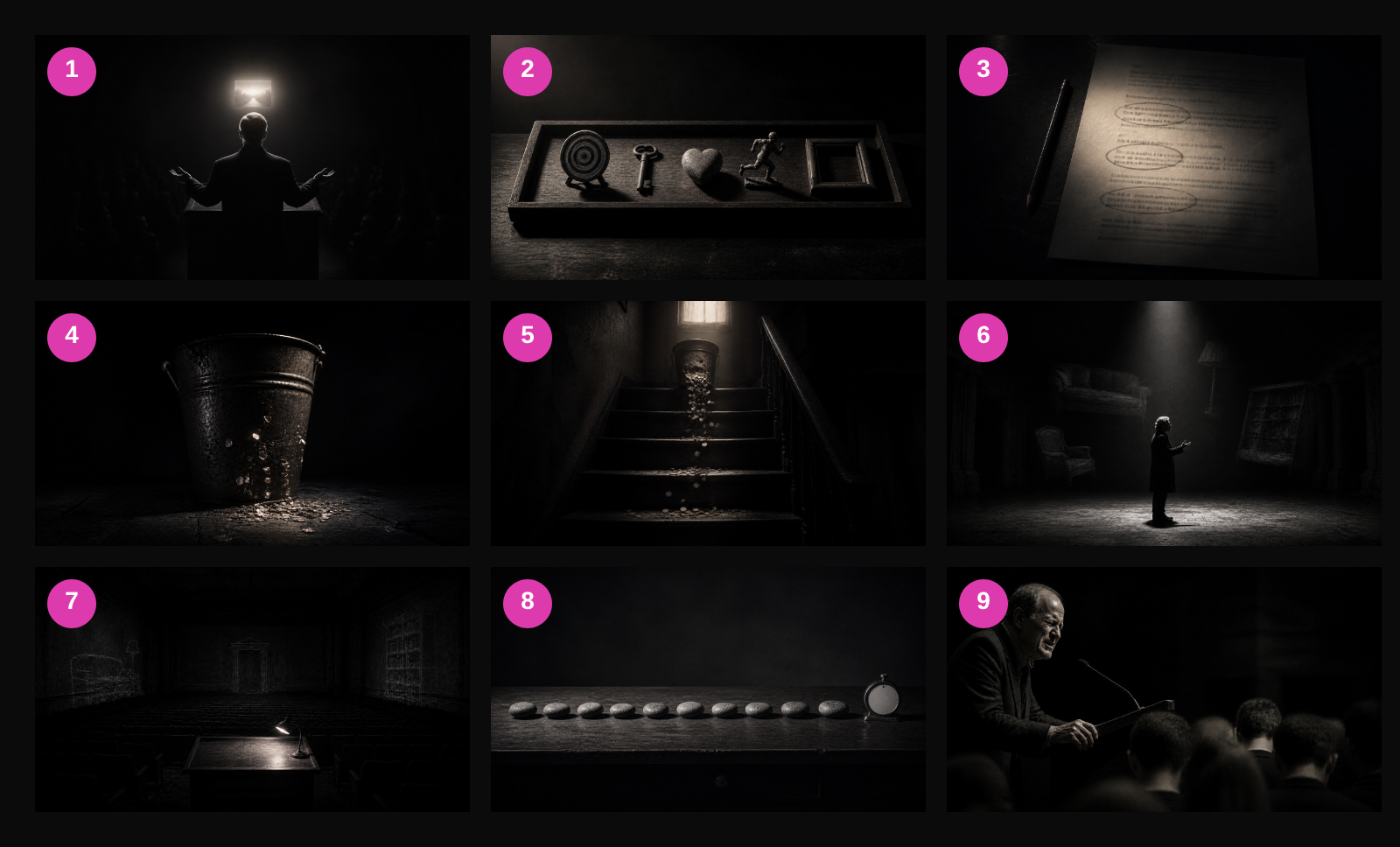
- Memorise ideas, not words; the words come from the ideas. Image: a speaker with a single bright picture floating above their head and no paper in their hands.
- The five ingredients: intent, meaning, emotion, action and visual cues. Image: five objects on a tray, a target, a key, a heart, a running figure, a picture frame.
- Find the key beats of the speech, one idea per beat. Image: a script with a few sentences circled and everything else greyed out.
- Create one visual cue per beat. Image: a leaky bucket with coins dripping through the holes.
- Place the cues on a memory palace, each interacting with its location. Image: that bucket balanced on a staircase, coins running down the steps.
- Rehearse by projecting the palace into the real space around you. Image: a person speaking in an empty hall, faint household furniture ghosted around them.
- Bring the palace into the venue: lay your locations over the real room before you start. Image: a lectern with a sofa, bookcase and front door drawn faintly onto the seats and walls.
- A five-minute pitch is eight to ten beats and about fifteen minutes to build. Image: ten stones in a row beside a kitchen timer.
- Common mistakes: memorising words, too many cues, retreating into your head. Image: a speaker with eyes screwed shut while an audience looks away.
Sources
- Mark Channon, How to Remember Anything (Hodder Education)
- Mark Channon, Learning Your Lines (Nick Hern Books): https://www.nickhernbooks.co.uk/learning-your-lines
Frequently asked questions
Are you old school? Get Mark's book Improve Your Memory and dive in depth.
Loci
Build the memory palace in this article inside Loci — store your locations, link images, and rehearse with spaced repetition.
Try it in LociMemory School community
Learn directly with Mark inside the Memory School community on Skool — monthly lessons, practice, and Q&A.
Join Memory SchoolAbout the author
Mark Channon
Grand Master of Memory (1995). Author of three books on memory published by Hodder and Nick Hern. Creator of BBC1's Monkhouse's Memory Masters. Memory coach on Channel 4's Can I Improve My Memory?
Read full bio →