
How to Remember Anything
How to Remember Conversations
You understood every word, and an hour later you cannot repeat it. How to listen on three levels, play it back, ask like a detective, and pin the key points to the room you are standing in.
I use AI to dig up the latest research and shape the draft. The stories and the 30+ years of know-how are mine.
You know the feeling. A colleague explains something in the corridor, a friend tells you about their week, a client walks you through what they need. You followed every word. You understood it. And an hour later, when you try to pass it on, it comes out as a vague outline with the important details missing.
Understanding and remembering are not the same thing. In a conversation, most of your attention is busy: working out what to say next, managing your face, half thinking about the meeting after this one. The words go past. Very little of them is held.
The fix is a different way of listening, with a few memory techniques folded in at exactly the right moments.
Why conversations slip away
Three things work against you.
You are listening on the surface. You take in the words, but not what sits underneath them: how the person feels about it, what they actually want.
You are thinking about your response. Part of your mind is working out what you might say, so it is not fully on what is being said.
Nothing gets fixed. Even the parts that land are never turned into anything your memory can hold on to. No picture, no place, no play-back. They fade with the next distraction.
So the method deals with all three: listen deeper, play it back, and give the key points somewhere to live.
Step 1: Listen on three levels
In a conversation it is easy to listen only to what is on the surface: the facts. To remember a conversation, listen on three levels at once.
- Facts. What is actually being said. Names, dates, numbers, decisions.
- Feelings. What the person feels about it. Excited, worried, frustrated, relieved. You hear it in their voice and see it in their face.
- Intentions. What they want, or what sits underneath. The subtext. Why are they telling you this?
What I have seen is that a fact with a feeling and a reason attached is easier to hold. "The launch has moved to March" is easy to forget. "The launch has moved to March, she is relieved about it, and she wants more time with the new team" is a story.
Do it now: in your next conversation, notice one fact, one feeling and one intention. Just notice them.
Step 2: Play it back
Reflecting, paraphrasing and summarising are listening tools, and they are also memory tools. Each one makes you put what you heard into your own words.
Reflect. Mention what you notice: "You sound relieved about that."
Paraphrase. Say it back in your own words: "So the launch is moving to March and you want time to settle the new team in. Is that right?"
Summarise. Pull the whole thing together near the end: "We've talked about the new date, who needs to know, and what you'd like from me. Is that right?"
There is a bonus. Playing it back confirms you heard it correctly. If you got something wrong, you find out now rather than next week.
Do it now: at the end of your next conversation that matters, summarise it in one sentence and check you have it right.
Step 3: Be a detective
Questions are where conversations get memorable. Think of a TV detective like Columbo: one more question, and the picture gets clearer.
Two kinds of question are worth having to hand.
Open questions search for facts, options and understanding. "What makes this important to you?" "How did that come about?" "What happens next?"
Closed questions get confirmation and clarity. "Is that the final date?" "Are you happy with that?"
Every question you ask does two jobs. It draws out more of the picture, and it gives the other person a moment to think, which gives you a moment to fix what you have just heard.
Do it now: write down three open questions you could ask in your next important conversation.
Step 4: Dial it up at the right moment
Here is where creative memorisation comes in: turning what you hear into pictures with meaning, as set out in Creative Memorisation: The Four Ingredients That Make Anything Memorable. The timing matters.
While the other person is speaking, keep your attention on them. Pictures and connections will come to mind naturally. Let them happen, but do not go off building elaborate scenes while they are talking, or you will miss what comes next.
Your moment to dial it up is when you are playing back and asking questions. That is when you are active. Let your imagination paint the picture: the launch date as a calendar page with a rocket on it, the relief as a long breath out. Put the facts into images while you say them back.
My preference is to project what is happening in my head out in front of me, so the pictures sit in the space between us rather than inside my head. That keeps me in the moment and still talking to the person. How to Memorise a Speech with a Memory Palace (No Notes Needed) explains this technique, the iMind, for presenting.
Do it now: next time you summarise a conversation, make one picture for the most important fact as you say it.
Step 5: Pin the key points to the room
For a conversation with several things you need to keep, build a temporary memory palace: one you make on the spot, use and let go. A memory palace is a set of places you can walk through in order, with one picture left at each, and How to Build a Memory Palace: A 7-Step Beginner's Guide (With Worked Examples) covers the full method.
You do not need to plan one. Use whatever is around you.
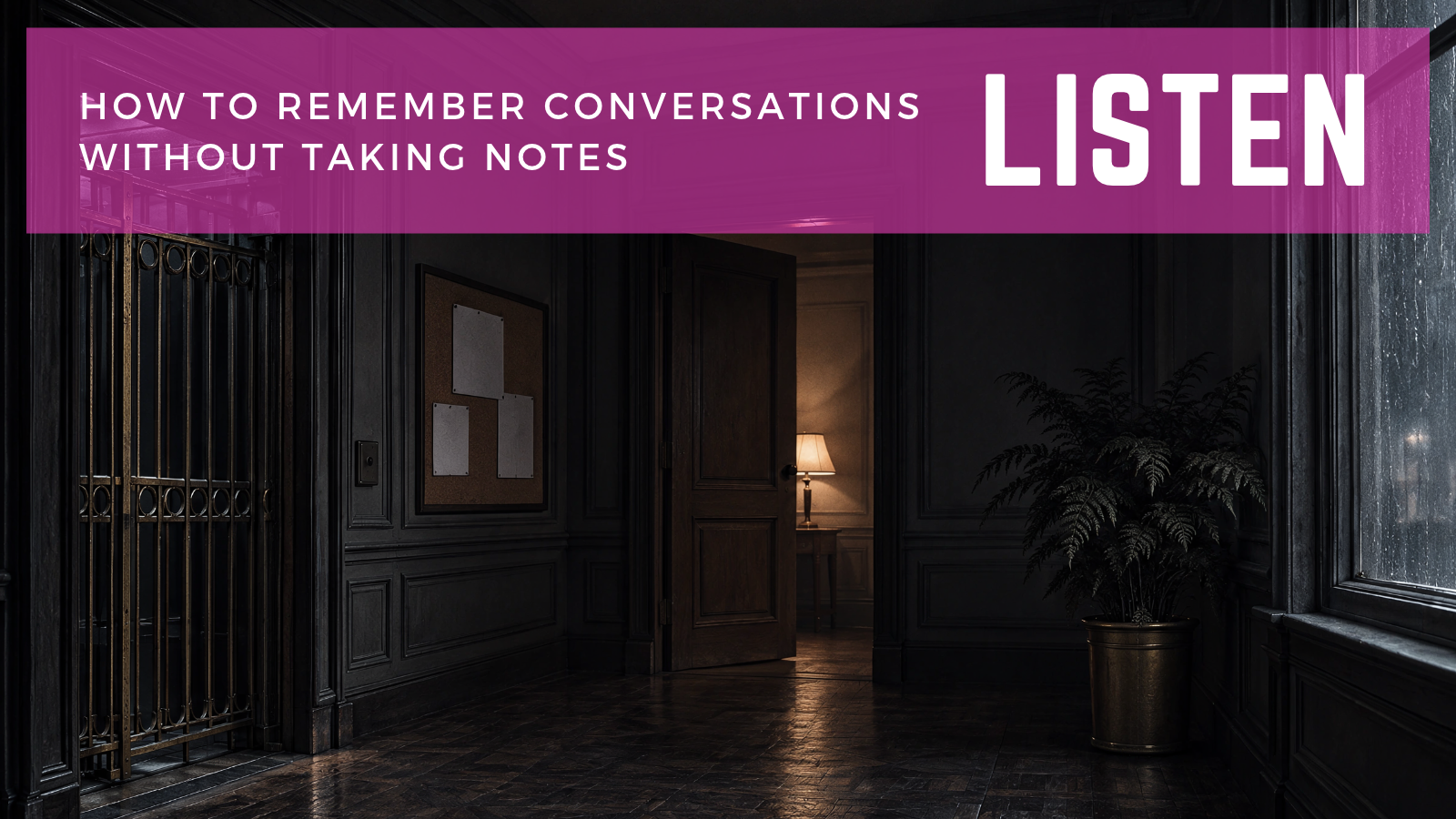
Say you are talking to someone beside a lift. Start with the thing on your left and move your eyes round clockwise: the lift button, the plant, the noticeboard, the window, the door. Each one becomes a place for one key point. You can even use the other person: their shoulder, their glasses, their hand.
As each important fact comes up, turn it into a picture and put it on the next place. Then, if you can, ask a question about it. The question buys you a few seconds to fix the picture, and it confirms you have the detail right.
Afterwards, walk the room in your head. Lift button, plant, noticeboard, window, door. The points should come back in order.
Do it now: in your next conversation, use three parts of the space around you or the other person to hold three key points, and ask one question as you place each.
After the conversation
Straight after the conversation, take two minutes:
Replay it. Walk back through it in your head: the places, the pictures, the facts, feelings and intentions.
Capture it. If it matters, make a quick visual note: a few words and pictures, no full sentences. A mind map works well for this.
Use it. Mention one detail next time you see them: "How did the March date go down with the team?" It is a review for you too.
Practise it
You do not need a high-stakes meeting to get good at this.
Ask a friend, partner or colleague to explain a subject they know really well, something you know little about. Listen on all three levels, play it back, ask your questions, and put the key points into pictures as you go. Afterwards, make a visual note of everything you remember, and show it to them.
See how much of it you can give back.
There's a catch
Listening this way takes more effort than listening on autopilot, especially at first. Doing all five steps at once in a fast conversation is a lot.
So add them one at a time. Spend a week just listening on three levels. Then add the play-back. Then the questions. The pictures and the room come last, once the listening feels natural.
A plan for this week
- Day 1 and 2: listen for one fact, one feeling and one intention in every conversation.
- Day 3 and 4: summarise one conversation a day out loud, and check it is right.
- Day 5: ask three open questions in a conversation that matters.
- Day 6: make one picture for the key fact as you summarise.
- Day 7: pin three points to the room around you, and replay them that evening.
Memory map
- Understanding is not remembering; in conversation your attention is busy elsewhere. Image: a person nodding along while a thought bubble above them rehearses their own reply.
- Listen on three levels: facts, feelings, intentions. Image: a three-layer cake, the top layer a calendar, the middle a heart, the bottom an arrow.
- Reflect, paraphrase, summarise: put it back in your own words. Image: a mirror talking back to the person looking into it.
- Playing it back also checks you heard it right. Image: a tick appearing on a speech bubble.
- Be a detective: open questions to search, closed questions to confirm. Image: a scruffy detective in a raincoat, one finger raised, "one more question".
- Dial it up while you play back, not while they talk. Image: a volume dial turned up at the moment someone starts speaking back.
- Project the pictures into the space between you. Image: a calendar with a rocket on it hovering in the air between two people.
- Pin the key points to the room, clockwise from your left. Image: a lift button, a plant and a noticeboard, each with a small glowing picture attached.
- Ask a question as you place each point: it buys time and confirms the detail. Image: a question mark holding a picture in place like a drawing pin.
- Afterwards: replay, capture a visual note, use one detail next time. Image: a notebook with a quick sketch and three words, and two people greeting each other in a corridor.
- There's a catch: add the steps one at a time. Image: a staircase with five steps, the first one lit.
Sources
- Mark Channon, The Memory Workbook (Hodder Education)
Are you old school? Get Mark's book The Memory Workbook and dive in depth.
Loci
Build the memory palace in this article inside Loci — store your locations, link images, and rehearse with spaced repetition.
Try it in LociMemory School community
Learn directly with Mark inside the Memory School community on Skool — monthly lessons, practice, and Q&A.
Join Memory SchoolAbout the author
Mark Channon
Grand Master of Memory (1995). Author of three books on memory published by Hodder and Nick Hern. Creator of BBC1's Monkhouse's Memory Masters. Memory coach on Channel 4's Can I Improve My Memory?
Read full bio →