
Memory Palace
Memory Palace Examples You Can Copy
Six real memory palaces, from one room to a whole method on a London square, with what each one holds and the structure you can copy for your own.

The quickest way to understand a memory palace is to look inside someone else's.
A memory palace is a set of locations you know in order, a room, a house, a street, with a picture left at each one. To remember, you walk the route in your mind and collect the pictures as you go. That is the whole idea. What takes a little longer to grasp is how flexible it is: the same method holds a shopping list, the chapters of a book or a full training programme.
Here are six real ones, from the smallest to the biggest: where each one is, what it holds, and the part worth copying.
1. One room, five spots
Where: a living room. Locations: sofa, curtains, coffee table, TV, bookcase. What it holds: five things. The points for a meeting, five errands, five names.
This is the Roman room, and it is the easiest place to start. Stand in the doorway in your mind and go clockwise. Going the same way every time is what keeps the order fixed.
Copy this: the clockwise five. Any room you know well gives you a palace in a few minutes. The Roman Room Method has the full walkthrough, with a worked meeting agenda.
2. A whole home, twenty spots
Where: your own home, four rooms. Locations: five per room, clockwise in each, moving through the rooms in the order you would walk them. What it holds: twenty items. A long list, a twenty-point talk, a week's priorities.
This is simply the Roman room stacked four times. Living room, kitchen, bedroom, bathroom, five each, and you have twenty files in an order you already know, because you have walked that route thousands of times.
Copy this: the four by five grid. When you finish the last spot in one room, walk through the door into the next. How to Build a Memory Palace: A 7-Step Beginner's Guide (With Worked Examples) takes you through choosing the rooms and fixing the route.
3. The walk to the station
Where: the route from your front door to your local train station. Locations: front door, garden gate, the corner with the lamp post, the fence outside the school, and on to the bridge over the tracks. Sixteen spots in about 90 seconds of thinking. What it holds: anything that needs more room than a house. Extend it to the office at the other end and it keeps going.
Copy this: a route you walk or drive every day. You already know the order, so the palace is built before you start. The Journey Method Explained shows how far one journey will stretch.
4. A high street holding a book
Where: the centre of Sevenoaks, the town near where I live, walked on Street View in LOCI. Locations: 13 spots: a café chair, a shop window, a pub sign, a postbox, the barbers, ending at a café table. What it holds: the 13 chapter titles of a book, one per spot. A dartboard on the chair. An explorer smashing through the window. Light bulbs hanging from the pub sign like fruit.
The high street gives each chapter its own place, and the image at each place carries the chapter title.
Copy this: one location per chapter. Next time you read a book you want to keep, put its table of contents on a street first. You can build that street in LOCI from Google Street View, even somewhere you have never been. How to Build a Memory Palace: A 7-Step Beginner's Guide (With Worked Examples) has all 13 images.
5. One book, two palaces
Where: Soho, in London. Locations: first palace, a short walk around Frith Street, past Ronnie Scott's to Bar Italia. Second palace, Soho Square and the streets around it. What it holds: The Procrastination Equation by Piers Steel. The 11 chapters go on the first palace. The 13 strategies go on the second, grouped by which part of the equation they work on.
This is how I memorised it for a live Book Club session. The chapters give me the shape of the book. The strategies are what I want to use, so they get a palace of their own. Einstein sits on the steps of Ronnie Scott's with his research papers for the equation chapter. A giant wishing well stands in the middle of Soho Square for wish fulfilment.
Copy this: split the book. Structure on one palace, the useful content on another, so neither gets crowded. The Procrastination Equation: Key Ideas, Memorised walks through both palaces location by location.
6. A whole method on seven stops
This is the one I want to show you in full, because it does something the others do not. Each stop holds a whole stage of a method, and the stage's key ideas sit inside a single scene.
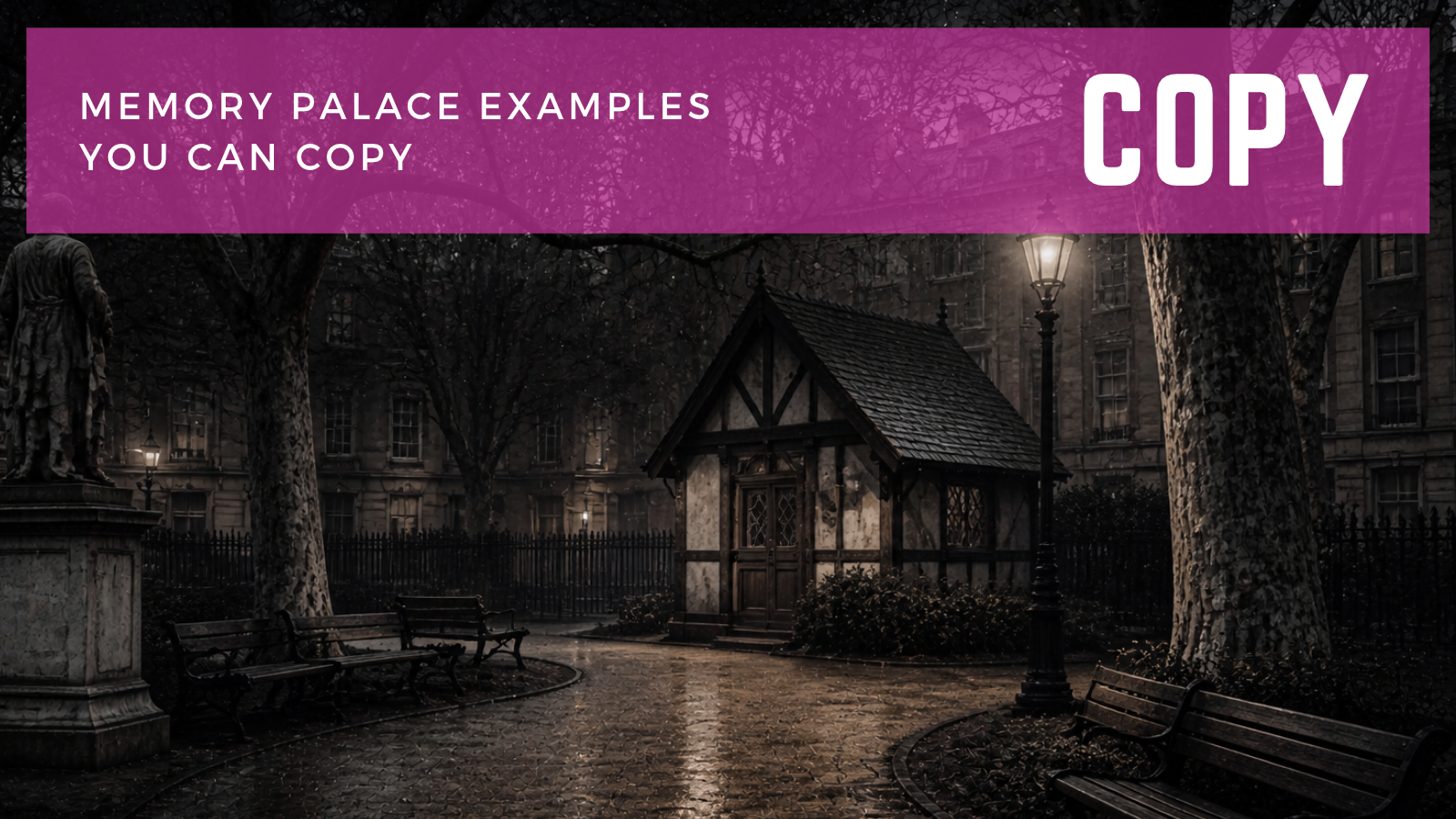
Where: the garden in the middle of Soho Square, built in LOCI. Locations: seven: the statue, a bronze sculpture, a plane tree, the wheelie bins by the gate, the bench by the hose reel, the benches by the steps, and the gardener's hut. What it holds: the seven stages of my method for learning lines: Strategise, Prepare, Prime, Connect, Embed, Rehearse, Perform, and the ideas inside each one.
Here is the walk.
Stop 1, the statue: Strategise. On top of the statue is a chess piece, with a light bulb on its head, tied in chains, within a palace that has a golden dial. The chess piece is strategy. The light bulb is creative memorisation. The chains are the chain method. The palace is memory palaces, and the golden dial is dialling it up.
Stop 2, the bronze sculpture: Prepare. A prepared meal, with a thought bubble, with a tiny plant inside. The stage holds mindfulness, beliefs and habits.
Stop 3, the plane tree: Prime. An engine revving, with a pair of scales on top. On one side, a pessimistic brain. On the other, an optimistic brain. The stage holds procrastination, and pessimism against optimism.
Stop 4, the bins by the gate: Connect. A big red magnet, surrounded by a tornado, with a funny character inside. The stage holds the breath and connecting with your character.
Stop 5, the bench by the hose reel: Embed. A bed. On top of the bed is a large map, with a visual cue in the middle. It is all in space, and the map is holding a gun. The stage holds mapping the visual cues, spaced retrieval practice and triggers.
Stop 6, the benches by the steps: Rehearse. A character, with energy moving from his skull down into his body. He is balancing on a seesaw while a speedy stake flies around him. The stage holds embodying the lines, getting off balance, and the speed run with the stakes raised.
Stop 7, the gardener's hut: Perform. A stage, with magic dolphins. Energy flies around the space. A fear creature dances with a dolphin, with a big smile. The stage holds animal magic, owning the space, using your fear and getting into state.
Read those scenes cold and they are crazy nonsense, but every part has a meaning, and that is why it works for me. Walk the seven stops and the method comes back in order.
Copy this: one stop per stage, and pack the stage's ideas into one scene where the pieces touch each other. A chess piece with a light bulb on its head, tied in chains, inside a palace with a golden dial, is one picture holding five parts.
What all six have in common
Look across the six and the same few things keep turning up.
- The order is fixed. Clockwise in a room, front door to platform on a route. You never have to think about what comes next.
- The locations are distinct. A chair, a postbox, a pub sign. Two identical doors on the same route will blur.
- One scene per location. Even when the scene holds several ideas, it is one picture.
- The images do something. The explorer smashes the window. The engine revs. The pieces move and touch.
- The palace fits the job. Five spots for five things, two palaces for a book with two layers.
Which one to copy first
Start with number 1. One room, five spots, today. It takes a minute to build and you can use it on your next shopping trip.
When five spots feel easy, grow it into the home palace in number 2. Twenty spots is enough for a long list, a talk or a week's plan.
The Soho Square example is the one to aim for. Once you can pack a few ideas into a single scene, a seven-stop palace can hold a whole method.
There's a catch: keeping one takes a little effort. From what I have seen, a palace you never walk again fades in two or three days, which is fine for a temporary one. For one you want to keep, walk it that evening, the next day and a few days later. Spaced Repetition: The Complete Guide covers when to come back to it.
Practise it today
Pick one of these and copy it now.
- The quick one. Choose a room. Name five spots clockwise. Put tomorrow's five most important tasks on them, one picture each, and walk it twice.
- The book one. Take a book you have read recently. Find a street, real or in LOCI, with one spot per chapter. Give each chapter title a picture.
- The method one. Take something you do in stages at work: onboarding a client, running a meeting, a sales call. Find a small park or square with one feature per stage. Build one scene per stage with its key points inside it.
Then walk it tomorrow, without looking. Whatever is missing tells you which picture needs more life.
Memory map
- A memory palace is a set of locations in order, with a picture at each. Image: a hallway with a bright object resting on each doorstep.
- One room, five spots, clockwise from the door. Image: a person in a doorway, arm sweeping round the room like a clock hand.
- A whole home: four rooms of five, twenty spots. Image: a doll's house with the front open, five glowing spots in each room.
- The walk to the station: a route you already know. Image: footprints running from a front door to a train platform bench.
- A high street holding a book: one chapter per location. Image: a giant dartboard sitting on a café chair on a busy high street.
- One book, two palaces: chapters on one, strategies on the other. Image: Einstein on the steps of a jazz club, a wishing well in a square behind him.
- A whole method on seven stops in Soho Square. Image: a statue with a chess piece on top, a light bulb on its head, wrapped in chains.
- Pack a stage's ideas into one scene where the pieces touch. Image: a revving engine with a pair of scales balanced on it, a brain in each pan.
- Crazy nonsense, but every part has a meaning. Image: a fear creature dancing with a dolphin on a stage, both grinning.
- What they share: fixed order, distinct spots, one moving scene each, the right size for the job. Image: a row of different doors, each with something bursting out of it.
- Start with one room today; walk it again that evening and the next day. Image: a person walking slowly round their own living room, eyes closed.
Sources
- Mark Channon, How to Remember Anything (Hodder Education)
Loci
Build the memory palace in this article inside Loci — store your locations, link images, and rehearse with spaced repetition.
Try it in LociMemory School community
Learn directly with Mark inside the Memory School community on Skool — monthly lessons, practice, and Q&A.
Join Memory SchoolAbout the author
Mark Channon
Grand Master of Memory (1995). Author of three books on memory published by Hodder and Nick Hern. Creator of BBC1's Monkhouse's Memory Masters. Memory coach on Channel 4's Can I Improve My Memory?
Read full bio →