
Memory Palace
Memory Palace vs Mind Palace: What Sherlock Gets Right
Mind palace or memory palace? Same technique, different name. What Sherlock gets right, what the show invents, and how a real one is built from your own life rather than a Victorian townhouse.

A mind palace and a memory palace are the same thing. If you arrived here because of Benedict Cumberbatch closing his eyes mid-scene and pacing through a mental version of 221B Baker Street, you have already seen the technique in action, and the only difference between what he does and the real technique is the name and the special effects.
The technique is two and a half thousand years old. The Romans called it the method of loci. Memory teachers mostly say memory palace. The BBC's Sherlock said mind palace, and because the show reached far more people than any memory book ever will, that is the term you probably searched for. So that is the name to use, and the useful thing is to separate what the show gets right from what it invents, so you can build one that actually works.
What the mind palace is
A mind palace is a journey in your mind with locations along it, onto which you place images of the things you want to remember. To recall them, you walk the journey and the images hand the information back.
It works because your brain has an enormous, effortless memory for places. You can picture every room in the house you grew up in. You can navigate your kitchen in the dark. Nobody taught you that; your brain absorbed it because knowing where things are kept your ancestors alive. The mind palace borrows that system and lends it to information that has no natural place, a list, a speech, a syllabus, by giving each item a location.
That is the whole technique. Everything else is detail and practice.
What Sherlock gets right
More than you might expect. Whoever wrote those scenes had read about the method.
It is spatial. Sherlock walks. He opens doors, goes down corridors, finds the thing he wants in a specific room. That is exactly right. The information is attached to a place, and he retrieves it by going there.
It stores an enormous amount. The show treats the palace as effectively unlimited, and in practice it holds a great deal. Memory competitors use palaces with hundreds of locations and keep dozens of palaces. A professional with a serious body of knowledge to hold can build thousands of locations over time.
It is deliberate. Sherlock does not stumble on the memory. He goes looking for it in the place he filed it. Real palaces work the same way: you put the image on the location on purpose, and you go back to the location on purpose.
It is a skill he has practised. The show makes clear he has built this over years. True. The first palace takes an afternoon. Fluency takes about six weeks of daily practice. Mastery takes a long time, and it is worth it.
What the show invents
Three things, and they are the three things that stop people trying.
The drama of retrieval. On screen, Sherlock reels, clutches his head, flings imaginary files around. In reality, walking a palace is calm and quick. You think of the location, the image appears, you read off the information. It takes a second and nobody around you would know. The staggering is television.
The grand building. The show implies a palace has to be imposing: a townhouse, a library, somewhere worthy of the name. It does not. Your studio flat works. Your route to the bus stop works. A town you have never visited, explored on Google Street View in LOCI, works. The word "palace" is a hangover from the Romans, who used their villas. The requirement is not grandeur. It is simply that you can recall the locations in order.
That it is a gift. Sherlock has it because he is Sherlock. The truth is the opposite. The mind palace is the most learnable technique in memory training. Children, executives, actors and pensioners all learn it. Nobody is born with one. Everyone can build one.
How a real one is built: from your own life
Here is the part the show never covers, and it is the part that makes the technique yours.
Real palaces do not come from a Victorian floor plan. They come from your episodic memory, the timeline of places you have actually been. Your brain has already stored thousands of locations in order, and all you have to do is go and find them.
I did this once with a client who was sure he had no places to use. We took a mind map and put a few branches on it: events, people, places, things, time. The holiday branch sent him straight back to somewhere he had gone as a child, and within a minute he had his first ten locations from that one memory:
- Caravan
- Bumpy road
- Trees
- Shop (with red liquorice)
- Entrance
- Post office
- Road
- Telephone box
- Stile
- Turnstile
Ten locations, in order, already in his head before he had tried to remember them, because he had walked that route as a boy and never forgotten it. From the rest of the map he pulled out several more journeys in under a minute each. We used a set of story cubes, dice with a different picture on each face, to prompt him: roll one, ask "what does this remind me of?", and the brain comes back with a place. It is like a search engine. You can create thousands of locations just by probing your own past.
That is what a mind palace really is. Not a building you invent. A life you already remember, put to work.
How to build your first one in ten minutes
If you want the Sherlock experience without the Sherlock budget, do this.
- Pick a place from your life. Your home is quickest for a first attempt. A childhood route or a holiday town works just as well.
- Choose ten locations in a fixed order. Walk through in your mind, clockwise, and pick ten distinct spots: the front door, the hall table, the stairs, and so on.
- Lock the sequence in. Observe each location for three to five seconds. Close your eyes and run them in order. Then in reverse. Three times.
- Place ten things. Take any list of ten you want to remember. Turn each item into a vivid image and put it on a location, interacting with it. Not next to the stairs, falling down the stairs.
- Walk it back. Go through the locations and read off the images. You may be surprised how many come back.
That is a working mind palace. Scale it up by adding rooms, routes and towns, and by building them in LOCI when you run out of places you have been.
What people actually use a mind palace for
Sherlock uses his to solve murders. You are unlikely to need that. Here is what a mind palace gets used for instead, which is a better guide to whether it is worth building one.
Talks and presentations without notes. Each section of the talk goes on a location. You walk the room in your mind as you speak and never lose your place. Once the palace is solid, you can even bring it into the venue with you and lay the locations over the real room, so you stay present with the audience rather than retreating into your head.
Exams. A syllabus broken into topics, each topic in its own area of a palace, each fact an image on a location. Students who do this stop cramming, because walking a palace for ten minutes is revision.
Names at an event. Place each new person on a location as you meet them. By the end of the evening you can walk the palace and greet thirty people by name. Nothing you do at a networking event will land harder.
Lines, lists and languages. Actors use palaces to hold scenes until the words are in the body. Anyone can use one for a shopping list, the order of a day's meetings, or a set of vocabulary.
None of these need a Victorian townhouse. All of them need the thing the show never shows: twenty minutes of building, and the habit of using it.
Why the name does not matter and the practice does
Call it a mind palace, a memory palace or the method of loci. They are one technique with a long history and a very good publicist. What matters is not the name but that you build one, use it for something real, and practise until walking it is as automatic as walking your own hallway.
Sherlock makes it look like genius. It is actually a habit. What is a Memory Palace? A Beginner's Guide to the World's Oldest Memory Technique and How to Build a Memory Palace: A 7-Step Beginner's Guide (With Worked Examples) take you through the full method step by step, and The Journey Method Explained shows how to turn a route into a palace of any size. If you would rather start inside a ready-made palace and walk it in VR, LOCI was built for exactly that.
Memory map
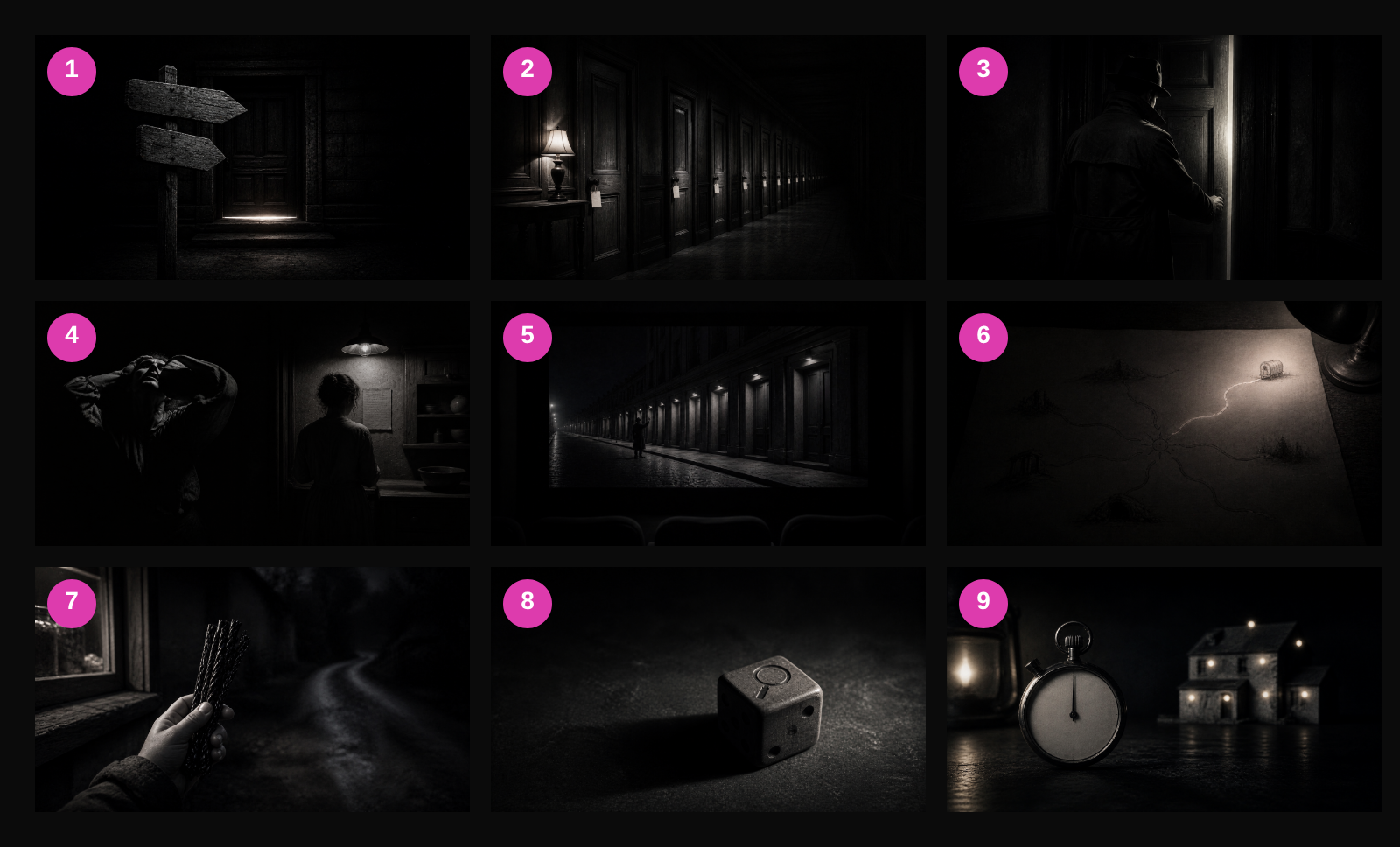
- Mind palace and memory palace are the same technique. Image: two signposts pointing at one door.
- It works by attaching information to places, which your brain remembers effortlessly. Image: a list of words hung on the doors along a corridor.
- Sherlock gets the spatial, deliberate, trained nature of it right. Image: a detective calmly opening a labelled door.
- The show invents the drama, the grand building and the idea that it is a gift. Image: a head-clutching actor beside a person quietly reading a list off a kitchen wall.
- A palace does not need to be a place you already know; it needs locations you can recall in order. Image: a small figure dropped into an unknown street on a screen, counting plain coloured doorways.
- Real palaces come from your own episodic memory. Image: a mind map with a holiday branch leading to a caravan.
- The client's first ten: caravan, bumpy road, trees, shop with red liquorice... Image: a boy's hand holding red liquorice outside a shop by a bumpy road.
- Story cubes prompt the brain to surface places like a search engine. Image: a rolled die with a magnifying glass on it.
- First palace in ten minutes: place, ten locations, lock in, place ten things, walk it back. Image: a stopwatch at ten minutes beside a house with ten glowing spots.
Sources
- Mark Channon, How to Remember Anything (Hodder Education)
- Mark Channon, The Memory Workbook (Hodder Education)
Loci
Build the memory palace in this article inside Loci — store your locations, link images, and rehearse with spaced repetition.
Try it in LociMemory School community
Learn directly with Mark inside the Memory School community on Skool — monthly lessons, practice, and Q&A.
Join Memory SchoolAbout the author
Mark Channon
Grand Master of Memory (1995). Author of three books on memory published by Hodder and Nick Hern. Creator of BBC1's Monkhouse's Memory Masters. Memory coach on Channel 4's Can I Improve My Memory?
Read full bio →