
Memory Techniques
What is a Mnemonic?
A mnemonic is a memory tool that turns abstract information into something your brain finds easy to grab. Here are the five families, how they work, and which one to reach for first.

A mnemonic is a small mental tool that turns information your brain finds hard to remember into something it finds easy. Abstract facts get turned into vivid images. Random sequences get strung together into stories. Boring lists get hung onto things you already know. First letters get arranged into sentences your tongue can roll out without thinking.
The word comes from Mnemosyne, the Greek goddess of memory. Mnemonics have been around for at least two and a half thousand years and they have outperformed every other memory tool we have ever invented, including the apps sitting on your phone right now.
It is easy to treat mnemonics as a single trick, a rhyme or an acronym from school. They are not. There are five distinct families, each one doing a different job, each one suited to a different kind of information. The reason memory champions seem to remember impossible things is not that they have one secret weapon. It is that they have five, and they know which one to reach for in any given moment.
Why mnemonics work
Your brain did not evolve to remember bullet-pointed text. It evolved to remember places, faces, stories, and pictures. Anything that looks like one of those four things gets remembered easily. Anything that does not gets forgotten almost immediately.
A mnemonic is a way of disguising boring information as something the brain is good at. Numbers become pictures. Lists become stories. Facts get linked to locations. First letters get arranged into a sentence you can recite. Once the disguise is in place, the brain does the rest for free.
There is real neuroscience behind this. The hippocampus, the part of the brain that consolidates new memories, is also heavily involved in spatial navigation and pattern recognition. Vivid images activate your visual cortex. Stories activate your language and narrative systems. Sequences of locations activate your spatial-memory hardware. A good mnemonic lights up multiple parts of the brain at once, which is why a single image can be retained for years while a fact you read three times yesterday is already gone.
There is also a behavioural reason mnemonics work. When you build a mnemonic, you have to process the information actively. You have to choose an image, place it somewhere, link it to something else. That act of processing is what moves information from short-term into long-term memory. Repetition without processing is the slowest way to memorise. Processing without repetition is the fastest. The best memorisers do both.
The five families of mnemonics
Strip away all the jargon and every mnemonic technique on the planet falls into one of five families. Knowing which family fits the information in front of you is half the skill.
1. Image-based mnemonics
The simplest family. You turn the thing you want to remember into a vivid mental picture. The picture is concrete, exaggerated, and a bit ridiculous, which is exactly why it sticks.
To remember that the capital of Burkina Faso is Ouagadougou, picture a barking dog with a mean face. "Barkin' Face" sounds enough like Burkina Faso that the connection holds. The dog is also a wonderful waggy doggy. "Waggy Doggy" sounds enough like Ouagadougou. Two ridiculous images, two seconds of attention, and the fact sticks.
If you meet a new person called Rose with striking red hair, picture a rose growing out of the hair, thorns and all. The image triggers the name the next time you see the hair. (Names get a full five-step method in How to Remember Names: A Five-Step Framework That Actually Works.)
Image-based mnemonics are best for pairs of facts you want to remember together. A country and its capital. A face and a name. An English word and its French equivalent. A historical event and its date. Anything that comes in pairs and has no obvious story between them is a candidate.
2. Sequence-based mnemonics
When you have a list rather than a pair, you need a sequence-based mnemonic. The most common is the chain method, where you link the items in a list together through a single flowing story.
A quick example. Say you need to pick up bread, an umbrella, a goldfish, a trumpet and a candle. Imagine a loaf of bread opening an umbrella in the rain. Sitting under the umbrella is a goldfish, blowing a trumpet. Out of the trumpet, instead of a note, shoots a lit candle. Read that twice, look away, and you can list all five in order and in reverse. The story does the work. (The Chain Method: How to Remember Lists Without Building a Memory Palace has a fifteen-item version.)
Sequence-based mnemonics shine when you need to recall things in a specific order and you are not too worried about jumping into the middle of the list. Shopping lists, agenda items, short ordered processes, brief poems, and small vocabulary chunks all suit this family. With a little practice you can comfortably handle ten to twenty items in a single chain.
Beyond twenty items the chain becomes brittle, and you switch to the next family.
3. Location-based mnemonics
Location-based mnemonics use the most powerful family of all. You place vivid images at specific locations along a journey in your mind, then walk the journey to recall them. The journey can be somewhere you already know or somewhere you have learned for the purpose; what matters is that you can recall the locations in order.
This is the technique known as the memory palace or the method of loci. It dates back to a Greek poet called Simonides of Ceos who survived a banquet collapse around 500 BCE and realised he could identify the dead by remembering exactly where each guest had been sitting. Roman orators used the method of loci to deliver speeches lasting hours. Memory competitors still use it today.
The advantage of location-based mnemonics over the chain method is scale. A chain holds twenty items comfortably. A memory palace holds hundreds. The other advantage is random access. With a chain you have to walk through the whole sequence to find item nine. With a palace, you can jump straight to location nine without disturbing anything else.
If building palaces from scratch feels slow at first, LOCI builds palaces for you from Google Street View or with AI, and they work the same way the ones in your head do. Once they feel familiar, bring them across into your own mental space.
4. Code-based mnemonics
Some information is so abstract that even image-based mnemonics struggle with it. Numbers are the obvious example. The digit 7 has no shape, no smell, no story. Your brain has nothing to grab onto.
Code-based mnemonics solve this by assigning a fixed image to every abstract symbol you might encounter. Then memorising the underlying information becomes a question of stringing the images together.
The two most common codes for numbers are the number shape system, which gives every digit a picture of its own shape (1 is a pencil, 2 is a swan, 7 is an axe), and the major system, which gives every digit a consonant sound so that pairs of digits can be turned into words. The number 34 becomes "mare." The number 17 becomes "tack." Once you know the code, long numbers become a short run of pictures.
Code-based mnemonics also work for shuffled playing cards. All 52 cards carry a fixed image. Memorising a deck becomes a question of walking that fixed set of 52 images through a memory palace.
Code-based mnemonics take longer to set up than the other families, but once the code is in your head it serves you for life. If you want a tool that drills the major system and other codes for you so they become automatic, mindforge.memoryschool.com is built for exactly this.
5. Acronym and acrostic mnemonics
The family you probably learned as a child without realising it had a name. Acronym and acrostic mnemonics work by taking the first letter of each item in a list and turning it into a single memorable word or sentence.
If you ever learned music, you probably learned the lines of the treble clef as Every Good Boy Deserves Football (E, G, B, D, F). The spaces of the treble clef spell FACE. The colours of the rainbow are ROYGBIV (red, orange, yellow, green, blue, indigo, violet). The Great Lakes are HOMES (Huron, Ontario, Michigan, Erie, Superior). The compass directions clockwise from north are Never Eat Shredded Wheat (north, east, south, west). The order of mathematical operations is PEMDAS in the US (parentheses, exponents, multiplication, division, addition, subtraction) and BODMAS in the UK.
Acronyms and acrostics are best when the items themselves are already familiar but the order or grouping is hard to remember. They are weaker when the items are unfamiliar, because the first letter alone is not always enough of a trigger. "E" can stand for a thousand words. If you have not already met "Every Good Boy Deserves Football" alongside the treble clef in a music lesson, the acronym on its own would not have helped you.
They are also the easiest family to design on the fly. If you need to remember the four steps of a process you have already learned but keep forgetting in the wrong order, you can usually rig an acronym in thirty seconds. Some of the best business frameworks in the world started life as throwaway acronyms that survived because they were easy to teach.
How the families combine
Real memorising is rarely a single family. A medical student memorising a drug class might use a code-based mnemonic for the dose, an image-based mnemonic for the mechanism of action, an acronym for the side effects, and a memory palace to keep the whole drug class in order. You can stack the families on top of each other like this.
The skill is knowing which family fits which slot. As a rough guide:
- Pairs of facts go in image-based mnemonics.
- Short ordered lists go in sequence-based mnemonics.
- Long ordered information that you want to keep for years goes in location-based mnemonics.
- Inherently abstract data, especially numbers and cards, goes in code-based mnemonics.
- Lists where the items are familiar but the order is not go in acronym mnemonics.
Most days you will use two or three of the families without thinking about it. The conscious choice fades after the first few weeks of practice.
A worked example
Take a real piece of information and run it through several families to see how flexible they are.
The fact: the First Battle of the Marne was in 1914.
Image-based. Picture a giant marlin (Marne) holding up a pencil and a balloon on a string (1, 9), then a pencil and a yacht's sail (1, 4), at the edge of a battlefield. One scene, all the elements.
Sequence-based. Chain marlin to pencil to balloon to pencil to sail to tank. Now you have linked this fact to the next one in your sequence of First World War events.
Location-based. Place the marlin scene at the third location of your World Wars memory palace. Now you also know it was the third major event of the war.
Acronym. If you needed to remember the first four major battles of the war in order (Marne, Tannenberg, Ypres, Verdun), you might rig the acronym MTYV or invent a sentence like "Marne Tackled Young Verdun."
Four different ways to make the same fact sticky. None of them involve repetition.
Do mnemonics replace understanding?
No, and they are not meant to. Done properly, they build it. To make an image for a fact you have to work out what it means, and every association ties it to something you already know. Take the Krebs cycle, the loop of chemical steps your cells use to release energy: picture what each step does, not just its name, and you understand the cycle as you memorise it. Memorising for memory's sake is pointless. The aim is to understand something and then use it.
The same goes for material that does not arrive as a list. A book, a scene, a dance routine: find the story or the shape in it, picture that, and let the detail hang off it. Creative Memorisation: The Four Ingredients That Make Anything Memorable sets out the model underneath every mnemonic, and Mnemonics: The Complete Guide to Making Anything Memorable shows how far it reaches.
Where to start
If you have never built a mnemonic before, start with the chain method. It works on almost any short ordered list, and you will feel the effect inside ten minutes. Build one for a real shopping list. Then a real to-do list. Then a list of fifteen vocabulary words.
Once you trust the basic mechanism, build a memory palace. Start with twenty locations in your home and use it to memorise something useful, like the chapters of a book you want to remember properly.
After a week or two of practice, start adding the other families. Build a code for digits 0 to 9 using the number shape system. Try an acronym for the next list of four or five items you need to remember. The first mnemonic you build is the hardest. By the tenth one, the technique disappears into the background and you stop thinking of yourself as someone who memorises things. You just do.
That is the real test of a working mnemonic skill. Not that you can recite a deck of cards on stage, but that you walk through life remembering the things that matter, without effort, and without ever opening the notes app on your phone.
Memory map
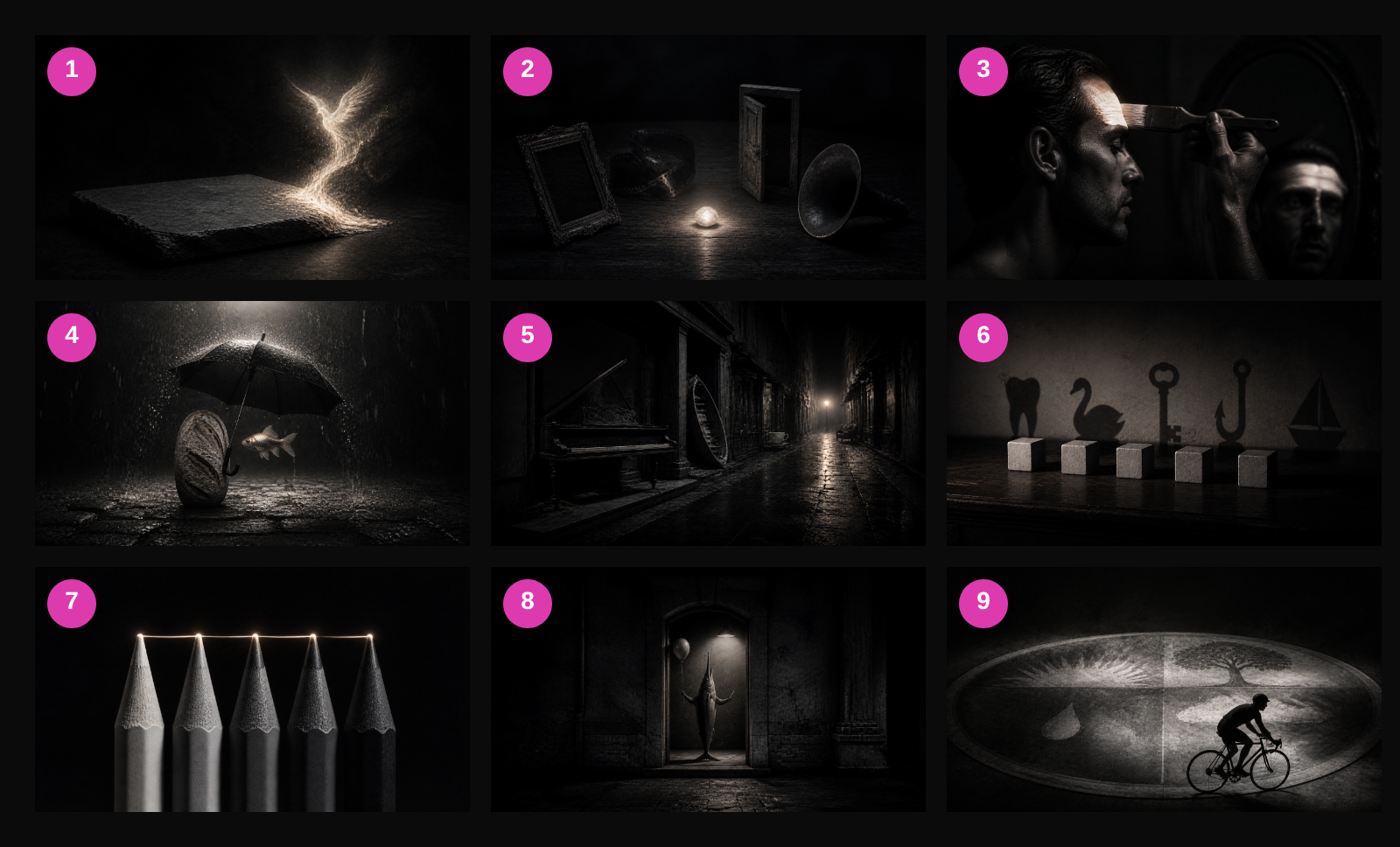
- A mnemonic turns information your brain finds hard into something it finds easy. Image: a grey block of text melting into a bright, moving picture.
- Mnemonics work by giving abstract information a picture, a story, a place or a sound. Image: a word surrounded by a frame, a film strip, a door and a speaker.
- Image-based mnemonics: a vivid picture for a single fact. Image: a man painting his own forehead with a bright brush.
- Sequence-based mnemonics: items linked into one story. Image: a loaf of bread opening an umbrella in the rain, a goldfish beneath it.
- Location-based mnemonics: images placed along a journey you can recall in order. Image: a street with a strange object outside each shop.
- Code-based mnemonics: numbers turned into sounds and words. Image: a row of digits each casting the shadow of a letter.
- Acronyms and acrostics: first letters carrying a list you already know. Image: five coloured pencils spelling a word by their tips.
- The families combine: an image, in a chain, on a location. Image: a marlin holding a pencil and a balloon, standing in a numbered doorway.
- Mnemonics build understanding: picture what each step does, not just its name. Image: a cyclist pedalling round a circular track, each stretch of track painted with a different scene.
Sources
- Mark Channon, How to Remember Anything (Hodder Education)
- Mark Channon, The Memory Workbook (Hodder Education)
Loci
Build the memory palace in this article inside Loci — store your locations, link images, and rehearse with spaced repetition.
Try it in LociMemory School community
Learn directly with Mark inside the Memory School community on Skool — monthly lessons, practice, and Q&A.
Join Memory SchoolAbout the author
Mark Channon
Grand Master of Memory (1995). Author of three books on memory published by Hodder and Nick Hern. Creator of BBC1's Monkhouse's Memory Masters. Memory coach on Channel 4's Can I Improve My Memory?
Read full bio →