
Memory Techniques
Mnemonics: The Complete Guide to Making Anything Memorable
The same principle that gets a child through the colours of the rainbow got me through 732 digits in an hour. How mnemonics work, the four ingredients behind every one, how to build your own in four steps, and why there is almost nothing they can't help with.

Mnemonics have an image problem. You probably met them at school, as a sentence about Richard of York (Richard Of York Gave Battle In Vain: red, orange, yellow, green, blue, indigo, violet) or a rhyme about the days in September, and filed them away as a childhood trick. Useful for the colours of the rainbow. Not serious.
Then in 1995 I sat in a hall at the World Memory Championships and memorised 732 consecutive digits in one hour. No special talent, no photographic memory. I used a mnemonic. The same kind of tool as the rainbow sentence, built out a bit further and practised. That is all the people you see on television reciting packs of cards and strings of numbers are doing. They are not doing something different from the child with the rainbow. They are doing the same thing, more.
That "same thing" is the principle underneath every mnemonic: what a mnemonic actually is, why it works on a brain that forgets so easily, how to build one for whatever you need to remember, and how far it reaches. If you want the five families of mnemonic laid out and compared, read What is a Mnemonic?
What every mnemonic has in common
Strip away the acronyms, rhymes, stories and palaces and every mnemonic does one job. It takes information your brain is bad at holding and attaches it to something your brain is good at holding.
Your brain is bad at the abstract: bare numbers, unfamiliar names, lists of terms with no story, facts with no picture. It is very good at the concrete: places, faces, movement, sound, anything that made you feel something. A mnemonic is a bridge between the two. The sentence about Richard of York works because a story about a man giving battle in vain is easier to hold than seven colours in a fixed order. My 732 digits worked because each pair of digits became a picture and the pictures were placed along a route I knew. In both cases the hard thing was carried by an easy thing.
The artefact you produce when you do this is called a reference story. It is a container of images whose meaning refers to some real-world information. The images are the hook. The information hangs on it. Once you see mnemonics this way, the whole field stops looking like a bag of unrelated tricks and starts looking like one idea with many outfits.
Why it works: give the fact what the brain wants
The reason this works is not mysterious. Your brain keeps things that are vivid, connected and meaningful, and drops things that are not. Think about what you remember effortlessly: where you were during a big news event, the layout of your childhood home, the chorus of a song you have not heard in twenty years. All of them arrived with a place, a feeling, movement or sound. None of them needed revision.
Now think about what slides off: the PIN for the new card, the name you were told ninety seconds ago, the definition you read three times last night. All of them arrived as bare information with nothing attached.
A mnemonic simply adds the missing attachments. A picture gives the fact something to look at. A story gives it movement and a sequence. A location gives it a place. Saying it aloud gives it a sound. Making it funny or alarming gives it a feeling. You are not cheating your memory. You are feeding it the way it likes to be fed, and in return it does what it does with experiences: keeps them.
This is why mnemonics feel like effort at first and then stop feeling like effort. The first time you turn a dull fact into a picture you are doing something unfamiliar. By the twentieth time, your brain has learned that this is how facts arrive and starts doing some of the work for you.
The four ingredients
It is easy to assume you lack some gift the memory champions have. You do not. Every mnemonic, from the rainbow sentence to a palace of 400 images, is made from the same four ingredients. Together they are creative memorisation: the act of creating something memorable.
1. Flow: the right state. Before you picture or connect anything, get into the best state to memorise, and later the best state to recall. Stress works against you here. Even mild stress can quickly impair the prefrontal cortex, the part of the brain you lean on for focus and working memory (Arnsten, 2009), which is why the words vanish when nerves take over. Calm, absorbed and curious is the state where memorising feels easy.
2. Imagination is your ability to bring all your senses together to bring something to life. Not just to see a cow, but to see a cow the size of a bus, hear it, smell it, be slightly alarmed by it. If you feel you cannot visualise, that is fine. Talking a scene through, hearing it or feeling it gets you there too. There is a way in for everyone.
3. Association is your ability to make connections, and your brain is an association machine. The word "aperture" connects to an opening door. The number 94 connects to beer, if you know the major system, a code that turns digits into consonant sounds. A new colleague called Wendy connects to a windy day, her hair blown sideways. Get curious: what does this remind me of, what does it sound like, where have I met this before?
4. Meaning is what makes it last. When you build an image and tie it to something you already know, you are creating meaning, and meaning makes memories stick. Thinking about what a word means leads to better memory than thinking about how it sounds or looks (Craik and Tulving, 1975).
Imagination and association get information in quickly and let you hold far more of it. Meaning makes it stick for longer. Then spaced retrieval practice, coming back to it at widening gaps, carries it into long-term memory. Creative Memorisation: The Four Ingredients That Make Anything Memorable takes each one in depth.
How to build your own mnemonic in four steps
Here is the process, and it works for a single word or a whole syllabus. The example is deliberately small so you can see the mechanism.
Suppose you need to remember that the chapter on high performing teams in a management book lists seven qualities: Purpose, Empowerment, Relationships, Flexibility, Optimal performance, Recognition, Morale.
Step 1: Identify exactly what needs remembering. Not the whole chapter. The seven words, in a form you can use. Be selective here. Anything you already hold needs no image at all, and one image that triggers the whole chunk beats five that each carry a piece. This is the MIN rule, minimum images necessary, and ignoring it is the fastest way to turn mnemonics into a chore.
Step 2: Find your images. Two routes. A natural image comes from the meaning: Purpose might be a signpost, Relationships two people holding hands. A sound image comes from how the word sounds: "Volta" becomes voltage, "Lithuania" becomes a lit tune on a piano. Use whichever arrives first. For our seven qualities, the first letters already spell a word, PERFORM, so the acronym does part of the job. But an acronym on its own is thin. It tells you the letters, not the words, and six months later you will remember PERFORM and not what the R stood for.
Step 3: Build the reference story. Connect the images so they carry the real information. For PERFORM, here is a one-line narrative: a PERFORMER with a real PURPOSE and super POWERS, in an intimate RELATIONSHIP with the OPTIMAL product, which has facial RECOGNITION and makes her feel GREAT. Each word in capitals is a hook for one of the seven. The performer carries the acronym, the story carries the words. Now the mnemonic has a picture, movement and a feeling, which the bare acronym never had.
You can build the story as a narrative like this, or by visual embedding, where you take one main image and attach up to three smaller ones to it in a fixed pattern, head to middle to feet. Narratives suit lists and sequences. Embedding suits small, dense chunks like a PIN or a definition.
Step 4: Test it aloud while seeing it. This is the step people skip and it is the one that matters most. Recite the real information, Purpose, Empowerment, Relationships, while watching the story play in your mind. Not the story. The information. You are welding the hook to the thing it carries. Do it a handful of times at speed. Then put it away and come back an hour later, the next day, a week later. Each time the reference story will be a little less necessary, until one day you simply know the seven qualities and the performer has retired.
That last part is important. A well-built mnemonic is scaffolding. It holds the information up while the real memory sets, and then you no longer need it. If someone tells you mnemonics mean you end up reciting silly stories for the rest of your life, they have never used one properly.
Dialling it up
If a mnemonic will not stick, the image is almost always too polite. The fix is to dial it up: bigger, brighter, louder, stranger. A cow becomes a cow the size of a bus. A signpost spins. The performer is not on a stage but on your kitchen table.
Think of a dial from one to ten and ask where the image sits. Most first attempts are a three. Turn it to an eight and the memory arrives without being asked. This is not about being crude or shocking for its own sake. It is about intensity, because intensity is what your brain reads as "this matters, keep it". Humour works. So does exaggeration, movement, colour and putting yourself in the scene. The ones that make you smile as you build them are the ones that will still be there next month.
The question that comes up most
The most common question is some version of this: isn't it easier just to remember the information than to make up stories about it?
The answer depends on you, and I mean that. If you can read a page of facts, a list of names or a phone number and simply retain it, do that. You do not need a mnemonic for anything you can already hold. If you cannot, you usually know exactly where your memory lets you down: names, numbers, vocabulary, the order of things, facts that have no natural picture. Those are the places for mnemonics. Everywhere else, leave them alone.
A better question than "isn't it easier" is "what don't I know, and could a mnemonic help?" Put that way, you stop treating mnemonics as a party trick or a way of life and start treating them as a tool you pick up when there is a job for it.
From the rainbow to 732 digits: the same tool, scaled
Here is how the childhood trick and the championship feat connect, because once you see the ladder you can climb as far as you want.
Rung one: a single hook. One picture for one fact. A gust of wind for Wendy. Stop here and you still have a tool that beats repetition every time.
Rung two: a chain. Hooks linked into a story so they come back in order. The PERFORM narrative is a chain. So is any mnemonic that turns a list into a sequence of connected scenes. You can hold twenty items this way with a few minutes' work.
Rung three: a fixed set of locations. Instead of linking the images to each other, you place them on places you already know, a route or a room, and walk back through to collect them. This is the memory palace, and it is what lets you store hundreds of items and retrieve any one of them without walking from the start.
Rung four: a code. For information that has no natural picture at all, numbers above all, you build a fixed vocabulary of images in advance. The major system turns each digit into a consonant sound, so 94 becomes BeeR and 01 becomes SeaT, and once the vocabulary is learned any number becomes a string of pictures. This is what I used in 1995: every pair of digits became an image, the images were placed along journeys I knew, and 732 digits became around 400 pictures on a walk.
Nobody needs rung four to get through their working life. But notice that nothing changes between the rungs except the amount of structure. The child with the rainbow and the competitor with the digits are both attaching hard information to easy hooks. The competitor has just prepared more hooks.
Is there anything a mnemonic can't help with?
Very little. You will often hear that mnemonics are fine for lists but no use for understanding or for skills. Both claims miss what a mnemonic is doing.
Understanding. To picture a concept you have to work out what it means, and every association you make ties it to something you already know. That is meaning, the fourth ingredient. So a mnemonic is not something you bolt on once you understand. Built properly, it is how the understanding gets built. That is why memory techniques are thinking tools as much as memory tools. Memorising for memory's sake is pointless; the point is to understand something and then use it.
Skills. A dance routine, a tennis serve, a swim stroke. These live in procedural memory and are built by doing, but a mnemonic still has a job. As a West End performer, I used them at every audition with a dance routine. I would watch the routine, find the story of the dance, make a picture for each section, and let my body and my training deal with the detail. The map in my head got the routine into my body faster. How to Memorise a Dance Routine shows the method.
There is a second way in, through analogy. Emi, a client training for a triathlon, was stuck at seven lengths of the pool, running a checklist of about twenty things in his head before he even got in. We found an animal for the feeling he wanted, a dolphin, and he stopped thinking and started swimming. The next day he texted: "Mark, I'm a dolphin!!" He had swum twenty-five lengths. His skill had not changed. What swimming meant to him had. Animal Magic: Beat Paralysis by Analysis With Analogy Learning tells the whole story.
The one time to skip it. If something is already in, leave it in. Building a mnemonic for information you already hold is wasted effort.
Getting started this week
If this is new to you, do not start with a system. Start with a single hook. Pick one fact you keep losing, a name, a word in a language you are learning, a figure you need for work. Find an image, build a one-line story, say the real information aloud while you see it, and test yourself tomorrow. One success will teach you more than any amount of reading about it.
Then add a chain for the next list you need. Then, when you want to hold more than a list, build a palace. The order matters less than the habit of asking, every time something refuses to stick, "what could I turn this into?"
Mnemonics are not a trick and they are not a talent. They are what memory looks like when you work with the brain you have instead of against it. Memory Techniques: The Complete Guide maps the full set and which to learn first; The Chain Method: How to Remember Lists Without Building a Memory Palace shows how to link images into a story; The Major System Explained covers the code I used for those digits; and What is a Memory Palace? A Beginner's Guide to the World's Oldest Memory Technique takes you through the location rung step by step. If you would rather drill the building skill directly, MindForge gives you a daily set of images to encode against the clock.
Memory map
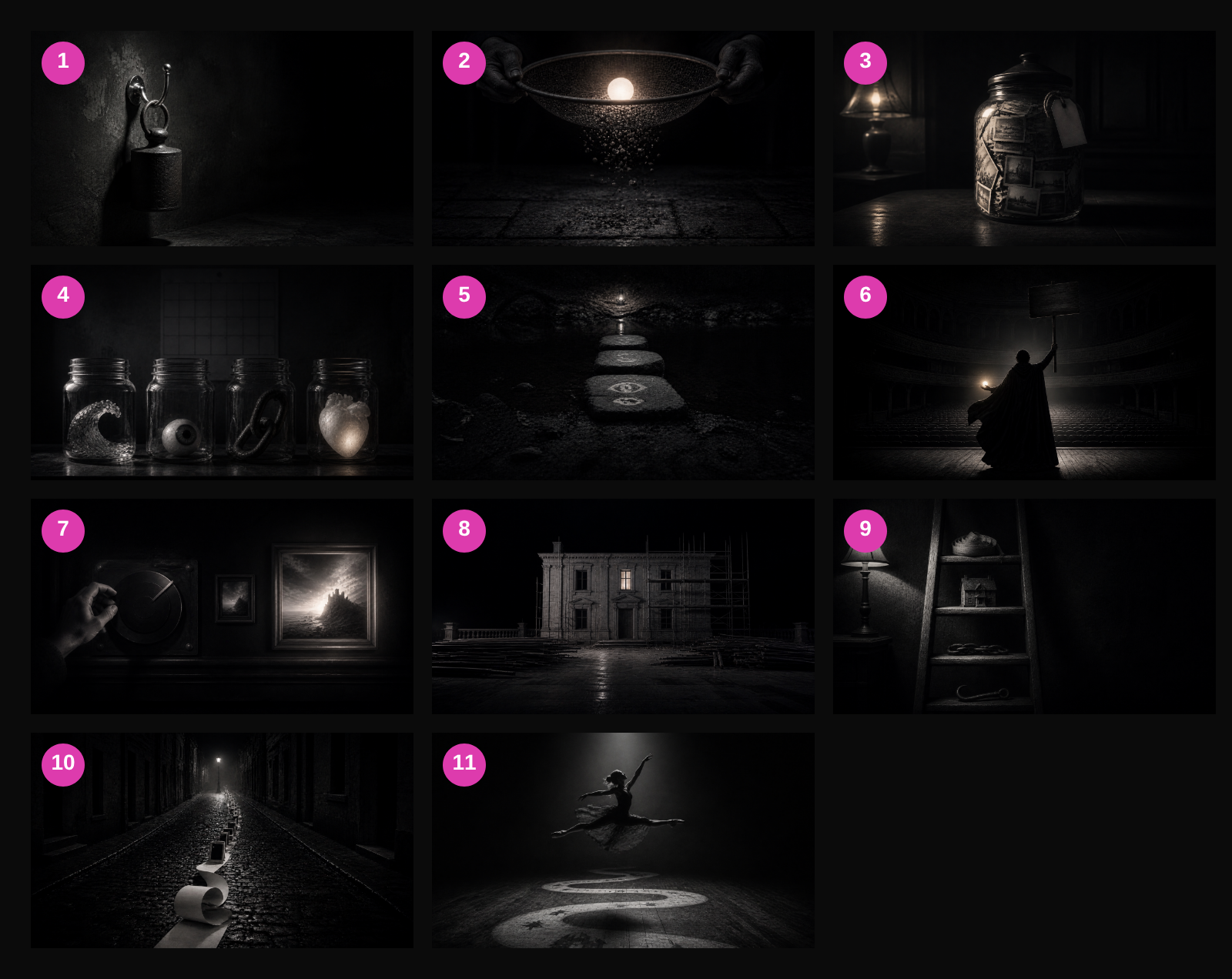
- Every mnemonic attaches hard information to something the brain holds easily. Image: a heavy iron weight hanging from a bright coat hook on a wall.
- The brain keeps what is vivid, connected and meaningful and drops the rest. Image: a sieve catching a glowing coloured ball while grey pebbles fall through.
- A reference story is a container of images whose meaning refers to real information. Image: a glass jar full of small pictures with a label tied to the lid.
- Four ingredients: flow, imagination, association and meaning; spaced retrieval makes it last. Image: four jars on a kitchen counter holding a calm wave, an eye, a chain link and a red heart, a wall calendar behind them.
- Four steps: identify, find images, build the story, test aloud while seeing it. Image: four stepping stones across a stream, the last one with a mouth and an eye painted on it.
- PERFORM: the performer with a purpose and super powers carries all seven words. Image: a caped performer on a stage holding a signpost, with a glowing product in her hand.
- Dial it up: a polite image is a three, a memorable one is an eight. Image: a volume dial turned from three to eight, the picture beside it growing bigger and brighter.
- A good mnemonic is scaffolding; once the fact sets you no longer need it. Image: scaffolding being taken down from a finished building.
- The ladder: one hook, a chain, a set of locations, a code. Image: a four-rung ladder with a hook, a chain, a house and a string of digits on the rungs.
- 732 digits in 1995 used the same principle as the rainbow sentence, prepared further. Image: a long ribbon of numbers turning into a line of pictures along a street.
- Mnemonics build understanding and help skills too: map a routine as a story. Image: a dancer mid-leap above a floor painted with a winding storybook path.
Sources
- Mark Channon, How to Remember Anything (Hodder Education)
- Mark Channon, The Memory Workbook (Hodder Education)
- Arnsten, A. F. T. (2009). Stress signalling pathways that impair prefrontal cortex structure and function. Nature Reviews Neuroscience, 10(6), 410 to 422. https://doi.org/10.1038/nrn2648 (the home for this study is How to Focus Better: A Memory Coach's Method)
- Craik, F. I. M., and Tulving, E. (1975). Depth of processing and the retention of words in episodic memory. Journal of Experimental Psychology: General, 104(3), 268 to 294. https://doi.org/10.1037/0096-3445.104.3.268 (the home for this study is Creative Memorisation: The Four Ingredients That Make Anything Memorable)
Loci
Build the memory palace in this article inside Loci — store your locations, link images, and rehearse with spaced repetition.
Try it in LociMemory School community
Learn directly with Mark inside the Memory School community on Skool — monthly lessons, practice, and Q&A.
Join Memory SchoolAbout the author
Mark Channon
Grand Master of Memory (1995). Author of three books on memory published by Hodder and Nick Hern. Creator of BBC1's Monkhouse's Memory Masters. Memory coach on Channel 4's Can I Improve My Memory?
Read full bio →