
Memory Techniques
The Chain Method: How to Remember Lists Without Building a Memory Palace
The chain method links each item to the next in a vivid mental story. Perfect for shopping lists, vocabulary, and any short ordered sequence, no palace required.

The memory palace, where you picture each thing you want to remember at a spot along a route you already know, like the rooms of your home, is the most powerful memory technique ever invented. But it isn't always the right tool for the job. Sometimes you don't need a 50-location mental architecture, you just need to remember twelve items off the top of your head, right now, with no preparation.
That's what the chain method is for. It's about as fast as mnemonic techniques get, it works on virtually any short list, and once you've got the hang of it you can use it on the fly in any situation.
Here is what the chain method is, when to use it (and when not to), and a seven-step process to make it stick.
What Is the Chain Method?
The chain method, sometimes called the link system or link method, is a memory technique where you link each item in a list to the next, in order, through a single flowing story made of vivid mental images.
You take item one and connect it visually to item two. You take item two and connect it visually to item three. And so on, all the way down the list. To recall, you start at item one, and the chain pulls you through the rest.
That's the whole technique. No palace. No locations. Just one item triggering the next in a chain reaction of images.
A typical chain method story might be 10 to 20 images long. Shorter than that and you don't really need a technique. Longer than that and you should probably switch to a memory palace, which scales better.
When to Use the Chain Method (and When Not To)
The chain method is the right tool for:
- Short shopping lists (10 to 20 items)
- Quick to-do lists for the day ahead
- Vocabulary chunks, 15 words you want to learn for a foreign-language session
- Talking points for a brief meeting
- The order of a small dance routine, exercise sequence, recipe
- The "first pass" on a chapter, a chain of key concepts that gives you a reference for the whole chapter
- Any sequential list you only need to remember once
It's not the right tool for:
- Long lists of 30+ items, switch to a memory palace
- Information you need to access in random order, a chain runs in sequence, so jumping into the middle is awkward
- Knowledge you want to keep forever, chains fade faster than palaces unless aggressively reviewed
- Pairs of facts (country → capital, English → French), these are better as reference stories, where one small vivid scene ties the two halves of each pair together
The simplest way to decide: if it's a short, ordered, one-off list, use a chain. Otherwise build a palace.
The Big Ben Story: A Worked Example
The easiest way to learn the chain method is to do it.
Read this short story three times. Each reading, let the images come to life in your mind as vividly as you can. Don't try to memorise. Just see the story.
Imagine this:
Big Ben is wearing a fur coat. He's bouncing up and down on a springboard. He dives off the springboard into a large pot of honey. Out of the honey comes a dinosaur. The dinosaur is wearing a baseball cap and swinging a baseball bat. He starts smashing up a Ferrari with the baseball bat. Driving the Ferrari is Tom Cruise. Tom is holding a gigantic cigar. He takes the cigar and stubs it out on the hand of a bald-headed man. The bald-headed man is eating a big sticky chocolate bar. Wrapped around the chocolate bar is a slimy snake. The snake is playing the drums and drinking a bottle of beer.
Read that through two more times, bringing it to life with more clarity each time. See Big Ben in the fur coat. Feel the bounce of the springboard. Smell the honey.
Now look away. Grab a piece of paper. Write down as many of the 15 key items as you can remember in order.
You probably got most of them, somewhere between 12 and 15 out of 15 from one careful read-through. The next day, with no review, the recall is typically a little lower. A week later, with one short refresh, it's still strong.
That's the chain method: fifteen items in about three minutes.
How Long Does the Chain Method Last?
Without review, a chain typically fades faster than a memory palace, say, days rather than weeks. With a few spaced reviews, for example at one hour, one day and one week, a chain can hold for months.
For most one-off uses (shopping, today's meetings, this weekend's social plans), you don't need to review at all. Build the chain, use it, let it fade.
The 7-Step Process for a Sticky Chain
Here's the process, step by step, for every chain you build.
1. Get Into Flow
Tension kills memorisation. Before you start, take three slow breaths. Drop your shoulders. Lengthen the back of your neck. You are after a state that is relaxed and alert at once, the one in which images arrive without being forced.
If your shoulders are around your ears and your jaw is clenched, the chain won't work. Loosen first.
2. Look for Meaning
Before you start placing images, scan the list. Is there a natural meaning, theme, or context that links these items? A weekly shopping list for a roast Sunday lunch has a meaning. Twenty random words from a vocabulary book don't, but you can give them one. Imagine the words are all happening in a haunted forest, or a 1980s nightclub, or the surface of Mars. A backdrop holds the chain together.
3. Create Your Images and Associations
For each item, decide on the image you'll use. Concrete words ("apple", "hammer", "dog") are already images, just see them. Abstract words ("freedom", "synthesis") need sound-images (a picture built from what the word sounds like) or symbols. Freedom → an eagle bursting out of a cage. Synthesis → a thesis paper with a glowing red sin on the cover.
Use the MIN rule, Minimum Images Necessary. One vivid image per item, not three.
4. Articulate the Words Aloud
This step is often skipped and it matters enormously. As you place each image, say the word out loud. Hearing yourself say it in your own voice creates a much stronger memory than imagining it silently.
If you're somewhere you can't speak aloud, whisper it. If you can't even whisper, mouth the word silently. The articulation matters.
5. Connect the Chain
Make each link interact with the next. Don't put item B near item A, make item B do something to item A. The dinosaur isn't standing near the honey, he's coming out of the honey, dripping. The snake isn't near the chocolate bar, it's wrapped around the chocolate bar.
A useful extra trick: join the last item back to the first. In the Big Ben story, you could imagine the snake passing the beer up to Big Ben. This forms a complete loop and lets you run the chain in either direction.
6. Dial Up Your Memory
Once the chain is built, imagine a dial in front of you marked 1 to 10. Where is the chain in vividness right now? Probably a 4 or 5. Turn the dial up to 8. Wait. Notice what happens.
You will probably find the images become more vivid straight away. Colours brighten. Sounds get louder. The dinosaur smells like swamp. This dial-up technique is one of the fastest ways to lock in a chain.
7. Run Your Remote
Last step. Mentally "play" the chain like a movie. Start at item one, run forwards. Now run backwards. Now run forwards again, quickly. The "movie" you're playing is encoding the sequence into long-term memory.
Three passes is usually enough. For a high-stakes chain, do five.
4 Things to Watch Out For
Some common blockers beginners hit:
Spending too long on the initial pass. Build quickly. Don't agonise. Momentum matters.
Holding on too tight. If a link won't come, move on. Come back to it on the second pass.
Looking for the "right" image. There are no rules. The first image your brain offers is usually the best one.
Creating too much complexity. A single vivid interaction beats a complicated mini-scene every time.
Real-World Uses
Here are a few places the chain method earns its keep, every week:
Shopping list. Build a chain of the 12 to 15 items you need from the shop. Don't write it down. The chain holds long enough to get you to the till and back.
Pre-meeting talking points. Before a meeting, chain the 5 to 8 things you want to make sure you say. You don't need to take notes in.
Conference takeaways. At a talk, build a chain of the key insights as the speaker presents them. By the end of the day you have a complete reference chain for each session.
The first pass on a book. Before reading a non-fiction book seriously, scan the chapter list and build a chain of the chapter titles. It primes your brain to make connections as you read, and gives you a built-in reference for the whole book.
Vocabulary chunks. When learning a new language, batch 12 to 15 new words into a single chain. It's much faster than flashcards for the encoding phase, the first time you take the words in.
How the Chain Method Connects to the Memory Palace
The chain method and the memory palace are partners, not rivals.
A chain has no fixed locations, it floats. A palace has locations, it's anchored.
When you place a chain inside a palace, you get the best of both: the rapid encoding of a chain plus the durable, navigable structure of a palace. This combination is the heart of how actors can learn long monologues, each line becomes a tiny chain (the visual cue), and those cues sit on locations in a palace. The result is dialogue that can be recalled, in order, in any direction, and that survives stage nerves.
For more on that combination, read How Actors Learn Lines Fast: The Seven-Step Recipe (From Learning Your Lines).
Where to Go Next
- What is a Memory Palace? A Beginner's Guide to the World's Oldest Memory Technique, when you're ready to scale up beyond chains
- How to Build a Memory Palace: A 7-Step Beginner's Guide (With Worked Examples), the practical walkthrough
- The Method of Loci Explained: The Ancient Memory Technique Still Used by World Memory Champions, the theory behind it all
Memory map
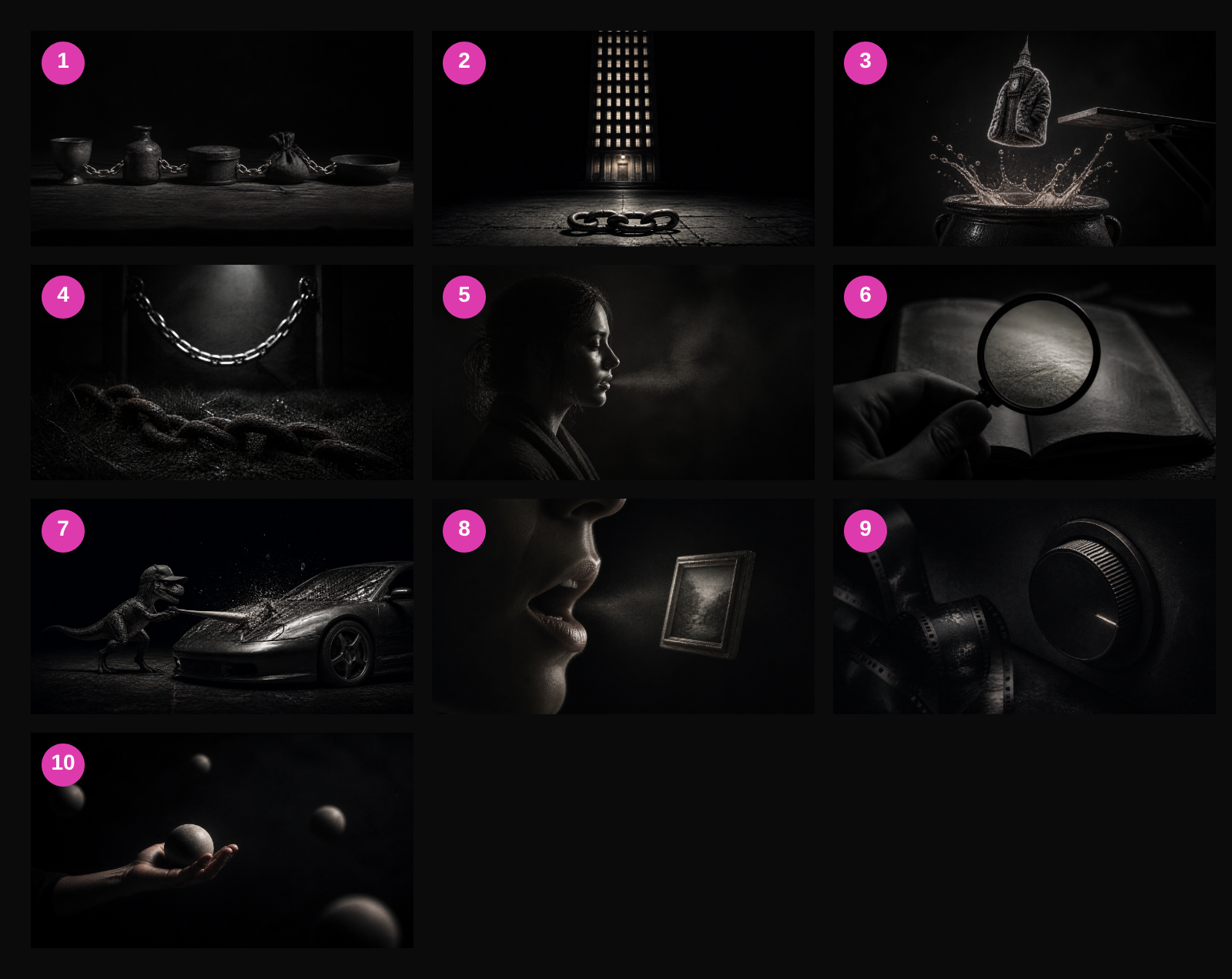
- The chain method links each item to the next in one flowing story. Image: a row of objects joined by glowing links of chain.
- Use it for short ordered lists; use a palace when you need to jump to any item. Image: a short chain beside a tall building with numbered windows.
- Big Ben in a fur coat bounces on a springboard into a pot of honey. Image: exactly that, honey splashing.
- A chain lasts days if left alone and years if reviewed. Image: one chain rusting in grass, another polished and hung on a wall.
- Get into flow before you start. Image: a person breathing out slowly, shoulders dropping, eyes soft.
- Look for meaning in each item before you make the image. Image: a magnifying glass held over a single word on a page.
- Create vivid images and make each one act on the next. Image: a dinosaur in a baseball cap swinging a bat at a red sports car.
- Say the words aloud as you see the pictures. Image: a mouth open mid-word, a picture floating just in front of it.
- Dial up the vividness and run the story back and forth like a film. Image: a volume dial turned towards ten beside a strip of film.
- Do not agonise over images; the first one your brain offers is usually right. Image: a hand catching the first ball thrown, ignoring the others in the air.
Sources
- Mark Channon, How to Remember Anything (Hodder Education)
- Mark Channon, The Memory Workbook (Hodder Education)
Frequently asked questions
Are you old school? Get Mark's book Improve Your Memory and dive in depth.
Loci
Build the memory palace in this article inside Loci — store your locations, link images, and rehearse with spaced repetition.
Try it in LociMemory School community
Learn directly with Mark inside the Memory School community on Skool — monthly lessons, practice, and Q&A.
Join Memory SchoolAbout the author
Mark Channon
Grand Master of Memory (1995). Author of three books on memory published by Hodder and Nick Hern. Creator of BBC1's Monkhouse's Memory Masters. Memory coach on Channel 4's Can I Improve My Memory?
Read full bio →