
Study and Learning
How to Memorise the Periodic Table
The first ten elements in five minutes with a story, the first thirty in half an hour with pegs and a memory palace that give you the atomic numbers for free. The exact method from a Grand Master of Memory's books.

The periodic table is the classic memory challenge, and the classic way to fail at it is to stare at the chart and chant. Hydrogen, helium, lithium, beryllium, boron. By carbon you have lost lithium. By the second row you have lost the will. That is not a memory problem. It is a method problem, because a list of unconnected abstract words is exactly the kind of information the brain is worst at holding.
Turn the elements into pictures and link them, and the first ten go in within five minutes. Put them on pegs and in a memory palace and the first thirty go in within half an hour, and you get the atomic numbers for free. Here are both methods, with ready-made images so you can start immediately, and then how to extend it as far as you want to go.
Why the chart will not go in by itself
Element names are abstract. Most of them are not pictures, and the ones that are, like iron, are outnumbered by the ones that are not, like beryllium. They are also in an order that has nothing to do with their names: there is no story in hydrogen being followed by helium. So the brain, which keeps what is vivid, connected and meaningful, has nothing to hold onto.
The fix is the same as for any abstract list. Give each element an image, connect the images, and if you want the numbers, put the images somewhere that carries the number for you.
Method 1: The first ten in five minutes with a chain
For each element, create an image. Some elements suggest a natural image from their meaning. For the rest, use a sound image: something that sounds like the name or its first syllable. Here is a set to start with, marked natural (n) or sound (s).
- Hydrogen: a bomb (n)
- Helium: a balloon (n)
- Lithium: leaves (s)
- Beryllium: a bee (s)
- Boron: a boar (s)
- Carbon: a car (s)
- Nitrogen: nitro, the big red button (s)
- Oxygen: an oxygen mask (n)
- Fluorine: toothpaste (n, fluoride)
- Neon: a neon strip light (n)
Now set a backdrop. A laboratory works. The story will happen there, though the scene can shift as the action does. Then link the images into one flowing story. Here is one that works:
You walk into the laboratory holding a bomb and throw it into a hot air balloon. As it rises and explodes, thousands of green leaves fall to the ground, covering a bee the size of a person, which stings a boar. The boar runs at you and you manage to get into a car before it smashes the door. You press the big button that says nitro, and you are going so fast around the laboratory that an oxygen mask drops down. When you stop, you take a huge tube of toothpaste from the dashboard, step outside and squirt it onto a neon strip.
Read it through twice. Make the images come alive with your senses: hear the balloon burst, feel the leaves land, smell the toothpaste. Dial up the intensity until the scene is vivid. Then run it as a movie, fast, forwards and back.
Now the step that turns the story into knowledge. The first few times, recite the story. After that, recite only the real information, hydrogen, helium, lithium, while seeing the story in your mind. Say the element names aloud. You are connecting the images to the words, and within three or four passes the words come without the story.
Five minutes. Ten elements, in order, forwards and backwards.
Method 2: The first thirty, with atomic numbers, on pegs and a memory palace
A chain is perfect for a short list, but it has two limits. You have to walk it from the start, and it does not give you the atomic numbers. For that you need a fixed set of numbered locations you know by heart: a peg list, a memory palace, or both.
The clever part is this. Use the number of the location to represent the atomic number. Boron goes on your fifth location, so boron's atomic number is five. You never create a separate image for the number. The position carries it.
Here is the layout, using a peg list and a memory palace you can build in minutes.
Locations 1 to 10: the body system. Feet, knees, thighs, behind, waist, chest, neck, face, hair, ceiling. Ten pegs that are always with you.
Locations 11 to 30: a memory palace. Four rooms in your home, five items in each, chosen clockwise. Twenty locations.
Then place one image per element:
- Feet: hydrogen bomb
- Knees: helium balloon
- Thighs: leaves (lithium)
- Behind: bee (beryllium)
- Waist: boar (boron)
- Chest: car (carbon)
- Neck: a knight (nitrogen)
- Face: oxygen mask
- Hair: fluoride toothpaste (fluorine)
- Ceiling: neon lights
Then into the palace:
- Salt (sodium)
- Magazine (magnesium)
- Ale (aluminium)
- Silly cone (silicon)
- Fozzie Bear (phosphorus)
- Surfer (sulphur)
- Swimming pool (chlorine)
- Aga oven (argon)
- Pots (potassium)
- Milk (calcium)
- Scanner (scandium)
- Tights (titanium)
- Van (vanadium)
- Chrome wheels (chromium)
- Man on his knees (manganese)
- Iron (iron)
- Cobbles (cobalt)
- Coin (nickel)
- Policeman (copper)
- Sink (zinc)
Make each image interact with its location. Salt is not near the first item in your living room, it is pouring out of it. The man is not standing by the twenty-fifth item, he is kneeling on it. As you place each one, say the element aloud.
Then recite all thirty, starting with your feet and walking to the last item in your palace. You have just memorised the first thirty elements with their atomic numbers, in around thirty minutes, and you can jump to any of them. What is element 19? Nineteenth location, pots, potassium. What number is iron? It is on your twenty-sixth location. Twenty-six.
Making the images your own
The images above work, but images you create yourself will always work better, because the association is already in your head. If "Fozzie Bear" means nothing to you, use something that sounds like phosphorus and that you can see. Keep a few rules in mind.
Natural image first, sound image second. If the element name gives you a picture directly (iron, oxygen), use it. If not, find something that sounds like the start of the word.
Keep the image consistent. Once silicon is a silly cone, it is always a silly cone. The power of the system comes from the images being fixed.
Say the element aloud while you see the image. Every time. This is what connects the picture to the real word so you do not end up reciting "silly cone" in the exam.
Extending it
Thirty elements is a good place to stop, and for most exams it is plenty. If you want more, the method scales without changing.
Add a second palace for locations 31 to 60, and a third for 61 to 90. Build them in LOCI if you run out of rooms: it builds memory palaces from Google Street View or with AI, so a town you have never visited gives you as many locations as you like. Keep the rule that the location number is the atomic number, and the whole table becomes a walk.
You can also hang more on each location. Once the element image is solid, embed the symbol on it, or a key property, or the group it belongs to. The image becomes a hook for everything you know about that element, which is what a memory palace is for.
Revision
Anything you memorise fades without review, and the periodic table is no exception. Walk the pegs and the palace an hour after you build them, the next day, a week later and a month later. Each walk takes two or three minutes. After the month it will stay for years, and a single walk before an exam brings all thirty back in full.
If a particular element keeps dropping out, the image is too weak. Make it bigger, louder, stranger, or swap it for one that means more to you. Then say it aloud a few more times.
Try it now
Do the ten-element story before you do anything else. Set a timer for five minutes, read the laboratory scene twice, run it as a movie, then recite the elements. If it works, and it will, build the thirty.
The periodic table has a reputation as the hardest thing in school to memorise. It is not hard. It is just a list, and lists are what memory techniques were built for. The Chain Method: How to Remember Lists Without Building a Memory Palace covers the story technique in depth, and The Peg System Explained and How to Build a Memory Palace: A 7-Step Beginner's Guide (With Worked Examples) show how to build the pegs and the palace. If you would rather have the images generated for you, LOCI turns your own material, the element list included, into images and builds the palace for you.
Memory map
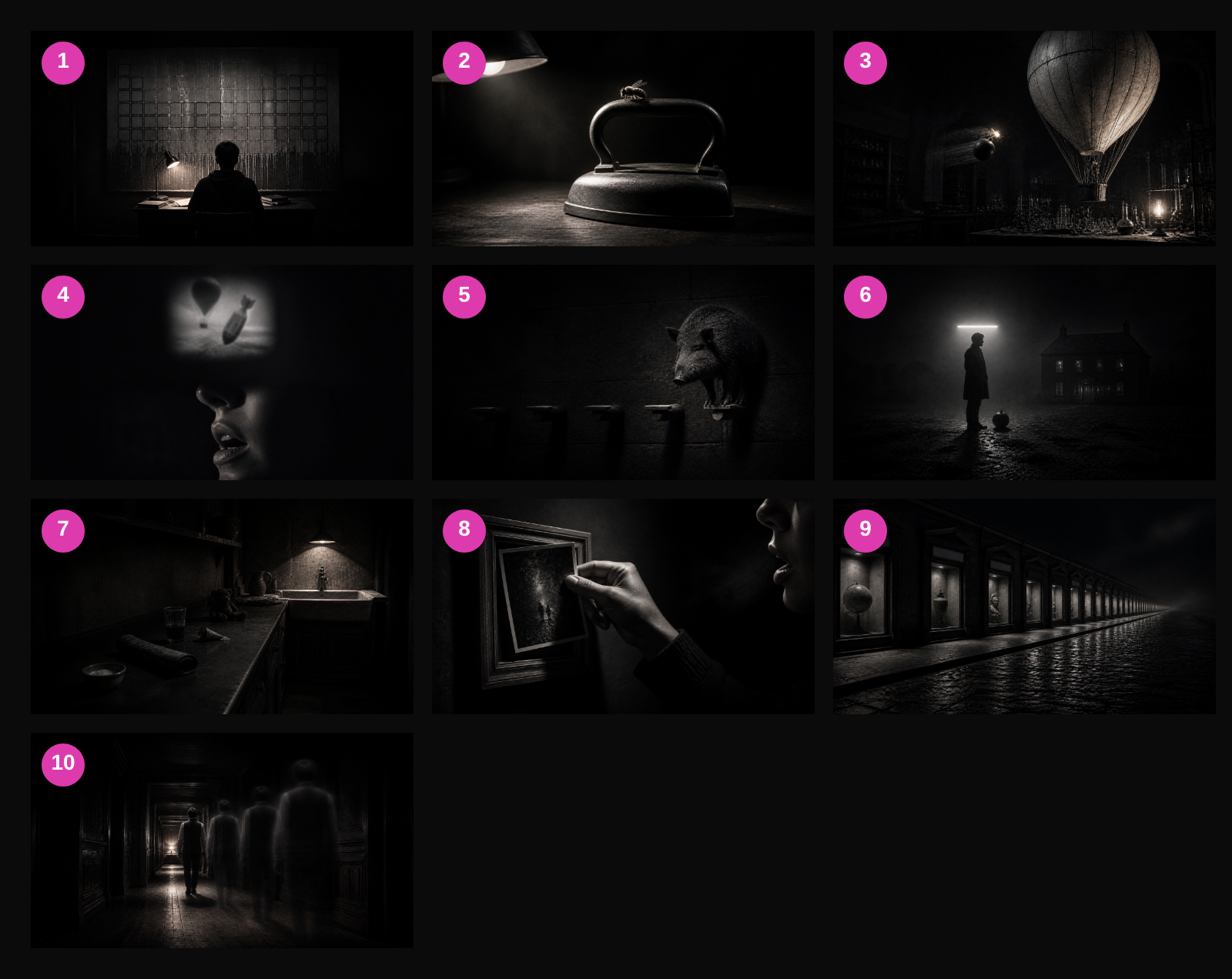
- The chart will not go in by chanting because element names are abstract and unconnected. Image: a student staring at a wall chart, the words sliding off like rain.
- Give each element an image: natural if the name suggests one, sound if not. Image: an iron (natural) beside a bee (sound, beryllium).
- First ten as a chain in a laboratory: bomb, balloon, leaves, bee, boar, car, nitro, mask, toothpaste, neon. Image: a bomb flying into a hot air balloon over a lab bench.
- Recite the story first, then only the real names while seeing it. Image: a mouth saying "hydrogen, helium" while a small film plays above.
- Pegs and a memory palace give you atomic numbers for free: the location number is the number. Image: a numbered peg with boron's boar standing on peg 5.
- Body system for 1 to 10, a four-room palace for 11 to 30. Image: a figure with a bomb at the feet and a neon light at the ceiling, next to a house with twenty glowing spots.
- Salt, magazine, ale, silly cone, Fozzie Bear... sink. Image: a kitchen sink made of zinc at the end of a trail of objects.
- Your own images beat borrowed ones; keep them consistent and say the element aloud. Image: a hand swapping a picture in a frame, a mouth beside it speaking.
- Extend with more palaces, built in LOCI if needed, and embed symbols and properties on each image. Image: a street of numbered shopfronts stretching to the horizon.
- Revise at one hour, one day, one week, one month. Image: four short walks through the same house, each one faster.
Sources
- Mark Channon, How to Remember Anything (Hodder Education)
- Mark Channon, The Memory Workbook (Hodder Education)
Loci
Build the memory palace in this article inside Loci — store your locations, link images, and rehearse with spaced repetition.
Try it in LociMemory School community
Learn directly with Mark inside the Memory School community on Skool — monthly lessons, practice, and Q&A.
Join Memory SchoolAbout the author
Mark Channon
Grand Master of Memory (1995). Author of three books on memory published by Hodder and Nick Hern. Creator of BBC1's Monkhouse's Memory Masters. Memory coach on Channel 4's Can I Improve My Memory?
Read full bio →