
Study and Learning
Study Techniques That Actually Work
Most study techniques are rereading with extra steps. These are the ones that hold up: purpose, preview, mind map, memory palaces, spaced revision and active testing, in the order a Grand Master of Memory uses them.

Most study techniques are rereading with extra steps. Highlighting is rereading with a pen. Copying out notes is rereading with a hand. Watching the lecture again is rereading with a screen. They all feel like work, and they all produce the same result: a warm sense of familiarity with material you cannot actually recall when the exam paper is in front of you.
The study techniques that work are different in kind. They make you create something, retrieve something, or connect something, and they do it on a schedule your brain can keep up with. They work on everything from the elements of the periodic table to a professional qualification you have six weeks to pass. Here is the method, in order.
Start with the state, not the book
Before any technique, there is a step you have probably been skipping: getting into a state where learning is possible.
Think about the last time you sat down to study and did not feel like it. You opened the book, read the same paragraph three times, checked your phone, and an hour later had learned nothing except that you did not feel like it. That is not a study problem. It is a state problem. Anxiety and boredom both shut down the part of the brain you need for learning.
The fix is a ritual. Close your eyes and remember a time when learning felt great, a book that gripped you, a skill someone showed you that clicked. Notice what that felt like in your body. Now imagine your ideal study space: what it looks like, what you would need around you, what you would do and say to get yourself excited about learning the thing in front of you. Spend five minutes building that space in your mind. Then build as much of it as you can in the real world, and run through the same short ritual every time you sit down.
It sounds soft. It is not. A ritual changes how you feel in under a minute, and how you feel determines whether the next hour produces anything.
Technique 1: Create purpose and direction
Why are you studying this? Not "because there is an exam." What will knowing it let you do? What will you have achieved six months after you have learned it? How committed are you, on a scale of one to ten, and if the answer is below eight, what would it take to get there?
Write the answers down. Stick them on a wall if you have one. This is two minutes of work and it changes everything that follows, because purpose primes your attention. When you know why the material matters, your brain starts noticing what is relevant without being told.
Technique 2: Preview before you read
Before you read anything in detail, preview it. Take no more than five minutes. Read the contents page, flick through, notice headings, diagrams, anything that grabs you. Do not read properly. Then spend ten to twenty minutes skimming at high speed, again without stopping on detail.
This feels like a waste of time and it is the opposite. Previewing primes your brain with the terminology and structure, so that when you read properly the material feels familiar rather than foreign. You have met the words before. You know roughly where things are. The detailed read then goes faster and sticks better, because you are filling in a frame rather than building one from nothing.
Technique 3: Capture the big picture in a mind map
After the preview, take a sheet of paper and some coloured pens and map what you think the subject is about. One central image, main branches for the big themes, one word per branch. Add what you already know. Capture questions you want answered.
Mind maps work because they bring together words with colour, logic with imagination, sequence with rhythm, detail with the overall picture. A linear list uses half of that. The map becomes your mental scaffolding, and as you study, you add branches to it. By the end, the whole subject is on one page you can see in your mind.
If you tried mind mapping years ago and decided it was not how you work, wipe the slate clean. Chances are you drew a spider diagram, with words at the ends of the lines, which soon turns into a mess. A mind map, as Tony Buzan created it, has its own rules: a central image, at least three colours, organic branches that are thicker at the centre and thinner as they go out, and each word written along its branch so the words connect visually. Add images, and link branches with lines, dotted connectors or symbols. Then switch between two modes: focus mode, writing words and making connections, and diffuse mode, doodling, drawing and colouring, which I call active daydreaming.
Technique 4: Chunk the material into learning topics
Big subjects defeat people because they try to swallow them whole. Break the syllabus into learning topics, ten or so, and list them. Then look for themes that cross topics, because those are the connections the examiner will test.
When my wife Zoe trained as a Pilates instructor, her written exam covered ten learning topics, from the skeletal system to postural analysis to the order of thirty-four exercises. The exercises were a theme that ran through several topics: to know which exercise to give a client, you had to understand postural analysis. Spotting that link turned two topics into one connected piece of knowledge, which is far easier to remember than two separate piles of facts.
Technique 5: Memorise with a memory palace, not repetition
This is where the method parts company with everything you were taught at school.
Facts, sequences, terminology and definitions do not go in by rereading. They go in by being turned into images and placed in a memory palace (a building in your mind with an image at each spot), on a journey (the same idea along a route) or on a peg list (a short numbered set of images like the parts of your body), each a fixed set of mental locations you can walk in order. Each learning topic gets its own area of a palace. Each fact becomes a reference story, a small vivid scene that captures the information. Sequences become chains, stories that link each item to the next. Numbers become number images, a fixed picture for each digit.
Take a set of business terms you need for an exam. Rereading the glossary for an hour will not do it. A picture will: AIDA, the Attention, Interest, Desire, Action model, becomes the opera Aida on stage, a spotlight grabbing your attention, a singer you cannot look away from, the whole audience wanting more, and everyone rushing to buy tickets for the next night. One scene, four steps, in order. Five minutes, and the sequence is permanent. The same move works for any list, and How to Memorise the Periodic Table shows it on the first thirty elements.
The principle generalises. Anything you need to recall, not just recognise, goes into a memory palace, or onto a peg list, as an image. Say the real information aloud as you place it. That is the step that turns a picture into knowledge.
Technique 6: Revise on a schedule, not in a panic
Everything you memorise starts to fade immediately. That is normal and it is predictable, which means it can be beaten with a small amount of well-timed review.
A widening schedule that has been around for decades works well: one hour after memorising, then one day, one week, one month, three months, six months, then as needed. Each review is short. For material on a palace it is a walk through the palace. The total time is a fraction of what cramming costs, and the material lasts years instead of days.
The night before an exam is for a final walk through the palaces, not for learning anything new. Sleep consolidates what you have, and a calm walk through rehearsed material beats a panicked reread every time.
Technique 7: Test yourself, out loud, in different voices
Rereading trains recognition. Exams test recall. They are different skills, and only one of them gets you marks.
So test. Cover the material and produce it. Walk the palace and say what is on each location. Explain a topic to someone, or to the wall. And here is a trick that makes testing stick harder: recite the information in different genres. Tell it as a horror story, then as a comedy, then as a melodrama. Play with it. Every retelling is another retrieval, and the emotion you add each time strengthens the trace. Learning that makes you laugh is learning you keep.
Technique 8: Act on it
The learning cycle has three steps: take in the experience through your senses, integrate it by reflecting and connecting, then act to test what you have learned. Most studying stops after the first step. Complete the loop. Use the knowledge. Solve a past paper, teach it, apply it to a real problem, write the essay. Action is where understanding is confirmed and where the memory gets its final anchor.
The method in one page
- Ritual: get into a learning state.
- Purpose: write down why, and how committed you are.
- Preview: five minutes, then a fast skim.
- Mind map: the big picture on one page.
- Chunk: ten learning topics, and the themes between them.
- Memorise: images in a memory palace, said aloud.
- Revise: one hour, one day, one week, one month.
- Test and act: recall out loud, in different voices, then use it.
Six weeks of this, done daily, is enough for most professional exams. Zoe passed hers on roughly that timeline. The method is not faster because it is clever. It is faster because every step makes you do something with the material, and doing is what the brain remembers.
For the detail on each step: Using a Memory Palace for Studying: A Smarter Way to Memorise Vocabulary, Anatomy and Exam Content shows how to lay out a syllabus across palaces, How to Remember Definitions and Facts (The Reference Story Method) covers turning facts into images, and The Forgetting Curve (and How to Beat It) explains why the revision schedule works. If you want to build palaces straight from your course notes, LOCI pulls the key ideas out of your notes, gives each one an image on a palace, and puts the real information on a flashcard behind every image, with spaced retrieval practice built in.
Memory map
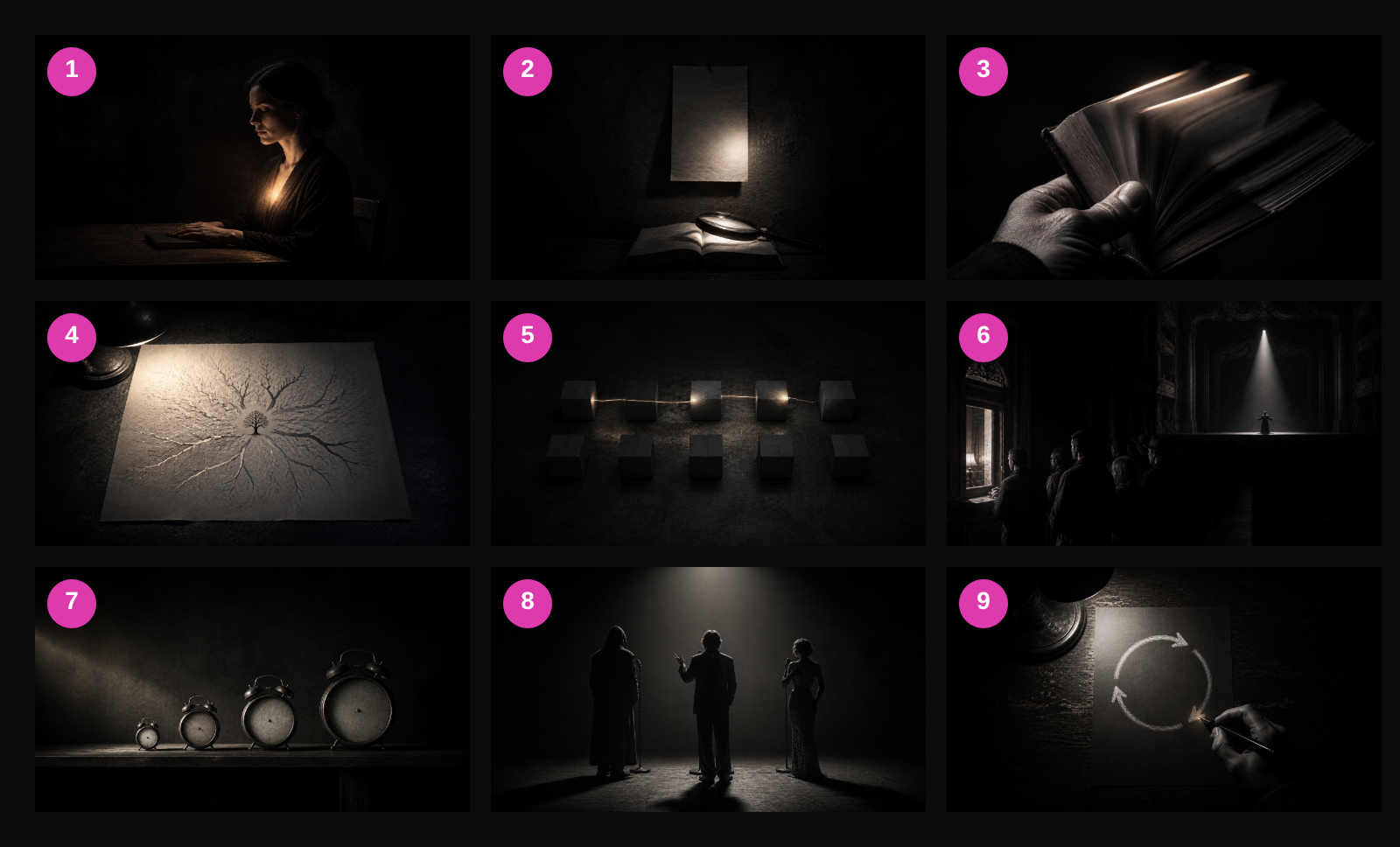
- State first: a ritual gets you ready to learn. Image: a person closing their eyes at a desk, a glow spreading from their chest.
- Purpose primes attention. Image: a sheet of answers stuck to a wall, with a magnifying glass over the book below it.
- Preview before reading: five minutes, then a fast skim. Image: pages flicking past under a thumb, headings lighting up.
- Mind map the big picture on one page. Image: a central picture with coloured branches radiating out.
- Chunk into learning topics and find the themes between them. Image: ten boxes with a bright thread linking three of them.
- Memorise with images in a memory palace, never by rereading. Image: an opera stage with a spotlight, a singer and a queue at the box office.
- Revise at one hour, one day, one week, one month. Image: four alarm clocks in a row, each bigger than the last.
- Test out loud in different genres. Image: the same fact being told by a horror villain, a comedian and a soap star.
- Act on it to complete the learning cycle. Image: a circle drawn in three strokes, the last stroke being finished by a pen.
Sources
- Mark Channon, How to Remember Anything (Hodder Education)
- Mark Channon, The Memory Workbook (Hodder Education)
Loci
Build the memory palace in this article inside Loci — store your locations, link images, and rehearse with spaced repetition.
Try it in LociMemory School community
Learn directly with Mark inside the Memory School community on Skool — monthly lessons, practice, and Q&A.
Join Memory SchoolAbout the author
Mark Channon
Grand Master of Memory (1995). Author of three books on memory published by Hodder and Nick Hern. Creator of BBC1's Monkhouse's Memory Masters. Memory coach on Channel 4's Can I Improve My Memory?
Read full bio →