
Study and Learning
Using a Memory Palace for Studying: A Smarter Way to Memorise Vocabulary, Anatomy and Exam Content
How students and medical trainees use memory palaces to memorise vocabulary, anatomy, formulas and exam content, without burning out on flashcards.

The study advice you are handed at school comes down to one tool: repetition. Read it. Read it again. Make a flashcard. Read the flashcard. Read it again. Test yourself. Repeat for a thousand items and several hundred hours.
It works, sort of. It's also slow, painful, and the information evaporates the moment the exam ends.
There is a better way, and it isn't a new app. It's a 2,500-year-old technique called the memory palace, where you turn each fact into an image and leave it at a stop along a route in your mind, and it changes how much of your study time actually sticks while raising your exam marks.
Medical students, law students and vocational trainees use it. So did my wife Zoe, who used it to pass her Pilates instructor exam with an average of 93%. Here is exactly how to use a memory palace for studying.
Why Flashcards Aren't Enough
Flashcards aren't bad. They're a useful tool for testing retrieval, which is important. But as a way to encode new information, they have a fatal weakness: they treat every fact as an isolated, abstract piece of text.
Your brain doesn't store information that way. Your brain stores information by association, by connecting new facts to existing knowledge, to images, to places, to emotions. Information that has a home in your mind sticks. Information that floats around with no anchor evaporates.
A memory palace gives every fact a home. Not metaphorically, literally. Each fact lives at a specific location in a mental space you can walk through. That single change, turning abstract text into spatial, visual, narrative information, is what makes it stick.
The flashcards still have a role. We'll come back to that.
How a Memory Palace Helps You Study
A memory palace works for studying because it uses three things your brain is good at:
- Spatial memory. You can navigate places you know without thinking. The hippocampus, the part of your brain involved in forming new memories, is also heavily involved in spatial navigation. The two systems are deeply linked.
- Visual memory. Images stick. Words don't. When you turn a fact into a vivid image, you give it a hook your brain can grab onto.
- Associative memory. When you place that image at a location, you create a triple-anchor: location triggers image, image triggers idea, idea triggers fact.
Done well, this gives you information you can recall in order, weeks or months after you first took it in.
A Real Example: Zoe's 93% Pass Rate
Let me tell you about the time my wife Zoe trained to be a Pilates instructor. To qualify, she had to pass two exams: a 90-minute practical and a 2-hour written paper. The written exam covered:
- The skeletal system
- Muscle groups and their range of movement
- Anatomical terminology
- Planes of movement and the types of movement within those planes
- Types of muscular contraction
- Neutral anatomical position
- Postural analysis
- Four types of postural alignment
- The order of 34 specific exercises
- Cues and modifications for each exercise
That's a lot of information to hold in your head. Grinding through it with flashcards could take months.
Zoe used creative memorisation, turning dry facts into vivid images that connect to each other: memory palaces, the chain method, reference stories, the body system (images placed on parts of your own body, from your feet upwards), mind maps. She memorised the entire written-exam syllabus in around six weeks, with daily study sessions of 30 to 60 minutes. She passed with a 93% average.
The reason wasn't that Zoe is a natural memoriser (although she's brilliant). It's that the technique fits the way the brain actually works.
What to Memorise in a Memory Palace
A memory palace is the right tool for any study content that has structure, lists, sequences, definitions, terminology, paired facts. Specifically:
- Vocabulary, foreign-language words, medical terminology, legal Latin, scientific names
- Anatomy, bones, muscles, organs, vessels, neural structures and their functions
- Formulas and equations, chemistry, physics, statistics
- Historical timelines, dates, sequences of events, dynasties, presidents, monarchs
- Lists with structure, the periodic table, the planets, the FTSE 100, capitals of every country
- Frameworks and models, management models, psychological theories, philosophical schools
- Speeches, quotes, poems, scripts, see also How to Memorise a Speech with a Memory Palace (No Notes Needed)
For raw comprehension, understanding the material, memory palaces are supplementary. You still need to think, discuss, abstract, apply. But for the layer of factual knowledge that has to be available before you can think with it? A memory palace is the most efficient tool I know.
How to Use a Memory Palace for Studying: Step by Step
Here's the workflow if you want to use memory palaces seriously.
1. Build Your Study Palaces First
Don't try to build a palace and learn content at the same time. Build the palace as an empty container, lock it in, then fill it.
For a typical course of study, build three to five permanent study palaces before you start cramming any actual content. Each palace might have 20 to 50 memory files, the individual locations that each hold an image. The locations can come from places you already know (your home, a relative's home, your school or campus, regular walking routes) or from places you explore for the purpose in LOCI, Memory School's app for building palaces from Google Street View or with AI. You do not need a place you are already familiar with; a few seconds observing each location is enough to lock it in. Just avoid using the same building for two different palaces, as it gets confusing.
If you need more locations, LOCI gives you virtually unlimited new memory palaces, either a real town walked on Google Street View or a palace generated with AI. Pick one you find interesting, walk it, and snap mental pictures of distinctive shops and landmarks as you go.
For a full walkthrough on building palaces, read How to Build a Memory Palace: A 7-Step Beginner's Guide (With Worked Examples).
2. Chunk Your Subject Into Topics
Before you start encoding, take 15 minutes to slice your subject up. Most subjects naturally fall into chunks, anatomical regions, historical eras, grammatical rules, drug classes.
For Zoe's Pilates exam the chunks were things like muscle groups, planes of movement, exercise order. Each chunk gets its own area of palace, a specific room, a stretch of street, a single floor.
This is essential. Without chunking, you end up with one giant, undifferentiated palace where everything blurs together. With chunking, you can mentally walk to a specific area when revising a specific topic.
3. Encode Each Fact as an Image
Now you start turning facts into images. The technique depends on what type of information you're encoding.
Pairs (e.g. country → capital, term → definition, English word → French word) become reference stories. A reference story is a small vivid scene that captures both halves of the pair. An example: confabulate → to engage in conversation. The word gives you no picture, so use the sound: two coins looking fabulous, deep in conversation. Say "confabulate" aloud as you see them. Two seconds. Word and meaning, together.
Sequences (e.g. order of exercises, sequence of events, ordered list of presidents) become a chain, each item interacting with the next in a single flowing story. See The Chain Method: How to Remember Lists Without Building a Memory Palace for the full technique.
Anatomical terms can be encoded by acting them out as you create the image:
- Transverse plane → imagine a train driving around your waist as you sweep your hand horizontally across your body
- Superior → imagine Superman as you look up and raise your arms
- Distal → imagine a distilled bottle hovering away from your trunk as you reach for it
Prefixes, roots and suffixes in medical or scientific vocabulary can be encoded once and reused. Bi (two) becomes a bison riding a bicycle. Sub (under) becomes a submarine. Inter (between) becomes someone trapped between two doors.
The principle is the same in every case: use the MIN rule, Minimum Images Necessary. Don't over-encode. One vivid image per fact.
4. Place the Images in Your Palace
Walk your palace. At each location, place one image, but don't just put it there. Make it interact with the location. The two fabulous coins aren't near the front door, they're wedged in the letterbox, chatting away as you walk in. The Superman isn't near the lamp, he's bursting up through the lampshade, knocking it across the room.
The richer the interaction, the stronger the memory.
Place images in chunks of five. Test each chunk before moving on. If an image won't stick, dial it up, imagine a dial in front of you and turn the vividness from a 4 to a 7. Wait. Notice what changes. This simple trick is the fastest way I know to access the unconscious and lock in a stubborn image.
5. Review on a Schedule
This is the easiest step to skip. Don't skip it.
The first time you walk a palace after building it, the images are fresh. Without review they fade. To consolidate them into long-term memory, walk the palace on a spaced schedule:
- One hour after encoding
- One day later
- One week later
- One month later
- And periodically thereafter, once a quarter for high-stakes information
Each "walk" takes 1 to 5 minutes for a typical 20-location palace. The total time investment is tiny compared to what flashcard repetition demands.
6. Test Yourself in Both Directions
Memory works both ways. After a few review walks, test yourself forwards (location 1 → location 20), backwards (location 20 → location 1), and randomly (jump to location 12, what's there?).
This bidirectional testing exposes weak associations. If you can walk forwards fine but stumble backwards, there's an image that hasn't fully encoded. Strengthen it with another dial-up or, if needed, rebuild it from scratch.
7. Then Use Flashcards (For Pure Retrieval Practice)
Flashcards are excellent for the retrieval phase of study, testing whether the information comes back to you when you need it. But they're a poor tool for the encoding phase. Encode in the memory palace; test with flashcards.
Temporary vs. Permanent Palaces
One of the most useful distinctions in study work:
Temporary palaces are for short-term content, a single test, an audition, a one-off presentation. After 2 to 3 days without review, the images fade naturally and the palace is ready to be reused. Don't try to fight this. Use it.
Permanent palaces are for long-term knowledge, a body of professional information you want to keep for years. Reinforce them with periodic review.
A typical student might have ten permanent palaces (subject knowledge they want to retain through their career) and dozens of temporary palaces, recycled constantly as exams come and go.
The Six-Week Rule
How long does it take to get good at this? Expect results in a week or two, real fluency in around six weeks, assuming 10 to 20 minutes of daily practice.
Six weeks is not an arbitrary number. It matches the brain-imaging research on memory training by Dresler, Konrad and colleagues (2017), which found measurable changes in how efficiently people learned after roughly that long of daily practice. The Memory Athlete Brain Study (Dresler 2017) Explained breaks it down.
If you're a student with an exam in three months, you have time. Start practising now, and by the time the exam comes around, the technique will be second nature.
Common Mistakes Students Make
Trying to learn the technique while cramming for an exam. Build the skill before you need it. Spend two weeks practising on low-stakes content (random vocabulary lists, capital cities, song lyrics) before using it for real exam content.
Skipping review. Unreviewed, a palace fades within weeks. Five short walks on the schedule above and it holds for years.
Using one giant palace for everything. Chunk your subjects across multiple palaces. Don't blur economics and biology in the same hallway.
Over-encoding. MIN rule. One vivid image per fact, not three.
Trusting weak images. If a placement feels shaky, dial it up. If it's still shaky, replace it with something more vivid.
Forgetting the comprehension layer. Memory palaces give you information available but they don't replace thinking. Use both.
Where to Go Next
If you haven't built a memory palace yet, start with How to Build a Memory Palace: A 7-Step Beginner's Guide (With Worked Examples).
If you want to understand the deeper technique behind it, read The Method of Loci Explained: The Ancient Memory Technique Still Used by World Memory Champions.
For shorter ordered lists where you don't want to build a full palace, use The Chain Method: How to Remember Lists Without Building a Memory Palace.
Memory map
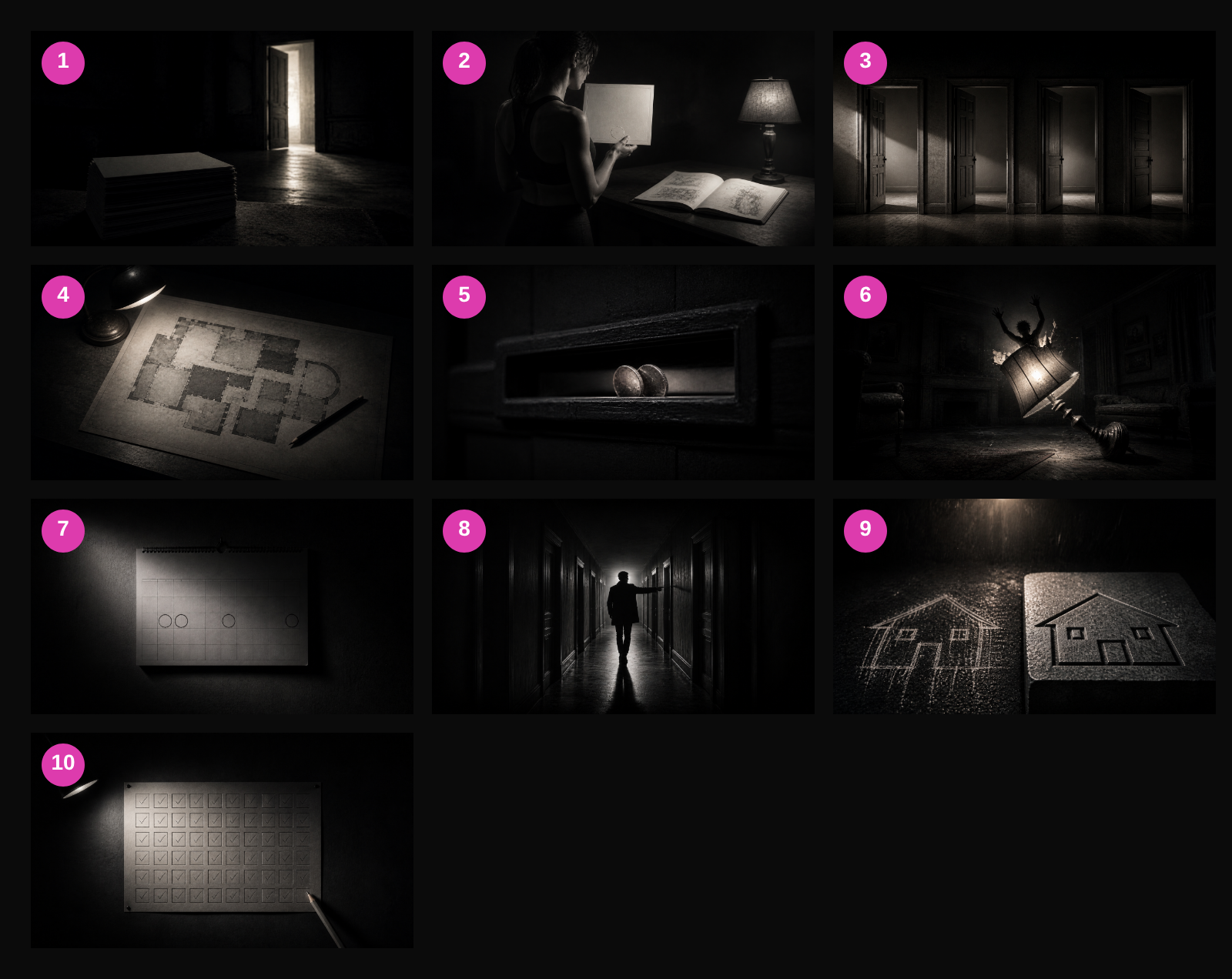
- Flashcards train recognition; exams need recall, so build the palace first. Image: a stack of flashcards in shadow behind a brightly lit doorway.
- Zoe passed her Pilates exam at 93 per cent after six weeks of palace work. Image: a woman in exercise kit holding an exam certificate, a notebook of sketches beside her.
- Build three to five study palaces before you learn any content. Image: four doors in a row, each a different colour, all empty inside.
- Chunk the subject into topics, one area of a palace per topic. Image: a floor plan with rooms shaded in different colours.
- Encode each fact as an image: pairs become reference stories, sequences become chains. Image: two shiny coins deep in conversation, wedged in a letterbox.
- Place images so they interact with their locations. Image: a figure bursting up through a lampshade, knocking it across the room.
- Review at one hour, one day, one week and one month. Image: a wall calendar with four dates ringed.
- Test in both directions and from random points. Image: a person walking a hallway backwards, pointing at doors.
- Temporary palaces fade in two to three days; permanent ones need regular review. Image: one chalk drawing washing away in rain, one carved into stone.
- Six weeks of daily practice is when the skill embeds. Image: a six-week wall planner with a pencil on the last square.
Sources
- Mark Channon, How to Remember Anything (Hodder Education)
- Dresler, M., Shirer, W. R., Konrad, B. N. et al. (2017). Mnemonic training reshapes brain networks to support superior memory. Neuron, 93(5), 1227 to 1235. https://doi.org/10.1016/j.neuron.2017.02.003
- Cepeda, N. J., Pashler, H., Vul, E., Wixted, J. T., and Rohrer, D. (2006). Distributed practice in verbal recall tasks: a review and quantitative synthesis. Psychological Bulletin, 132(3), 354 to 380. https://doi.org/10.1037/0033-2909.132.3.354 (the home for this study is The Spacing Effect (Cepeda 2006) Explained)
Frequently asked questions
Are you old school? Get Mark's book Improve Your Memory and dive in depth.
Loci
Build the memory palace in this article inside Loci — store your locations, link images, and rehearse with spaced repetition.
Try it in LociMemory School community
Learn directly with Mark inside the Memory School community on Skool — monthly lessons, practice, and Q&A.
Join Memory SchoolAbout the author
Mark Channon
Grand Master of Memory (1995). Author of three books on memory published by Hodder and Nick Hern. Creator of BBC1's Monkhouse's Memory Masters. Memory coach on Channel 4's Can I Improve My Memory?
Read full bio →