
Focus and Concentration
Animal Magic: Beat Paralysis by Analysis With Analogy Learning
When you overthink a skill you already have, a checklist in your head is the problem, not the fix. How one picture can replace twenty rules, the research on analogy learning, and the Animal Magic technique step by step.

Emi came to me while he was training for a triathlon. The running was good. The cycling was good. The swimming was not. He was managing about seven lengths in training and needed to get to twenty-five.
As we talked it through, the problem became clear. Before he even got into the water, he was running a checklist of about twenty things in his head: arms, breathing, kick, head position, all of it. He was tying himself in knots.
So we tried something different. I asked him what animal came to mind. A dolphin. What is a dolphin like? What would it be like if you had those qualities? You don't have to pretend to be a dolphin or look like one. What does it feel like to swim like that? Have you ever felt that way? Then: imagine you just had the essence of it. How do you swim now?
The next day he texted me: "Mark, I'm a dolphin!!" He had just swum twenty-five lengths.
Nothing had changed in his skill. His technique was the same as the day before. He had got out of his own head. That is the lesson: when you are overthinking a skill you already have, swap the rules for one picture.
What paralysis by analysis is
Paralysis by analysis is the popular name for what happened in that pool: thinking so hard about how to do something that you can no longer do it. A golfer who freezes over a short putt. A speaker who loses the thread the moment they think about their hands. A dancer who knew the routine until someone was watching.
There are two broad ways to learn a physical skill. Explicit learning is a set of detailed instructions: do this, then this, keep that straight. You could probably recite what you are supposed to do, but that does not mean your body will do it, and trying to get every instruction right adds stress of its own. Implicit learning is picking up the skill without that list, through practice, imitation, or an image that carries the movement for you.
The pressure part has been studied. Rich Masters found that golfers who learned a putt with lots of conscious rules were more likely to fall apart under pressure than those who learned it with few rules (Masters, 1992). Implicit vs Explicit Memory: Knowing How and Knowing That covers that study and the two kinds of memory behind it.
So if rules in your head are what break under pressure, the question becomes: can you learn, or relearn, a skill without filling your head with rules? That is where analogy comes in.
What the research says
Three questions sit underneath Emi's story. Why does thinking about each step hurt a skill you already have? Can learning through an analogy protect a skill under pressure? And can changing what a feeling means change how you perform? Each has research behind it.
The research: Beilock and colleagues, 2002
- In short: Experienced golfers and footballers performed better when they were distracted than when they were told to attend to each step of their technique. Novices did better attending to the steps.
- What they did: Experienced golfers putted under two conditions: with a second task taking their attention off the putt, and while attending to the step-by-step execution of the putt. Novice and experienced footballers dribbled a ball through a slalom course under the same two conditions, with their strong right foot or their weaker left foot.
- Who was involved: Beilock, Carr and colleagues, with experienced golfers and with novice and experienced footballers; the published summary does not give the numbers.
- What they found: Experienced golfers putted more accurately when distracted than when focusing on each step. Experienced footballers using their strong foot also did better when distracted, but with their weaker foot they did better focusing on the steps. Novices did better focusing on the steps whichever foot they used.
- What they concluded: Attending to each step helps a beginner, but it harms a skill that is already well learned.
It is a lab comparison of two kinds of attention. It did not test pressure, anxiety or analogies. But it describes Emi exactly: a well-learned skill, and a twenty-point checklist pulling his attention onto each step.
The research: Liao and Masters, 2001
- In short: Novices learned a table tennis stroke in one of three ways: with explicit technique instructions, implicitly, or through a single analogy. The analogy learners picked up fewer conscious rules, and their stroke held up better under stress than that of the players taught with rules.
- What they did: In the first experiment, three groups learned the forehand topspin: implicitly, explicitly, or by analogy. They were then tested while doing a second task at the same time, and asked to report the rules they knew. In the second experiment, an explicit group and an analogy group played under stress while trying to suppress their thoughts.
- Who was involved: Chin-Mei Liao and Rich Masters, with table tennis novices. The published summary does not give the group sizes.
- What they found: The analogy and implicit learners reported fewer rules than the explicit learners. When a second task was added, the explicit group's performance dropped more than the other two. Under stress, the explicit learners got worse and the analogy learners did not.
- What they concluded: Learning through an analogy behaves like implicit learning, and may be an effective way to teach sport skills without loading the learner with rules.
The research: Lam, Maxwell and Masters, 2009
- In short: People who learned a basketball shot through an analogy kept their performance under pressure, while those taught explicit rules got worse.
- What they did: Learners practised a seated basketball shot, taught either through an analogy or through explicit rules, then were tested later and under pressure. A reaction-time measure checked how much attention the shot took.
- Who was involved: Lam, Maxwell and Masters; the published summary does not give the numbers.
- What they found: The two groups were equal while learning and at the later test. Under pressure, the rule learners got worse and the analogy learners did not. The analogy learners could put far fewer rules about their technique into words. The shot took the same amount of attention in both groups.
- What they concluded: A skill learned through an analogy relies less on conscious rules, and that seems to be why it held up under pressure.
The research: Brooks, 2014
- In short: Students who called their nerves excitement before singing, giving a speech or sitting a maths test performed better than those who tried to calm down or said nothing, even though they felt just as anxious.
- What they did: Before singing karaoke, students said "I am excited", "I am anxious" or nothing. Before a recorded persuasive speech, they said "I am excited" or "I am calm". Before a timed maths test, they read "try to get excited", "try to remain calm" or a neutral line. Singing was scored by a games console; speeches by judges who did not know which group was which.
- Who was involved: Brooks, with four experiments on students (113 for karaoke, 140 for the speech, 188 and 218 for maths) and a pilot survey of 300 people.
- What they found: Singing accuracy was about 81% after "I am excited", 69% after saying nothing and 53% after "I am anxious". The excited speeches were rated more persuasive, confident and competent. Maths scores were higher after "get excited". Felt anxiety and heart rate did not change; felt excitement, and seeing the task as an opportunity, went up. In the pilot, nine in ten people picked "calm down" as the best advice for themselves.
- What they concluded: Anxiety and excitement are both high-energy states, so it is easier to relabel nerves as excitement than to calm them, and doing so shifts you towards seeing an opportunity and improves performance.
These are short lab tasks with students; they show a few words can shift a performance in the moment, not that the effect lasts or works for every task.
The research: Carnero-Díaz and colleagues, 2025
- In short: A review of 16 randomised trials found that learning a movement through an analogy gave a small edge over technique rules and over no instruction, with children and novices gaining most.
- What they did: Pooled every trial they could find that compared analogy instruction with explicit rules or with no instruction, and checked whether the results changed with age, skill level, stress, the number of rules and the amount of practice.
- Who was involved: Carnero-Díaz and colleagues, pooling 16 trials; the summary does not give the total number of people.
- What they found: Analogies beat no instruction and beat explicit rules, both by small amounts. Children and novices benefited most. Under stress, the advantage was borderline against no instruction and not significant against rules.
- What they concluded: Analogy instruction may improve how well people perform a movement, especially beginners and children. The authors flagged that the studies varied a lot and many had a high risk of bias.
Put together: thinking through each step can hurt a skill you already have; a skill held through an analogy leaves fewer rules to trip over, and in the table tennis and basketball studies it held up under pressure; and calling the same nerves by a different name changed how people performed. Most of the analogy studies were on beginners, and that is where the review found the biggest gains. A skilled performer freezing, which is where Emi was, has been tested less directly.
What I take from it
One well-chosen picture can do the work of a list of instructions, and it leaves far less in your head to go wrong when the pressure comes on.
Emi already had the skill. What had gone wrong was the twenty-point checklist: exactly the step-by-step attention that made the experienced golfers and footballers worse. The picture did not teach him to swim. It cleared the rules out of the way so the skill he already had could come through. I have seen Animal Magic work time and again with clients, not just Emi. It is the technique I reach for when someone is tying themselves in knots.
It also changed what swimming meant to him. Before, it was a test he kept failing. After, it was being a dolphin. That is reframing: the same thing Brooks found when people called their nerves excitement. The feeling stayed; its meaning changed, and so did the performance. You can build confidence to create the competence, and a change in meaning is often what does it. Memory is fluid; what an experience means to you can be updated, and so can the belief that came with it.
Animal Magic, step by step
Animal Magic is a way of finding your analogy on purpose. It works for any skill you overthink: a swim, a serve, a presentation, an audition, a difficult conversation.
- Pick the moment. Bring to mind the exact point where you start overthinking: standing at the side of the pool, stepping up to serve, walking into the room.
- Ask: what animal pops into my head? Take the first one. Don't choose the sensible one.
- Describe it. What are its qualities? How does it move? What is it like?
- Ask: if I had these qualities, what would that do for me? How would you approach the moment?
- Find its feeling. Close your eyes and think about the states this animal lives in: calm, playful, powerful, quick. If you had those, how would the moment feel?
- Take on the essence. You don't need to look like the animal or act it out. Just imagine you have its essence, as if it has become part of you. What is it like to move now?
- Run it in your mind. Bring the moment to life with the essence in place, going well, and spend a little time enjoying how well it goes.
- Go and test it. Think of the animal just before you start. Then do the thing.
If an animal doesn't come, a phrase can do the same job. "Float like a butterfly, sting like a bee." If you acted that out, how would you move? Your body answers instantly, with no rules at all.
Rules still have a place
This is not an argument against instruction. Understanding how something works is useful, and if you coach or teach a skill, you need to be able to explain it. The best approach is a balance: understand the instructions with your head, then let your head step out of the way so your body can do it. An analogy is how you step out of the way.
Use explicit rules when you are learning what to do. Use an analogy when you already know what to do and your thinking is getting in the way.
Try it this week
Pick one thing you do that falls apart when you think about it too much. It might be physical, a stroke, a swing, a routine. It might be a performance, a pitch, a speech, an interview answer.
- Run through the eight steps once, slowly, before you next do it.
- Write the animal and its three main qualities on a card.
- Just before you start, look at the card or picture the animal for a few seconds.
- Afterwards, notice how much you were thinking about technique compared with usual.
Where to go next
Analogy and metaphor are a form of meaning, one of the four ingredients in Creative Memorisation: The Four Ingredients That Make Anything Memorable. For using pictures to learn a sequence of movements rather than to quiet your thinking, see How to Memorise a Dance Routine. And if the overthinking turns into nerves, How to Focus Better: A Memory Coach's Method covers getting into the right state on purpose.
Memory map
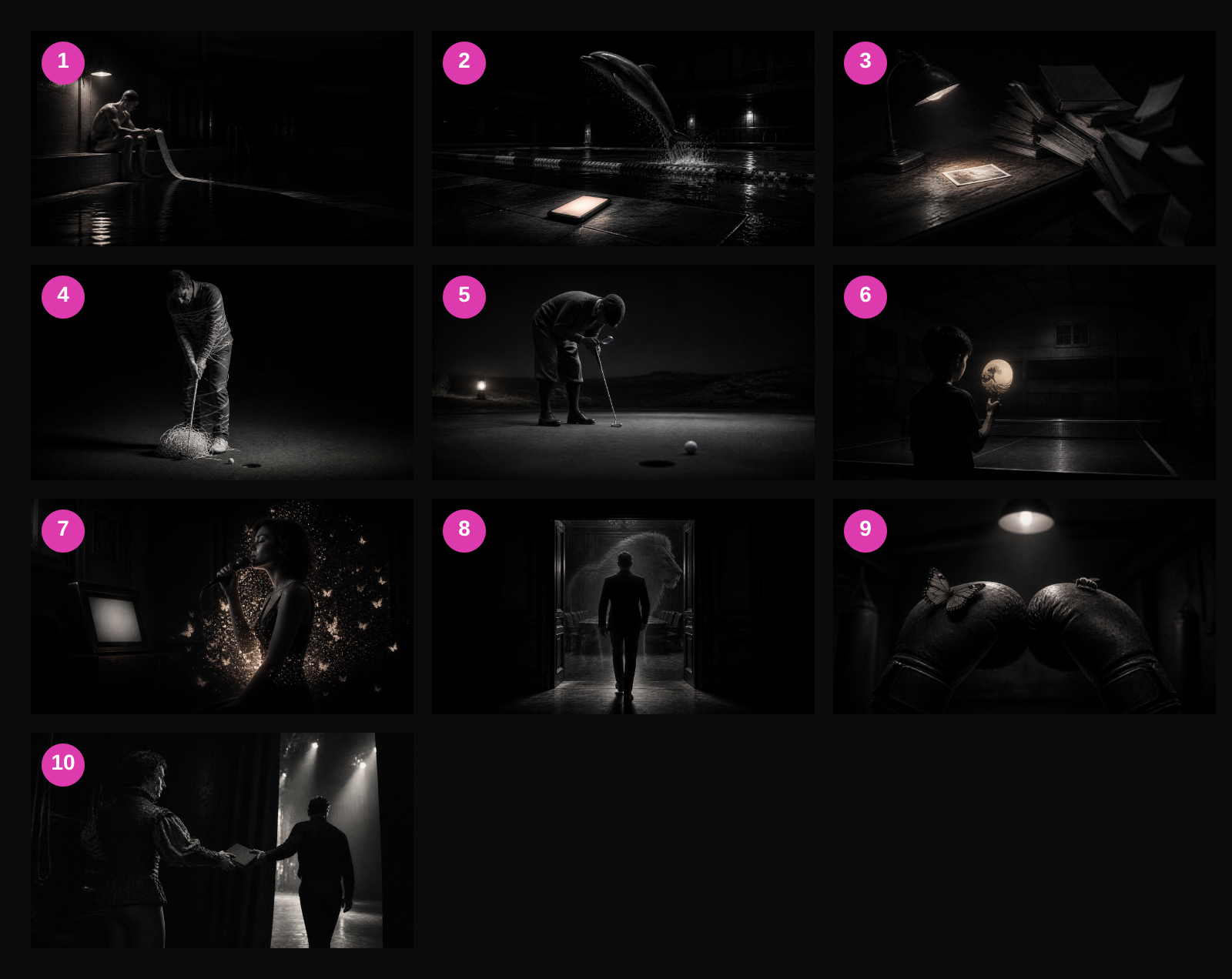
- A triathlete stuck at seven lengths, running a twenty-item checklist in his head. Image: a swimmer on the edge of a pool reading a scroll that unrolls into the water.
- "Mark, I'm a dolphin!!": twenty-five lengths the next day, with no change in skill. Image: a dolphin leaping over a lane rope while a phone lights up beside the pool.
- When you overthink a skill you already have, swap the rules for one picture. Image: a pile of instruction manuals swept aside by a single bright postcard.
- Paralysis by analysis: thinking so hard about how that you can no longer do it. Image: a golfer frozen over a short putt, tangled in a ball of string.
- Experts did worse attending to each step of a skill they already had (Beilock 2002). Image: a golfer peering through a magnifying glass at his own hands, the ball rolling wide.
- Liao and Masters 2001, and a 2025 review: one analogy gives fewer rules and a small edge, most of all for beginners. Image: a table tennis bat glowing with a single picture on its face, a child holding it.
- Call your nerves excitement: same feeling, new meaning, better performance (Brooks 2014). Image: a singer at a karaoke machine, butterflies in her stomach turning into fireworks.
- Animal Magic: the first animal, its qualities, its feeling, its essence, then do it. Image: a person walking into a meeting room with the faint outline of a lion around them.
- No animal? A phrase works too: float like a butterfly, sting like a bee. Image: a boxer dancing lightly with a butterfly on one glove and a bee on the other.
- Understand the rules with your head, then let your head step out of the way. Image: a person handing a rule book to a stagehand as they walk on stage.
Sources
- Mark Channon, Learning Your Lines (Nick Hern Books)
- Mark Channon, The Memory Workbook (Hodder Education)
- Liao, C.-M., and Masters, R. S. W. (2001). Analogy learning: a means to implicit motor learning. Journal of Sports Sciences, 19(5), 307 to 319. https://doi.org/10.1080/02640410152006081
- Beilock, S. L., Carr, T. H., MacMahon, C., and Starkes, J. L. (2002). When paying attention becomes counterproductive: impact of divided versus skill-focused attention on novice and experienced performance of sensorimotor skills. Journal of Experimental Psychology: Applied, 8(1), 6 to 16. https://doi.org/10.1037/1076-898X.8.1.6
- Lam, W. K., Maxwell, J. P., and Masters, R. S. W. (2009). Analogy learning and the performance of motor skills under pressure. Journal of Sport and Exercise Psychology, 31(3), 337 to 357. https://doi.org/10.1123/jsep.31.3.337
- Brooks, A. W. (2014). Get excited: reappraising pre-performance anxiety as excitement. Journal of Experimental Psychology: General, 143(3), 1144 to 1158. https://doi.org/10.1037/a0035325
- Carnero-Díaz, Á., Pecci, J., Calvo-Lluch, Á., and Camacho-Lazarraga, P. (2025). Use your imagination for better performance. Effects of analogy instruction in motor skills. A systematic review and meta-analysis. Psychology of Sport and Exercise, 76, 102766. https://doi.org/10.1016/j.psychsport.2024.102766
- Masters, R. S. W. (1992). Knowledge, knerves and know-how: the role of explicit versus implicit knowledge in the breakdown of a complex motor skill under pressure. British Journal of Psychology, 83(3), 343 to 358. https://doi.org/10.1111/j.2044-8295.1992.tb02446.x (the home for this study is Implicit vs Explicit Memory: Knowing How and Knowing That)
Loci
Build the memory palace in this article inside Loci — store your locations, link images, and rehearse with spaced repetition.
Try it in LociMemory School community
Learn directly with Mark inside the Memory School community on Skool — monthly lessons, practice, and Q&A.
Join Memory SchoolAbout the author
Mark Channon
Grand Master of Memory (1995). Author of three books on memory published by Hodder and Nick Hern. Creator of BBC1's Monkhouse's Memory Masters. Memory coach on Channel 4's Can I Improve My Memory?
Read full bio →