
How to Remember Anything
How to Memorise a Dance Routine
Find the story of the dance, give each section a picture, and let your body handle the detail. How to get a routine in fast, from the audition room to the rehearsal floor.

For years I went to auditions as a singer, dancer and actor, for West End musicals like 42nd Street and Crazy for You. These are big dancing musicals, so of course, there's the dance audition. You are shown a routine, you have very little time to get it into your body, and then you dance it in front of the people deciding whether you get the job.
What I did every time was watch the routine and look for the story of the dance. This section does this, then it does this, then it turns into that. I made a picture for each of those sections, so I had a map of the whole routine in my head, the same way I would map a book. Then I let my body and my training deal with the detail.
That is the core of it: give the big picture to your mind and the detail to your body. Your mind is good at holding a story. Your body is good at steps it already knows. A routine falls apart when you ask either one to do the other's job.
Why routines slip away
Learning to dance is procedural memory: skill built into the body by doing it, again and again. Nothing replaces those repetitions, and Procedural Memory Explained covers why skills, once built, last so well.
But watch what goes wrong when you are new to a routine. It is rarely a step you cannot do. It is the order. You finish one phrase and the next one is not there. You are counting, watching the person in front, trying to remember what comes after the turn, and the whole thing jams.
That is a working memory problem. Working memory, the mental workspace for whatever you are handling right now, holds only a handful of chunks at once, a chunk being a group you hold as one thing, about four on later estimates (The Magical Number Seven, and Why It Is Really Four covers the research). A routine of thirty or forty separate moves is far too much to hold one move at a time. Six or seven named sections, each one a picture, is not.
The second reason the story works is that it points at what you already know. A new combination built from steps you have done for years is far easier to hold than one built from steps you have never done. Someone trained in one martial art picks up a new sequence in that style faster than someone who has spent years in a different one. The picture does not have to describe every step. It only has to say which bit of your skill comes next.
The story of the dance, step by step
1. Watch it all the way through first. Don't start marking it, walking the moves through at reduced size, straight away. Look for the shape: where the sections start and stop, where the routine changes direction or level, where the big moments land. You are reading the plot before you learn the lines.
2. Break it into sections and name them. Use the music and the counts to find the joins, usually every eight or sixteen counts, or wherever the phrase changes. Give each section a name in your own words: the sweep, the stamp and turn, the slow fall, the travelling bit. Names you would actually say out loud.
3. Turn each name into a picture. Let the movement suggest it. A sweeping arm becomes a broom. A sharp turn with a point becomes a compass needle. A slow drop to the floor becomes a leaf falling. If a section has a feeling, use that: a proud, chest-out walk might be a peacock. The more vivid, the better it holds.
4. Link the pictures into a story. The broom sweeps a compass across the floor, the needle spins and points at a falling leaf, the leaf lands on a peacock's back. It sounds silly written down. That is fine. Silly is memorable, and a story carries its own order, so you always know what comes next. The Chain Method: How to Remember Lists Without Building a Memory Palace shows how to build a story like this for anything.
5. Hang the story on the music. Play the track and, without moving, run the story in your head, placing each picture where its section starts in the music. Then play it again and mark the routine through, seeing each picture as the music reaches it. Then do the full sequence without the music. By then the music has become a cue in its own right: a particular phrase triggers the next picture, and the picture triggers the movement.
6. Dance it, and let the pictures fade. The first few times through, you will be looking for each picture as you go. Then, without noticing when, you stop needing them. Your body has the routine and the story drops away. The pictures were only ever there until it felt like second nature.
7. Rehearse with everything. Not just going through the movements, but putting your whole self into them: the energy, the face, the attitude of each section. Every one of those adds another connection to the memory.
What the research says about rehearsing a routine
Two pieces of research back up the way the method rehearses.
The research: Warburton and colleagues, 2013
- In short: Dancers who rehearsed a routine by marking it, a cut-down walk-through, performed it better than dancers who rehearsed it full out.
- What they did: Dancers rehearsed choreography either by marking it or by dancing it full out, and their performance was then compared.
- Who was involved: Warburton, Wilson and colleagues, with dancers; the published summary does not give the numbers or their level.
- What they found: Performance was better after marking. The authors' explanation is that dancing full out uses up mental resources that marking frees for learning the sequence.
- What they concluded: Marking does more than save energy. It helps the mind learn the routine. It is one study of dancers learning choreography, so it does not say full-out rehearsal is a mistake, only that marking earns its place.
That is step 5 above. Marking it through with the story running in your head gives your mind room to learn the order, and the full-out runs come after.
The second piece is about rehearsing in your head. Running a performance in your imagination reliably improves the real thing, though it works as an add-on to physical practice rather than a replacement (Driskell, Copper and Moran, 1994). Running the story against the music without moving, before you mark it, is exactly that.
Where the counts come in
Some routines live and die on a count: a stamp on the seven, a pause on the three. For those, give the count its own picture and tie it to the section. A number image, built once and reused forever, does this cleanly. The Number Shape System, which pictures each digit as something it looks like, is the quickest way in: 3 is a snake and 7 is an axe, so a stamp on seven might be a foot coming down on the handle of a giant axe. It sounds ridiculous, and it works.
A rhythm that would not stick in Tap Dogs, the tap dance show, went in exactly this way; Procedural Memory Explained tells that story.
Get a head start before the class
You can do half the work before you walk in. If you know the names of the moves you are about to learn, a list of steps in a tap class, a sequence of Pilates exercises, the forms in a martial art, turn each name into a picture and chain them into a story beforehand. In Pilates, if the roll-up comes after the cat stretch, picture a cat eating a jam roll.
When the teacher demonstrates, you are not meeting the sequence for the first time. You are matching moves to pictures you already have. That is priming, where an earlier brush with something readies your brain to take it in, and it means your attention can go on the detail of the movement rather than the order.
When you blank in the middle
It happens to every dancer. You are mid-routine, and the next section is not there.
State is the first thing to fix, because stress works directly against recall. Even a little of it can quickly impair the prefrontal cortex, which you need for focus and for holding what comes next (Arnsten, 2009). That is the panic you feel in your head as the music carries on without you. How to Focus Better: A Memory Coach's Method covers how to get back into a calm, focused state on purpose.
The story gives you a way back. If the detail goes, jump to the next picture. Your body knows the steps in that section; it only needed to know which section it was in. Keep the story running and the body catches up.
Try it this week
Pick a short routine from a video, thirty-two counts or so, ideally something just above your level.
- Watch it three times without moving.
- Split it into four sections and name each one.
- Make a picture for each name and link them into one story.
- Run the story against the music, then mark it, then dance it.
- Tomorrow, without the video, see how much is there.
Then try the same routine the usual way, copying it from the screen until it sticks, and notice which gets there faster.
Where to go next
The four ingredients behind this method, getting into the right state, imagination, association and meaning, are set out in Creative Memorisation: The Four Ingredients That Make Anything Memorable. For the wider question of whether a mnemonic can help with a physical skill at all, see Mnemonics: The Complete Guide to Making Anything Memorable. And if your problem is not remembering the routine but overthinking it, Animal Magic: Beat Paralysis by Analysis With Analogy Learning takes a different route into the body.
Memory map
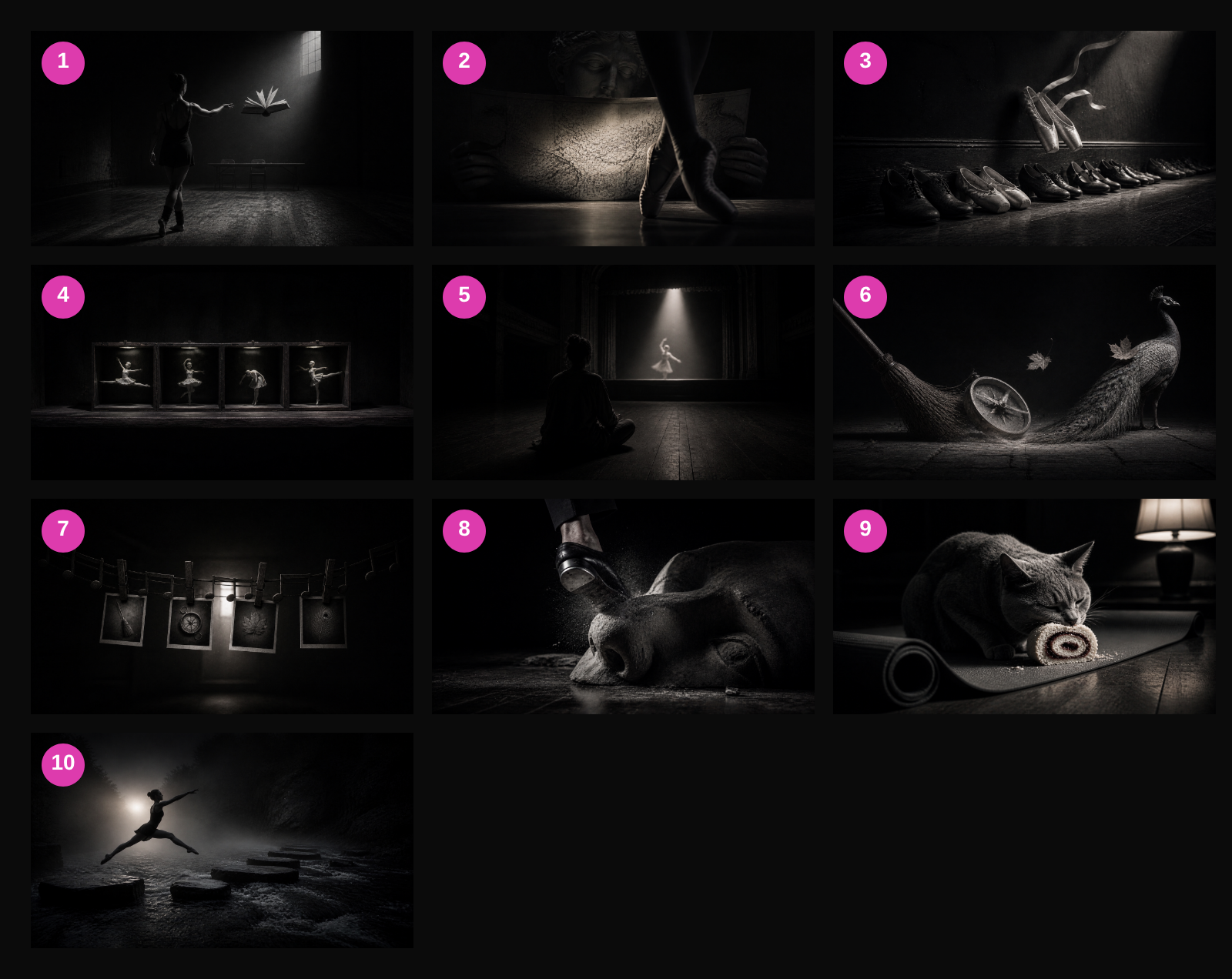
- At an audition, find the story of the dance, picture each section, and let your body handle the detail. Image: a dancer in an audition room, a storybook open in the air beside them.
- Big picture to the mind, detail to the body. Image: a head holding a map while a pair of feet dance across it.
- Routines slip because of order, not steps. Image: a row of dance shoes with one pair jumping the queue.
- Working memory holds about four chunks, so name six or seven sections, not forty moves. Image: four boxes on a shelf, each with a tiny dancer inside.
- Watch it all the way through before marking it. Image: a person sitting cross-legged watching a stage, hands still in their lap.
- Name each section, turn the name into a picture, link the pictures into a story. Image: a broom sweeping a spinning compass towards a falling leaf that lands on a peacock.
- Hang the story on the music, then mark it, then dance it: marking helped dancers learn (Warburton 2013). Image: pictures pegged along a washing line made of musical notes.
- Give a tricky count its own picture: a stamp on seven is a foot on a giant axe. Image: a tap shoe stamping down on the handle of an enormous axe.
- Picture the names of the moves before the class and you arrive primed. Image: a cat eating a jam roll on a Pilates mat.
- If you blank, jump to the next picture and let the body catch up. Image: a dancer leaping from one stepping stone to the next across a river.
Sources
- Mark Channon, The Memory Workbook (Hodder Education)
- Mark Channon, How to Remember Anything (Hodder Education)
- Warburton, E. C., Wilson, M., Lynch, M., and Cuykendall, S. (2013). The cognitive benefits of movement reduction: evidence from dance marking. Psychological Science, 24(9), 1732 to 1739. https://doi.org/10.1177/0956797613478824
- Driskell, J. E., Copper, C., and Moran, A. (1994). Does mental practice enhance performance? Journal of Applied Psychology, 79(4), 481 to 492. https://doi.org/10.1037/0021-9010.79.4.481
- Arnsten, A. F. T. (2009). Stress signalling pathways that impair prefrontal cortex structure and function. Nature Reviews Neuroscience, 10(6), 410 to 422. https://doi.org/10.1038/nrn2648 (the home for this study is How to Focus Better: A Memory Coach's Method)
- Cowan, N. (2001). The magical number 4 in short-term memory: a reconsideration of mental storage capacity. Behavioral and Brain Sciences, 24(1), 87 to 114. https://doi.org/10.1017/S0140525X01003922 (the home for this study is The Magical Number Seven, and Why It Is Really Four)
Loci
Build the memory palace in this article inside Loci — store your locations, link images, and rehearse with spaced repetition.
Try it in LociMemory School community
Learn directly with Mark inside the Memory School community on Skool — monthly lessons, practice, and Q&A.
Join Memory SchoolAbout the author
Mark Channon
Grand Master of Memory (1995). Author of three books on memory published by Hodder and Nick Hern. Creator of BBC1's Monkhouse's Memory Masters. Memory coach on Channel 4's Can I Improve My Memory?
Read full bio →