
How Memory Works
Beliefs Are Memories: How to Change a Limiting Belief
What you believe about yourself is built from what you remember. Change how you see those memories, create new ones about the future, and the belief can change too. Jo's story, the research, and the five steps.

Jo had failed the California bar exam the year before she came to me. She was a paralegal in her sixties, and she had already picked up some memory techniques and was good at them. None of that was the problem. The problem was what she believed about herself: "I'm a scatterbrain. I just fall apart in exams."
We worked on two things. The first was that belief. We went back through the memories it was built on and looked at them properly, pointing out where they were not the whole truth. We broke the idea apart, built new beliefs to replace it, and created new memories of the future: Jo, calm, in the exam, knowing her material. Every morning she spent a couple of minutes thinking about those beliefs and where they would show up in her day.
The second was evidence. Jo used memory palaces to learn the case law she needed, so the new belief had something real behind it. A memory palace is a route through a place you know, where each thing you want to recall becomes a picture left at a stop along the way.
On the day of the exam, the computers went down. The room panicked. Jo did not, because by then she believed that whatever happened, she could handle it. Afterwards she wrote to me:
"If there was one person who really helped it was you. I passed the California Bar exam. Only 39% passed. It was really scary as you know. Just today I was thinking of how you got me through. It still brings tears to my eyes. I am working in my own practice saving my poor clients who have been denied social security benefits and I was asserting in the car at the top of my voice - I have everything I need within in me now. I am up to my neck in briefs."
The lesson is this: beliefs are built from memories, and memories can be updated, so beliefs can change too.
Where beliefs come from
A belief is a mini-story you play in your head: words, a picture, a feeling. "I'm not good enough." "This is too much to learn." "I have a terrible memory." And each one can usually be justified by something you remember. Dry once in an audition and "I'm no good at auditions" has its evidence, even if you have had auditions that went brilliantly.
Beliefs come in three kinds:
- Identity beliefs are about who you are: "I'm a scatterbrain", or its opposite, "I'm a fast thinker".
- Global beliefs are about the world: "work is a chore", "the future is bleak".
- Situation beliefs switch on in one place: "I'm confident until I walk into the room", "I can't focus at home".
Any of them can show up as a metaphor: "I have a brain like a sieve." "My mind goes blank." Listen for those, because a metaphor is a belief wearing a picture.
Here is why this matters for memory in particular. You do not decide what you believe from a fair summary of your whole life. You decide from the memories that come to mind, and the ones that come to mind are often the painful ones. The good news is that memory is fluid. A memory is rebuilt each time you recall it, and what other people tell you, and what you tell yourself, can change it (Loftus and Pickrell, 1995; Lost in the Mall: How False Memories Are Planted covers the research). That works in both directions. If a memory can be influenced for the worse, you can also influence how you see it for the better.
What the research says
The research: Beaudoin and Desrichard, 2011
- In short: Across 107 studies, people who were more confident in their memory tended to remember slightly better, especially when that confidence was about the task in front of them.
- What they did: Gathered every study they could find that measured both what people believed about their own memory and how well they actually remembered, combined the results, and tested what made the link stronger or weaker.
- Who was involved: Beaudoin and Desrichard, pooling 107 studies of healthy adults.
- What they found: The link between memory confidence and memory performance was low but real. It was stronger when people judged the specific task in front of them than when they rated their memory in general, and stronger for recalling than for recognising.
- What they concluded: What you believe about your memory and how it performs are related, though modestly.
It is a correlation. It does not show that believing in your memory makes it better; people who remember well may simply grow more confident.
The research: West, Bagwell and Dark-Freudeman, 2008
- In short: Older adults who took a memory course that built their confidence alongside memory strategies improved both their belief in their memory and their recall of names and stories.
- What they did: The course stressed that good memory is possible at any age, had people set their own goals and gave them chances to succeed, while teaching strategies such as association, imagery and organisation. Trainees were compared with people waiting to take the course.
- Who was involved: West, Bagwell and Dark-Freudeman, with a group of older adults; the published summary does not give the numbers.
- What they found: Against the waiting group, trainees grew in memory confidence and sense of control, recalled names and stories better, and used good strategies more often. Their confidence was one of the best predictors of their final scores.
- What they concluded: Building belief into memory training, alongside the strategies, helps.
The course taught strategies and belief together, so it cannot separate one from the other. That is exactly the pairing that worked for Jo.
The research: Schacter and Addis, 2007
- In short: Imagining a future event draws on much the same brain network as remembering a past one.
- What they did: Reviewed brain imaging studies in which people remembered real past events or imagined plausible future ones, along with studies of people with memory loss. A later review by the same lab (Schacter and colleagues, 2012) pulled the evidence together.
- Who was involved: Daniel Schacter and Addis; no new participants, as this is a review.
- What they found: Remembering and imagining activated a shared set of regions, including the hippocampus, a structure deep in the brain that is central to memory. There were also differences between the two. Some people with severe memory loss struggled to imagine new scenes as well as to remember. In the later review, imagining an event repeatedly made it seem more likely to happen.
- What they concluded: Memory is constructive. The system you use to rebuild the past is the one you use to build the future.
What I take from it
A future memory is not a figure of speech. When you imagine a moment that has not happened yet, you are using the same machinery you use to remember, which is why it can feel so real and why it can shift what you believe is likely.
The research also keeps the claims honest. Belief and memory are linked, but modestly. Belief on its own is not magic, and imagining success does not make it happen. What changes things is belief and evidence together: the new belief, the future memory, and the practice that proves it. Jo had all three.
How to change a limiting belief, in five steps
This is the process that worked for Jo. It takes about half an hour the first time.
1. Find the beliefs. Think about the area you want to change: exams, your memory, speaking up, whatever it is. Let your mind wander back to a memory that catches your attention, good or bad. Write down the phrases that went through your head at the time. Then move to another memory, and another. Sort the phrases into two lists: the ones that helped you and the ones that held you back.
2. Decide. Pick the two or three beliefs from the second list that have cost you the most. Spend a few minutes writing, or saying out loud, what they have cost you so far. Notice the feeling that comes with it; don't fight it. Then decide which belief you are going to change.
3. Write a bridging belief. First get playful and write the opposite, as far from the old belief as you can imagine. "I'm a scatterbrain" becomes "I have a lightning brain". You will probably feel your mind push back. So build a bridge: make the new belief specific enough that you can accept it today. "When I give myself space, I am capable of high levels of focus." In time the bridge can widen.
4. Write down what it will give you. If this new belief were simply part of who you are, what would change? List the benefits. Enjoy it.
5. Create a future memory. Imagine a moment in the future where the new belief is already true, and live it as if it has already happened. Where are you? Who is there? What do you hear, see and feel? What do people say to you, and what goes through your head? Let the emotion come with it. Stay there as long as it feels good.
Then make it a habit. For the next few weeks, spend a couple of minutes each morning with the new belief and the future memory, and think about where it might show up in your day. That is what Jo did. Then notice when it does.
Back the belief with evidence
A new belief holds better when it has proof behind it. For Jo, the proof was the memory palaces: the case law was in her head, and she knew it. Confidence and competence fed each other. You can build confidence to create the competence, and the competence then makes the confidence real.
So pair the belief work with one piece of evidence you can build quickly. If the old belief is "I have a terrible memory", learn twenty items on a memory palace this week and test yourself tomorrow. How to Build a Memory Palace: A 7-Step Beginner's Guide (With Worked Examples) takes you through it. If the belief is "I'm terrible with names", How to Remember Names: A Five-Step Framework That Actually Works gives you something to prove it wrong at the next event you go to.
Try it this week
- Write down one belief about your memory that you have said out loud in the last month.
- Find three memories that seem to prove it, and one that doesn't.
- Write a bridging belief you can accept today.
- Create one future memory where it is true, with all your senses.
- Spend two minutes with it every morning for a week, and build one piece of evidence alongside it.
Where to go next
The thinking behind this is in Creative Memorisation: The Four Ingredients That Make Anything Memorable: meaning is one of the four ingredients, and changing what a memory means is how a belief changes. For the same idea applied to a skill you overthink, see Animal Magic: Beat Paralysis by Analysis With Analogy Learning. And for why memories can be reshaped at all, Lost in the Mall: How False Memories Are Planted is the place to start.
Memory map
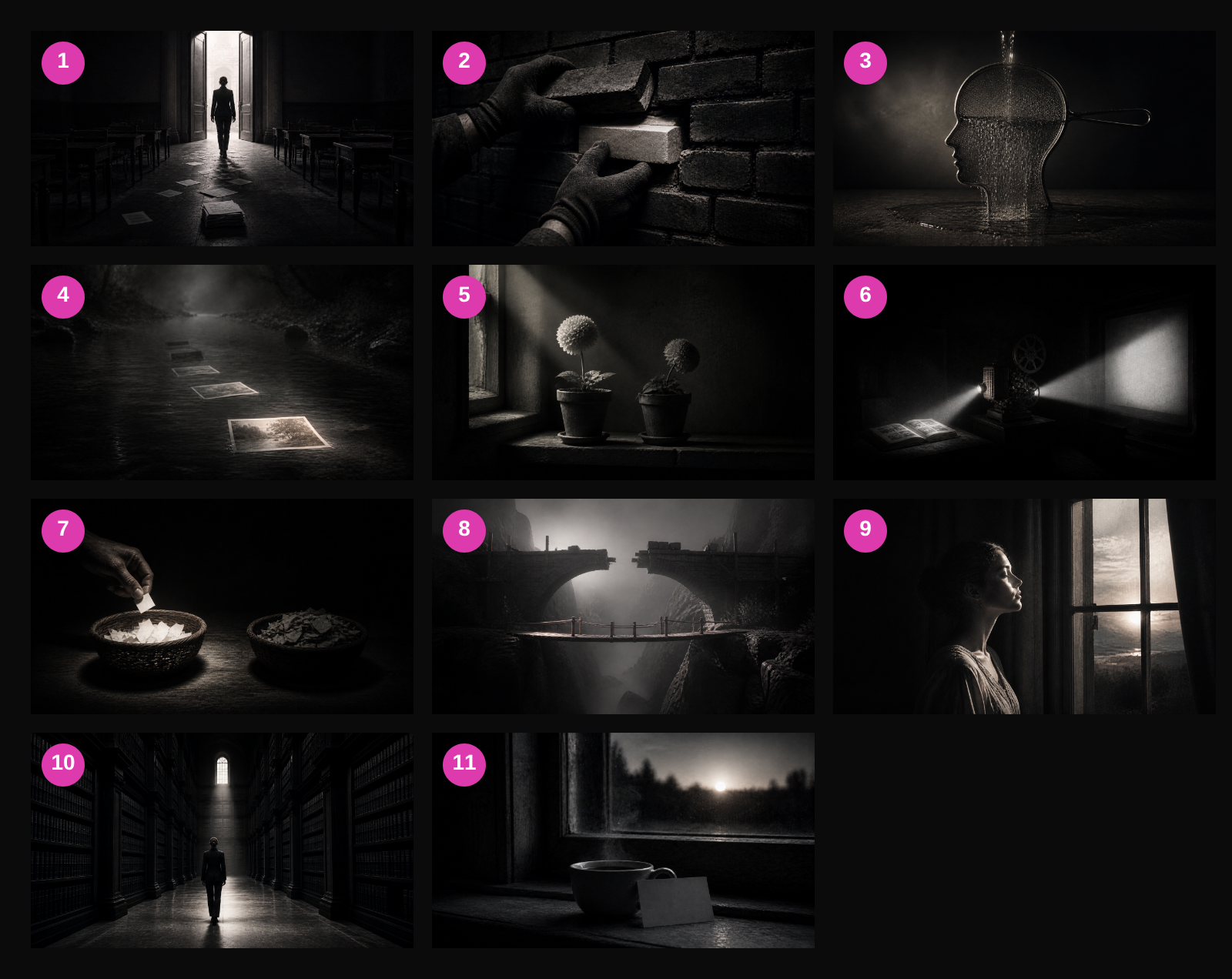
- Jo failed the bar exam believing she was a scatterbrain, then passed. Image: a woman in a dark suit walking out of an exam hall into sunshine, a scattered pile of papers behind her neatly restacking itself.
- Beliefs are built from memories, and memories can be updated. Image: a brick wall where a builder is swapping one brick for a new, brighter one.
- Three kinds of belief: identity, global and situation; listen for the metaphors. Image: a sieve shaped like a head, water pouring through it.
- Memory is fluid, so how you see a memory can change for the better too. Image: a river carrying old photographs that change colour as they float.
- 107 studies: confidence in your memory and how well it performs are linked, modestly (Beaudoin and Desrichard 2011). Image: two plant pots side by side, a confident sunflower growing slightly taller than its neighbour.
- Imagining the future uses the same brain network as remembering the past (Schacter and Addis 2007). Image: a film projector throwing two beams, one onto an old photo album, one onto a blank screen showing tomorrow.
- Find the beliefs: wander back through memories and sort the phrases into two lists. Image: two baskets on a kitchen table, one of golden words, one of grey.
- Write a bridging belief you can accept today. Image: a small wooden bridge across a gap, with a wide stone bridge being built beside it.
- Create a future memory with every sense and live it as if it has happened. Image: a person standing in front of a window that shows tomorrow, sunlight on their face.
- Back the belief with evidence: a memory palace full of case law. Image: a grand library hall, every shelf a law book, a woman walking through it calmly.
- Two minutes each morning with the belief, then notice where it shows up. Image: a cup of coffee steaming beside a sunrise, a small card propped against it.
Sources
- Mark Channon, Learning Your Lines (Nick Hern Books)
- Mark Channon, The Memory Workbook (Hodder Education)
- Loftus, E. F., and Pickrell, J. E. (1995). The formation of false memories. Psychiatric Annals, 25(12), 720 to 725. https://doi.org/10.3928/0048-5713-19951201-07 (the home for this study is Lost in the Mall: How False Memories Are Planted)
- Beaudoin, M., and Desrichard, O. (2011). Are memory self-efficacy and memory performance related? A meta-analysis. Psychological Bulletin, 137(2), 211 to 241. https://doi.org/10.1037/a0022106
- West, R. L., Bagwell, D. K., and Dark-Freudeman, A. (2008). Self-efficacy and memory aging: the impact of a memory intervention based on self-efficacy. Aging, Neuropsychology, and Cognition, 15(3), 302 to 329. https://doi.org/10.1080/13825580701440510
- Schacter, D. L., and Addis, D. R. (2007). The cognitive neuroscience of constructive memory: remembering the past and imagining the future. Philosophical Transactions of the Royal Society B, 362, 773 to 786. https://doi.org/10.1098/rstb.2007.2087
- Schacter, D. L., Addis, D. R., Hassabis, D., Martin, V. C., Spreng, R. N., and Szpunar, K. K. (2012). The future of memory: remembering, imagining, and the brain. Neuron, 76(4), 677 to 694. https://doi.org/10.1016/j.neuron.2012.11.001
Loci
Build the memory palace in this article inside Loci — store your locations, link images, and rehearse with spaced repetition.
Try it in LociMemory School community
Learn directly with Mark inside the Memory School community on Skool — monthly lessons, practice, and Q&A.
Join Memory SchoolAbout the author
Mark Channon
Grand Master of Memory (1995). Author of three books on memory published by Hodder and Nick Hern. Creator of BBC1's Monkhouse's Memory Masters. Memory coach on Channel 4's Can I Improve My Memory?
Read full bio →