
How Memory Works
Procedural Memory Explained
Procedural memory is how skills get into your body: riding a bike, typing, a dance routine. What it is, why it lasts, and how to use memory techniques to build it faster.

Procedural memory is the memory for how to do things. Tying your shoelaces, touch typing, riding a bike, a golf swing, the chords of a song, the steps of a dance. You do not remember these the way you remember a fact or a birthday. You cannot describe them very well. You just do them, and once they are in, they tend to stay in for life. That is procedural memory, and it is one of the most reliable systems in your head.
It is also the one people think memory techniques have nothing to do with. They are wrong about that, and I learned it the hard way in a show in 1997 with a tap routine that would not go in.
Here is what procedural memory is, how it differs from the memory for facts and events, why it is so durable, and the one place where a memory technique can get a skill into your body faster than repetition alone.
Where procedural memory sits
Memory is not one system. The simplest useful map splits long-term memory into two halves.
Declarative memory is conscious. You make an effort to remember and you can put the result into words. It covers episodic memory (your timeline of events and experiences) and semantic memory (your knowledge of facts).
Non-declarative memory is non-conscious. You do not try to remember, but you do. It covers priming (an earlier encounter quietly shaping how you respond later), conditioned responses (learned automatic reactions) and, the big one, procedural memory: getting "how to" information into your body.
The difference shows up most clearly in a famous case from 1953. A patient known to science by his initials had part of his brain removed to treat severe epilepsy, including the hippocampus, a small structure deep in the brain. His old memories, facts and events alike, survived the operation, and so did his ability to hold a few digits in mind. What vanished was the ability to lay down anything new that he could consciously recall. Yet he could still learn new tasks. Taught a skill, he got better at it with practice, like anyone else. He simply could not remember ever having learned it.
That is procedural memory in isolation: a skill that goes in and stays in without any conscious record of how it got there. The hippocampus, essential for new facts and events, is not where skills live.
Why skills last and facts fade
Ask yourself what you can still do from twenty years ago versus what you can still recite. You can almost certainly still ride a bike. You almost certainly cannot recite what you learned in a geography lesson the same year.
Procedural memory lasts because it is built by repetition and stored in the body's movement systems rather than in the networks that hold facts. Every rep strengthens the same pathway. There is no single moment of learning to forget, just thousands of small reinforcements that gradually become one smooth action. The downside is that it is slow to build. The upside is that once built, it is close to permanent.
Semantic memory is the opposite. A fact can go in after one exposure if it is vivid enough, and it can fade just as fast if it is not. That is why memory techniques exist mostly for facts: they give a single exposure the vividness and connection it needs to survive. Skills do not need that, because repetition does the job.
Or so I thought.
Tap Dogs, 1997, and a rhythm that would not stick
In 1997 I was in a show called Tap Dogs. One routine involved a machine we called a grinder: you ground metal while tap dancing, which sent a "grzzzz" sound and a shower of sparks through the air, all on specific counts. Everyone else seemed to get it. I could not get my rhythm right, which meant the whole thing kept dropping out of sync, and in a show built on precision that is not a small problem.
Repetition was not working fast enough. So I did something I had never tried for a physical skill. I used a peg list, which works like a memory palace: a fixed set of places you can hang pictures on, in order.
I took the body system, the ten pegs that run from your feet to the ceiling above your head (each peg a fixed spot you attach an image to), and combined it with the number system I use for digits. The "grzzzz" fell on the third and seventh counts. In the major system, where each digit is assigned its own consonant sound, 3 is an m sound and 7 is a k sound, so 37 is "Mac". I put a big Mac on my knees. Knees were my second peg; the burger told me "three and seven". Every time the routine reached that point, I saw the burger, and my feet hit the grind on three and seven.
It did not take long before my body simply had the rhythm, and I stopped needing the image. That is the point. The picture was never meant to replace the procedural memory. It was scaffolding: a marker that told me where I should be while the real, slower learning caught up. Once my body knew, the scaffolding came down on its own.
How to use visual cues for any skill
That experience became a method for anyone learning a sequence of movements: dancers, musicians, athletes, anyone. It is the same idea actors use to learn lines, applied to the body.
Break the skill into markers. Not every movement, just the points where you are most likely to lose your place or get the timing wrong. For a golf swing that might be grip, stance, backswing, downswing, follow-through. For a dance routine it is the counts where the move changes. For a cooking technique it is the moments where timing matters.
Give each marker an image. The image should remind you of what happens there. Mine was a burger that encoded the count. Yours might be a picture of the position, a sound image for a cue word (a picture of something that sounds like it), or a number image for a count.
Place the images on a peg list or in a memory palace. The body system is ideal for physical skills because it is literally on you. Markers go on feet, knees, thighs and so on, in the order they happen.
Rehearse with the images, then without. The first few times through, see each image as you reach it. As your body takes over, you will notice you are no longer looking for the pictures. Let them go. They have done their job.
Use music if there is any. When you learn movement to music, the music itself becomes a cue. A particular phrase triggers the next move. Dancers, yoga practitioners and martial artists know this instinctively. If your skill has no music, the images do the same job.
The method does not shortcut the repetition. Nothing does. What it removes is the long, frustrating phase where you keep making the same mistake because you cannot hold the whole sequence in your head at once. The cues hold it for you while your body learns.
Procedural memory and the learning cycle
There is a reason this works, and it is the same reason all learning works. Every skill goes round a cycle: you take in an experience through your senses, you integrate it by reflecting, questioning and connecting it to what you know, and you act to test what you have learned. Then round again.
Pure repetition drills only the first and last steps. You sense, you act, you sense, you act. The integration step, where you reflect on what is actually going wrong and connect the fix to something you already understand, often gets skipped, because mid-rep there is no time for it. Visual cues force the integration step. To build a cue, you have to stop and think about what happens at that point and why. That reflection is where most of the acceleration comes from.
The other side: when procedural memory works against you
Because procedural memories are durable and non-conscious, they also hold bad habits with the same stubbornness as good ones. A flawed swing, a typing habit with two fingers, a way of standing on stage that you picked up years ago. You cannot think your way out of these, because they do not live in the thinking system.
The route out is the same route in: repetition of the new pattern, scaffolded with cues until the body has it. It is slower than learning fresh, because the old pathway is still there and still strong. But it works, and knowing that the problem is procedural rather than a failure of understanding takes a lot of the frustration out of it.
What this means for how you learn
Three practical takeaways.
Do not expect skills to behave like facts. A skill will not go in after one vivid exposure, however good your images are. It needs reps. Plan for weeks, not an afternoon.
Do expect memory techniques to help. Visual cues on your body or in a memory palace cut the time you spend lost in a sequence, which is where most of the wasted reps happen. Build the cues, use them, drop them.
Trust the durability. Once a skill is in your body, it is in. You can leave it for years and it will still be there, rusty but intact. That is a system worth building on.
If you want to try the method today, pick any sequence you are learning, five markers, five images, the body system from feet to waist. Run it three times with the images and notice how quickly you stop needing them. For the number side of it, The Major System Explained covers the code that turned 37 into a burger. For the acting side, where this whole approach came from, see How Actors Learn Lines Fast: The Seven-Step Recipe (From Learning Your Lines).
To put procedural memory to work, How to Memorise a Dance Routine shows how pictures carry a routine until your body takes over, and Animal Magic: Beat Paralysis by Analysis With Analogy Learning helps when a skill falls apart because you are thinking about it too hard.
Memory map
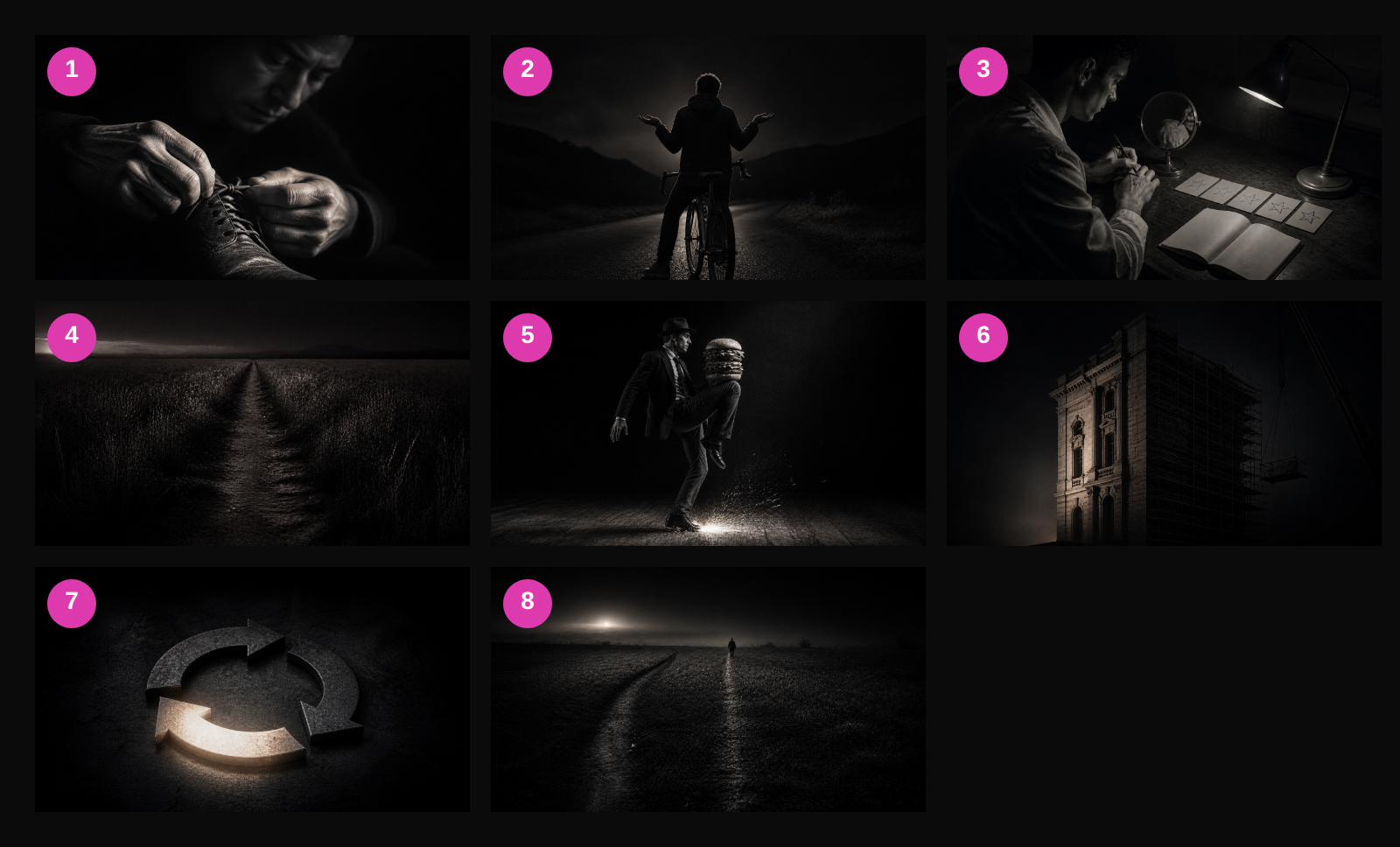
- Procedural memory is the memory for how to do things. Image: a pair of hands tying a shoelace with their eyes closed.
- It is non-declarative: you do it without being able to say how. Image: a bike rider shrugging when asked to explain balance.
- The 1953 patient lost new facts but could still learn new skills. Image: a man practising a task and getting better, with a blank diary beside him.
- Skills are built by repetition and last for life. Image: a path worn deep into grass by thousands of footsteps.
- Tap Dogs 1997: a Big Mac on the knees meant "grind on three and seven". Image: a tap dancer with a giant burger balanced on their knees, sparks flying.
- Visual cues on the body system scaffold a skill while the body learns. Image: scaffolding around a building being taken down as the walls stand on their own.
- Cues force the integration step of the learning cycle. Image: a loop of three arrows, sense, integrate, act, with the middle one lit up.
- Bad habits are procedural too, and are rebuilt the same way. Image: a worn path with a new path being trodden beside it.
Sources
- Mark Channon, How to Remember Anything (Hodder Education)
- Scoville, W. B. and Milner, B. (1957). Loss of recent memory after bilateral hippocampal lesions. Journal of Neurology, Neurosurgery and Psychiatry, 20(1), 11 to 21. https://doi.org/10.1136/jnnp.20.1.11
Loci
Build the memory palace in this article inside Loci — store your locations, link images, and rehearse with spaced repetition.
Try it in LociMemory School community
Learn directly with Mark inside the Memory School community on Skool — monthly lessons, practice, and Q&A.
Join Memory SchoolAbout the author
Mark Channon
Grand Master of Memory (1995). Author of three books on memory published by Hodder and Nick Hern. Creator of BBC1's Monkhouse's Memory Masters. Memory coach on Channel 4's Can I Improve My Memory?
Read full bio →