

How to Remember Anything
How to Memorise a Sales Pitch
A sales pitch you've memorised properly is a sales pitch you can deliver while looking the prospect in the eye, reading the room, and adjusting on the fly. Here's how.

A sales pitch read off the slides is a sales pitch the prospect tunes out of by minute two. A pitch memorised by rote is brittle, robotic, and falls apart the moment the prospect interrupts. A pitch memorised properly, structured but spoken fresh, lets you have a real conversation.
The trick is to memorise the structure of the pitch, not the words. Once the structure is locked in, the words look after themselves. Here is the system.
Why most memorised pitches sound bad
Two failure modes are worth naming up front.
Mode one. The slide-read. You memorise the slides instead of the pitch. You deliver each slide in order, talking through the bullet points like a tour guide pointing at exhibits. The prospect can read. They tune out and check their phone.
Mode two. The rote recital. You memorise the words verbatim, in order, the way a school child memorises a poem. The first time the prospect interrupts, asks a clarifying question, or jumps ahead, the whole thing collapses. You either restart from the beginning or stumble through to the end, neither of which closes the deal.
The fix is to memorise something between the slides and the words. The structure. The journey. The beats the pitch needs to hit, in order, with the freedom to change the language each time. A memory palace is how you hold that structure. A memory palace is a route you already know, such as the walk from your front door through your home, where you store each point as a picture placed at a stop along the way.
Start with discovery
A pitch rarely comes out of nowhere. When I'm pitching something, maybe a training or a service I offer, I always go into discovery mode first. I want to find out:
- What does this person, or this company, want?
- What have they tried before, and what hasn't worked?
- What problems are they dealing with right now?
- What happens if they don't do anything?
- What has worked well so far, and what hasn't?
This is where memory pays off. If I remember ten things you said, and I have a structure, I can feed them straight into the pitch on the fly. "So what I've heard is..." becomes the problem. "If you don't do anything, what you've told me is..." becomes the cost of inaction. You can do it all on the same call, or have a discovery call first and pitch on a follow-up call.
One way to hold what they tell you: give each answer a quick picture and drop it at the matching stop in your pitch palace, their problem at the problem, the cost at the cost of inaction. When you reach that stop, their words are waiting for you.
What you actually need to memorise
A pitch is not a script. It is a sequence of points, in a deliberate order, designed to take the prospect on a journey. To deliver it well you need to know:
- The opening. Your hook, your story, your way in.
- The problem. The pain the prospect is feeling.
- The cost of inaction. What happens if they do not fix it.
- The insight. The thing you understand that the competition does not.
- The solution. How your product or service actually works.
- The proof. Case studies, numbers, social proof.
- The objections. The two or three things you know they will push back on, and your responses.
- The ask. What you want them to do next.
Eight beats. Eight locations in a memory palace. Eight visual cues that trigger each section. That is the whole structure, and it is the same whether the pitch is five minutes or forty. The longer the pitch, the more sub-beats inside each of these eight, but the top-level shape is constant.
Step 1. Map the pitch into beats
Sit down with your pitch in front of you and break it into the eight beats above. If your pitch does not naturally have those beats, fix the pitch first. That is a separate problem and probably a bigger one than the memorisation.
For each beat, write down the core idea in your own words in a single sentence. Not the whole paragraph. The single sentence the prospect should walk away with.
A worked example. Imagine you are pitching a software tool that helps sales teams find the right document in the middle of a deal.
- Opening. "Last year we watched a big company lose a deal because three salespeople couldn't find the same case study."
- Problem. "Your team is sitting on hundreds of documents, and none of them can be found in the moment they are needed."
- Cost of inaction. "Every quarter you stay as you are, deals slip away because the right proof never reaches the buyer."
- Insight. "The problem is not content production. It is content retrieval. Nobody has solved retrieval."
- Solution. "We put a searchable library inside the tools your sellers already use, and it surfaces the right document for each deal."
- Proof. "Here is what our first three customers changed, and what it did for their numbers."
- Objections. "Yes, it works alongside the tools you have. Yes, it passes a security review. No, you will not need to reorganise your files."
- Ask. "A twenty-minute follow-up next Tuesday with your sales director and your three best sellers."
Eight sentences. The skeleton of the pitch.
After the proof: space, price, objections
Once people have seen what you're offering, give them a little space to talk. They will usually ask how much it is. If they don't, ask: "Have you got any questions for me?" Then give the price, and anchor it so it is framed the right way.
I always treat a sale as a price test. It's a test of everything. If they say no, that is when you deal with the objections: find out what they are and what is going to stop them. If discovery showed they really need and want this, that part gets much easier.
Step 2. Build a visual cue for each beat
For each of the eight sentences, build one vivid mental image. Big. Weird. Slightly ridiculous.
Using the eight beats above.
- The opening is a giant fishing hook with a small version of you dangling off it
- The problem is a tangled mess of cables on fire
- The cost of inaction is a leaky bucket pouring money onto the floor
- The insight is a glowing light bulb with eyes
- The solution is a Rube Goldberg machine clunking through its sequence
- The proof is three gold trophies stacked on top of each other
- The objections is a row of shields lined up in front of you
- The ask is an outstretched hand with the prospect's logo on the palm
Use the MIN rule. Minimum images necessary. One per beat. Do not overload it. If you build too many cues you spend the pitch hunting through your own imagery.
Step 3. Place the cues in a memory palace
Walk your favourite memory palace and place one cue on each location. If you have never built one, How to Build a Memory Palace: A 7-Step Beginner's Guide (With Worked Examples) walks you through it. As you place each one, make it interact with the location. Not just sitting near it, but doing something to it.
A walked example using a typical living room as the palace.
- Front door. The fishing hook is hanging from the inside handle, slowly swinging.
- Hallway table. The tangled cables are on fire on the table, smoke pouring up to the ceiling.
- Stairs. The leaky bucket is balanced on the third step, money trickling down each step like water.
- Sofa. A giant lightbulb is sitting on the sofa, looking around the room with wide eyes.
- Window. A Rube Goldberg machine is smashing through the glass, bits flying.
- TV. Three gold trophies are stacked on top of the TV, the top one leaning precariously.
- Bookcase. A row of shields is leaning against the bookcase, partially blocking the books.
- Coffee table. An outstretched hand is rising up through the coffee table, palm out.
For a typical eight-beat pitch this whole process takes about ten minutes once you have done it a few times.
Step 4. Rehearse out loud, in the wild
Stand up. Project the palace into the actual space you are in. Walk through the pitch out loud, looking at each cue, speaking the section in your own words. Different words each time. The cue is fixed. The language is alive.
Do this five times. Each pass will feel slightly different. By the fifth, the pitch will feel yours. Not memorised, just known.
A useful tip. Record yourself on the third pass. Listen back. Notice where you stumble, where the language feels forced, where the cue triggered a tangent that hurt the pitch rather than helped it. Adjust on pass four and five.
Step 5. Bring the palace into the room
When you walk into the prospect's office, or join their Zoom, mentally place the locations of your palace around the actual room you are in. The fishing hook is on the wall to your left. The Rube Goldberg machine is over by the window. The trophies are on the meeting table.
Actors use the same technique when they have rehearsed in their living room and are now stepping into an audition room: do not travel to the palace, bring the palace to you. The full exercise is in How Actors Learn Lines Fast: The Seven-Step Recipe (From Learning Your Lines).
For a pitch, rehearse the transfer before the meeting. Sit in your car, or in reception, and picture the room you are about to walk into as best you can. Place the fishing hook on the wall to the left of where the decision-maker will sit. Put the leaky bucket on the table in front of them. Stand the trophies on the windowsill behind them. When you walk in and the room is different from what you pictured, adjust in a second: the hook moves to whatever wall is on your left. The cues travel with you.
Now you have a pitch you can deliver while:
- Looking the prospect in the eye
- Reading their body language
- Adjusting your emphasis on the fly
- Taking interruptions and folding them in
- Handling questions without losing your place
The structure is fixed. The delivery is fresh.
Handling interruptions
Interruptions are where a word-for-word pitch falls apart. A memory-palace pitch copes with them.
When the prospect interrupts, you stay where you are in the palace. Note your current location (say, you were at the sofa, about to describe the insight). Address the interruption fully. Answer their question. Take them on the small tangent they want.
When the conversation returns to your pitch, glance back at your current location. The light bulb is still on the sofa. You pick up exactly where you left off. The prospect does not feel rushed. You do not feel derailed.
You can jump to any beat without losing the rest.
What this gives you
A salesperson who has memorised a pitch properly:
Never gets lost. Even after a long interruption, glancing at the next location pulls the next beat in immediately.
Sounds different every time. Same structure, fresh language, no robotic delivery.
Handles objections cleanly. The objection beat is already in the palace. You pre-rehearsed the responses, so they come out smoothly. You do not stumble or stall when the predictable concern lands.
Gives the prospect your attention. You are no longer using your head to remember what comes next, so you can listen, read the room and adjust as you go.
A practice plan for a new pitch
If you have a brand new pitch to learn, here is a practical schedule.
Day 1. Map the pitch into the eight beats. Build the cues. Place them in your palace. Run the pitch out loud three times.
Day 2. Run the pitch out loud five times. Record yourself once. Listen back and note the rough edges.
Day 3. Run it five more times, focusing on the rough edges. Add sub-cues inside any beat that turned out to be longer than expected.
Day 4. Run it three times under "interruption pressure." Have a colleague interrupt you randomly. Practise the return-to-palace skill.
Day 5. Two clean run-throughs. Then deliver it for real.
You will be ready to deliver within a week. Keep using it across different pitches, and after about six weeks the technique runs in the background.
Where to go from here
Think about where you pitch in your own work: investor meetings, board presentations, job interviews, a team update. The structure changes but the method is the same.
If your pitch leans on key figures, turn those into pictures too and place them at their beat. How to Memorise Numbers shows how.
Natural next read: How to Memorise a Speech with a Memory Palace (No Notes Needed), for presentations and longer talks.
Memory map
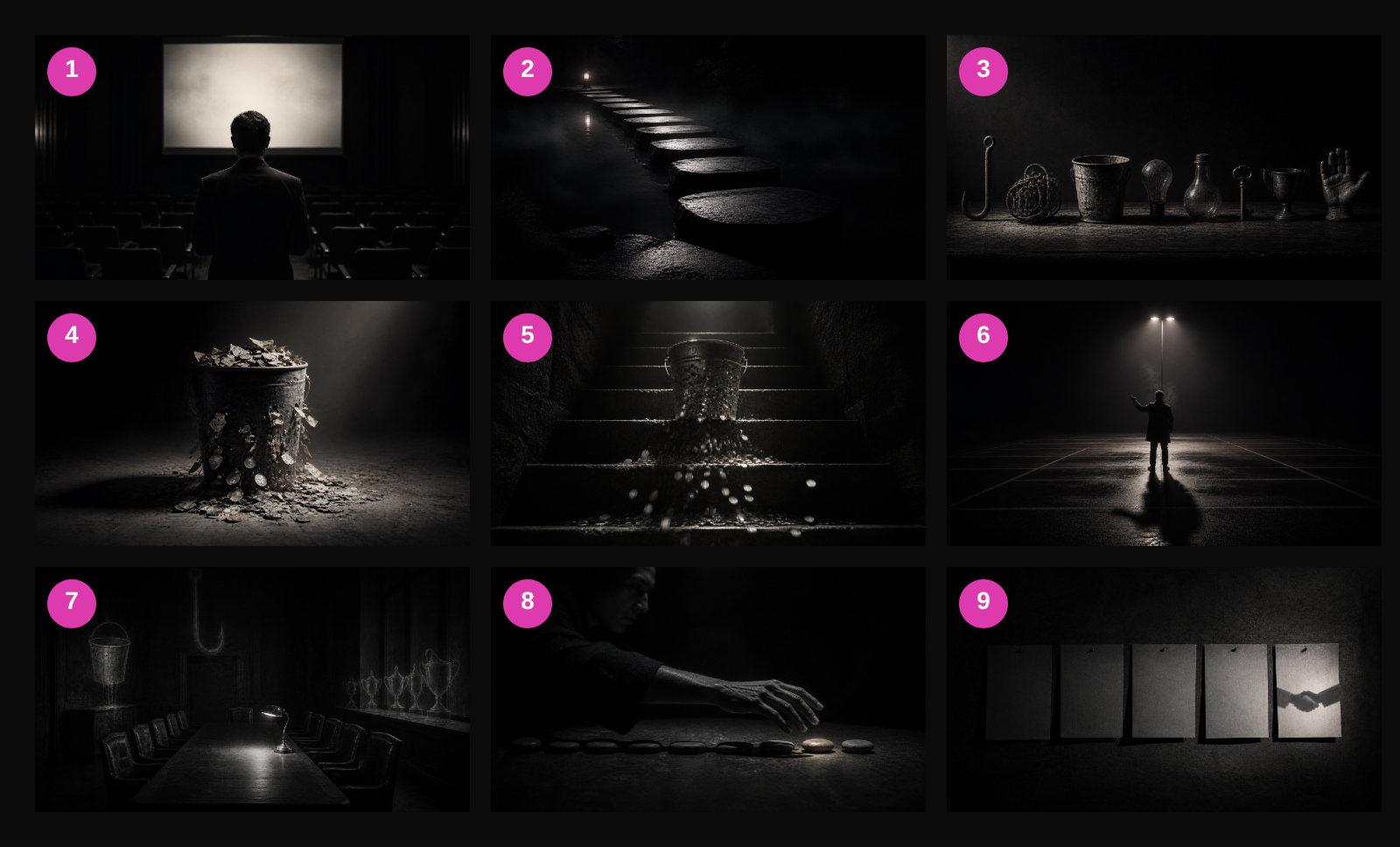
- Memorised pitches sound bad when they are slide-reads or rote recitals. Image: a presenter with their back to the room reading a screen word for word.
- Start with discovery: what they want, what they've tried, their problems, the cost of doing nothing. Image: a person leaning in and listening, a notebook of small sketches open on the table.
- Memorise the beats and the logic, not the words. Image: eight large stepping stones across a pond, no words on any of them.
- Map the pitch into beats: opening, problem, cost, insight, solution, proof, objections, ask. Image: eight objects in a row, a hook, tangled cables, a leaky bucket, a lightbulb and more.
- After the proof, leave space; anchor the price; treat the sale as a price test, then handle objections. Image: a price tag balanced on one side of a set of scales, a quiet pause in an empty chair beside it.
- Build one visual cue per beat. Image: a leaky bucket with money trickling through the holes.
- Place the cues in a memory palace, each interacting with its spot. Image: that bucket balanced on the third stair, coins running down each step.
- Rehearse out loud in the wild, in different rooms and moods. Image: a person pitching to an empty car park, then to a kitchen wall.
- Bring the palace into the prospect's room and lay your locations over their furniture. Image: a meeting room with a faint hook, bucket and trophies ghosted onto its walls.
- Interruptions stop mattering: glance at the next location and the next beat returns. Image: a conversation bubble cutting across a row of eight stones, the speaker's eye on the next one.
- Five days from mapping to delivery. Image: five calendar pages, the last showing a handshake.
Sources
- Mark Channon, How to Remember Anything (Hodder Education)
Loci
Build the memory palace in this article inside Loci — store your locations, link images, and rehearse with spaced repetition.
Try it in LociMemory School community
Learn directly with Mark inside the Memory School community on Skool — monthly lessons, practice, and Q&A.
Join Memory SchoolAbout the author
Mark Channon
Grand Master of Memory (1995). Author of three books on memory published by Hodder and Nick Hern. Creator of BBC1's Monkhouse's Memory Masters. Memory coach on Channel 4's Can I Improve My Memory?
Read full bio →