
Memory Training
Speed Cards Explained: How a Pack Gets Memorised in Under a Minute
Speed cards is the headline event of memory sport: one shuffled pack, memorised against the clock. What the rules are, how the record fell from minutes to seconds, exactly what competitors are doing in their heads, and how to train your own time down.

Speed cards is the last event at the World Memory Championships and the only one that comes down to a stopwatch. A competitor sits with a shuffled pack face down, starts the timer, turns the cards and memorises their order as fast as they can, stops the timer, and then has five minutes to arrange a second, ordered pack to match. If every card is in the right place, the time stands. If one is wrong, the time is lost.
When I competed in 1995 I could do a pack in a little under a minute and a half, an unofficial 1 minute 24 seconds. In 2011 Simon Reinhard set a world record of 21.19 seconds. The Guinness World Records mark is now 13.96 seconds, set by Zou Lujian at the 2017 World Memory Championships in Shenzhen.
It can look like a party trick, and it does make a good one, but it is not a gift. It is a system, and every part of it can be explained and learned. Here is what is actually happening.
The rules, briefly
Two packs. One is shuffled and placed face down; the other is in a known order. At the World Memory Championships the clock starts when you lift your hands off a touch-sensitive timer and stops when you put both hands back on it. You have up to five minutes to memorise.
Recall is five minutes. You take the ordered pack and arrange it into the sequence you memorised. The arbiter then compares the two packs, card by card. A perfect match records your time. At the first mistake, only the cards up to that point count, and the attempt is scored as if you had used the full five minutes, a fraction of what a complete pack earns. There are two attempts and the better one counts, so competitors often do one safe attempt and one fast one.
That rule shapes everything about the technique. You are not trying to remember most of the pack. You are trying to remember all of it, because one near miss costs you the time.
What a competitor is doing in their head
Three things, layered.
Every card is already a picture. Before the competitor ever sits down, each of the 52 cards has been given a fixed image, learned until it is instant. The seven of clubs is not a seven of clubs; it is a cake, or a particular person, or whatever the system says. The competitor is not memorising cards. They are watching a sequence of pictures they already know.
The pictures go onto places. The competitor has a route, a memory palace with a fixed series of locations, and as the cards turn, the images are dropped onto the locations in order. First card at the front door, second on the hall table, and so on. Recall is a walk back through the route, reading off the images and translating each back into its card.
Several cards share a location. This is where the speed comes from. A beginner puts one card on each location, which needs 52 locations and 52 separate acts of placing. Competitors combine cards. Two cards per location, one image acting on another, halves the route to 26. Some competitors use a person-action-object (PAO) system in which three cards become one scene, the person from the first card doing the action from the second with the object from the third, so a whole pack becomes 17 or 18 pictures on 17 or 18 locations.
Everything else is practice: making the translation from card to image instant, making the placing instant, and making the walk back reliable.
Why the record fell so far
The record has come down a long way since the 1990s. Three things changed.
Systems got denser. One image per card gave way to two per location and then to three. Three cards per scene does not mean you take three times as long on each scene as you used to take on one card. The way to get the benefit, or close to it, is to learn to recognise three cards in about the time you used to take for one.
Recognition got faster. From what I have seen, the best competitors no longer translate. They do not see a king of spades and think of the image; the image is simply what the card looks like to them, the way a fluent reader does not sound out letters. This takes a lot of repetition, and the training exists to produce it.
The field got deeper. When the sport began in 1991, nobody knew what was possible. By 2015 some 35 countries had taken it up, according to the World Memory Sports Council, and with results published, the ceiling keeps moving because everyone can see where it is.
None of these is talent: they are system, drilling and competition.
The training that gets you fast
Card training breaks down into drills, and the drills matter more than the attempts.
Recognition drills. Take the pack and turn the cards at an even, slow rhythm, saying each card's image aloud as you go. If one does not come, move on. Speed up gradually, still speaking. Do this for three minutes and at the end find the cards that stalled you and dial them up: make their images bigger, stranger, more yours. You are conditioning the brain to recognise a visual language without thinking, so the decoding step disappears.
Palace drills. Run your card route forwards, then backwards, then both at speed, as if with a remote control on fast forward and rewind. Time the run. The route has to be as fluent as the images; a hesitation about which location comes next costs more than a slow card.
Relative intensity training. Set the load to you, not to a fixed number. Someone experienced and a beginner can train at the same effort with very different loads: a full pack against the clock for one, half a pack for the other. Different load, same effort. On a tired day, go lighter, same effort.
Progressive overload. Your body adapts to the work you give it, and so does your memory. To keep improving, ask a bit more of it over time. With cards, more can mean more cards, more packs, less time to memorise, or a harder version, such as more cards per location. Small steps, regularly, keep you improving. Too big a jump, a full pack against the clock on day one, sets you back; no jump at all, and you plateau.
Stamina training. Thirty minutes, as many packs as you can memorise and recall. You will probably manage three or four to begin with.
Full attempts. Only when the drills are fluent. Shuffle, time, memorise, recall into a second pack, check. Record the time and the errors. One timed full attempt a day; the volume comes from the stamina session.
A realistic route towards two minutes
Two minutes for a pack is a serious milestone for anyone. Six weeks will usually get you timing full packs and, at some point, under five minutes. Two minutes in that time is possible, but there is no guarantee. Here is a route for a motivated beginner.
Weeks one and two: images. Build your 52 images and drill recognition daily until any card produces its image in under a second. No palace yet.
Weeks three and four: the route. Build a palace of 26 locations and drill it until you can run it forwards and back without thought. Then start placing two cards per location, one image interacting with the next, on a slow, untimed pack. Recall it. Check it.
Weeks five and six: timed packs. One a day. You will probably start at about ten to fifteen minutes for a pack and bring it down gradually. At some point there is usually a big drop, to under five minutes. Every day, note which cards slowed you and which locations felt vague, and fix them in the drills.
After six weeks: speed. Use relative intensity and progressive overload, and add a weekly stamina session. Add a second route and alternate, so the last pack's images are not still sitting on the locations you are about to use. Your time can come down towards two minutes, then plateau, then come down again when you fix the next weak spot.
A note on review. In a speed attempt there is no time for mid-memorisation review, which is why the images must be strong on first placement. In longer card events competitors glance back over early locations before recall. In speed cards you get one pass, so the training is about making one pass enough.
What speed cards is for
Nobody needs to memorise a pack of cards. Outside competition, I have been asked to, usually by friends or as the odd party trick. The value is what it does to the rest of your memory.
A pack is 52 abstract items in random order, with no story of its own. Once you can hold that, everything else becomes easier, because the images and palaces you drill on cards are the same tools you use on a shopping list, an agenda, the names around a dinner table or the key figures for a meeting.
I have not competed in years, but memorising a pack of cards still feels quite amazing. Even though you know how it is done, there is a part of you that goes, "How is this possible?"
For the full system, How to Memorise a Deck of Cards builds the images and the palace step by step, and The PAO System Explained explains how three cards become one picture. For the sport around the event, The World Memory Championships Explained (by Someone Who Competed in 1995) covers the other nine disciplines and how the titles work. For a daily structure that includes the drills above, The Daily Memory Workout. And if you want the locations built for you to start placing cards on today, LOCI builds a memory palace for you from Google Street View or with AI.
Memory map
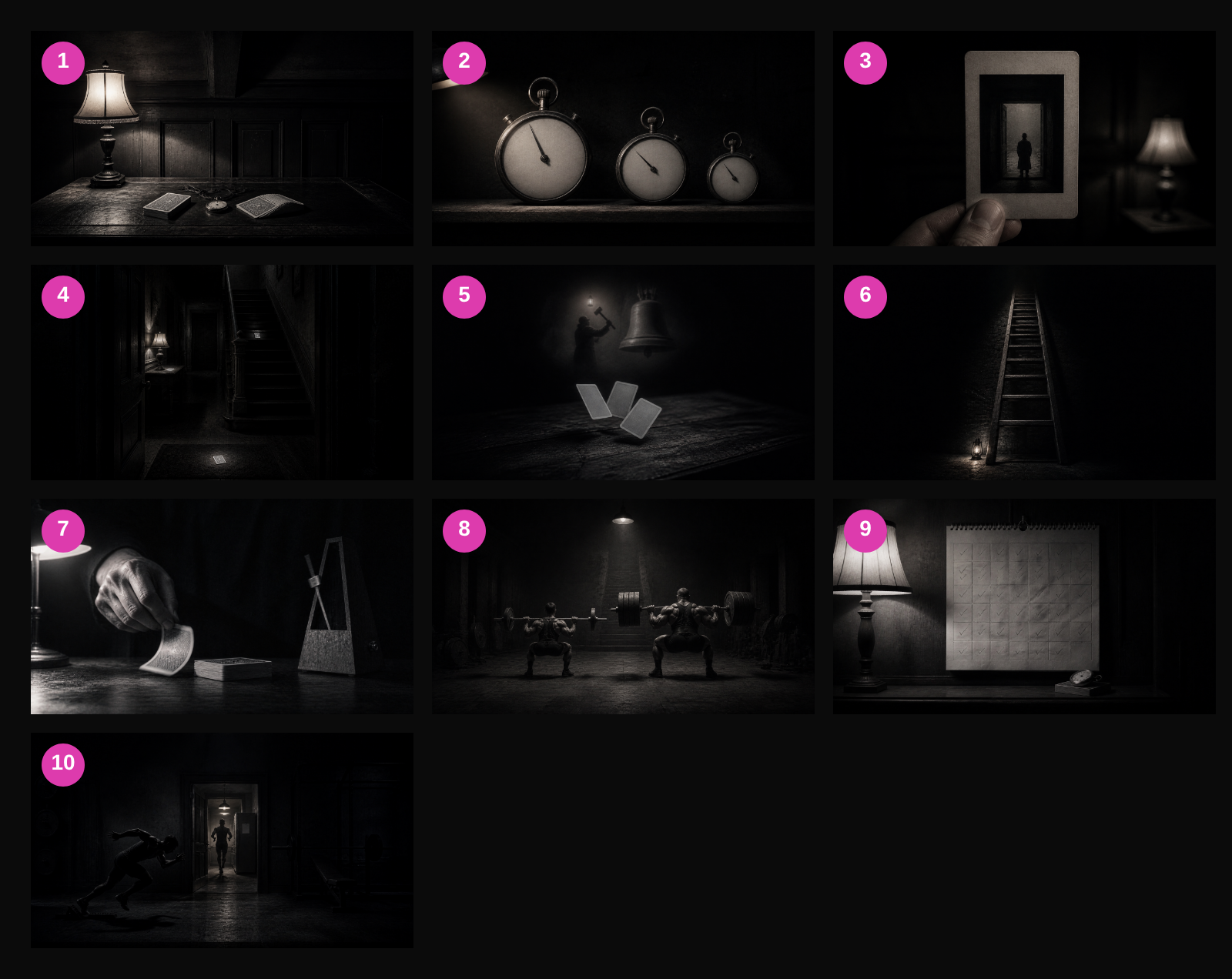
- Speed cards: one shuffled pack, memorised against the clock, recalled by arranging a second pack; one error loses the time. Image: two packs side by side on a table with a stopwatch between them.
- 1995: an unofficial 1 minute 24; Simon Reinhard's 21.19 seconds in 2011; today under 14. Image: three stopwatches in a row, each showing a smaller number.
- Every card is already a picture before the competitor sits down. Image: a playing card with a photograph where the pips should be.
- Pictures go onto a route of locations; recall is a walk back. Image: a front door, a hall table and a staircase, each with a card image resting on it.
- Two cards per location halves the route; three per location with PAO makes a pack 17 or 18 scenes. Image: three cards fusing into one scene of a person doing an action with an object.
- The record fell because systems got denser (learning to recognise three cards in the time of one), recognition got instant and the field got deep. Image: a ladder whose rungs get closer together towards the top.
- Recognition drill: turn cards to a rhythm, say the image aloud, speed up, dial up the stragglers. Image: a hand turning cards with a metronome ticking beside it.
- Relative intensity and progressive overload: set the load to you, then ask a bit more over time; add a 30-minute stamina session. Image: two lifters at the same effort with different weights, beside a staircase of small steps.
- Towards two minutes: images, route, two per location, timed packs from about ten to fifteen minutes, then speed. Image: a six-week calendar with a pack of cards and a stopwatch at the end.
- Nobody needs to memorise cards; it makes everything with meaning easier, and it still feels amazing. Image: a sprinter in a weight room, then jogging past a shopping list pinned to a fridge without breaking stride.
Sources
- World Memory Sports Council (2015, 18 December). NEW World Memory Champion Crowned (founding 1991, some 35 countries). https://www.worldmemorychampionships.com/?p=4406
- World Memory Sports Council (2019). Official Competitor's and Arbiter's Handbook, 3rd edition (speed cards rules: timing, recall, two attempts, scoring at the first discrepancy). https://www.worldmemorychampionships.com/wp-content/uploads/2022/09/Arbiters-Handbook-3rd-Edition-1.pdf
- World Memory Sports Council (2013). World Memory Championships Press Pack (speed cards record: Simon Reinhard, 21.19 s, German Open 2011). https://www.worldmemorychampionships.com/wp-content/uploads/2013/10/2013_WMC_Press_Pack.pdf
- Guinness World Records, fastest time to memorise and recall a deck of playing cards (Zou Lujian, 13.96 s, 2017): https://www.guinnessworldrecords.com/world-records/67743-fastest-time-to-memorize-and-recall-a-deck-of-playing-cards
Loci
Build the memory palace in this article inside Loci — store your locations, link images, and rehearse with spaced repetition.
Try it in LociMemory School community
Learn directly with Mark inside the Memory School community on Skool — monthly lessons, practice, and Q&A.
Join Memory SchoolAbout the author
Mark Channon
Grand Master of Memory (1995). Author of three books on memory published by Hodder and Nick Hern. Creator of BBC1's Monkhouse's Memory Masters. Memory coach on Channel 4's Can I Improve My Memory?
Read full bio →