
Memory Techniques
Memorisation Techniques Compared: What Works, What Doesn't, and When
Rote repetition, flash cards, spaced practice, retrieval, chunking, mnemonics, memory palaces, teaching it back. Eight memorisation techniques judged on what they are good for, and the night I built my first memory palace at 15 without knowing it.

I was 15, it was the night before my physics exam, and I had failed the mocks. My parents had made me a deal: pass all my exams and I could try out for a performing arts school in London. I had an E grade, little interest left in the subject and 24 hours to get to a C. I pulled my textbooks and exam notes into my parents' kitchen and turned it into a lab. My parents went to bed early.
I worked out which twenty or so equations would get me from an E to a C. Then I wrote each one on a post-it note and stuck them around the kitchen, the fridge included. I had no picture for any of them. I just went to each post-it, looked at the equation, and thought about what it meant.
The next day, in the exam, I would read a question and think, which equation do I need? And I could see where it was in the kitchen: on the fridge, or wherever I had stuck it. It was where they were that made them stick. I passed with a C, and the equations stayed with me for months. It was just a cool trick that worked, and I did not use it again. Years later, a friend of mine, Steve, taught me the memory palace: placing what you want to remember on spots along a route you can walk in your mind. Even then I did not register what I had done at 15. It was about 20 years later that I made the connection and thought, wait a minute: that night in the kitchen, I built my first memory palace. I just did not know that was what it was.
People ask which memorisation technique is best. The better question is what each one is for, because they are not rivals. Eight familiar ones, judged on what they actually do:
1. Rote repetition
What it is. Reading, saying or writing the thing over and over until it sticks.
What it is good for. Short, fixed sequences you will use constantly: a new phone number, a password you type daily, the first line of a speech. Repetition also slows how fast something new slips out of short-term memory. That store is small: about four chunks (meaningful groups of information) on later estimates (Cowan, 2001), rather than the famous figure of seven from George Miller's 1956 paper, and without rehearsal new items drop out within seconds (Peterson and Peterson, 1959). The Magical Number Seven, and Why It Is Really Four covers the four-chunk limit; Peterson and Peterson (1959): How Fast Short-Term Memory Fades covers how fast it drops out.
Where it fails. Almost everywhere else. Repeating a fact without thinking about what it means skips the part that matters most: in the research, thinking about what a word means made it far more memorable than thinking only about how it looks or sounds (Craik and Tulving, 1975). What I have seen is that it also comes back only in the exact form it went in. Rote is also what people fall back on when they are tired or the material gets hard. If you believe you have a bad memory, rote may be the only method you were ever shown.
Verdict. Fine for a PIN. Not a strategy.
2. Flash cards
What they are. A question or cue on one side, the answer on the other. Paper or app.
What they are good for. Flash cards work for one reason, and it is not the card. They make you try to pull the answer out before you see it, and practising recall, retrieval practice, is one of the best-supported ways there is to remember more (Roediger and Karpicke, 2006). They are portable and easy to shuffle, and a box of cards sorted by how well you know them is one of the simplest ways to space your reviews.
Where they fail. When the card holds a bare fact and you flip it, read the answer and nod, you are doing rote repetition with extra admin. And cards hold isolated pairs, so they are weak for anything that needs order or the big picture.
Verdict. A container, not a technique. What you do with the card decides whether it works: make the answer mean something before you test yourself on it.
3. Spaced practice
What it is. Coming back to material in several short sessions rather than one long one. There is more than one way to do it:
- A widening schedule. Review soon after learning, then at longer and longer gaps. One long-standing version runs one hour, one day, one week, one month.
- A card box. Cards you get right move to a box you review less often; cards you miss go back to the first box.
- An app that schedules each item for you.
- Spacing inside one session. Three short bursts of study with 10-minute breaks of something physical in between.
What it is good for. Remembering anything for the long term. Spacing has some of the strongest evidence in memory research: across hundreds of experiments, spreading study out beat cramming the same amount into one go, and the longer you need to remember something, the wider the gaps can be (Cepeda and colleagues, 2006; The Spacing Effect (Cepeda 2006) Explained has the detail).
Even when you only have an hour. This is the version that rarely gets taught. In one English school, biology teachers taught a topic in a single hour: three bursts of 20 minutes or less covering the same material, with two 10-minute physical breaks such as basketball or juggling. On the national biology test, students who had just that hour did about as well as students who had been taught the topic over four months (Kelley and Whatson, 2013). It is one school and a preliminary result, but it means spacing is not only for people who planned ahead. Spaced Learning: The One-Hour Lesson That Matched Four Months tells the full story.
Where it fails. What I have seen is that spacing cannot rescue a weak start. If the first encoding, the moment you got it in, was weak, you are spacing out a weak memory.
Verdict. Worth doing for anything you want to keep. It works across a term, and one promising school study suggests it can work inside a single hour too.
4. Retrieval practice
What it is. Testing yourself. Closing the book and trying to produce the answer rather than reading it again.
What it is good for. Anything you need to recall on demand. In Roediger and Karpicke's studies, students who practised recalling a passage remembered far more of it a week later than students who simply reread it, even though rereading felt better at the time (The Testing Effect (Roediger and Karpicke 2006) Explained).
Where it fails. When you cheat. Peeking before you have tried, or only testing yourself on what you can already answer easily, removes the effort that, from what I have seen, makes it work. But do not drop the ones you have got right either: in a follow-up study, students learning Swahili word pairs who kept testing themselves on pairs they already knew remembered about 80% a week later; those who only restudied them remembered about a third (Karpicke and Roediger, 2008).
Verdict. The second half of every good technique. Make it the default and rereading becomes the exception.
5. Chunking
What it is. Breaking a mass of information into groups small enough to work with. The number 241849382 is unwieldy. As 241, 849, 382 you can hold it, think about it and use it.
What it is good for. Anything that overwhelms you on first sight: a syllabus, a long number, a page of forty terms. Chunking makes material manageable, and when each chunk means something to you, it can change how much you can remember. In one carefully studied single case, a man who grouped digits into running times (3492 became 3 minutes 49.2 seconds, close to a world-record mile) took the number of digits he could repeat back from about 7 to 70 over roughly 200 hours of practice (Chase and Ericsson, 1979). His short-term memory itself did not grow; the chunks did the work.
Where it fails. When the chunks have nothing to hold on to. Chunking works by recognising patterns you already know. Chess masters remember real game positions far better than weaker players, but in chess research summarised by Gobet and Simon (1996), when the pieces were placed at random, their advantage almost vanished. The digit study shows the same limit: when the man with the running times switched from digits to letters, he was back to about six (Chase and Ericsson, 1979). So 241, 849, 382 is easier to handle than 241849382, but I find each group still needs something that makes it stick, which is where a mnemonic comes in. I have also seen a tidy set of headings feel like knowledge when it is only a filing system.
Verdict. The first step that makes everything after it easier. Most powerful when each chunk means something.
6. Mnemonics: images and stories
What they are. Turning information into a picture, or a chain of pictures, that your brain can hold. The Latin root "apert", meaning open, becomes a camera aperture swinging open like a door. A list of ten elements becomes one story where each thing leads to the next.
What they are good for. Pretty much everything. A mnemonic gives a fact something to see, something that moves, something that connects to what you already know and means something to you. In my view, that last part matters most. In the research, thinking about what a word means made it far more memorable than thinking about how it looks or sounds (Craik and Tulving, 1975). What I have seen is that building an image is a way of thinking about meaning, so a good mnemonic does not sit on top of understanding. It builds it. Creative Memorisation: The Four Ingredients That Make Anything Memorable explains how the state you are in, imagination, association and meaning work together.
The challenge. Mnemonics are a skill, and a skill takes effort. Rote repetition needs no training, which is why it is the default. Building images takes practice at first, and you need a few reviews to weld each picture to the real information. That is the bad news. The good news is that anyone can learn it, and you do not need mastery, just a level of proficiency. Once you have that, from what I have seen it is far more effective than repetition.
You may hear that research rates mnemonics as low utility for students. One common source is a large 2013 review of ten study techniques that students could use on their own. It rated practice testing and spacing the most useful, and rated two imagery techniques low. One was the keyword mnemonic, used mostly for foreign vocabulary: you link the foreign word to an English sound-alike, then picture that keyword interacting with the word's English translation. It helped straight away across many kinds of material, but it was rated low for the time it takes, for being hard to apply to material that does not suit a keyword, and because in two studies keyword learners forgot faster than rote learners a week later. The other was forming pictures while reading (Dunlosky and colleagues, 2013).
In my view, the flaw is in treating that as a verdict on mnemonics as a whole. Memory palaces were not among the ten, and nor was anything like creative memorisation. The keyword method as tested linked word pairs, with no step for working out what the material meant. For me, meaning is everything. A proper test of mnemonics would start with people who have built some proficiency in them, as you would for any other skill. What the review highlights for me is how few people know how best to apply memory techniques.
The science is starting to catch up with memory palaces. In research by Martin Dresler, Boris Konrad and colleagues, people who trained in the memory palace for six weeks kept far more of what they learned four months later (Wagner and colleagues, 2021). And the model I have used for 30 years, creative memorisation, has meaning right at its centre.
So the research does not show that mnemonics do not work. The challenge is the one I see all the time: they are a skill, they take some effort to learn, and they are not a magic bullet.
Imagine if every child learned this when they started school. I believe it would simply become how they learn. They would not think of it as something different; they would build the skill early. For the children who find the way school is structured hard, this way of thinking and learning, ancient as it is, could make a real difference. It might even change how we educate.
Verdict. In my view, one of the strongest ranges of techniques there is for remembering pretty much anything, and the one you were probably never taught. Mnemonics: The Complete Guide to Making Anything Memorable goes deeper.
7. Memory palaces
What they are. A memory palace is a route of places you can recall in order: your home, your route to work, the room you are sitting in, or a street you have never visited. You place what you want to remember on the spots along it, usually as images. It is a mnemonic too: the place gives everything you put there an address. Even with no images, as in my kitchen, the place alone did that. LOCI, Memory School's palace app, can build one for you from Google Street View or with AI.
What they are good for. Order, volume and jumping straight to any item. A palace can hold a shopping list, a speech, or the structure of a whole subject, each chapter in a room and each section on an object in that room.
There are two kinds, and knowing the difference makes palaces far more useful:
- Temporary palaces you build on the spot. Look around the room you are in and you have ten places to hang ten things straight away. Use it for the day and let it fade; you do not need it again.
- Permanent palaces are the ones you keep things in for the long term and come back to.
Memory palaces are probably the easiest memory technique to start with, because you can start with places already in your head. And they work for beginners, not only for memory athletes (people who compete in memory championships). In one small study, people with no training who did about 40 half-hour sessions of memory palace practice over six weeks saw their brain networks shift towards the pattern found in memory athletes, with their memory gains still there four months later (The Memory Athlete Brain Study (Dresler 2017) Explained).
The challenge. The same as every memory technique: it is a skill. A palace is not overkill for a shopping list; that is a fine place to start. The catch is stopping at the shopping list.
Verdict. A mnemonic in its own right, and one that deserves its own place: the technique for order and volume, from ten items to a whole syllabus. What is a Memory Palace? A Beginner's Guide to the World's Oldest Memory Technique is the place to start.
8. Teaching it to someone
What it is. Explaining what you have learned to another person, out loud, in your own words.
What it is good for. Three things at once. Saying it out loud is verbalisation: you hear it as well as think it. It is active recall, because you have to pull every piece out with no notes in front of you. And it builds understanding, because you cannot explain how something works without working out how it works. The same goes for the chain method, where each item in a list links to the next in one story: tell that story to someone and you are recalling it, saying it and making sense of it in one go. No one to teach? Teach the wall. The effect is in the explaining, not the audience.
Where it fails. When you explain the easy parts and skate over the hard ones. Be honest about where you stumble; that is where the gaps are.
Verdict. A strong final step: cheap, fast and honest.
The comparison in one place
- Rote repetition. Best for short fixed sequences you use daily. Fails on anything complex or long-term. Role: holding things briefly; the fallback.
- Flash cards. Best for running retrieval and spacing on the move. Fail when you just read the answer. Role: container.
- Spaced practice. Best for keeping anything for the long term, across months or, it seems, inside a single hour. Fails when the first encoding was weak. Role: keeping it for the long term.
- Retrieval practice. Best for recall on demand. Fails when you peek. Role: the second half of everything.
- Chunking. Best for material that overwhelms. Fails when the chunks have nothing to hold on to. Role: first step.
- Mnemonics. Best for almost anything, and they build meaning as they go. The challenge: a skill that takes practice. Role: encoding.
- Memory palaces. Best for order and volume, temporary or permanent. The challenge: a skill that takes practice. Role: storage and structure.
- Teaching it. Best for recall, saying it out loud and understanding. Fails when you skip the hard parts. Role: final check.
They are not rivals
Before any of them, get into the right state to learn (flow, the first of the four ingredients of creative memorisation). Then chunk. Encode with images and meaning. Give them a place in a palace. Retrieve rather than reread. Space the reviews. Explain it to someone. Six of the eight are stages of one process, and the other two, rote and flash cards, are a fallback and a container.
Each one, tested on its own, looks weak somewhere. Spacing without good encoding spaces out a weak memory. Images without retrieval leave you with pictures you never practised pulling back. Retrieval without chunking means testing yourself on a mess. Put them in order and each covers the gap the last one left.
That night in my parents' kitchen I had no name for what I was doing. I used two things: a place for each equation, and time spent on what each one meant. The place is what made them stick. In the exam I could see where each equation was in the kitchen, and I walked in feeling as though I had my notes in front of me.
Who knows what would have happened with 48 hours.
Where to start
Stop choosing. Pick the technique that fixes the problem in front of you right now.
Material overwhelming you? Chunk it. Facts sliding off? Give them a picture and a meaning. Need them in order? Put them in a palace, even a temporary one in the room you are in. Afraid you will blank? Test yourself. Need it next month? Space it, and if tonight is all you have, try spacing it within the hour. Not sure you really know it? Explain it to someone.
The full set of memory techniques and the order to learn them is mapped in Memory Techniques: The Complete Guide. For building images into a story, start with The Chain Method: How to Remember Lists Without Building a Memory Palace. For running all of this across a syllabus, Study Techniques That Actually Work takes you through it step by step. And if you want the image-building skill drilled daily, MindForge, Memory School's practice app, gives you a fresh set of information to turn into images against the clock.
Memory map
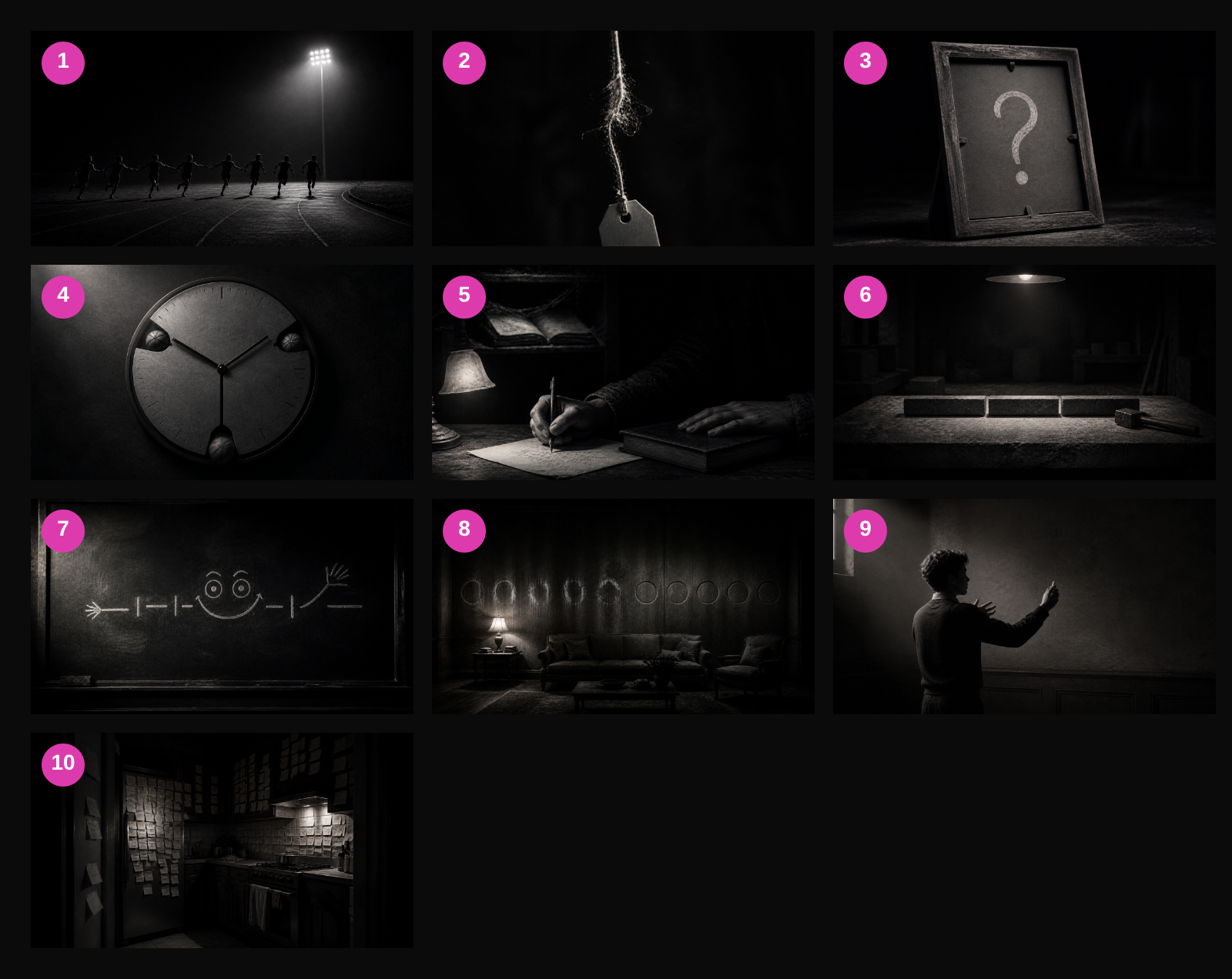
- Six of the eight techniques are stages of one process; rote and flash cards are a fallback and a container. Image: six runners passing one baton along a track, with two figures at the side holding a box and a crutch.
- Rote repetition skips meaning; fine for a PIN, not a strategy. Image: a single thread tied to a number, fraying.
- Flash cards earn their place by making you recall; the card is a container. Image: an empty picture frame with a question mark on the back.
- Spaced practice comes in many versions, even three short bursts inside one hour. Image: a clock face split into three slices, with a basketball in each of the two gaps.
- Testing yourself beat rereading a week later, even though rereading felt better. Image: a student writing answers from memory beside a closed book, while a reread book gathers dust on the shelf.
- Chunking makes 241849382 manageable as 241, 849, 382; it is strongest when each chunk means something. Image: a long digit string snapped into three short bars.
- Mnemonics give a fact a picture and a meaning; the challenge is that they are a skill. Image: a camera aperture swinging open like a door.
- Memory palaces, temporary or permanent, are probably the easiest place to start. Image: a living room with ten glowing spots, half of them fading like chalk in rain, half carved in stone.
- Teaching it back is saying it, recalling it and understanding it at once. Image: a student explaining to a blank wall, chalk in hand.
- At 15, twenty equations on post-its around the kitchen: a first memory palace. Image: a kitchen at night with yellow sticky notes on the fridge and around the walls.
Sources
- Cowan, N. (2001). The magical number 4 in short-term memory: a reconsideration of mental storage capacity. Behavioral and Brain Sciences, 24(1), 87 to 114. https://doi.org/10.1017/S0140525X01003922 (the home for this study is The Magical Number Seven, and Why It Is Really Four)
- Miller, G. A. (1956). The magical number seven, plus or minus two: some limits on our capacity for processing information. Psychological Review, 63, 81 to 97. https://doi.org/10.1037/h0043158 (the home for this study is The Magical Number Seven, and Why It Is Really Four)
- Peterson, L. R., and Peterson, M. J. (1959). Short-term retention of individual verbal items. Journal of Experimental Psychology, 58(3), 193 to 198. https://doi.org/10.1037/h0049234 (the home for this study is Peterson and Peterson (1959): How Fast Short-Term Memory Fades)
- Cepeda, N. J., Pashler, H., Vul, E., Wixted, J. T., and Rohrer, D. (2006). Distributed practice in verbal recall tasks: a review and quantitative synthesis. Psychological Bulletin, 132(3), 354 to 380. https://doi.org/10.1037/0033-2909.132.3.354 (the home for this study is The Spacing Effect (Cepeda 2006) Explained)
- Kelley, P., and Whatson, T. (2013). Making long-term memories in minutes: a spaced learning pattern from memory research in education. Frontiers in Human Neuroscience, 7, 589. https://doi.org/10.3389/fnhum.2013.00589 (the home for this study is Spaced Learning: The One-Hour Lesson That Matched Four Months)
- Gobet, F., and Simon, H. A. (1996). Templates in chess memory: a mechanism for recalling several boards. Cognitive Psychology, 31(1), 1 to 40. https://doi.org/10.1006/cogp.1996.0011
- Chase, W. G., and Ericsson, K. A. (1979). A mnemonic system for digit span: one year later. Paper presented at the 20th Annual Meeting of the Psychonomic Society, Phoenix, Arizona. https://apps.dtic.mil/sti/pdfs/ADA081039.pdf
- Roediger, H. L., III, and Karpicke, J. D. (2006). Test-enhanced learning: taking memory tests improves long-term retention. Psychological Science, 17(3), 249 to 255. https://doi.org/10.1111/j.1467-9280.2006.01693.x (the home for this study is The Testing Effect (Roediger and Karpicke 2006) Explained)
- Karpicke, J. D., and Roediger, H. L., III (2008). The critical importance of retrieval for learning. Science, 319(5865), 966 to 968. https://doi.org/10.1126/science.1152408 (the home for this study is The Testing Effect (Roediger and Karpicke 2006) Explained)
- Craik, F. I. M., and Tulving, E. (1975). Depth of processing and the retention of words in episodic memory. Journal of Experimental Psychology: General, 104(3), 268 to 294. https://doi.org/10.1037/0096-3445.104.3.268 (the home for this study is Creative Memorisation: The Four Ingredients That Make Anything Memorable)
- Wagner, I. C., Konrad, B. N., Schuster, P., Weisig, S., Repantis, D., Ohla, K., Kühn, S., Fernández, G., Steiger, A., Lamm, C., Czisch, M., and Dresler, M. (2021). Durable memories and efficient neural coding through mnemonic training using the method of loci. Science Advances, 7(10), eabc7606. https://doi.org/10.1126/sciadv.abc7606 (the home for this study is The Memory Athlete Brain Study (Dresler 2017) Explained)
- Dunlosky, J., Rawson, K. A., Marsh, E. J., Nathan, M. J., and Willingham, D. T. (2013). Improving students' learning with effective learning techniques: promising directions from cognitive and educational psychology. Psychological Science in the Public Interest, 14(1), 4 to 58. https://doi.org/10.1177/1529100612453266 (the home for this study is Study Techniques That Actually Work)
- Dresler, M., Shirer, W. R., Konrad, B. N., Müller, N. C. J., Wagner, I. C., Fernández, G., Czisch, M., and Greicius, M. D. (2017). Mnemonic training reshapes brain networks to support superior memory. Neuron, 93(5), 1227 to 1235. https://doi.org/10.1016/j.neuron.2017.02.003 (the home for this study is The Memory Athlete Brain Study (Dresler 2017) Explained)
Loci
Build the memory palace in this article inside Loci — store your locations, link images, and rehearse with spaced repetition.
Try it in LociMemory School community
Learn directly with Mark inside the Memory School community on Skool — monthly lessons, practice, and Q&A.
Join Memory SchoolAbout the author
Mark Channon
Grand Master of Memory (1995). Author of three books on memory published by Hodder and Nick Hern. Creator of BBC1's Monkhouse's Memory Masters. Memory coach on Channel 4's Can I Improve My Memory?
Read full bio →